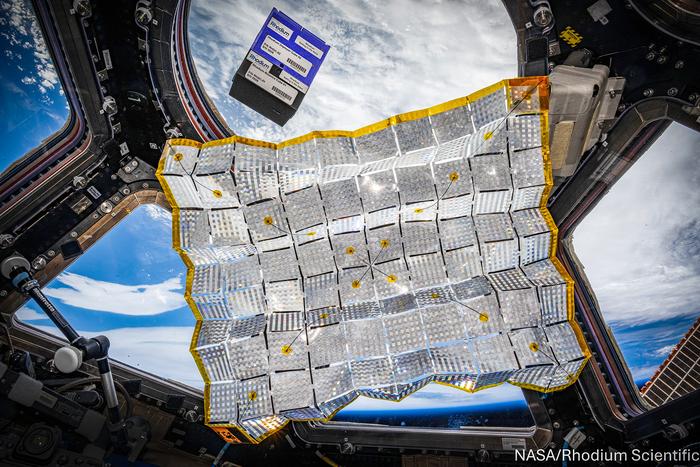
Олон улсын сансрын станцаас хөөргөсөн уг туршилт нь од хоорондын аялал хийхэд шаардлагатай технологийн томоохон дэвшил болж байна.
Корнеллийн их сургуулийн Сансрын системийн дизайны студийн инженерүүд “Alpha CubeSat” болон “Sailing to the Stars” нэртэй хоёр гэрлийн далбаат хөлгийн туршилтыг Олон улсын сансрын станцаас амжилттай хэрэгжүүллээ. Эдгээр төхөөрөмж нь 2025 оны сүүлээр сансарт хөөргөгдсөн бөгөөд “CubeSat” технологид суурилсан оригами загварын нугагддаг далбаа болон чип хиймэл дагуулаас бүрдэж байна. 2025 оны 12 дугаар сарын 2-нд станцаас салж, тойрог замд орсон эдгээр хөлөг нь гэрлийн даралтыг ашиглан хөдөлгөх боломжийг судлах зорилготой юм.
Туршилтын явцад “TinyGS” сүлжээгээр дамжуулан холбоо тогтоож, хөлгийн бүрэн бүтэн байдал болон мэдээлэл дамжуулах чадварыг шалгасан байна. “Alpha CubeSat” нь дэлхийн агаар мандалд шатаж дуусах хүртлээ хэд хэдэн чухал үзүүлэлтийг туршсан бөгөөд үүнд соронзон хөдөлгүүртэй тогтворжуулах алгоритм, 3D хэвлэмэл их бие, анхны голограф дүрс бүхий мессеж хавтан зэрэг багтжээ. Төслийн удирдагч Жошуа Уманский-Кастрогийн тэмдэглэснээр, ийм жижиг хэмжээтэй сансрын хөлөг тойрог замаас дэлхий рүү бүрэн хэмжээний өгөгдлийн багц дамжуулсан нь ChipSat платформын хувьд томоохон амжилт болсон байна.
Төслийн менежер Верена Падрес болон багийнхан сансрын хөлгийн ажиллагаа, тэр дундаа далбаа дэлгэгдэх динамикийг хянах чухал дүрс бичлэг болон хэмжилтийн мэдээллийг цуглуулж чадсан юм. Энэхүү туршилт нь 3D аргаар хэвлэсэн модульчлагдсан эд анги, зөөврийн компьютерын хатуу дискний эргэлтийн механизм зэрэг хямд, хүртээмжтэй технологийг сансрын уудамд амжилттай ашиглаж болохыг харууллаа. Эдгээр үр дүн нь цаашид од хоорондын аялал, Ангараг гараг болон нарны аймгийн захын бүс рүү хурдан шилжих, мөн од хоорондын биетүүдийг судлах чиглэлд хийгдэх судалгаанд чухал суурь болох юм.
Гэсэн хэдий ч ирээдүйн од хоорондын аялалд хүрэхийн тулд сансрын лазер систем хөгжүүлэх, урт хугацааны аялалыг даах тэсвэртэй материал бүтээх зэрэг томоохон сорилтуудыг даван туулах шаардлагатай хэвээр байна. Энэхүү туршилт нь Breakthrough Starshot болон Project Lyra зэрэг ирээдүйн томоохон төслүүдийн хүрээнд яригдаж буй гэрлийн далбаат хөлгийн технологийг хэрэгжүүлэх бодит алхам болж байна.
Дэлгэрэнгүйг эх сурвалжаас харах
Эх сурвалжийг нээх ↓
If humanity intends to engage in interstellar exploration in the near future, lightsails are currently the best option. This technology, consisting of laser arrays pushing a reflective sail and tiny spacecraft to relativistic speeds (a fraction of the speed of light), is presently the only promising method for sending missions to the nearest stars within a human lifetime. Alas, several major hurdles need to be overcome and technological developments made before any such missions are possible.
These range from developing space-based laser systems and creating materials that can survive the journey through interstellar space to testing proof of concepts in space. According to recently published results, engineers at Cornell University’s Space System Design Studio (SDSS) successfully deployed two lightsail experiments – Alpha CubeSat and Sailing to the Stars – from the International Space Station (ISS).
The missions were created as part of the Museum of Science Fiction’s 2016 CubeSat Competition, a design competition for next-generation spacecraft concepts using off-the-shelf technologies. The experiments were funded by NASA’s CubeSat Launch Initiative, which launched to the ISS in late 2025 aboard the NG-23 and Crew-11 missions, respectively. Both consist of origami-style lightsails and chip satellites (ChipSat) that were folded for launch (to conserve room for other payloads) and unfurled upon deployment.
During deployment, communications were established through the open-source global satellite network TinyGS. Sailing to the Stars, a companion experiment, tested the performance of AlphaCube and five other lightsails (NRCSD-29), which deployed from the ISS on December 2nd, 2025. Until AlphaCube burned up in Earth’s atmosphere, the CubeSat confirmed a successful deployment and carried out several secondary technology demonstrations.
These included a magnetorquer-only spin-stabilization algorithm, a full test of the lightsail’s avionics, the first-ever flight of a RockBLOCK Iridium modem (a waterproof global tracker designed for extreme environments), a fully 3D-printed chassis, and the first holographic-image message plaques sent to space. Said mission lead Joshua Umansky-Castro, a recent graduate of Cornell’s Aerospace Engineering Ph.D. program. “This is the first time a spacecraft this small has transmitted complete data packets from orbit to ground. This is a huge milestone that advances the state-of-the-art for the ChipSat platform.”
“Going into college, it was my dream to work on something that would fly in space,” said Verena Padres, a fellow engineering graduate and the manager of the Sailing to the Stars project. “I’m so grateful for the opportunity to not only gain hands-on spacecraft engineering experience, but to also lead the team from mission concept through launch!” During deployment, Sailing to the Stars obtained critical video footage and Inertial Measurement Unit (IMU) data that allowed the mission teams to track the sail-deployment dynamics.
The deployment also tested two different CubeSat-scale deployer designs, both of which were 3D-printed with modular “CubeSat-LEGO” components, spin-stabilized with laptop hard disk drive reaction wheels, and commanded via TV remotes. These two lightsails also have the distinct honor of being the first spacecraft of their size to transmit complete data packets from orbit to ground. These results will inform future CubeSat and lightsail demonstrations that test associated technologies, such as steering, orbit-raising, and laser propulsion.
The concepts of lightsails, directed-energy propulsion (DEP), and gram-scale spacecraft (the aforementioned ChipSats) have become of considerable interest in the past decade. Notable examples include Breakthrough Starshot, Project Lyra, and Swarming Proxima Centauri, all of which hope to leverage lightsails as a means of sending missions to nearby stars, enable rapid-transit missions to Mars and the outer Solar System, and catch up with interstellar objects (ISOs).
Further Reading: Cornell University

