Ирэх сард болох сонгууль нь ХАМАС-ын халдлагын дараах Израйлын улс төрийн чиг хандлагыг тодорхойлох эгзэгтэй үе болж байгаа ч улс төрийн хүчнүүдийн дунд санал хуваагдсан хэвээр байна.
Израйлын Ерөнхий сайд Беньямин Нетаньяхугийн тэргүүлж буй эвсэл засгийн газар байгуулахад шаардлагатай 61 суудлын босгыг давах магадлал бага байгааг санал асуулгууд хоёр жил гаруйн турш харуулж байна. Гэсэн хэдий ч түүний гол өрсөлдөгч, Израйлын Батлан хамгаалах хүчний штабын дарга асан Гади Эйзенкотын тэргүүлж буй нам ч мөн тодорхой давуу талыг олж чадахгүй байгаа аж. Эйзенкот нь Палестины иргэдийн удирддаг намуудтай эвсэл байгуулахгүй гэдгээ мэдэгдсэн нь түүнийг засгийн эрхэнд гарахад хүндрэл учруулж байна.
Өнгөрсөн долоо хоногт нийтлэгдсэн Channel 13-ын санал асуулгаар Нетаньяху болон түүнийг эсэргүүцэгчдийн аль аль нь олонх болох хэмжээний санал авч чадахгүй байгаа нь улс төрийн гацаа үргэлжилж байгааг илтгэв. Сонгогчдын дунд үүссэн энэхүү үл итгэх байдал, улс орны ирээдүйд санаа зовох хандлага нь 2023 оны аравдугаар сарын 7-ны халдлага болон Газын зурвас, Ливан, Ирантай үргэлжилж буй мөргөлдөөнүүдтэй холбоотой байна.
Сонгуулийн сурталчилгааны явцад хэт барууны үзэл баримтлалтай Итамар Бен-Гвир нарын улс төрчид Газын зурвас дахь цэргийн ажиллагааг үргэлжлүүлэх байр суурийг илэрхийлж байгаа бол нөгөө талд эдийн засаг, нийгмийн асуудалд анхаарахыг шаардсан сонгогчид нэмэгджээ. Мөн хэт үнэн алдартан (Haredi) иргэдийн цэргийн алба хаах асуудал нь нийгэмд маргаан дагуулж, сонгуулийн үр дүнд нөлөөлөх хүчин зүйл болоод байна.
Сонгуулийн төв хорооноос Палестины хоёр гол намыг сонгуульд оролцохыг хориглосон шийдвэр гаргасан нь мөргөлдөөнийг улам хурцатгав. Энэхүү шийдвэрийг Дээд шүүхээр хэлэлцэхээр төлөвлөж байгаа бөгөөд хэрэв эдгээр намууд оролцох эрхтэй болбол сөрөг хүчний засгийн газар байгуулах боломжид чухал нөлөө үзүүлэх юм.
Дэлгэрэнгүйг эх сурвалжаас харах
↓Эх сурвалжийг нээх ↓
On the streets of Jerusalem, crowded with secular and ultra-Orthodox Jews, religious nationalists, settlers, Palestinians, and soldiers returning from deployments, uncertainty hangs over an election less than a month away that could mark a turning point for a country profoundly changed after the Hamas attacks of 7 October 2023 and nearly three years of war in Gaza, Lebanon and Iran.
The political battle remains on a knife-edge.
For over two years most polls have predicted that the coalition of parties led by prime minister Benjamin Netanyahu will collectively slip below the 61-seat threshold needed to form a government.
But there is no clear path to power for his main opponent, Gadi Eisenkot, the former chief of staff of the Israel Defense Forces, even if he maintains current levels of support, because he has ruled out going into coalition with any of the parties led by Palestinian citizens of Israel, who are projected to claim a critical 12 seats.
For Netanyahu to stay in power, he would have to either put together a different coalition or pull off an unprecedented election night surprise. Another deeply fragmented Knesset seems likely, in which neither side is close to securing a majority.
The latest Channel 13 poll, published last week, captured that deadlock: Jewish Israeli parties opposed to Netanyahu were projected to win 52 seats, against 51 for the prime minister’s bloc, with both falling short of the 61 required for a majority.
Eisenkot’s Yashar party topped the poll with 22 seats, while Netanyahu’s Likud was projected to take 18. The lack of clarity over the next government – with both main blocs on the right – is fuelling unease among Israelis, some of whom believe little will change whoever becomes prime minister.
“I’m not going to vote because I don’t trust anyone,” said Rachel, 42, an Israeli citizen living in West Jerusalem. “I used to vote for Yair Lapid,” she added, referring to the leader of the centrist Yesh Atid party. “The party’s name means ‘there is a future’. But today, I don’t see any future for this country.”
Average public trust across the eight Israeli institutions measured consistently by the Israel Democracy Institute, a statistics body, stood at 34% in 2025, compared with 61% in 2012.
An atmosphere of pessimism and indecision is palpable in Jerusalem, where tensions between Palestinians in occupied East Jerusalem – the majority of whom cannot vote in Israeli national elections – and rightwing Jewish Israelis have deepened since 7 October. The Hamas attack is likely to weigh heavily on the ballot: a recent poll by the Israel Democracy Institute found that 68% of Jewish respondents said 7 October would be a central factor in deciding how they voted.
“After 7 October, everyone in this government has to take the blame,” said Ilda, who owns a clothing shop on Jaffa Street, one of Jerusalem’s oldest and busiest thoroughfares. Referring to a Haaretz investigation claiming Netanyahu had been warned about the possibility of a major Hamas attack, which he denies, she said: “After journalists exposed what happened, look what they did: they attacked the journalists instead of taking responsibility.”
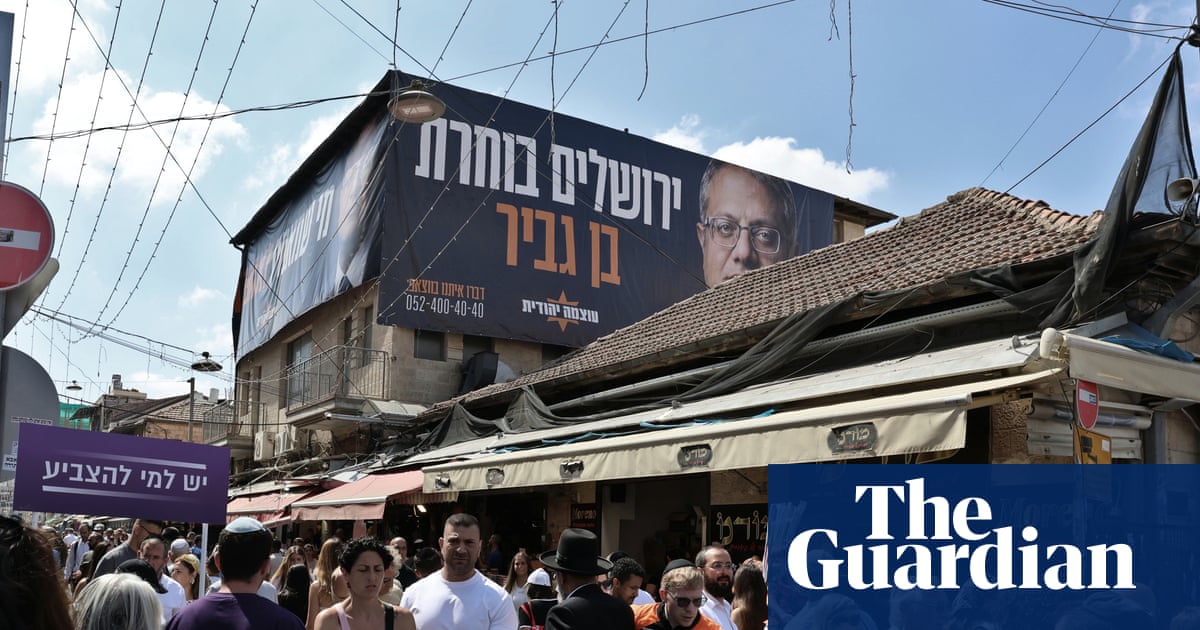
West Jerusalem has long been considered fertile ground for Netanyahu and the Israeli right. Yet Israel’s growing diplomatic isolation and the prospect of seemingly endless conflict on multiple fronts are beginning to worry voters even here, a few steps from the bustling Mahane Yehuda market, where giant election posters for Itamar Ben-Gvir, the far-right national security minister known for his anti-Palestinian rhetoric and championing a racist death penalty law that in practice applies only to Palestinians, loom over the streets.
“This country needs radical change. I think I’ll vote for Naftali Bennett,” said Yosef, 26, a religious Israeli, referring to the rightwing former prime minister who now leads the B’Yachad alliance and is one of Netanyahu’s main political rivals.
On one side are tens of thousands of Netanyahu supporters – called “Bibi-ists” in reference to the prime minister’s nickname – as well as backers of the far-right ministers Ben-Gvir and Bezalel Smotrich, who want to return the current coalition to power to “finish the job” in Gaza, Iran, Lebanon and the West Bank.
On the other are tens of thousands of voters who believe Israel is losing its standing in the world and needs a change of direction – something many see as embodied by the centre-right Eisenkot. His supporters argue that he would place greater emphasis on education, social policy and the economy, areas they say have been neglected by the current government.
“I’ll vote for anyone but the prime minister of 7 October,” said Turgeman as he enjoyed a coffee with his wife at a cafe in Jaffa during the Jewish high holiday season. “I’ve never voted Likud in my life, and I’m certainly not going to start now. I’ll vote for Eisenkot. We need a normal prime minister – someone who also cares about the economy and about prices, which have soared because of the war.”
Food prices in Israel have reached record highs amid the regional conflict and supply chain disruption, with food inflation outpacing the broader consumer price index. The cost of food, including fresh fruit and vegetables, has risen by 9.5% over the past two years.
“They think about wars, while nobody is dealing with the economic crisis,” Turgeman said. “And what has Netanyahu done? He has continued to provide financial support that benefits the Haredi [ultra-Orthodox] community.”
Since 7 October, Israel’s ultra-Orthodox community has been at the centre of a bitter dispute over military conscription. While most Jewish Israelis serve, Haredi men studying in religious seminaries have long been largely exempt.
In 2024, amid war and growing pressure on reservists, the supreme court ruled there was no legal basis to continue the exemption, fuelling anti-draft protests, roadblocks and clashes with police. Haredi parties have blamed Netanyahu for failing to pass legislation to protect the exemption.
Ultra-Orthodox Jews, who make up about 14% of Israel’s population, have traditionally voted for parties backed by their rabbis, including the two main Haredi parties in Netanyahu’s coalition. But anger among younger Haredim over conscription and the policing of protests could lead some to defy their religious leaders this time.
“All the options in this election are junk, but I think I will vote for Eisenkot,” said Pinchas, 24, an ultra-Orthodox student who recently completed his military service. “I have the impression that this time people my age won’t vote according to what the rabbis tell them. Many are angry about the way Netanyahu handled the conscription law, and especially about the crackdown on those who protested against it.”
As the Guardian conducted interviews near Jerusalem’s central bus station, an elderly passerby called out: “There is only one prime minister – Bibi!” It was a reminder that, despite the uncertainty and the opposition’s narrow lead in the polls, the Israeli leader retains a loyal base.
“I’m sure Netanyahu will win,” said Avraham Levy, 76, a Likud supporter and fruit seller at Mahane Yehuda market. “We’ll have the majority. We need to support Netanyahu because he has to finish the job. If he doesn’t, who will?” he said, referring to Israel’s wars on several fronts.
Among those still backing Netanyahu’s coalition partners are supporters of the far right, including Jakub, 23, who was due to begin his military service soon. “I’ll vote for Moshe Feiglin,” he said, referring to an extreme far-right former Israeli Knesset member who declared in 2025 that the conflict in Gaza was not against Hamas but against every child and baby in the territory, and is now running jointly with the far-right Religious Zionist party. “Because he represents my values, and he has never changed his principles,” Jakub said.
The field is wide open and the divide is also generational: by 2019, support for a Palestinian state stood at about 20%-30% among the youngest Jewish Israeli cohorts, compared with roughly 40%-55% among older generations, reflecting a longer-term shift towards more hawkish attitudes. No more recent comparable data was available.
The difficulty for the anti-Netanyahu camp is that it remains fragmented and has struggled to agree on a coherent political platform or a common strategy capable of uniting its different factions.
Parties representing Palestinian citizens, known as Arab parties inside Israel, could push Eisenkot’s coalition over the 61-seat threshold, but amid a campaign of racism and Islamophobia, he has ruled out going into government with them.
They could potentially support a minority government.
But last week, the Central Elections Committee voted to bar Ra’am and the Joint List, the country’s two main Palestinian parties, from the election, after the far-right Otzma Yehudit party filed a petition arguing that they support terrorism and deny the existence of Israel as a Jewish and democratic state.
The opposition Democrats party filed a similar petition arguing for Otzma Yehudit to be banned for incitement to racism and negating the existence of Israel as a democratic state, because of racist policies pursued in power under its leader Itamar Ben Gvir. That was not upheld.
The decision is being challenged in the supreme court, which has overturned similar bans in past elections.
If allowed to run in the elections, the Arab parties will be crucial to the opposition’s prospects of forming a government and to Eisenkot’s chances of replacing Netanyahu.
Tensions between Palestinian citizens of Israel and the state have deepened since 7 October amid arrests, interrogations and other legal action against Arab citizens, often over protests or social media posts.
For these reasons, Palestinian citizens of Israel are often reluctant to express their voting preferences. In the 2025 Israeli Democracy Index survey, 70% said they preferred to remain silent about their political views in the presence of strangers, up from 45% in 2016 and compared with 53% of Jewish respondents.
But Palestinian citizens of Israel remain divided over how best to respond, with many pessimistic that any future government will defend rights they say have too often been denied. The Joint List has maintained a more oppositional stance, signalling it could support an anti-Netanyahu minority government from outside while stopping short of joining a coalition, although it has done so in the past.
“These elections are about our strength as an Arab community and our ability to have an influential political voice,” said Amir, 34, from Mashhad in northern Israel, who plans to vote for the Joint List. “We need strong, united Arab representation on equality, discrimination and the Palestinian cause, while cooperating when it benefits our community.”
Ra’am, led by Mansour Abbas, has instead made political pragmatism its defining strategy. In 2021 it became the first independent Arab party to join an Israeli governing coalition, seeking budgets, services and greater influence for Palestinian citizens of Israel.
“Arab society is being torn apart by crime and violence, while relations with Jewish Israelis are becoming more hostile,” said Abu Mahmoud, 33, from Kafr Kanna, also in the north of the country. “That’s why I’ll vote for Ra’am: negotiate, secure budgets and work with Jewish Israelis where possible.”
He added: “I want politics that can actually improve people’s lives.”
Jamal Risheq contributed to this report

