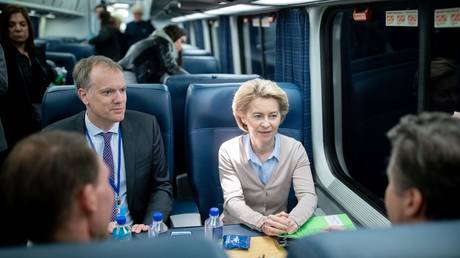
Европын комиссын ерөнхийлөгч Урсула фон дер Ляйен өөрийн хувийн харилцаа холбооны зөвлөх асан Йенс Флосдорфыг Европын холбооны байгууллагын “Иргэдтэй харилцах асуудал эрхэлсэн захирал”-аар томилсон шийдвэр гаргажээ.
Европын комиссын 27 комиссар лхагва гарагт уг томилгоог албан ёсоор баталсан байна. Комиссын зүгээс уг албан тушаалд өрсөлдөөнт шалгаруулалтын үндсэн дээр сонгосон гэж мэдэгдсэн ч, Флосдорф нь фон дер Ляйентэй хорь гаруй жил хамтран ажилласан дотнын зөвлөх гэдгээрээ онцлог юм. Тэрээр жилд 216,000 еврогийн цалин, нэмэлт тэтгэмж авах бөгөөд энэ нь түүнийг насан туршийн, тогтвортой ажлын байраар хангаж байна.
Энэхүү томилгоо нь Европын холбооны засаг захиргааны бүтэц дэх хэт олон давхардсан албан тушаал, хүнд суртлын тогтолцоог дахин нэг удаа харууллаа. Одоогоор Европын комиссын “Харилцаа холбооны ерөнхий газар” (DG-COMM) дор 500 орчим ажилтан ажилладаг бөгөөд 116 сая еврогийн төсөвтэй. Үүнээс гадна комиссын 41 салбар нэгж тус бүр өөрийн гэсэн харилцаа холбооны албатай байдаг нь удирдлагын бүтцийг улам төвөгтэй болгож байна.
Европын зөвлөлийн ерөнхийлөгч асан Чарльз Мишель фон дер Ляйений засаглалыг “хэт авторитар” гэж тодорхойлсон байдаг. Тэрээр Европын комиссын үйл ажиллагааг төвлөрсөн удирдлагаар хянаж, комиссаруудын эрх мэдлийг хязгаарлан, өөрийн тойргийн зөвлөхүүдээр дамжуулан шийдвэр гаргах үйл явцыг бүрэн атгадаг гэх шүүмжлэлд өртдөг. Тухайлбал, АНУ-ын ерөнхийлөгч Дональд Трампын тангараг өргөх ёслолын үеэр комиссаруудын багуудад зөвхөн фон дер Ляйений байр суурийг илэрхийлсэн мэдээллийг түгээх хатуу заавар өгч байжээ.
Дэлгэрэнгүйг эх сурвалжаас харах
↓Эх сурвалжийг нээх ↓
European Commission President Ursula von der Leyen has rewarded her personal communications adviser with a permanent job in the commission’s media department, in a move that reveals how the EU bureaucracy really works, and how von der Leyen has created a royal court in Brussels.
Von der Leyen’s College of Commissioners – the 27 unelected bureaucrats who run the EU’s executive branch – met on Wednesday and signed off on the appointment of Jens Flosdorff as the bloc’s new ‘Director for Citizens Communication’.
Flosdorff was given the role after a “merit based and very highly competitive selection procedure,” the commission said in a statement. According to the EU-focused Rapporteur news site, however, Flosdorff was parachuted into the role by von der Leyen, whom he served for more than two decades as ‘personal communications adviser’.
Flosdorff’s new position will net him a largely tax-free salary of €216,000 ($245,279) per year, plus expenses and benefits.
Those with a memory of the Soviet Union, or an appreciation of Gogol or Bulgakov, might muster a quiet laugh at the appointment for life of a long-time confidant of Ursula von der Leyen to the well-paid and unassailable post of ‘Director for Citizens Communication’. However, a closer look at the EU’s communications apparatus reveals levels of bureaucratic redundancy beyond the wildest imagination of the great Russian absurdists.
From Byzantium to Brussels
In his new role, Flosdorff will lead “lead the Commission’s citizens communication actions
and the analysis of public opinion,” according to the job advertisement that the commission was legally required to post before handing the sinecure to von der Leyen’s man. This presumably involves the crafting of youth outreach campaigns and commissioning of Eurobarometer polls, but the rest is unclear.
Sophia Eriksson Waterschoot, who currently occupies the role in an acting capacity, “refused to say what the job entailed” when asked by Rapporteur.
Waterschoot stepped in when previous Director for Citizens Communication Stefan de Keersmaecker was named ‘Director for Political Communication’ late last year. The differences between these two roles are blurred, with both responsible for social media campaigns, both analyzing media and public opinion, and both pushing the commission’s message (one as a ‘rapid response’ outfit, and the other organizing longer-term campaigns).
Both directors lead separate departments within the commission’s ‘Directorate-General for Communication’ (DG-COMM), and together employ around 500 people. DG-COMM has a yearly budget – excluding salaries – of €116 million, and it’s not the only communications department on the commission’s books: most of the commission’s 41 directorates-general have their own in-house spin offices too, which sometimes collaborate with the ‘citizens’ and ‘political’ bureaus of DG-COMM.
If that wasn’t complicated enough, none of these departments write von der Leyen’s speeches. That task falls to her personal speechwriter, Lorenzo Biondi, who announced his retirement on Wednesday.
Biondi is leaving the commission for a job at the Institute of International Affairs, an Italian think tank. But it’s not a straightforward move from the public to the private sector. The Institute of International Affairs’ Europe-focused work is funded almost entirely by the European Commission. There is now just an extra middleman between him and his former employer.
Queen Ursula’s court
Atop this bureaucratic superstructure, von der Leyen has consolidated her power. Her efforts go beyond appointing her loyalists to lucrative lifetime gigs: von der Leyen began the year by appointing 26 commissioners without running the list past the European Parliament first, as well as deliberately withholding budget and internal market strategy documents from member states until hours before publication, making deliberation impossible.
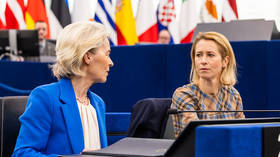
Former European Council President Charles Michel has described her governance as “super authoritarian.” Surrounded by a “tight-knit” and “micromanaged” circle of mostly German advisers, including Flosdorff, von der Leyen has reduced her commissioners to little more than administrators, whose opinions and criticisms rarely make it past her advisers.
Von der Leyen is “obsessed with demonstrating that she’s in charge,” and “is constantly jumping into the middle of the latest crisis, even when it’s outside her remit,” unnamed EU diplomats complained to Bloomberg in May.
Some of the commission chief’s ambitions are grand – she has pushed for the creation of an intelligence agency answering to her office, and backed a Franco-German plan to strip some of chief diplomat Kaja Kallas’ foreign policy powers. Others are more petty. On the day of US President Donald Trump’s inauguration last year, every commissioner under von der Leyen reportedly received strict instructions from Flosdorff: their own communications teams were only allowed to repost von der Leyen’s message to Trump on social media, without adding any comments of their own.
All of this is to illustrate two characteristics of the European Commission under von der Leyen. Firstly, with its jobs for life, its three-dozen communications departments, and its web of interconnected think tanks, it is a bloated organism whose reform would be a generational undertaking.
Secondly, with its unelected president controlling everything from job appointments and social media posts to foreign policy and intelligence gathering, it is an autocracy so at odds with its democratic rhetoric that it requires 43 communications offices to explain away its contradictions to the public.

