
Миссуригийн их сургуулийн судлаачид психопатийн шинж чанарууд нь хүний өдөр тутмын яриа болон бичгийн хэлбэрт хэрхэн илэрч буйг судалжээ.
Сэтгэцийн эмгэгийн оношлогооны гарын авлагад “психопати” гэсэн нэр томьёо албан ёсны онош болон бүртгэгдээгүй байдаг ч криминологи болон сэтгэл судлалд зан төлөвийн тодорхой шинжүүдийг тодорхойлоход ашигласаар иржээ. Судлаачид Кай Брэй болон Лаура Дрислан нар “Personality and Individual Differences” сэтгүүлд нийтлүүлсэн судалгаандаа психопатийг зоригтой байдал, дарангуйлалгүй байдал, хатуу ширүүн зан гэсэн гурван үндсэн хэмжигдэхүүн бүхий олон талт шинж чанартай гэж тодорхойлсон байна. Энэхүү судалгаанд 307 оюутан болон урьд нь ял эдэлж байсан 144 хүн оролцож, “Triarchic Psychopathy Measure” (TriPM) сорил бөглөхийн зэрэгцээ өөрийн амьдралын чухал үйл явдлуудын талаар бичгээр тайлбарлажээ.
Судалгааны үр дүнгээс харахад, психопатийн шинж тэмдэг өндөр хүмүүсийн бичгийн хэлбэр нь хэвшмэл ойлголт шиг сэтгэл хөдлөлгүй байдаггүй, харин нөхцөл байдалд тохиромжгүй байж болох талтайг харуулжээ. Тухайлбал, “зоригтой” оноо өндөртэй хүмүүс түгшүүртэй холбоотой үгсийг цөөн ашигладаг бол “хатуу ширүүн” зан чанар давамгайлсан хүмүүс амьдралын чухал үйл явдлын талаар бичихдээ сөрөг сэтгэл хөдлөлийг илэрхийлэх үгсийг бага хэрэглэдэг байна. Хамгийн их нөлөө үзүүлж буй “дарангуйлалгүй байдал” нь эерэг үр дүнг дурдах хандлагыг бууруулж, амьдралын тодорхой үеүүдэд мансууруулах бодис болон согтууруулах ундаатай холбоотой үгсийг илүүтэй ашиглахтай холбоотой байв.
Судлаачид энэхүү дүгнэлт нь психопатийг бичгээр оношлох зорилгогүй, харин энэ төрлийн зан төлөвийн шинжүүд нь гэмт хэрэг, дахин гэмт хэрэг үйлдэх магадлал болон харилцааны асуудлуудыг урьдчилан таамаглахад хэрхэн ашиг тустайг харуулах зорилготой гэж онцолжээ. Эдгээр хэмжигдэхүүнүүдийг нарийвчлан судлах нь цаашид сэтгэцийн энэхүү төлөвийг эмчлэх эсвэл урьдчилан сэргийлэх механизмыг ойлгоход чухал ач холбогдолтой юм.
Дэлгэрэнгүйг эх сурвалжаас харах
↓Эх сурвалжийг нээх ↓
Psychopathy is not listed in the Diagnostic and Statistical Manual of Mental Disorders, and it’s not an official diagnosis any psychiatrist or psychologist will give.
But the term is still widely used, especially in criminology, to describe a problematic cluster of personality traits.
The triarchic model says psychopathic personalities have three key features: boldness, disinhibition, and meanness.
A new study from clinical psychology researchers Ky Bray and Laura Drislane, both of the University of Mississippi, shows these traits can show up in people’s writing, in ways that don’t always fit with our stereotype of a ‘psychopath’.
Their results are published in the journal Personality and Individual Differences.
“People tend to think of psychopathy as one thing, but it’s actually multidimensional,” Bray says.
Everyone exhibits these traits to some degree. It’s when they appear together, at high levels across the board, that things can get dark.
“That’s in part why there’s a movement away from calling people ‘psychopaths,’ because we don’t view psychopathy as a category,” says Drislane.
“But psychopathic dimensions can predict important outcomes, things like crime, recidivism, or intimate partner violence.
“What our research, including this paper, suggests is that it’s important to look beyond that label and into the different components or dimensions of psychopathy, because each of those dimensions actually has a unique set of outcomes or things that it can predict.”
Bray and Drislane recruited 307 undergraduate students and 144 former incarcerated people from the community, who each completed a questionnaire (the Triarchic Psychopathy Measure, a.k.a. TriPM) designed to assess levels of the three psychopathic personality traits.
They were also asked to write about their lives, describing a high point, a low point, and a turning point.
The goal with this study, Bray emphasizes, is not to use writing to diagnose psychopathy (which, again, isn’t a formal diagnosis anyway), but to demonstrate how psychopathic traits can show up in everyday behaviors, including language.
For instance, people who scored high on the ‘boldness’ spectrum in the TriPM tended to use fewer anxiety-related words (for instance: ‘worry’, ‘fear’, ‘afraid’, or ‘nervous’) in their writing overall.
A person with a high score on ‘meanness’ was less likely to use words associated with negative emotions – ‘bad’, ‘hate’, ‘hurt’, or ‘tired’, for example – when writing about their life’s major turning point.
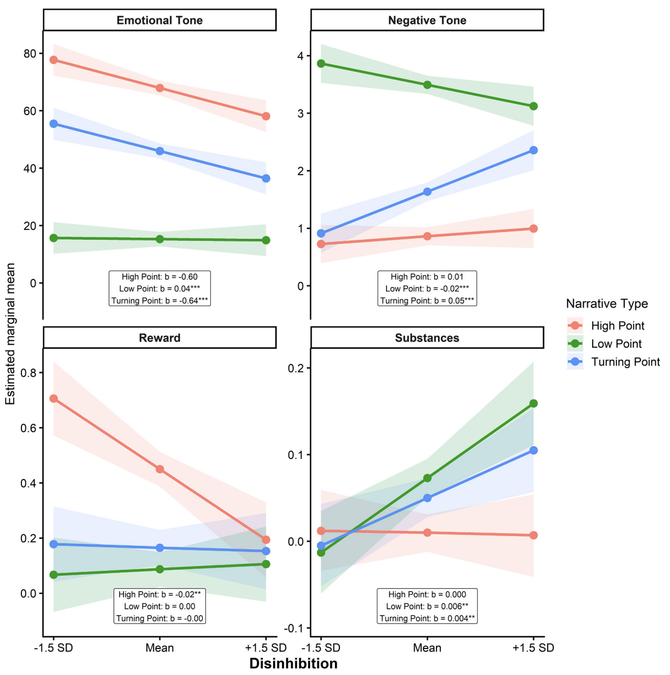
Disinhibition had the greatest effect on language of all three personality traits. People who scored high on disinhibition tended to refer to positive outcomes far less across all three writing prompts.
They used more negative language when describing high points and turning points than their peers, but not when writing about low points.
They also tended to refer to substance use (words like ‘beer’, ‘wine’, ‘drunk’, and ‘cigar’) more when talking about low points and turning points, but not high points.
“Viewing [psychopathy] from a multidimensional perspective allows us to observe how those traits might manifest in non-forensic populations, in people who have not committed a crime,” Bray says.
“That allows us to see how these traits affect college students, business professionals, or interpersonal relationships.”
The results suggest the language used by people with psychopathic traits is not necessarily lacking in emotion or personal meaning, counter to the stereotype of a cold, callous criminal.
But it may not always match what other people would consider appropriate for the context.
“If we want to be able to treat or ideally even prevent psychopathy from developing, we need to understand the mechanisms at play,” Drislane says.
“That comes down to understanding the unique contributors for all three of these dimensions.”
The research has been published in Personality and Individual Differences.
This article was fact-checked by Rachel Garner and edited by Rebecca Dyer. While we pride ourselves on our process, we are only human. If you spot a mistake, please let us know.

