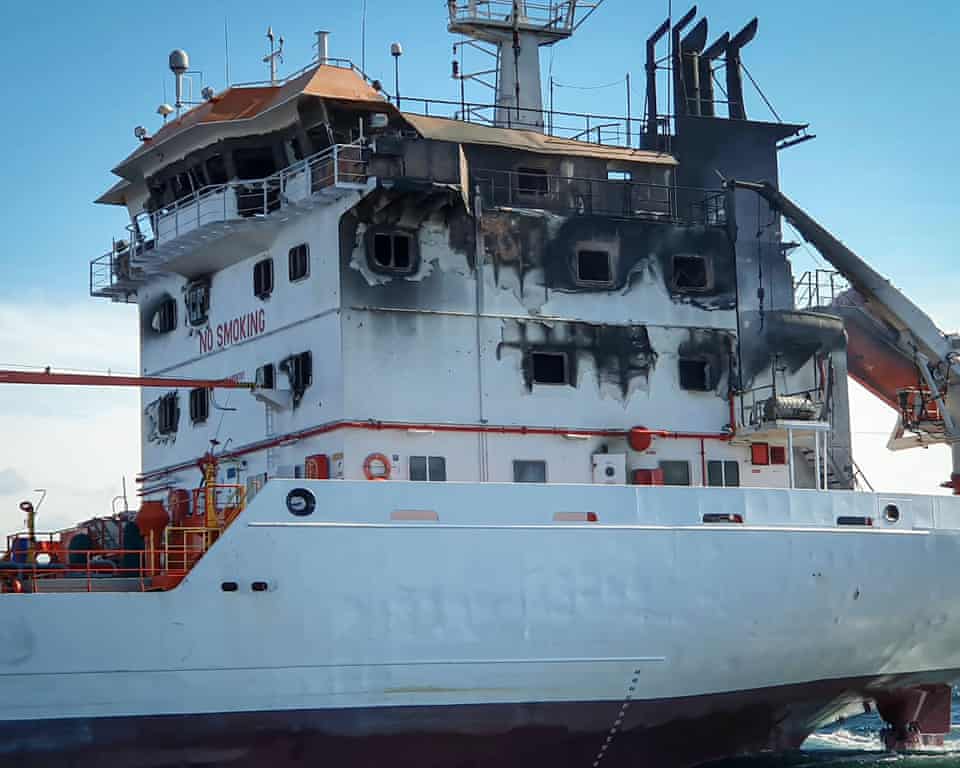
Хар тэнгист арилжааны хөлөг онгоцуудыг чиглэсэн дроны халдлага сүүлийн өдрүүдэд огцом нэмэгдэж, бүс нутгийн аюулгүй байдал болон олон улсын худалдааны урсгалд ноцтой эрсдэл учруулж байна.
Аравдугаар сарын 6-ны өдрөөс эхлэн 10 хоногийн хугацаанд зургаан хөлөг онгоц дроны халдлагад өртсөн нь далайн тээврийн салбарт урьд өмнө байгаагүй аюултай нөхцөл байдлыг үүсгэв. Үүнд Туркийн эзэмшлийн “Alfa Watan”, Болгарын эрэг орчимд халдлагад өртсөн “HS Dignity”, мөн Румыны нутаг дэвсгэрийн ус болон агаарын орон зайд халдлагад өртсөн химийн хоёр танкер багтаж байна. Шинжээчдийн дүгнэж буйгаар эдгээр халдлагын 80 хувийг ОХУ үйлдсэн гэх таамаглал байгаа бөгөөд гол зорилго нь Украйны үр тариа, хөдөө аж ахуйн бүтээгдэхүүний экспортыг тасалдуулахад чиглэж байна.
Дроны халдлагын улмаас далайчдын амь нас эрсдэх тохиолдол нэмэгдэж, даатгалын хураамж огцом өсөхийн зэрэгцээ Хар тэнгис нь дэлхийн хамгийн аюултай тээврийн бүсүүдийн нэг болон хувирчээ. Лондонгийн даатгалын зах зээлийн Хамтарсан дайны хорооноос Хар тэнгисийн ихэнх хэсгийг өндөр эрсдэлтэй бүсэд тооцох шийдвэр гаргасан байна. Болгарын Ерөнхий сайд Румен Радев эдгээр халдлагыг хүлээн зөвшөөрөх боломжгүй гэж мэдэгдсэн бол НАТО-гийн Ерөнхий нарийн бичгийн дарга Марк Рютте тус эвсэл Хар тэнгисийн бүс нутаг дахь хамгаалалт, саатуулах хүчин чадлаа шаардлагатай бол тохируулан ажиллах болно гэдгийг онцоллоо.
Олон улсын далайн байгууллага болон аюулгүй байдлын шинжээчид далайн тээврийг геополитикийн хөшүүрэг болгон ашиглаж буй энэхүү үйл явц нь дэлхийн хүнсний хангамжид сөргөөр нөлөөлж болзошгүйг анхааруулж байна. Одоогоор нэрвэгдсэн НАТО-гийн гишүүн орнууд эвслийн гэрээний 4-р зүйлийн дагуу аюулгүй байдлын асуудлаар албан ёсны хэлэлцүүлэг өрнүүлэх боломжийг хэлэлцэж байна. Энэ нь ОХУ-ын холимог дайны ажиллагаа Европ даяар өргөжиж буй энэ үед НАТО-гийн гишүүн орнуудын хувьд тулгамдсан сорилт болоод байна.
Дэлгэрэнгүйг эх сурвалжаас харах
↓Эх сурвалжийг нээх ↓
The first the crew of the Bulgarian ferry Dioscuria knew of an attack on a cargo ship in their country’s exclusive economic zone in the Black Sea in the early hours of 6 October was a distant explosion 70 miles off the coastal town of Byala.
The Turkish-owned Alfa Watan, heading for the Romanian port of Sulina, had been struck by suspected Russian air and naval drones. Arriving on the scene, Dioscuria found an overturned lifeboat and lifejackets in the water. There was no sign, however, of Alfa Watan’s crew of 10.
Six days later drones struck another ship off the coast of Bulgaria, HS Dignity. Eleven crew members died.
By Thursday, the attacks had encroached on Romania’s airspace and territorial water. Two chemical tankers, Wine Trader and Yara J, were attacked and left burning. Seven more sailors were missing.
The attacks on six ships in 10 days – the Able and Chelsea-3 were also hit – marked a dramatic escalation in a maritime conflict that is pressing on Nato’s borders.
While global attention has focused on the risks for sailors travelling through the strait of Hormuz, in recent months it is the Black Sea that has emerged as the more dangerous passage, with more sailors lost in a week and a half than US service members killed in the entire Iran war.
The maritime insurer and risk analyst Ambrey has warned that there is no end in sight to the threats to Black Sea cargo shipping, including grain and oil, and that insurance prices for passage of the waters have rocketed.
Tomas Alexa, a senior analyst at Ambrey, has noted a sharp increase in the tempo of attacks beginning in July. Russian forces are estimated to be responsible for 80% of them.
The recent loss of life, he suggests, has been exacerbated by “double tap” attacks involving aerial and surface drones, the latter often carrying up to half a tonne of explosive payloads. Smaller vessels that primarily use the Danube canal system have sunk rapidly.
“While attacks against merchant vessels in the Black Sea are not new, we are seeing an escalation both in terms of the number of attacks and in the geographical scope,” Alexa said.
The profile of vessels being attacked – that is, ships trading with Ukraine – had not changed, he added. “The Russian intent is clear, which is to degrade the export of Ukrainian grain and agricultural products.”
The result has been a precipitous fall in the number of vessels visiting Ukraine. Insurance rates have soared, and seafarers and operators have become increasingly reluctant to operate in the Black Sea basin, even on ships unconnected with Ukrainian cargoes.
The vast majority of the more than 60 fatalities of seafarers in the Black Sea since Russia’s full-scale invasion of Ukraine in February 2022 have occurred in the past year. In September the Joint War Committee, representing the London insurance market, moved to extend the high-risk areas of the Black Sea to include the whole of the basin, excluding the territorial waters of Turkey, Romania, Bulgaria and Georgia.
The threat is not confined to the Black Sea itself. Attacks on Ukraine’s Black Sea ports have also increased sharply in the past year.
A number of factors are driving the expansion and escalation of the conflict towards the shores of Nato countries, say experts. Russia has responded to a geographical expansion of Ukrainian strikes on its shadow fleet of oil tankers by intensifying strikes on Ukrainian agricultural cargoes – a key component of Kyiv’s economy.
As ships sought safer passage further from the coastlines, so the threat has changed: from naval mines to drones, with ever longer ranges.
Ursula von der Leyen, the European Commission president, said after the sinking of the Alfa Watan: “Commercial ships – and innocent crews – are being targeted, with lives already lost at sea.”
In a statement at the Organization for Security and Co-operation in Europe, Col Joby Rimmer, a senior British military adviser, said: “Attacks that fail to distinguish between military objectives and civilian vessels, or that are expected to cause excessive incidental harm to civilians and civilian vessels in relation to the anticipated military advantage, may violate international humanitarian law and the UN convention on the law of the sea.
after newsletter promotion
“Each attack raises the risk to crews of every nationality, drives up insurance costs and restricts the flow of food to those who depend on it. The UK is deeply concerned by the far-reaching consequences of successive crises across the global maritime domain. Stable and secure sea lanes are a global common good from which we all benefit.”
Operators have warned of the wider impact on trade in the Black Sea, including from Bulgarian ports. In a recent interview on Bulgarian television, the shipping agency owner Todor Georgiev warned the Black Sea was in danger of becoming a “dead zone”.
“Whenever the Russians are caught having struck a ship with one of their drones, they claim the vessel was carrying weapons,” he said. “Weapons are not being transported to Ukraine via the Black Sea.”
Rumen Radev, Bulgaria’s prime minister, has described the attacks in the vicinity of his country’s territorial waters as “absolutely unacceptable”.
Bulgarian officials are calling for the EU and Nato to support the efforts to enhance security, while working with Turkey and Romania on increased regional security.
Although they have refused to attribute blame to Russia, officials have said there is “no logic” for Ukraine to attack its own shipments.
“We do not have clear and conclusive evidence to attribute responsibility to either side,” said Radev. “However, as I have already stated, the logic suggests that the outcome benefits the Russian Federation.”
As Russian strikes on shipping move ever closer to the borders of Nato members, they pose mounting security challenges to the mutual defence organisation, which is already confronting Moscow’s growing hybrid warfare across Europe. There is speculation that the affected Nato countries may be forced to invoke article 4 of the organisation’s treaty, a step below the article 5 invocation of mutual self defence.
Triggered twice already around the Ukraine war – in the immediate aftermath of Russia’s invasion of Ukraine in 2022 and by Poland in 2025 after Russian drones violated Warsaw’s airspace – it calls for formal crisis discussions on a security threat.
On Thursday Mark Rutte, Nato’s secretary general, met Radev and Nicușor Dan, Romania’s president, to discuss security in the Black Sea. Rutte said: “Nato will continue to work closely with our allies in the Black Sea, adjusting our deterrence and defence posture as needed.”
Another consequence of the escalating attacks is the renewed danger of a global food crisis. Ukraine and Russia are major exporters of grain, as is Romania.
“We’re looking at the Black Sea as a global food artery,” said Oana Toiu, the Romanian foreign minister, at a security conference in Warsaw last week. “It is currently, unfortunately, the deadliest sea when it comes to the number of casualties of sailors in the last months. That means we need to increase our investments in deterrence, defence.”
Damien Chevallier, the director of maritime safety at the UN’s International Maritime Organization, warned last month of the long-term impact on shipping caused by attacks linked to the conflicts in Ukraine and the Middle East.
“With rising casualties across the Black Sea, Red Sea and strait of Hormuz, being a seafarer has become a genuinely dangerous profession,” he said. “Seafarers are not trained to deal with threats from actions which are linked to wider security issues or geopolitical situations.
“What makes this moment genuinely unprecedented is not just the number of incidents, but the pattern behind them. Shipping has become a deliberate instrument of geopolitical leverage.”

