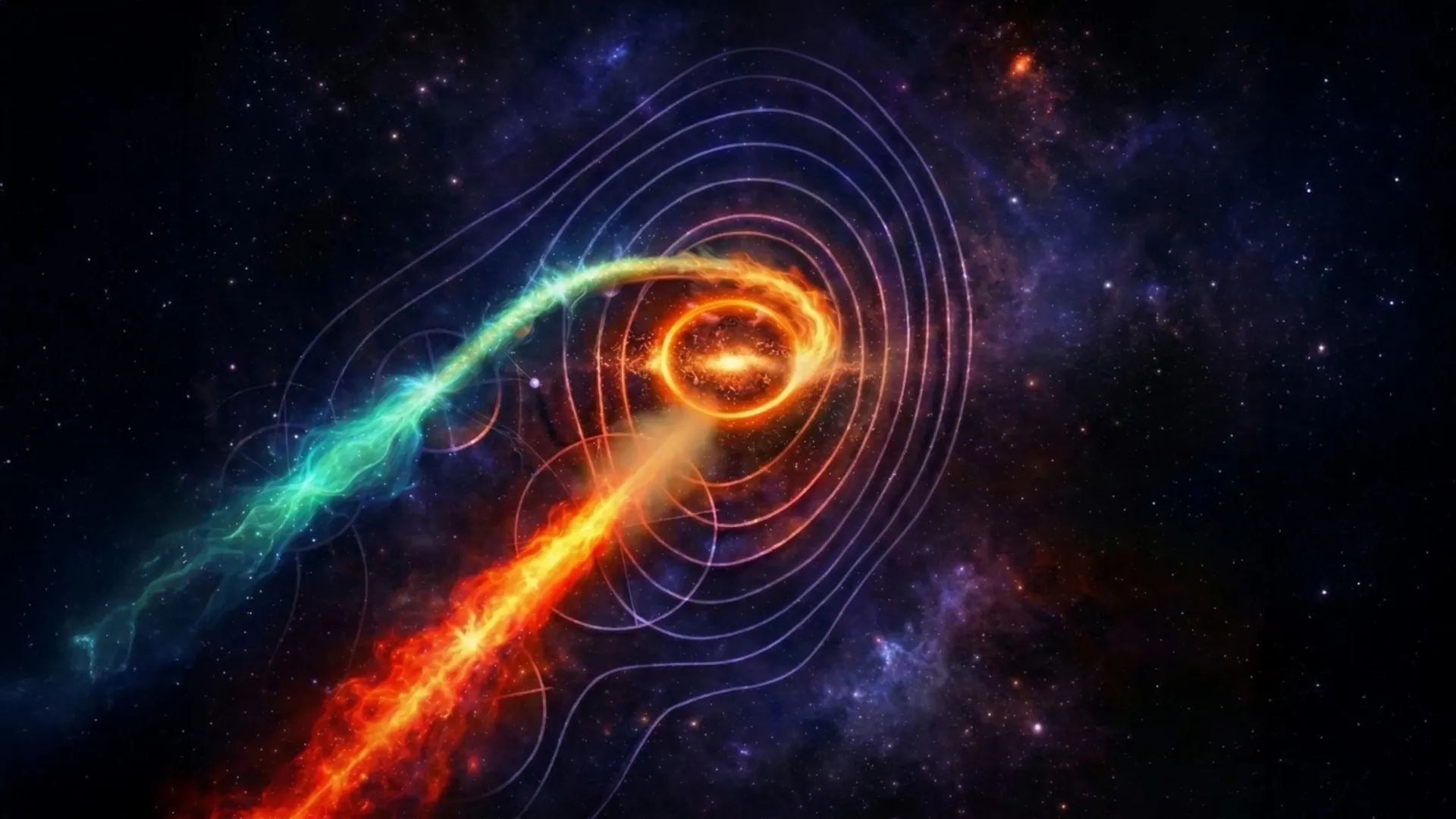
Олон улсын судлаачдын баг Mrk 501 галактикийн төвд хоёр супермассив хар нүх тойрог замын хөдөлгөөн хийж байгааг илрүүлсэн бөгөөд тэд ойрын 100 жилийн дотор нэгдэх магадлалтай байна.
Макс Планкийн Радио одон орон судлалын хүрээлэнгийн эрдэмтэн Зилке Бритзенээр ахлуулсан олон улсын баг Mrk 501 галактикийн төвд байрлах хар нүхний системийн нарийвчилсан судалгааг хийжээ. Тэд 23 жилийн турш цуглуулсан радио ажиглалтын өгөгдөлд дүн шинжилгээ хийх явцдаа урьд өмнө мэдэгдэж байсан бөөмийн урсгалын хажуугаар өөр нэгэн урсгал хөдөлж буйг илрүүлсэн байна. Энэхүү хоёр дахь урсгал нь том хар нүхний ар талаас гарч, цагийн зүүний эсрэг эргэлдэж байгаа нь тус системд хоёр хар нүх байгааг шууд бусаар нотлох баримт болжээ.
Судлаачдын тооцоолсноор, эдгээр хоёр аварга биет 121 хоног тутамд нэг нэгнээ тойрдог байна. Хэдийгээр тэдгээр нь дэлхий болон нарны хоорондох зайнаас 250-540 дахин их зайд оршиж байгаа боловч ийм төрлийн аварга биетүүдийн хувьд энэ нь маш ойрхон зай юм. Ийм нягт тойрог зам нь хар нүхнүүдийн хоорондох зайг хурдацтай багасгаж, ойрын 100 жилийн дотор нэгдэхэд хүргэж болзошгүй гэж эрдэмтэд таамаглаж байна.
Одоогоор Mrk 501 галактик маш хол оршдог тул хамгийн хүчирхэг дурангаар ч тэдгээр хар нүхийг тус тусад нь ялгаж харах боломжгүй юм. Гэсэн хэдий ч судлаачид таталцлын долгионыг ажиглах замаар тэдний нэгдэх үйл явцыг хянах боломжтой гэж үзэж байна. Пульсарын цаг хугацааны сүлжээ (PTA) ашиглан сансрын уудамд тархах маш бага давтамжтай таталцлын долгионыг илрүүлснээр эдгээр хар нүхний тойрог замын хувьсал болон нэгдэх үйл явцын талаар илүү тодорхой мэдээлэл авах боломж бүрдэнэ.
Дэлгэрэнгүйг эх сурвалжаас харах
↓Эх сурвалжийг нээх ↓
Supermassive black holes are thought to exist at the centers of nearly all large galaxies. These enormous objects can weigh millions or even billions of times as much as the Sun, but scientists still do not fully understand how they grow to such extraordinary sizes. Pulling in (accreting) gas from their surroundings is one way they gain mass, although this process alone may be too slow to explain the largest examples. Merging with other massive black holes could provide the missing explanation.
Galaxy collisions are common throughout the universe, making it likely that their central black holes also eventually come together. As two galaxies merge, their black holes are expected to move closer, begin orbiting one another, and gradually spiral inward until they combine into a single object.
Despite this expectation, scientists still struggle to model the final stages of these mergers. Even more puzzling, astronomers have not reliably identified a pair of supermassive black holes orbiting extremely close together, despite abundant evidence of colliding galaxies.
A Second Jet Reveals a Hidden Black Hole
An international research team led by Silke Britzen of the Max Planck Institute for Radio Astronomy (MPIfR) in Bonn has now uncovered direct observational evidence suggesting that such a pair exists at the center of the galaxy Mrk 501. The findings have been accepted for publication in Monthly Notices of the Royal Astronomical Society and are scheduled to appear in an upcoming issue.
Astronomers have long known that the central black hole in Mrk 501 produces an intense jet of particles that shoots into space at nearly the speed of light. These jets arise from the extreme conditions surrounding black holes, where powerful magnetic fields help accelerate material outward.
To investigate the system, researchers examined detailed radio observations collected at multiple frequencies on dozens of separate days over approximately 23 years. The extensive dataset revealed something remarkable: alongside the familiar jet was a second jet whose movement could also be tracked.
The observations provide what the researchers describe as the first direct imaging evidence of such a system at the center of a galaxy, strongly suggesting that a second supermassive black hole is present. The black holes themselves, however, remain too close together in the sky to be individually resolved.
“We searched for it for so long, and then it came as a complete surprise that we could not only see a second jet, but even track its movement,” reports Silke Britzen.
Two Supermassive Black Holes in a Cosmic Dance
The previously known jet is aimed toward Earth, making it appear exceptionally bright and relatively easy to observe. The newly identified jet points in a different direction, which helps explain why it remained hidden for so long.
Over just a few weeks of observations, astronomers noticed dramatic changes in the second jet’s position. It appeared to emerge from behind the larger black hole and sweep counterclockwise around it. The movement repeated, suggesting that the entire system was undergoing a regular orbital motion.
“Evaluating the data felt like being on a ship. The entire jet system is in motion. A system of two black holes can explain this: The orbital plane sways,” explains Silke Britzen.
The researchers also identified an unusual event in June 2022, when radiation from the system appeared to form a ring. This phenomenon, known as an Einstein ring, occurs when gravity bends light in a way that creates a ringlike appearance.
One possible explanation is that the two black holes and Earth were briefly aligned in just the right way. In that configuration, the gravity of the foreground black hole could have acted like a lens, bending light from the second jet behind it. This effect, called gravitational lensing, offers another potential clue to the nature of the system.
Two Black Holes Could Merge in Just 100 Years
By examining changes in the jets and repeating patterns in their brightness, the team calculated that the two black holes appear to complete an orbit around each other approximately every 121 days.
Their estimated separation is just 250 to 540 times the distance between Earth and the Sun. Although that might sound enormous, it is remarkably small for objects with masses ranging from 100 million to a billion times that of our Sun.
Such a tight orbit could have dramatic consequences. Depending on the black holes’ actual masses, their separation may shrink rapidly enough for them to merge in as little as 100 years.
That would be an exceptionally short countdown by astronomical standards, potentially giving researchers an extraordinary opportunity to investigate how supermassive black holes approach their final collision.
Gravitational Waves Could Reveal an Approaching Merger
Unfortunately, Mrk 501 is so distant that even today’s most powerful instruments cannot distinguish the two black holes as separate objects. The Event Horizon Telescope (EHT), which produced the first images of black holes in 2019 and 2022, also lacks the resolution needed to capture this particular pair individually.
As a result, astronomers will not be able to directly watch the distance between the black holes decrease. However, another method could reveal their approach.
As massive objects orbit one another, they generate gravitational waves, tiny distortions in spacetime that travel outward through the universe. The proposed black hole pair in Mrk 501 should produce extremely low-frequency gravitational waves that could be detected using pulsar timing arrays (PTAs).
These arrays use the remarkably regular radio pulses emitted by rapidly rotating neutron stars, known as pulsars, as precise cosmic clocks. By measuring subtle changes in when those pulses arrive at Earth, scientists can search for the influence of passing gravitational waves.
Supermassive black hole binaries (SMBHBs) are already considered the leading explanation for the gravitational wave background, a persistent signal thought to arise from many distant sources across the universe. In 2023, the European Pulsar Timing Array and other research collaborations reported evidence of this background.
The discovery in Mrk 501 now makes the galaxy a particularly promising target for connecting a gravitational wave signal to an individual pair of supermassive black holes.
Such a detection could do more than confirm the system’s existence. It might allow scientists to measure how the pair’s orbit evolves and determine whether the black holes are approaching their final merger.
“If gravitational waves are detected, we may even see their frequency steadily rise as the two giants spiral toward collision, offering a rare chance to watch a supermassive black hole merger unfold,” notes co-author Héctor Olivares.

