Эрдэмтэд Сүүн зам галактикийн бүтэц хоёр өөр үе шаттайгаар, “урвуу” дарааллаар бүрэлдэн тогтсоныг нотоллоо.
Сүүн зам галактик нь бүдүүн болон нимгэн диск гэсэн хоёр үндсэн хэсгээс бүрддэг бөгөөд тэдгээр нь бүтэц, оддын найрлагаараа эрс ялгаатай байдаг. Instituto de Astrofisica de Canarias (IAC)-ийн судлаач Дэвид Мирабал тэргүүтэй баг ESA-гийн Gaia сансрын дурангийн DR3 мэдээллийн санг ашиглан оддын нас болон металлын агууламжийг нарийвчлан судалжээ. Энэхүү судалгаагаар галактикийн дискний хөгжлийн түүхийг хоёр тодорхой үе шатанд хувааж үзсэн байна.
Анхны үе шатанд буюу Их тэсрэлтээс хойш хоёр тэрбум орчим жилийн дараа галактикийн хий маш их үймээнтэй, өргөн хүрээтэй байсан нь бүдүүн диск бүрэлдэх нөхцөлийг бүрдүүлжээ. Одоогоос 10.8 тэрбум жилийн өмнө энэхүү үйл явц эрс өөрчлөгдөж, хий нь хөрч, тогтворжсоноор илүү нимгэн диск үүссэн байна. Энэ үеэс эхлэн дискний босоо тэнхлэгийн зузаан огцом буурч, 4100 гэрлийн жилийн зузаанаас 1600 гэрлийн жил хүртэл хумигджээ.
Судалгааны үр дүнгээс үзэхэд эртний оддыг бусад хүчин зүйлс бүдүүн диск рүү шидэгдээгүй, харин тэд анхнаасаа л галактикийн зузаан бүтэц дотор төрсөн болохыг тогтоов. Энэхүү “урвуу” тогтоц нь галактикийн диск дотроосоо гадагш бус, харин бүдүүн давхаргаас нимгэн давхарга руу шилжих замаар хөгжсөнийг харуулж байна. Одоогийн байдлаар бүдүүн дискэнд нас өндөр, металл багатай одод байрладаг бол нимгэн дискэнд залуу одод төрсөөр байгаа юм.
Энэхүү нээлт нь өмнө нь зөвхөн загварчлалын түвшинд таамаглаж байсан галактикийн үүслийн асуудлыг ажиглалтын баримтаар нотолсон анхны тохиолдол болж байна. Судлаачид оддын насыг маш өндөр нарийвчлалтай тогтоосноор галактикийн хоёр үе шаттай хөгжлийн түүхийг бүрэн дүүрэн тайлбарлах боломжтой болсон гэж үзэж байна.
Дэлгэрэнгүйг эх сурвалжаас харах
Эх сурвалжийг нээх ↓
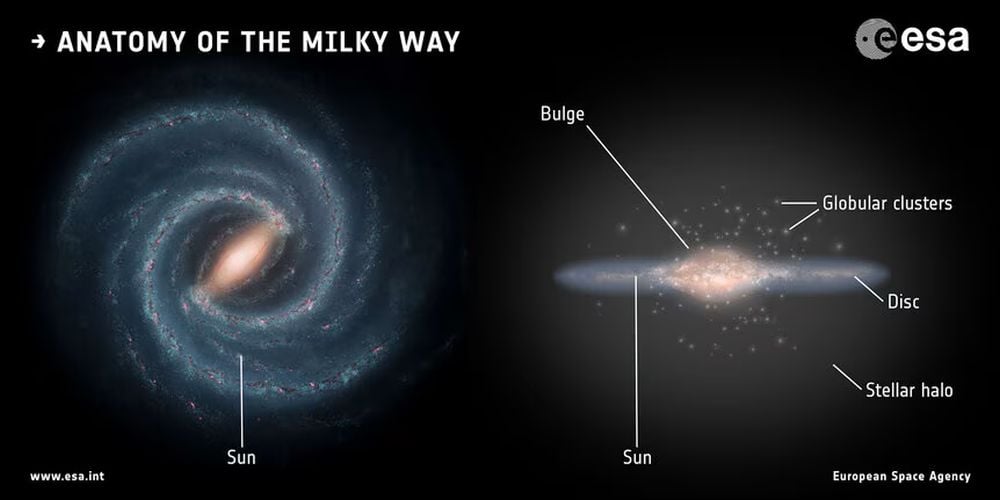
The Milky Way is home to hundreds of billions of stars arranged in a glorious spiral pattern. But beyond the obvious spiral, our galaxy has other physical characteristics. It’s divided into a galactic bulge, a galactic disk, and a galactic halo.
The disk is further divided into a thin disk and a thick disk. They’re not only structurally different, but their stellar populations and other characteristics are different.
The thin disk contains young stars, and middle-aged stars like our Sun. It holds the spiral arms, where our Solar resides and also holds most of the Milky Way’s gas and dust and is where young stars form. It also has higher metallicity, generated by previous generations of stars that have lived and died.
The thick disk is more puffy and diffuse than the thin disk. It holds ancient stars, and almost no new stars form there. It has much lower metallicity than the thin disk, and astronomers sometimes refer to it as a kind of stellar fossil record.
Astronomers wrestle with understanding the formation of these disks, and the Milky Way as a whole. Observations have led to a multiple explanations. In one, stars are born in the thin disk, and over time, encounters with gas clouds, the spiral arms, or even the central bar, perturb some of these stars. Dynamical scattering drives them away from the plane of the thin disk.
Another explanation says that as stars form in the inner disk, the gas they form from settles down into an even thinner disk. In this scenario, each successive generation of stars forms in an increasingly thin disk.
Astronomers have difficulty distinguishing between these competing explanations. It relies on accurate measurements of the ages of individual stars. That’s difficult to achieve, especially for the oldest stars.
New research in The Astrophysical Journal Letters used Gaia data to tackle the issue. It’s titled “A Two-stage Settling of the Milky Way Disk Revealed by Precise ChronoGal Ages,” and the lead author is David Mirabal. Mirabal is a pre-doctoral researcher at the Instituto de Astrofisica de Canarias (IAC).
“The spatial distribution of Galactic disk stars of different ages and metallicities encodes its dynamical evolution history and formation pathways,” the authors write in their research letter. “The lack of precise ages for large, representative samples of stars has traditionally been a drawback for securely differentiating among formation scenarios proposed to explain the vertical properties of the Milky Way disk.”
This work is based on data in Gaia Data Release 3 (DR3), released in June, 2022. This research is one of multiple papers released by a collaboration of researchers, aimed at deciphering stellar ages in the populations of the thin and thick disks. In this one, the authors employed colour-magnitude diagram fitting of the Gaia data. From that, they derived age-metallicity distributions for the stellar populations. They also studied their vertical profile, their position in either disk.
Earlier in the Universe’s history, the gas in the Milky Way was more turbulent and the galaxy was more puffed up vertically, as if it was one thick disk. Stars were born orbiting in the thick disk. As the gas calmed over time and became less turbulent, it cooled down and shrank down, creating a thinner disk inside the thick disk. There was a significant change about 10.8 billion years ago, a couple of billion years after the Big Bang, as the thin disk formed, with the older stars maintaining their orbits in the thick disk.
The existence of a clear break in the process about 10.8 billion years ago is the main argument in this research. The rate of vertical settling changed drastically at around this time.
“We find evidence that the scale height decrease rate changed drastically (~10.85) Gyr ago: at older ages, the evolution is very steep, with hZ (vertical scale height) dropping from over 1.26 to ∼0.5 kpc in merely 2 Gyr; subsequently, the thinning is very gradual, with hZ ∼ 0.1 kpc for the youngest populations,” the authors write.
So before about 10.85 Gyr ago, the disk flattened rapidly. In only about 2 billion years, it thinned from about 4,100 light years thick down to only about 1,600 light years thick. After that, the thinning was much more gradual, reaching a thickness of only about 400 light years.
This figure from the research is packed with information that wrinkly astrophysicist brains can decipher. For the rest of us, the important part is the sharp drop in hZ, or vertical scale height, about 10.8 billion years ago. This is when the disk stopped thinning so drastically, leaving ancient stars on orbits in the thick disk, well above or below the remaining thin disk. Image Credit: David Mirabal et al 2026 ApJL 1010 L38
This means the vertical structure of the disk components grew from the thick layer inward, an upside-down scenario. Ancient stars in the thick disk weren’t scattered there by interactions with gas clouds, spiral arms, or other things; they were born there when the disk was much thicker overall. As time passed, generations of stars were born in a successively thinner disk.
“The extremely rapid early vertical settling of the disk points to a fundamentally upside-down formation process at early times, when the thick disk component is basically formed,” the researchers explain. “Enabled by precise ages and high completeness, our results exhibit two clear, time-dependent evolutionary phases for the Galactic disk, which allow piecing together a comprehensive picture of the physical processes responsible for a two-phase assembly history of the Galactic disk.”
This created what we see today. The thick disk has older, metal-poor stars and almost no gas for new star formation. The thin disk has younger stars, is the site of most star formation, and holds most of the gas for new stars.
“We thus strongly support an evolutionary scenario defined by two distinct temporal phases: an initial, highly turbulent epoch that gave birth to the thick disk, and a subsequent more quiescent period of secular evolution and gradual gas settling, which formed the thin disk,” the authors write.
“This result resolves a classic problem in astrophysics,” lead author Mirabal said in a press release. “In the simulations, both disc formation models were possible, but there was a lack of observational evidence to determine which one occurred in the Milky Way. This is the first clear observational evidence favouring one of the two models for the Galaxy’s early stage. And it has been possible thanks to the high precision we achieved for the older ages,” he said.

