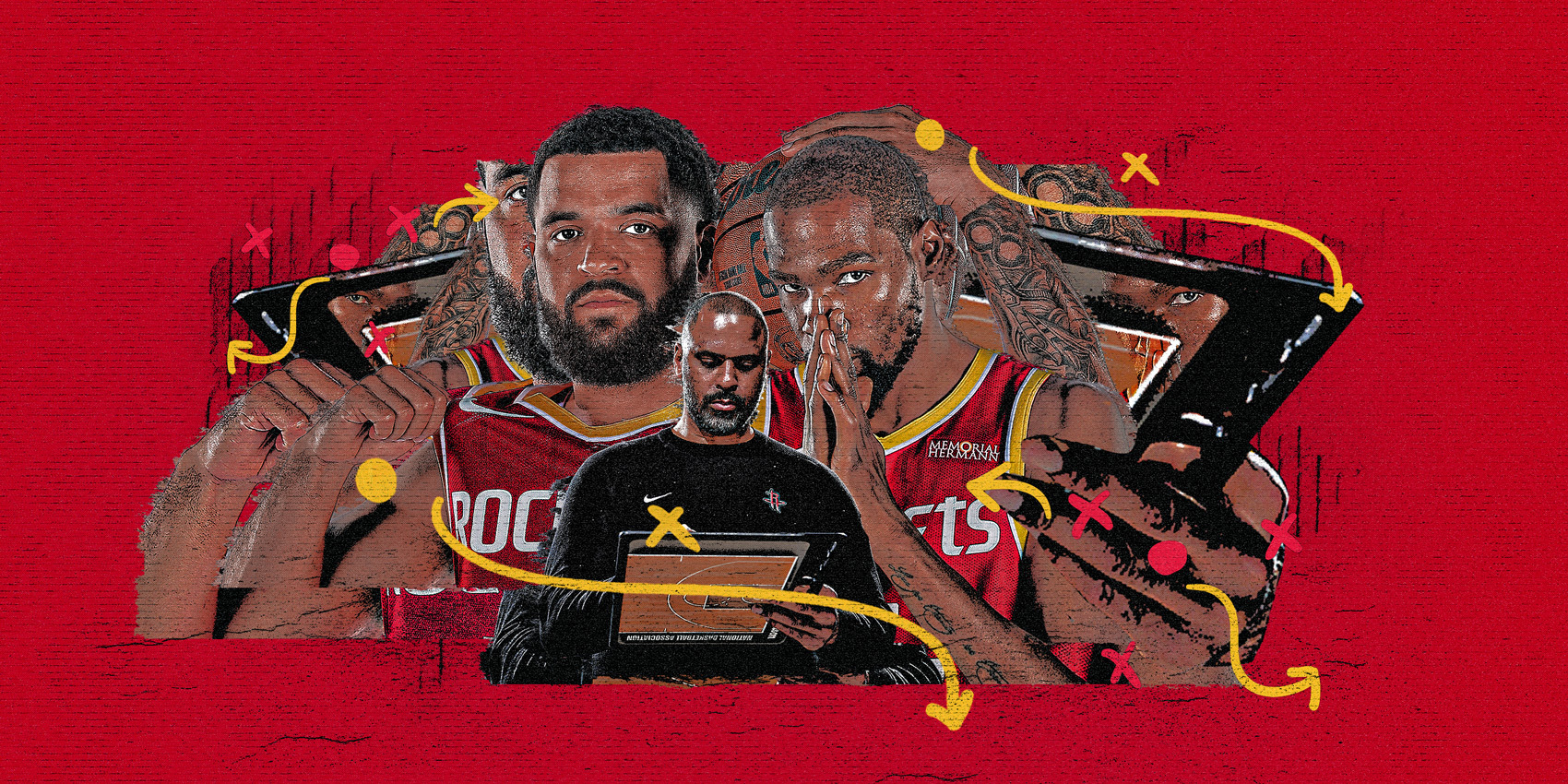
Хьюстон Рокетс багийн ерөнхий дасгалжуулагч Имэ Удока багийнхаа довтолгооны хурдыг нэмэгдүүлж, тоглолтын хэмнэлийг шинэчлэх замаар улирлын туршид илүү аюултай хүчин болохыг эрмэлзэж байна.
Имэ Удока багийнхаа өнгөрсөн улирлын үзүүлэлтүүдэд дүн шинжилгээ хийсний дүнд тоглолтын хурдыг нэмэгдүүлэх шаардлагатай гэж үзжээ. Рокетс өнгөрсөн улиралд хамгаалалтаараа сайшаагдсан ч довтолгооны хувьд удаан, хуучирсан бүтэцтэй байсан нь статистик үзүүлэлтүүдээр нотлогдсон байна. Тодруулбал, тус баг довтолгооны хугацааг хамгийн удаан ашигладаг багуудын тоонд багтаж, довтолгооны эхний секундууд дахь шидэлтийн тоогоор сүүлийн байрт бичигдэж байв.
Энэхүү өөрчлөлтийн хүрээнд Маркус Смарт, Богдан Богданович нарыг бүрэлдэхүүндээ нэмж, Фред ВанВлит, Стивен Адамс, Кэвин Дурант нар эргэн ирснээр багийн довтолгооны тэнцвэр сайжирчээ. Фред ВанВлит, Маркус Смарт, Рид Шеппард зэрэг олон бөмбөг залах чадвартай тоглогчидтой болсноор баг хурдан довтолгоог илүү үр дүнтэй зохион байгуулах боломжтой болсон байна.
Хьюстон Рокетс лхагва гарагт болсон улирлын нээлтийн тоглолтдоо Даллас Мавериксыг 128-110-ын харьцаатай ялж, шинэ стратегийн үр дүнгээ харууллаа. Тус тоглолтод баг 29 хурдан довтолгооны оноо авч, 32 дамжуулалт өгөн, 17 довтолгооны самбараас бөмбөг авалтыг 22 хоёр дахь боломжийн оноо болгон хувиргасан байна. Энэ нь өнгөрсөн улирлын дундаж үзүүлэлтээс таван оноогоор илүү байгаа бөгөөд багийн хурдтай тоглох зорилго бодит ажил хэрэг болж эхэлснийг харууллаа.
Дэлгэрэнгүй эх сурвалжийг харах
Эх сурвалжийг нээх ↓
Eight thousand miles from home, sandwiched between the game’s boisterous globalization and the ho-hum nature of preseason basketball, evolution and transformation are afoot.
In front of 15,000 fans at Macao’s Venetian Arena in early October, Fred VanVleet, moving rather spry for a 32-year-old coming off an ACL tear, draws two defenders before kicking out to Alperen Şengün for a wing 3 — it misses. Jabari Smith Jr. corrals the offensive rebound and dishes to Kevin Durant, who draws bodies as he charges toward the paint and relinquishes it for an open VanVleet triple — it misses. Seconds later, Amen Thompson tips another offensive rebound to Smith, who darts toward the restricted area before finding VanVleet in the corner.
Splash.
Truth be told, the Rockets’ exhibition game against the Mavericks is meaningless. Most, if not all, participants are hoping to avoid injury, put on a show for the fans and ramp up conditioning with the main event less than two weeks away. Between the lines, however, a different story is being told.
“It’s been fun,” VanVleet told Yahoo Sports. “We didn’t get a chance to do it last year — this is what it was supposed to look like before. Coach laid out the philosophy of what we want to do, and we’ve done a heck of a job, better than I expected, in terms of our intention. Our execution hasn’t been perfect, but our intention has been really, really good.”
After two consecutive first-round postseason exits, head coach Ime Udoka was forced this offseason to evaluate his three years at the helm. And while his team’s lowly performances weren’t entirely his fault — injuries and a lack of playoff experience certainly played a part in losses to veteran Warriors and Lakers teams — he was responsible for the overarching structure.
That framework had morphed Houston into a respected, physical defensive unit, but it was still mundane, archaic and sluggish at the other end of the floor. Last season’s aggressive acquisition of Durant (who would miss the majority of Houston’s first-round playoff loss due to injuries) only served as a reminder that brute force alone would not get the Rockets to where they wanted to go. New offseason additions, like Marcus Smart and Bogdan Bogdanović, and the return of injured players, like Durant, VanVleet and Steven Adams, wouldn’t be enough, either. Lifting the hood was the only way to see where they needed to improve.
“The pace, for sure,” Udoka said during the preseason. “We definitely have to play faster. When we did run [last season], we were the No. 1 team in the first six seconds of the shot clock — better than the best offense — and we were the worst in the last six seconds and took the most late-clock shots. You want to increase the pace, get up more 3s and touch the paint.”
Technically, the Rockets’ need for an overhaul might be somewhat overstated, given that the team finished seventh in offensive efficiency last season (only six teams had top-10 ratings at both ends of the floor). But the underlying numbers made it impossible to ignore just how labored their approach was. Houston was 28th in average time to shoot and 17th in effective field goal percentage on such shots; dead last in the amount of shots taken “early” in the shot clock, which Second Spectrum defines as between 18 and 15 seconds remaining; and 27th in shots taken between 22 and 18 seconds.
Udoka has stressed the need for speed with the group, emphasizing the breadth of athleticism on the roster and leaning into that. Between VanVleet, Smart and Reed Sheppard, the Rockets have more than enough ball-handling guards who can push the pace, get into actions quicker, and attack teams before they get set up. Houston played at a preseason pace (103.83 possessions per 48 minutes) that would have ranked second behind Miami last season. It’s hardly the sample size to warrant Mike D’Antoni’s attention, but it’s enough to show the team is responding to the desired shift. One of the benefits of the Rockets’ two-timeline approach is that the abundance of youth on the roster essentially forces them to run, something the team’s core has been embracing.
“I love it,” Sheppard said. “I like playing fast, shooting a lot of 3s. It’s been good to get out there and get going again.”
Cleaning up their shot profile has also been a pressure point for the Rockets, who finished with the third-lowest shot quality last season, per PBPStats. Some of that is naturally tied to VanVleet’s absence, but there seemed to be a manufacturing issue concerning where the shots were coming from. It’s almost unfathomable for a team as analytically inclined as Houston to rank 26th in 3-point rate and 18th in rim rate. Conversations about subtle tweaks to generate cleaner looks at the rim and perimeter have been frequent between veteran players and members of the coaching staff. It’s one thing to draw up plays and schemes, but another to take input from the players who are working through defenses in real time.
“They have opinions about certain things that work and you listen to those,” Udoka said. “They’re always on point with what they see and like to do. You want to play fast, not have to sit back and call plays and take the tempo out of the game. You may have to live with a few more turnovers here and there, but it outweighs it when you play with pace.”
Following a 113-89 preseason win over the Thunder, VanVleet cited the additions of players like Smart and Bogdanović as reasons for more of an offensive balance, unlocking more lineups that can feature spacing and legitimate 3-point threats. Both are underrated ball-handlers that help accelerate ball movement as well. (Thompson and Durant were in the top 50 in time of possession last season, per Second Spectrum; Sengun finished 52nd.)
“You get two ball-handlers,” Smart said on playing alongside VanVleet. “Two guys who can make plays not just for themselves but for others. It allows others to just get out and run because they know [we’ll] find you. Being able to have that helps with the pace for sure.”
Now, Udoka has the option to keep at least two of VanVleet, Smart and Sheppard on the floor at all times if he so chooses — with Thompson and Bogdanović also capable connectors. And it’s not required for them to reinvent the wheel, either. VanVleet and Sheppard are adept at decelerating and rising for quick-strike looks while defenses attempt to adjust. Bogdanović and Smart have rapid releases, too. Houston was second in 3-point rate during the preseason. Is it sustainable? Who knows. Is it intriguing? Definitely.
Concerning their paint creation and offensive rebounding, it’s more about fine-tuning those chances than reworking the structure. The Rockets were second-best in paint touches but third-worst in conversion. Conversely, they were just outside the bottom-10 in time to shoot after securing an offensive rebound and bottom of the barrel in effective field goal percentage. Internally, the goal is to look for outlets and seek cutters after securing second-chance opportunities as opposed to simply chucking up low-percentage shots. In terms of paint touches, most of the players on the roster are able to attack gaps and cause defenses to collapse, albeit to varying degrees. Thompson is seen as the gold standard because of his size, speed and physicality, but Udoka wants to empower everyone else to look to be aggressive.
“Even if you’re not a great 1-on-1 player that can beat your guy every time, you can still get to the paint and bait for other guys,” Udoka said. “It’s not just off the dribble-drive, though. We talked about offensive rebounding, slashing behind it. Anything that touches the paint has been good for us — especially in transition to get those early opportunities.”
The returns of VanVleet and Adams work in tandem when evaluating Houston’s possession aggression, how effectively they create additional opportunities for themselves and why that’s become so important in the modern game. According to Udoka and Houston’s data, the Rockets were a stunning 30-7 when they averaged five more shots than their opponents. With VanVleet being one of the league’s premier assist-to-turnover ratio guards and Adams an elite offensive rebounder — along with Durant being able to see less frequent traps with better players now around him — there’s a legitimate expectation that Houston should routinely have the upper hand simply due to more cracks at the apple.
In their season opener on Wednesday, a 128-110 win over the Dallas, Houston recorded a blistering 29 fastbreak points, dished out 32 assists, attempted 36 3s (converting 16 of them) and turned 17 offensive rebounds into 22 second-chance points. Their 29 transition points were more than their total in 81 of their 82 games last season. Their assists, attempted 3s and second-chance points were five marks higher than last season’s average. And the overall byproducts of playing faster were evident.
“We got so many different weapons and lineups this year, so it gives everybody more possessions and opportunities,” VanVleet said on Wednesday. “We’ve been a huge possession team over the last few years and we thought that playing fast can create more advantages, especially early on in a season. Our defense leads to easy offense, so just creates easier baskets.”
This is by no means a finished product. October basketball can be the best and worst thing when it comes to season-long projections. And entering Udoka’s fourth season — and even longer for some of the more tenured players — this franchise is approaching an inflection point. Title expectations aside, Houston is expected to affirm itself as a legitimate contender. If these Rockets are running more, shooting more and maximizing their possessions, their goals of becoming a more dangerous unit will become more realistic by the day.

