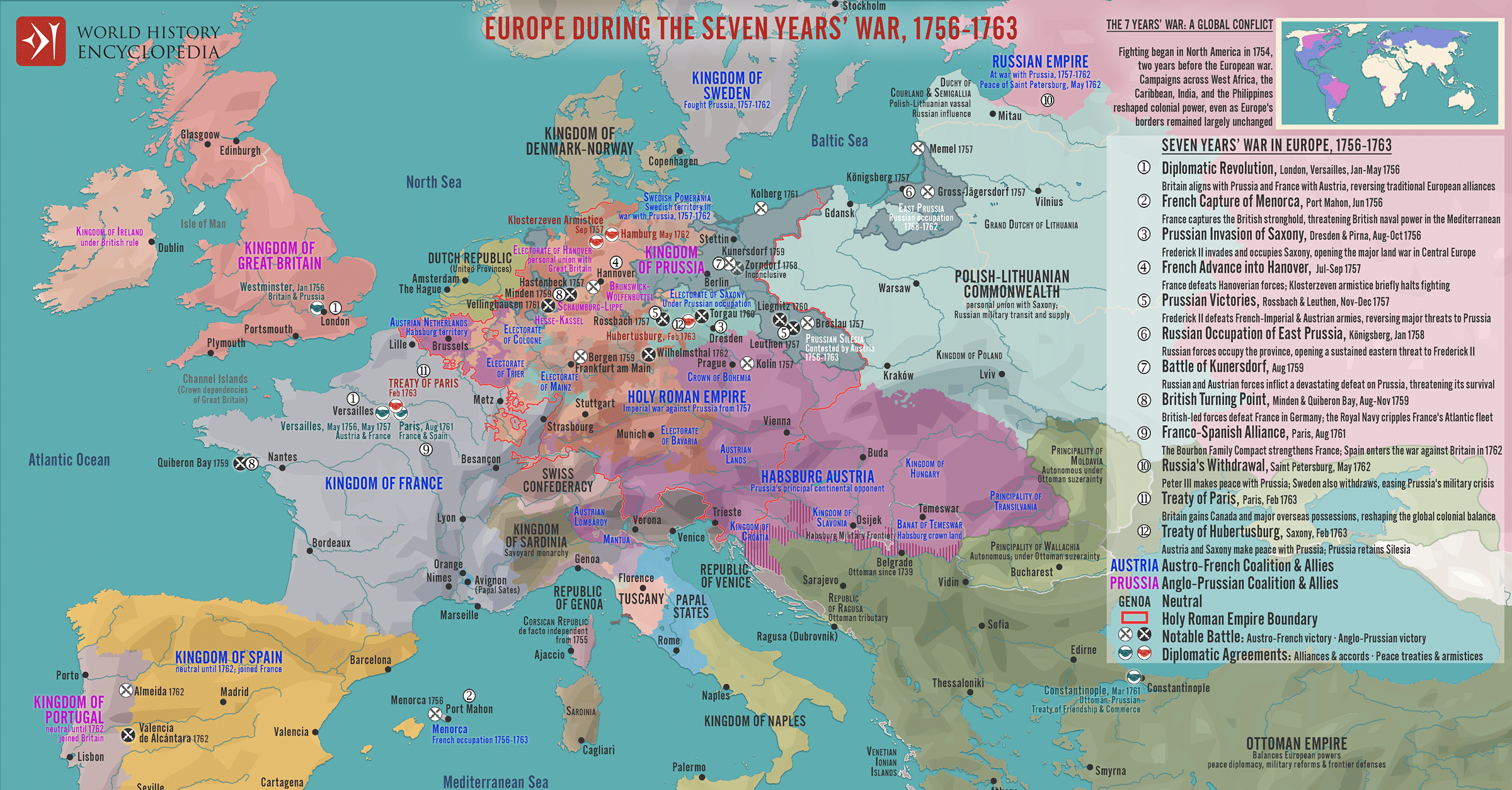
Энэхүү дайн нь XVIII зууны дунд үед Европын их гүрнүүдийн хооронд өрнөж, колоничлолын өрсөлдөөн болон газар нутгийн маргаанаас үүдэлтэйгээр дэлхий дахиныг хамарсан томоохон мөргөлдөөн болсон юм.
Долоон жилийн дайн (1756-1763) нь XVIII зууны дунд үед Европын их гүрнүүдийн хооронд өрнөсөн дэлхийг хамарсан томоохон зөрчил байв. Хэдэн арван жил үргэлжилсэн зөрчилдөөний оргил үе болсон энэхүү дайн нь хилийн чанад дахь колоничлолын өрсөлдөөн болон Европын дотоод дахь газар нутгийн маргаанаас үүдэлтэй байлаа. Энэхүү дайнд Их Британи, Прусс, Ганновер болон тэдний холбоотнууд Франц, Австри, Орос зэрэг улсуудын эвсэлтэй сөргөлдсөн юм.
Дайны улмаас нийт нэг сая гаруй хүн амь үрэгдэж, дайтагч талуудын ихэнх нь асар их өрөнд орсон байна. Эцэст нь Англи-Пруссын эвсэл ялалт байгуулж, Их Британи Францын Хойд Америк дахь колониудыг хяналтдаа авсан бол Прусс улс Төв Европ дахь давамгайлах хүчин болон гарч иржээ. Дайн зөвхөн Европоор хязгаарлагдалгүй, дэлхийн өнцөг булан бүрт өрнөсөн бөгөөд Хойд Америкт өрнөсөн Франц-Индианчуудын дайн болон Энэтхэг дэх Карнатикийн гуравдугаар дайнтай салшгүй холбоотой байв.
### Түүхэн дэвсгэр
1748 онд Европын эзэнт гүрнүүдэд тогтворгүй амар амгалан тогтсон байв. Найман жил үргэлжилсэн Австрийн залгамжлалын төлөөх дайн дууссан ч их гүрнүүд дараагийн дайнд бэлтгэж эхэлжээ. Төв Европт Пруссийн хаант улс Австриас ашиг орлого ихтэй Силези мужийг булаан авсан нь Австрийн эзэн хаан Мария Терезагийн дургүйцлийг хүргэж, тэрээр армиа бэхжүүлэн Силезийг эргүүлэн авах боломжийг хүлээж байв. Үүний зэрэгцээ Их Британи болон Францын колоничлолын өрсөлдөөн дэлхийг хуваахад хүргэж, дорно зүгт Оросын эзэнт гүрний хүч нэмэгдэж байсан нь анхаарал татаж байлаа.
1746 онд Австри, Орос улсууд Пруссын түрэмгийллээс сэргийлж хамтын ажиллагааны гэрээ байгуулсан бөгөөд үүнд дайны үед Силезийг Австрид буцааж өгөх нууц заалт байсан юм. Пруссын хаан II Фридрих буюу “Агуу Фридрих” тэлэлт хийхээр төлөвлөж, Саксоныг дараагийн бай болгож байв. Мөн Их Британийн хаан II Жорж өөрийн эзэмшлийн Ганновер зэрэг Европын газар нутгаа хамгаалахыг эрмэлзэж байсан тул дайны гал асахад бэлэн байлаа.
Дайны эхлэл Европт биш, Хойд Америкийн бөглүү нутагт тавигдсан юм. 1754 оны тавдугаар сард Виржиниагийн колони болон Шинэ Францын хооронд газар нутгийн маргаан үүсэж, хурандаа Жорж Вашингтоноор удирдуулсан цэргүүд Канадын цэргүүдтэй Жумонвилл Глен гэх газар мөргөлдсөн байна. 1754 оны долдугаар сарын 3-нд Форт Несесситийн тулалдаанаар Вашингтоны хүч бууж өгсөн ч зөрчил даамжирч, 1756 оны эх гэхэд Их Британи, Франц хоёр албан ёсоор дайны байдалд оржээ.
<span class="figtitle
Дэлгэрэнгүйг эх сурвалжаас харах
↓Эх сурвалжийг нээх ↓
The Seven Years’ War (1756-1763) was a global conflict fought between the great powers of Europe in the mid-18th century. The culmination of several decades of conflict, it was caused both by colonial rivalries abroad as well as territorial disputes within Europe itself. It pitted Great Britain, Prussia, Hanover, and their allies against a coalition that included France, Austria, and Russia, among others.
The war – which led to over a million total casualties as well as crippling debt for most belligerent nations – resulted in a victory for the Anglo-Prussian alliance; indeed, Britain ended up gaining control of France’s North American colonies, while Prussia emerged as a dominant power in Central Europe. The war was not only confined to Europe but was also fought in multiple theaters across the globe. It is often associated with the concurrent French and Indian War in North America, as well as the Third Carnatic War in India.
Background
In 1748, an uneasy peace settled upon the empires of Europe. After eight long and blood-soaked years, the War of the Austrian Succession had come to an end. But the ink on the peace treaty was barely dry before the great powers began preparing for the next war. Nobody was satisfied with the peace. In Central Europe, the Kingdom of Prussia had wrested control of the lucrative province of Silesia from Austria; Maria Theresa, the Austrian empress, now bided her time and built up her armies, waiting for the opportunity to take Silesia back and humble the overconfident Prussia. At the same time, the colonial rivalry between Great Britain and France threatened to tear the world apart while the growing power of the Russian Empire in the east could not be ignored.
The spark would not be ignited in Europe, but in the backwoods of North America.
The late 1740s and early ’50s saw the delicate balance of power shift in Europe. Fearing Prussian aggression, Austria and Russia had signed a defensive alliance in 1746, pledging to come to one another’s aid in the event of an attack. This alliance included a secret clause that would return Silesia to Austrian control, in the event of a war. It was a wise move, for King Frederick II of Prussia – now increasingly known by his moniker Frederick the Great – was indeed intent on expansion, eyeing the Electorate of Saxony as his next target. At the same time, King George II of Great Britain was determined to protect his holdings on the Continent, including the German Electorate of Hanover, of which he was prince-elector. The powder keg was set, and needed only its spark.
The spark would not be ignited in Europe, but in the backwoods of North America. In May 1754, a territorial dispute between New France and the British colony of Virginia resulted in bloodshed when a force of Virginian militia under Colonel George Washington ambushed Canadian militia at Jumonville Glen. The French retaliated by pursuing Washington’s ragtag force and forcing their surrender at the Battle of Fort Necessity (3 July 1754). The conflict escalated further the next year, when an entire British army was annihilated by French and Indigenous fighters in the forests of Pennsylvania. By early 1756, Great Britain and France were already at war – it was only a matter of time before the rest of Europe would be dragged kicking and screaming into their quarrel.
Ambush of Jumonville
Sensing that another major war was inevitable, the great powers rushed to form new alliances that would align best with their interests, a political realignment known as the Diplomatic Revolution. In January 1756, Britain and Prussia formed an alliance, promising to aid one another in the event of war, and to bring lasting peace and stability to Europe. In response, France joined the existing Austro-Russian alliance in May.
The alliances were now set, and Europe held its breath as the colonial war between Britain and France intensified – on 20 May 1756, British and French fleets clashed at the Battle of Minorca in the Mediterranean, bringing the war uncomfortably close to European shores. Unwilling to wait for the inevitable, King Frederick the Great of Prussia decided to take the initiative, hoping to use the chaos to make himself master of Germany.
In summary, the various alliances and the goals of each of the major nations included:
Alliance 1: Britain, Prussia, Hanover (Portugal in 1762)
War goals:
- Great Britain: protect and expand its colonial empire in North America at the expense of France, and defend Hanover in Central Europe.
- Prussia: Defend Silesia and seize control of Saxony, to increase its status as a great European power.
Alliance 2: France, Austria, Russia, Sweden, Saxony (Spain in 1762)
War goals:
- France: expand its colonial empire in North America, while checking British and Prussian power.
- Austria: Defeat Prussia, regain control of Silesia.
- Russia: Prevent Prussia from becoming too powerful.
On 29 August 1756, the brittle European peace was shattered when Frederick invaded Saxony with 63,000 men. Moving in three columns, the Prussians swiftly occupied the capital of Dresden, swatting aside the minimal resistance. The small Saxon Army, surprised by Frederick’s blitzkrieg, withdrew southeast to the city of Pirna to await reinforcements – 33,000 Austrians, under General Maximilian Ulysses von Browne, prepared to cross the border from Austrian-occupied Bohemia to deliver them from the Prussian yoke.
Frederick knew he had to act fast before his enemies could join forces. Leaving a portion of his army behind to keep the Saxons bottled up, he invaded Bohemia and attacked Browne’s troops at the Battle of Lobositz (1 October). The day-long battle was bloody and hardfought – the Prussians, advancing through heavy mist, were mowed down by withering Austrian fire, and Frederick, fearing the day was lost, almost fled from the battlefield. Yet when nightfall put an end to the fighting, it was Browne who blinked first – under the cover of darkness, the battered Austrian army withdrew, leaving 2,900 dead and wounded on the field.
Frederick the Great of Prussia 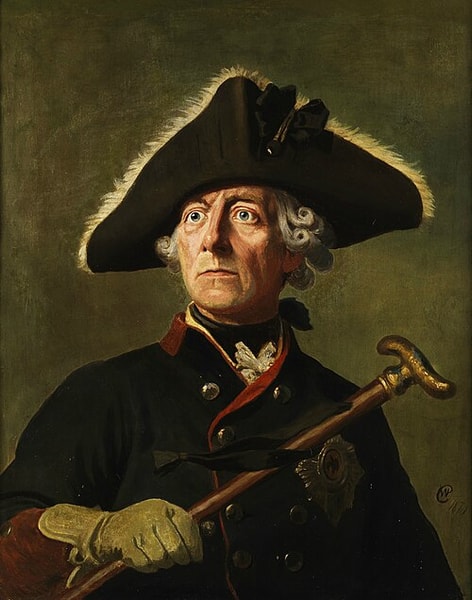
Frederick – who had lost a similar number of casualties – was left shaken by his near-defeat. Nevertheless, he was politically astute enough to claim victory before marching back into Saxony, capturing Pirna, and impressing the surviving Saxon soldiers into his army. His rapid invasion and occupation of Saxony sent shockwaves throughout Europe, triggering the various systems of alliances. To the east, Russia began to mobilize its armies, preparing to march to Austria’s aid. In the west, Britain prepared to send an army to the Continent to protect Hanover from French invasion. Britain also began sending supplies and money to Prussia.
1757: Escalation
The following spring, as the armies of Europe prepared for war, Frederick once again made the first move. Hoping for another lightning campaign, he invaded Bohemia with 64,000 men. At the Battle of Prague (6 May 1757), he attacked a 60,000-man Austrian army under Browne and Prince Charles of Lorraine. Both sides suffered horrendous losses – about 14,300 Prussian and 13,200 Austrian – but Frederick emerged victorious. Browne was mortally wounded, and the surviving Austrians were forced behind the walls of Prague. Since he had lost so many men, Frederick decided to besiege the city rather than risk an assault.
No sooner had Frederick settled down for a siege than he learned that a fresh Austrian army, under Count Leopold von Daun, was marching to Prague’s relief. Frederick quickly turned to meet Daun’s army, hoping to defeat it before the Austrian forces could unite. But this time, fortune was not smiling on Alte Fritz. In the resultant Battle of Kolín (18 June), the Prussians were soundly defeated, losing another 14,000 men compared to 8,000 Austrian losses. It was the first defeat of Frederick’s career; heartbroken, he was forced to break the siege of Prague and withdraw from Bohemia altogether.
Count Leopold Joseph von Daun 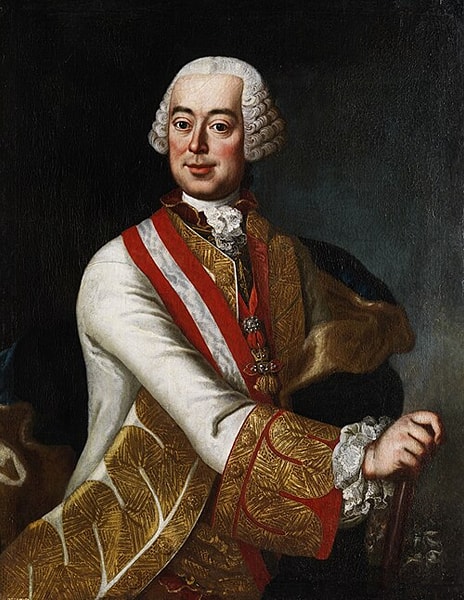
For Frederick, the defeat had come at the worst possible time, as now Prussian soil was being threatened. To the east, Russia had finished mobilizing and had sent an 83,000-man army into East Prussia. The Russians captured the Prussian fortress of Memel in July, before defeating a much smaller Prussian force at the Battle of Gross-Jägersdorf (30 August). However, the invaders’ momentum soon stalled – the Russians were low on ammunition, having spent most of their cannonballs during the siege of Memel. Defeated not by the Prussians but by their own poor logistics, the Russian army had no choice but to retreat.
Meanwhile, the war was heating up in the west. In June 1757, the French general Louis-Charles-César le Tellier, comte d’Estrées, invaded Hanoverian territory with 60,000 men. There he encountered the Army of Observation, a 35,000-man Anglo-Hanoverian force under William Augustus, Duke of Cumberland, a younger son of King George II of Great Britain. The two armies clashed at the Battle of Hastenbeck (26 July), which resulted in a decisive French victory. Cumberland was forced to withdraw to Stade on the North Sea coast, and, on 10 September, he signed the Convention of Klosterzeven, in which he agreed to disband his army and acknowledge French occupation of Hanover. For Britain, it was a humiliating defeat.
Having crushed Cumberland’s army and occupied Hanover, the French army continued pushing east, into Prussian territory. Frederick was now being squeezed from all sides, with the Austrians moving into Prussian-occupied Silesia. Like a caged animal, he lashed out. At the Battle of Rossbach (5 November), Frederick led 21,000 Prussians to victory against a 41,000-man Franco-Austrian army. In only 90 minutes, the Prussians inflicted over 7,000 casualties on the enemy while suffering only 550 losses of their own. Frederick then swung into Silesia and defeated a much larger Austrian force at the Battle of Leuthen (5 December). These two victories saved Prussia from defeat, and were regarded by Frederick as the greatest of his career.
King Frederick and His Army After the Battle of Leuthen 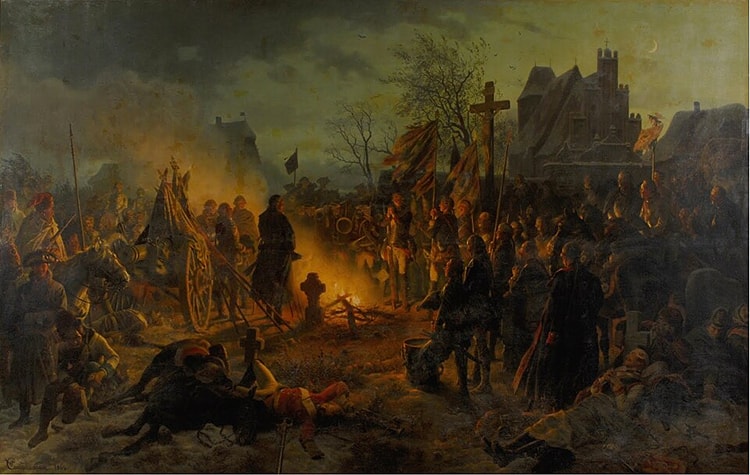
1758: Armageddon in Poland
Emboldened by Frederick’s masterful victories, Britain repudiated the Convention of Klosterzeven, and dispatched another army to the Continent. Under the command of Ferdinand, Duke of Brunswick, this new Anglo-Hanoverian army crossed the Rhine and smashed a French force at the Battle of Krefeld (23 June). The victory allowed Brunswick to take control of most of northwestern Germany. Frederick, meanwhile, had launched his own campaign season by laying siege to the Austrian fortress of Olmütz. He soon broke off the siege, however, in order to stop a fresh Russian army, which had advanced over the Oder River and was rapidly moving toward Berlin.
The two armies met at the Battle of Zorndorf (25 August) in modern Poland, which would prove to be the bloodiest battle of the war. During the intense day of fighting, both sides ran out of ammunition and were reduced to brutal hand-to-hand combat. By nightfall, the Prussians had suffered 12,000 losses compared to around 18,000 Russian casualties. The Prussians would long remember the ferocity of the Russian soldiers. “Bodies of Russians covered the field row by row,” a Prussian officer would remember, “they kissed their cannons while their bodies were cut to pieces by our sabers, but still they would not retreat” (quoted in Jarymowycz, 238).
Charge of the Prussian Cuirassiers at the Battle of Zorndorf 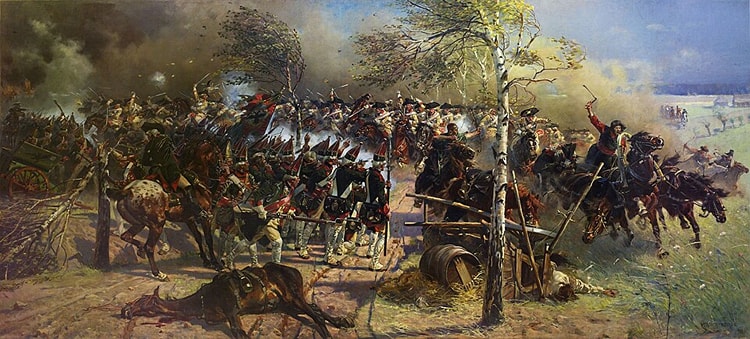
The battle was inconclusive and, despite taking heavy casualties, the Russians initially refused to retreat. However, once again they were defeated by logistics; having lost too many men and ammunition, the Russians could not continue their invasion and were forced to withdraw. Having narrowly staved off the Russians, Frederick raced into Saxony just in time to face his old enemy Leopold von Daun, who was leading a fresh Austrian force against Dresden. But once again, Frederick’s luck would run out – at the Battle of Hochkirch (14 October), Daun surprised and defeated the Prussian army. By this point, the season was rapidly changing, and Daun was forced to retire to winter quarters, leaving Saxony in Prussian hands.
1759: Annus Mirabilis
In 1759, the new French foreign minister, Étienne-François de Choiseul, duc de Choiseul, decided on an aggressive strategy. He began amassing troops near the mouth of the Loire River for an invasion of the British Isles. However, Choiseul’s ambitious plans would soon unravel. On 1 August, a 60,000-man French army was defeated by Brunswick’s Anglo-Hanoverian force at the Battle of Minden in Germany.
A few months later, on 20 November, the French fleet was smashed by the Royal Navy at the Battle of Quiberon Bay. The French lost seven ships-of-the-line in the engagement, ending their hopes of invading Britain. These victories – coupled with the conquest of Quebec in North America – formed part of Britain’s Annus Mirabilis (‘Year of Miracles’) of 1759.
Aftermath of the Battle of Quiberon Bay 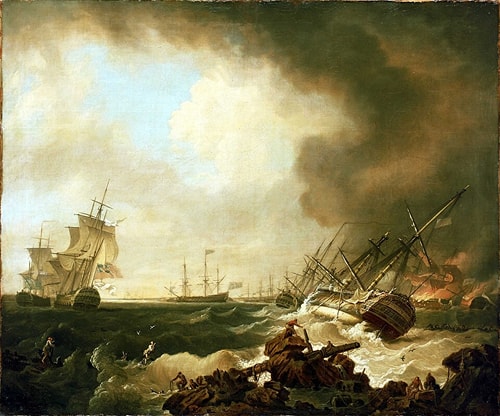
As Britain triumphed, its ally Prussia was faring less well. The Austrians and Russians had each launched new invasions, targeting the Prussian capital of Berlin. Hoping to buy time, Frederick sent a corps to contain the Russians, but his forces were defeated at the Battle of Kay (23 July). Three weeks later, Frederick faced a combined Austro-Russian army at the Battle of Kunersdorf (12 August), only 50 miles from Berlin.
For Frederick, the battle was a disaster – in six hours he lost 18,000 men, roughly half of his entire army. During the retreat, the Prussian king fell into a depression, considering abdication and even suicide. The situation was not helped when Daun marched back into Saxony and seized control of Dresden, liberating the city after three years of Prussian occupation. Yet for Frederick the silver lining was that Berlin itself remained untouched by enemy armies – at least for now.
1760-61: Prussia in Peril
The Austrians and Russians, hoping to capitalize on the success of the previous year, decided to focus their efforts on reclaiming Silesia. At the Battle of Landshut (23 June), the Austrians dealt the Prussians a stinging defeat before capturing the bastion of Glatz. Frederick marched into Silesia and met the Austrians at the Battle of Liegnitz (15 August), winning a decisive victory despite being outnumbered three to one. It was a much-needed success but left the path to Berlin wide open; on 8 October, a Russian detachment entered the Prussian capital with no resistance.
Capture of Berlin, 1760 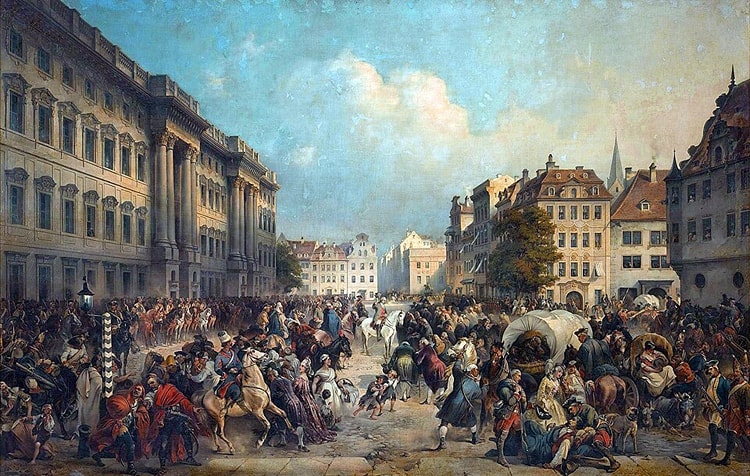
The Russians were unable to hold the city and evacuated five days later, but the fact that Berlin had fallen into enemy hands at all was a humiliation that could not be repeated. Frederick, needing to regain his military prestige, met his old enemy Daun at the Battle of Torgau (3 November). It was a decisive, yet costly, Prussian victory – Frederick lost 13,000 men compared to 11,000 casualties for Daun. Meanwhile, in Germany, the French once again tried to capture Hanover but were defeated by Brunswick’s Anglo-Hanoverian army at the Battle of Warburg (31 July).
The fruits of this victory were thrown into question the following autumn when, on 25 October, King George II died. His grandson and successor, George III of Great Britain, was much less concerned with protecting Hanover, and did not want to keep providing Prussia with subsidies. This could prove dire – without British money, Prussia would be unable to keep fighting. Its army was greatly depleted, and most of the Prussian soldiers were now raw recruits. For Frederick, time was running out. Fortunately for him, his enemies were just as exhausted.
In early 1761, the Prussians launched several successful raids against Russian supply bases in Poland, hoping to diminish Russia’s capacity to keep fighting. This strategy, however, was unable to prevent the Russians from laying siege to the Prussian fortress of Kolberg, which fell on 16 December; the loss of Kolberg deprived the Prussians of access to the Baltic Sea.
Meanwhile, to the west, Brunswick’s Anglo-Hanoverian army won a glorious victory, beating 90,000 French soldiers at the Battle of Villinghausen (15-16 July 1761). Yet not even this could sway the new king or Parliament, which was becoming increasingly war-weary; with all of New France now in British hands, they saw little reason to keep fighting on the Continent and began pressuring Frederick to end his war.
1762: The War Winds Down
In January 1762, two events transpired that changed the course of the entire war. The first occurred on 4 January when Britain declared war on Spain – the British, flush with victory in the New World, hoped to punish Spain for its erstwhile support of France and desired to take control of Spain’s lucrative Caribbean colonies as well. Portugal, Britain’s oldest ally, followed suit and also declared war on Spain.
Though Frederick failed to significantly expand Prussia’s borders, he had defeated two major European powers.
The other major event occurred the next day, 5 January, when Empress Elisabeth I of Russia died. Her successor, Peter III of Russia, was a Prussophile who idolized Frederick and had been an opponent of the war. In May, Peter III made peace with Prussia and pulled Russia out of the war. It was a stroke of tremendous luck for Frederick, who now only had to contend with the Austrians.
Frederick concentrated his entire army of 120,000 men and dove into Silesia, intent on driving the Austrians out once and for all. He recaptured the fortress of Schweidnitz in October, the same month that his brother Prince Henry covered himself in glory with a victory at the Battle of Freiberg (29 October). By November, the Prussians had regained control of Silesia; that same month, war-weary Austria finally asked for a ceasefire.
In Iberia, meanwhile, the Spanish invaded Portugal and seized the fortress of Almeida. For the next several months, Portugal became the scene of violent guerrilla warfare. While the Portuguese paid the price in blood, the British reaped the rewards, capturing the Spanish city of Havana in Cuba.
1763: Peace & Aftermath
By early 1763, the war was practically over. Britain had won in North America and Germany, while Prussia had defeated its enemies in the east. There were two major peace treaties. On 10 February 1763, the Treaty of Paris was signed between Britain, France, Hanover, and Spain. The primary outcome of this treaty was that France ceded all of its territory in mainland North America to Britain and agreed to evacuate Hanover. Britain, having succeeded in all its war goals, therefore emerged as master of North America.
Allegory of the Treaty of Hubertusburg 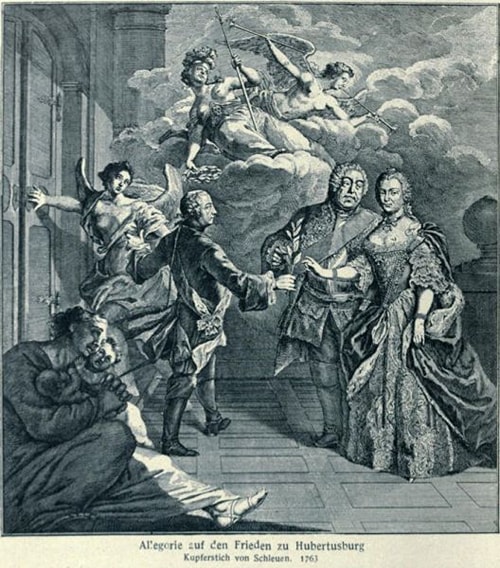
The Treaty of Hubertusburg, signed between Austria, Prussia, and Saxony, was concluded five days later on 15 February. This treaty simply confirmed the status quo antebellum, meaning all captured territories would be restored to their prewar owners. Effectively, this meant that Austria was relinquishing its claims on the coveted Silesia, which remained in Prussian hands. Though Frederick failed to significantly expand Prussia’s borders, he had made it through an existential struggle and had defeated two major European powers. Prussia, therefore, had finally completed its transformation from a third-rate backwater to a major European power.
The Seven Years’ War had been the bloodiest, most far-reaching 18th-century conflict up to that point. It had resulted in over a million deaths, both military and civilian, and had racked up mountainous debt for all major belligerents; this debt would directly contribute to both the American Revolution and the French Revolution later in the century. It saw the ascendancy of Britain and Prussia, shifting the global balance of power and setting the stage for the even bloodier conflicts that would engulf the continent in the coming decades.

