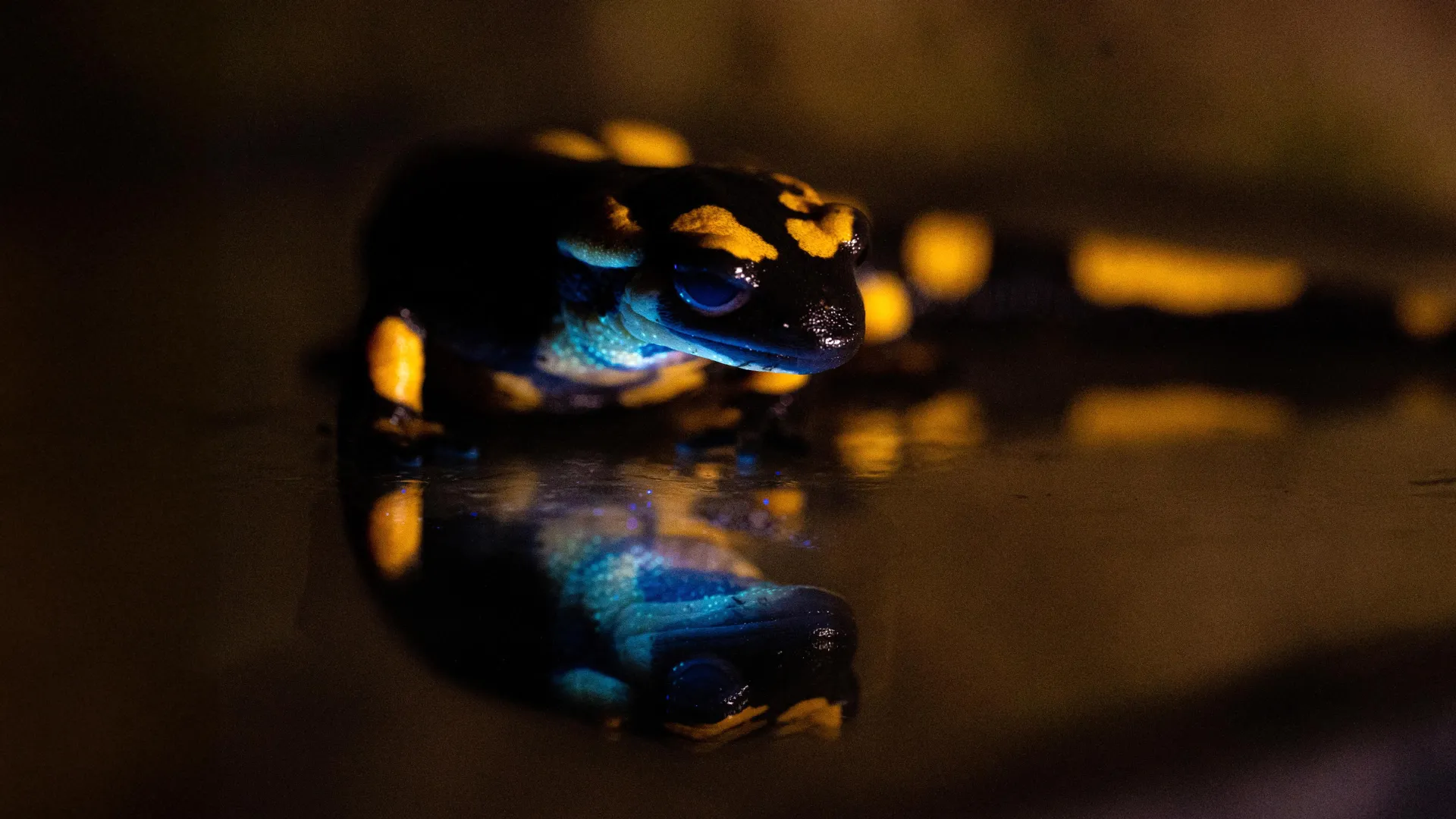
Европын галт гүрвэлүүд хэт ягаан туяаны нөлөөгөөр биеийн зарим хэсэгтээ тод ногоон болон цэнхэр өнгөөр гэрэлтэх чадвартайг судлаачид тогтоожээ.
Барселон дахь Байгалийн шинжлэх ухааны музейн судлаач Бернат Буриэл тэргүүтэй эрдэмтэд галт гүрвэлийн арьсан дахь булчирхай болон тэдгээрээс ялгардаг бодисууд нь хэт ягаан туяаг шингээн авч, харагдахуйц гэрэл болгон ялгаруулдаг биофлюоресценцийн үзэгдлийг илрүүлсэн байна. Энэхүү гэрэлтэлт нь амьтныг биеэсээ салсны дараа ч 24 цагаас илүү хугацаанд үргэлжилдэг нь тогтоогджээ. Өмнө нь биофлюоресценцийг ихэвчлэн далайн амьтдад тохиолддог гэж үздэг байсан бол сүүлийн үеийн судалгаагаар хуурай газрын хэвлээр явагчид болон хоёр нутагтан амьтдад ч илэрч байгаа нь шинжлэх ухааны хувьд анхаарал татаж байна.
Судлаачдын таамаглаж буйгаар, энэхүү гэрэлтэлт нь амьтдын хоорондын харилцаа холбоо, болзооны үеийн таних тэмдэг эсвэл махчин амьтдыг үргээх нэмэлт дохио байж болзошгүй юм. Ялангуяа сарны гэрэл хэт ягаан туяаны долгионыг агуулдаг тул харанхуйд гүрвэлүүд бие биенээ танихад энэхүү гэрэлтэлт тусалдаг байх магадлалтай гэж Макс Планкийн Химийн экологийн хүрээлэнгийн эрдэмтэн Мартин Калтенпот тэмдэглэжээ. Гэсэн хэдий ч энэ нь одоогоор зөвхөн таамаглал төдий бөгөөд уг үзэгдлийн биологийн тодорхой үүргийг хараахан нотлоогүй байна.
Гэрэлтэлтийг үүсгэж буй химийн нэгдлийг одоогоор бүрэн тодорхойлоогүй байгаа бөгөөд энэ нь өмнө нь бүртгэгдээгүй молекул байх магадлалтай гэж судлаачид үзэж байна. Энэхүү химийн бодисыг олж тогтоох нь галт гүрвэлийн биологийн онцлог болон тэдний хувьслын явцад ямар үүрэгтэйг ойлгоход чухал ач холбогдолтой юм. Уг судалгаа нь IUCN-ийн “эмзэг” ангилалд багтдаг галт гүрвэлийн амьдрах орчныг хамгаалах болон тэдний зан төлөвийг илүү гүнзгий судлахад хувь нэмэр оруулах юм.
Дэлгэрэнгүйг эх сурвалжаас харах
↓Эх сурвалжийг нээх ↓
Fire salamanders are among Europe’s most recognizable amphibians, known for their striking black and yellow coloring and the poisonous substances they release to deter predators. Despite their familiar appearance, scientists are still uncovering surprising details about their biology. The International Union for Conservation of Nature (IUCN) classifies the species as “vulnerable” on its Red List of Threatened Species. Fire salamanders typically inhabit damp forests, streams, and mountainous regions, where habitat destruction and fragmentation increasingly threaten their survival.
New research has revealed that fire salamanders possess an unexpected ability to fluoresce under ultraviolet light. The glow is most pronounced on the yellow underside of their bodies and along their sides. Researchers traced the fluorescence primarily to glands in the animals’ skin and the substances those glands release. Remarkably, these secretions can remain fluorescent for more than 24 hours after leaving the salamander’s body.
“It is fascinating that such a well-studied species still harbors unknown phenomena like this. It reminds us that even the most familiar organisms can hide secrets that are only revealed when they are observed with new tools,” says Bernat Burriel, a researcher at the Museum of Natural Sciences in Barcelona and the study’s first author.
The phenomenon occurs when compounds in the salamander’s skin absorb ultraviolet light, which humans cannot see, and reemit that energy as visible light. This process produces vivid green and cyan colors. Known as biofluorescence, it requires an outside source of illumination and should not be confused with bioluminescence. Animals such as fireflies produce their own light through chemical reactions, while fluorescent organisms must first absorb light from their surroundings.
Scientists once believed that biofluorescence occurred almost exclusively in marine organisms, with scorpions standing out as an unusual example on land. More recent studies have challenged that assumption, identifying fluorescent properties in a growing variety of terrestrial animals, including reptiles, birds, and amphibians.
Why Do Fire Salamanders Glow?
Although researchers have confirmed that fire salamanders fluoresce, the biological purpose of this ability remains uncertain. One possibility is that the glow serves as a form of communication, helping individuals recognize one another or assess potential mates. Another is that it makes their warning coloration more noticeable to predators.
“Fluorescence meets several criteria that suggest a communicative function. It could help salamanders detect each other in nocturnal or particularly dense environments, or act as an additional defense signal,” says Martin Kaltenpoth, director of the Department of Insect Symbiosis at the Max Planck Institute for Chemical Ecology and a co-author of the study.
The discovery that toxic skin secretions are also fluorescent raises additional questions about how salamanders interact with predators and other animals in their environment.
For now, these proposed functions remain hypotheses. Animals with particularly sensitive vision may be able to detect the green and cyan fluorescence even when it is extremely faint. Humans, however, need a UV lamp to observe the effect.
In the forests where fire salamanders live, nighttime illumination comes primarily from moonlight and starlight. Researchers note that full moonlight contains a greater proportion of ultraviolet and violet wavelengths than daylight, which has a more evenly distributed spectrum. Under these conditions, fluorescence could create small green and cyan highlights against the salamanders’ yellow markings, potentially making them easier for other salamanders to spot.
Could the Fluorescent Glow Warn Predators?
Another possible explanation involves aposematism, a defensive strategy in which animals display conspicuous colors to advertise that they are poisonous or otherwise dangerous. Fire salamanders already use their distinctive yellow and black patterns as warning signals, and fluorescence might provide an additional visual cue.
Scientists established a connection between salamander warning colors and chemical defenses more than a century ago when they identified samandarines. These highly toxic steroidal alkaloids are produced from cholesterol precursors and contribute to the animals’ chemical protection.
Despite decades of research into salamander toxins and skin chemistry, the newly observed fluorescence came as a surprise.
“The presence of this fluorescent compound was surprising because salamander skin secretions have been studied chemically for decades, and we were unaware of any published reports on fluorescence,” says Andrés Brunetti, a researcher at the Max Planck Institute for Chemical Ecology and a co-first author of the study.
The Mysterious Chemical Behind the Glow
One of the biggest unanswered questions concerns the substance responsible for the fluorescence. Researchers have not yet determined its chemical identity, although the evidence suggests it may be a molecule not previously recognized in fire salamanders.
“We still don’t know what the compound responsible for this fluorescence is, but everything indicates that it is a molecule unknown until now in this species. Identifying it will be key to understanding its origin and function,” adds Salvador Carranza, a researcher at the IBE (CSIC-UPF) and another co-author of the study.
The team is now working to identify and chemically characterize potential compounds responsible for the effect. Determining which molecule produces the glow could help explain how the fluorescence develops and whether it plays a meaningful role in salamander behavior or survival.
A New Discovery With Implications for Amphibian Conservation
Beyond revealing an unexpected feature of a familiar species, the findings demonstrate how new research techniques can uncover biological traits that have escaped scientific attention for decades.
Understanding whether fluorescence influences communication, mating, or predator avoidance could also contribute to conservation efforts. Such information may help researchers better understand the behavior and ecological needs of fire salamanders, which already face significant threats from habitat loss and fragmentation.
The research also involved scientists from the Institute of Subtropical Biology and the Catalan Society of Herpetology. It forms part of a pioneering amphibian conservation project in Catalonia supported by the Barcelona Zoo Foundation.

