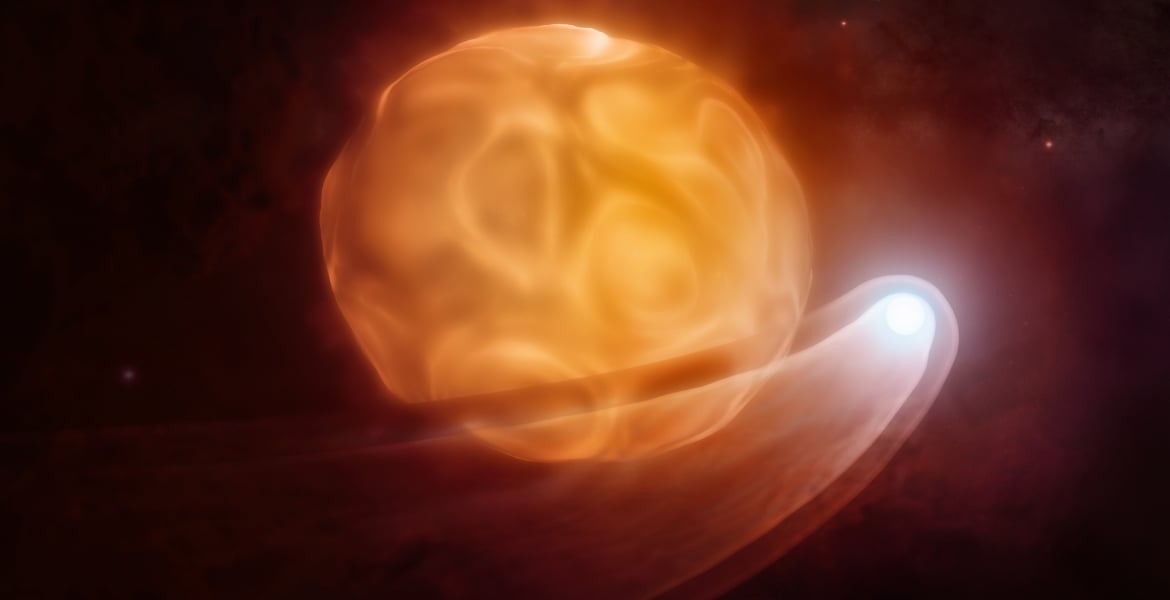
Шинэ судалгаагаар улаан аварга одны гэрэлтэлтийн өөрчлөлт нь түүнийг тойрон эргэх үл үзэгдэх дагуул одтой холбоотой байж болохыг харууллаа.
Орион одны эрхэст орших Бетельгейз нь шөнийн тэнгэр дэх хамгийн тод улаан оддын нэг юм. Удаан хугацааны туршид үүнийг ганц од гэж үздэг байсан ч сүүлийн үеийн ажиглалтууд түүнийг тойрон эргэх “Сиварха” нэртэй залуу шар одыг илрүүлж болзошгүйг харууллаа. Хэдийгээр уг дагуул одыг шууд ажиглах боломжгүй ч эрдэмтэд түүний Бетельгейзийн агаар мандалд үзүүлж буй нөлөөллийг судалж байна.
Бетельгейз нь амьдралынхаа төгсгөлд дөхөж буй улаан аварга од бөгөөд нарны масснаас 14 дахин их боловч диаметр нь нарныхаас 640 дахин том юм. Түүний агаар мандал нь Ангараг гаригийн тойрог замаас ч өргөн хүрээг хамардаг ч маш сийрэг бүтэцтэй байдаг. Сиварха дагуул од нь Бетельгейзийн радиусын гуравны нэгээс бага зайд, агаар мандлынх нь дотор талд маш ойрхон тойрон эргэдэг тул одны агаар мандлыг байнга үймүүлж байдаг.
Very Large Array (VLA) болон Atacama Large Millimeter-submillimeter Array (ALMA) ажиглалтын төвүүдийн өгөгдлөөс харахад Бетельгейзийн агаар мандал үе үе өндөг хэлбэртэй болж хувирдаг байна. Энэхүү хэлбэрийн өөрчлөлт нь дагуул одны таталцлын нөлөөгөөр үүсэж буй гажуудалтай нийцэж байгаа аж. Мөн Бетельгейзийн гэрэлтэлтийн 425 хоногийн циклээс гадна 5.9 жилийн хугацаатай хоёр дахь давтамж илэрсэн нь Сивархагийн тойрог замын үетэй давхцаж байна.
Эдгээр нотолгоо нь Бетельгейзийг хос оддын систем байх магадлалтайг харуулж буй хамгийн хүчтэй баримт юм. Гэсэн хэдий ч Сиварха оршин байгааг бүрэн батлахад одоогоор хангалттай нотолгоо дутагдалтай байна. Энэхүү судалгаа нь Бетельгейзийн төвөгтэй зан төлөв болон түүний гэрэлтэлт, температурын хэлбэлзэл нь зөвхөн одны өөрийнх нь үйл явц биш, харин дагуул одны нөлөөлөлтэй холбоотой байж болохыг илтгэж байна.
Дэлгэрэнгүйг эх сурвалжаас харах
Эх сурвалжийг нээх ↓
Betelgeuse is the red supergiant star known as the shoulder of Orion, famous for being the brightest red star in the night sky. It was long thought to be a single star, but recent observations have shown it has a companion star. A young yellow star not quite on the main sequence named Siwarha. We can’t observe this companion directly, so there has been some debate as to whether the companion truly exists. But new observations look at how the companion disturbs the atmosphere of Betelgeuse.
Betelgeuse is a star near the end of its life. As it struggles to burn the last of its stellar fuel, it has swollen into a large but diffuse star. Though it has a mass only 14 times that of the Sun, its diameter is more than 640 times that of the Sun. Including its atmosphere, the star is wider than the orbit of Mars. But the outer regions of the star are quite diffuse, what we would call a vacuum in a lab on Earth. The companion star Siwarha orbits Betelgeuse very closely. Less than three times the radius of Beteleguese and well within the outer atmosphere of the red supergiant. This means it disturbs the atmosphere as it orbits.
This new study is based on observations from the Very Large Array (VLA) and the Atacama Large Millimeter-submillimeter Array (ALMA), both of which can spatially resolve Betelgeuse at radio wavelengths. Based on these observations, the team was able to show that the atmosphere of the red supergiant is somewhat egg shaped at times. The star goes through a cycle of appearing more circular and more eggy, just as if a companion mass is distorting the star. The result is consistent with earlier studies that suggested the existence of Siwarha.
Although the evidence is not strong enough to confirm the existence of Siwarha, it would explain a long-term variability in the brightness of Betelgeuse. The star has long been known to have a variable cycle of about 425 days, but a second variable pattern of about 5.9 years has been discovered as well. This latter cycle coincides with the egg-shaped distortion and the possible orbital period of Siwarha.
This study is the strongest evidence so far that Betelgeuse is a binary star. It also demonstrates that the behavior of Betelgeuse is more complex than we thought. The atmosphere is stirred up by its companion, and this means the brightness and temperature variances we see are not simply the product of Betelgeuse itself. Its shadowy companion also has a story to tell.
Reference: Matthews, L. D., et al. “New Spatially Resolved Observations of Betelgeuse from the VLA and ALMA: Evidence for Atmospheric Perturbations from a Close Companion.” The Astronomical Journal 172.3 (2026): 184.

