
Гадаадын ханган нийлүүлэгчид Британийн батлан хамгаалахын томоохон гэрээг авахын тулд тухайн гэрээтэй тэнцэх хэмжээний хөрөнгө оруулалтыг Их Британийн дотоодод хийх шаардлагатай боллоо.
Батлан хамгаалах яамнаас танилцуулсан энэхүү шинэ бодлогын хүрээнд 50 сая фунт стерлингээс дээш үнийн дүнтэй гэрээнүүдэд “офсет” буюу харилцан нөхөх нөхцөлийг мөрдөхөөр болжээ. Ингэснээр гадаадын компаниуд Их Британид ажлын байр бий болгох, үйлдвэр нээх, технологи дамжуулах болон дотоодын ханган нийлүүлэгчидтэй хамтран ажиллах замаар хөрөнгө оруулалт хийх үүрэг хүлээх юм. Батлан хамгаалахын сайд Уэс Стрийтингийн тайлбарласнаар, энэ нь үндэсний аюулгүй байдлыг бэхжүүлэхийн зэрэгцээ дотоодын аж үйлдвэр, мэргэжлийн ур чадварыг хөгжүүлэхэд чиглэсэн алхам болж байна.
Өмнө нь батлан хамгаалахын салбарын худалдан авалтад зөвхөн үнэ болон чанарыг голчлон анхаардаг байсан бол одоо улс орнууд дотоодын хөдөлмөрийн зах зээлээ хамгаалахыг илүүд үзэх болсон. Польш, Норвеги, Нидерланд зэрэг улс ижил төстэй бодлогыг аль хэдийн хэрэгжүүлж эхэлснийг Батлан хамгаалах яам онцоллоо. Энэхүү шинэ бодлогын дэлгэрэнгүй мэдээллийг өнөөдөр нийтэлсэн албан ёсны баримт бичигт тусгасан байна.
double quotation mark British workers, businesses and apprentices will benefit from major changes which will see more defence work carried out in the UK thanks to the launch of a world-leading Offsets policy.Under the new rules, overseas companies that win significant UK defence contracts will be required to invest back into Britain, through new British jobs and apprenticeships, opening UK factories, investing in domestic suppliers, transferring technology and innovation know-how.
This means contracts worth over £50m will be considered for offsets. The contractors will be required to deliver such benefits to the UK that could reach the same value as the contract, for example a £100m contract could see new jobs, facilities, or skills training up to the same £100m value in the UK.
The government is prioritising buying British defence contracts wherever possible. Where it must buy defence equipment from overseas, this new approach will ensure British workers and businesses still benefit.
double quotation mark Every pound we invest in defence should be judged by what it does for Britain. That’s why we are backing British by buying British wherever we can.Even when that is not possible, we are acting to ensure that any investment brings jobs, skills and investment back home, strengthening our national security by boosting our domestic industry.
Дэлгэрэнгүйг эх сурвалжаас харах
↓Эх сурвалжийг нээх ↓
MoD says under new offset policy foreign firms will only get big defence contracts if they spend equivalent amount in UK
Wes Streeting, the defence secretary, was on the interview round this morning, announcing a new aspect of defence procurement policy. The Ministry of Defence is now saying that, if overseas suppliers win UK defence contracts, they will be required to spend the equivalent amount in the UK.
Explaining the policy, the MoD says:
double quotation mark British workers, businesses and apprentices will benefit from major changes which will see more defence work carried out in the UK thanks to the launch of a world-leading Offsets policy.Under the new rules, overseas companies that win significant UK defence contracts will be required to invest back into Britain, through new British jobs and apprenticeships, opening UK factories, investing in domestic suppliers, transferring technology and innovation know-how.
This means contracts worth over £50m will be considered for offsets. The contractors will be required to deliver such benefits to the UK that could reach the same value as the contract, for example a £100m contract could see new jobs, facilities, or skills training up to the same £100m value in the UK.
The government is prioritising buying British defence contracts wherever possible. Where it must buy defence equipment from overseas, this new approach will ensure British workers and businesses still benefit.
John Healey, the chancellor, and Streeting are formally announcing this on a visit to BAE Systems Scotstoun in Glasgow today.
The MoD says countries like Poland, Norway and the Netherlands use similar offset policies. Further details of how this will work are set out in an offset policy paper published today.
Streeting said:
double quotation mark Every pound we invest in defence should be judged by what it does for Britain. That’s why we are backing British by buying British wherever we can.Even when that is not possible, we are acting to ensure that any investment brings jobs, skills and investment back home, strengthening our national security by boosting our domestic industry.
In the past, the conventional globalist, free market approach to defence procurement operated on the basis that cost and quality were all that mattered and that, if a foreign firm could supply kit better and more cheaply than anyone else, that was enough. But the US is not the only country that has become protectionist in recent years, and this is a good example of Europe prioritising local employment in government procurement.
Key events
Burnham tells devolved governments he wants to ‘draw a line’, leading to better relationship
Andy Burnham delivered his opening remarks at the national economic council meeting in Glasgow on camera. Here are the key points.
-
Burnham stressed that he wanted to be cooperative. He said:
double quotation mark What I want to do is set the tone which is one of positive offer to work with both the Scottish and Welsh governments, in terms of looking at a model of deeper devolution in Scotland and Wales.
Referring to John Swinney and Rhun ap Iorwerth using their first names, not their titles, Burnham also said that he hoped they had seen enough of him as PM to know that he was serious about wanting “problem solving rather than point scoring”. He also said he wanted to “draw a line”, implying previous relations with the devolved governments weren’t ideal.
-
He said that, while he wanted “deeper devolution” (see 9.11am), “obviously, it’s for the devolved governments to determine the shape and the structure of that”.
-
He suggested his experience as mayor of Greater Manchester had made him more inclined to see Westminster the way Scotland and Wales did. He said:
double quotation mark Obviously, speaking as a former mayor, I saw how Greater Manchester was able to go on a very different track to the one that we’d been on pre the arrival of devolved powers in Greater Manchester.I’ll be honest, I looked at the world differently, and perhaps more from Scotland and Wales’ point of view, when we were making that case for a greater level of power.
He said, using devolved powers, as mayor he was able to set “high ambitions” for Manchester – “and a decade on the results are there to see.”
-
He said he wanted Westminster to work “in a more collaborative way” with the devolved governments.
-
He said that Britain in the past had not been particularly good at handling “industrial transition” and that he wanted to change this. He recalled visiting the site of the Ravenscraig steelworks near Motherwell recently, saying:
double quotation mark I was on the site of Ravenscraig and … I used to hear that word in the news when I was growing up. I only then, when I was there, understood the scale of what that industry once was, and how the country didn’t help those communities through industrial transition.
You could say the same of Port Talbot in south Wales, he said. He said what was happening in Port Talbot was a model of industrial transition.
-
He expressed regret that Northern Ireland’s first minister and deputy first minister weren’t at the meeting.
John Swinney, the Scottish first minister, and Rhun ap Iorwerth, the Welsh first minister, arrived together for the national economic council meeting in Glasgow. The SNP and Plaid Cymru are sister parties, and recently Swinney, ap Iorwerth and the Sinn Féin leaders Mary Lou McDonald and Michelle O’Neill held a meeting in Cardiff that was characterised by opponents as a summit to dismantle the UK.
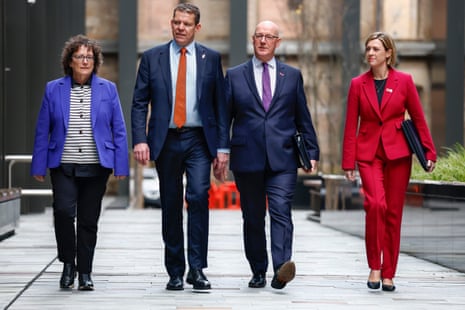
Rhun ap Iorwerth says he will asking Burnham to give Wales same devolved powers as Scotland at Glasgow summit
This is from Rhun ap Iorwerth, the Welsh first minister, summarising what he will be putting to Andy Burnham at their meeting in Glasgow today.
double quotation mark Today, I represent Wales at the National Economic Council in Glasgow.This is an opportunity for the UK Prime Minister to prove his commitment to a respect agenda that works both ways.
That means committing to not undermining the Senedd and to stop treating Wales as a region of England.
I will urge the Prime Minister to commit to a range of measures to improve the lives of people in Wales.
These include:
📈 A new Growth Partnership between the Welsh Government and the UK Government to boost prosperity in every part of our country.
💰 Fairer funding settlement.
🏴 Devolving the same powers as Scotland through a new Wales Bill.
🚂 And honouring, without delay, his commitment of £14bn for Welsh railways.
And that’s to name just a few of our demands.
Under the Plaid Cymru Welsh Government, Wales will never stay silent on issues that affect our communities.
Voters regard Healey’s budget as one of fairest for years, poll suggests
Yesterday the Institute for Fiscal Studies (see here) and the Resolution Foundation (see here) delivered fairly negative assessments of the budget. But mostly the gloom was triggered by the thinktanks said about the overall state of the economy and the public finances; they were critical of John Healey for deferring difficult choices, but less hostile about the decisions he did actually announce.
However, according to YouGov, voters are quite positive. They regard it as one of the fairest budgets for years.
This is how Dylan Difford explains the figures in his YouGov write-up.
double quotation mark The public’s initial reaction to John Healey’s first budget is in some key respects broadly positive, with nearly half of Britons (45%) regarding the budget as being fair, relative to just 20% seeing the measures announced as not fair.This is a notable improvement on last year, when Rachel Reeves’ second budget was declared ‘not fair’ by a near-inverse margin of 48% to 21%. In fact, on this measure, this is one of the most positively received budgets in recent times. In data going back to 2010, only George Osborne’s first budget in 2010 and Rishi Sunak’s Covid budgets of 2020 and March 2021 have been judged ‘fair’ by a greater proportion of Britons (50-55%).
The Covid budgets were both giveaway, rescue budgets, and so it is not surprising they polled well. Osborne’s first budget was an austerity budget, and it is not a model popular with Labour MPs, but it probably polled well on fairness because the pain was spread across all groups in society.
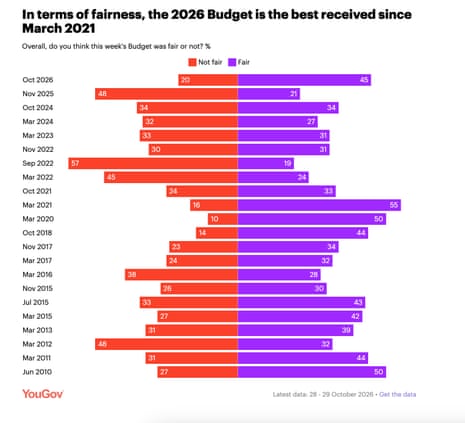
The YouGov figures also show that only 15% of people think their family finances will improve as a result of the budget. That may not sound much but, as Difford says, “this is a sharp and favourable contrast with last November’s budget, which 50% of Britons believed would leave them and their family worse off, compared to a mere 3% feeling they’d be better off.”
In fact, Healey and his first budget outperform Rachel Reeves and her budget last year on every measure assessed in the polling.
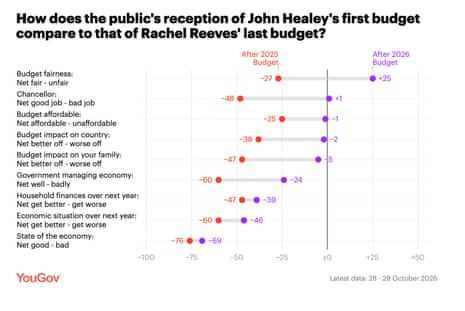
Yesterday one of the criticisms of the budget from the Resolution Foundation was that the energy cost of living support package helped the rich almost as much as the poor. That meant it was “poorly targeted”, said the RF, applying a progressive, social justice definition of fairness. What the YouGov poll suggests is that voters as a whole judge fairness differently; it is probably precisely because most households get the £100 energy payment that people regard it as fair.
In their London Playbook briefing for Politico yesterday, Sam Blewett and Megan McElroy said Healey used focus groups extensively before finalising his measures.
double quotation mark Government officials say they focus-grouped all this relentlessly. Playbook was told these sessions helped convince ministers to go for wider support payments for council tax bands A-D rather than the initial plans to go with something more targeted. It was the supposedly better-off voters who were complaining about the pinch as well.
The polling showed it worked.
MoD says under new offset policy foreign firms will only get big defence contracts if they spend equivalent amount in UK
Wes Streeting, the defence secretary, was on the interview round this morning, announcing a new aspect of defence procurement policy. The Ministry of Defence is now saying that, if overseas suppliers win UK defence contracts, they will be required to spend the equivalent amount in the UK.
Explaining the policy, the MoD says:
double quotation mark British workers, businesses and apprentices will benefit from major changes which will see more defence work carried out in the UK thanks to the launch of a world-leading Offsets policy.Under the new rules, overseas companies that win significant UK defence contracts will be required to invest back into Britain, through new British jobs and apprenticeships, opening UK factories, investing in domestic suppliers, transferring technology and innovation know-how.
This means contracts worth over £50m will be considered for offsets. The contractors will be required to deliver such benefits to the UK that could reach the same value as the contract, for example a £100m contract could see new jobs, facilities, or skills training up to the same £100m value in the UK.
The government is prioritising buying British defence contracts wherever possible. Where it must buy defence equipment from overseas, this new approach will ensure British workers and businesses still benefit.
John Healey, the chancellor, and Streeting are formally announcing this on a visit to BAE Systems Scotstoun in Glasgow today.
The MoD says countries like Poland, Norway and the Netherlands use similar offset policies. Further details of how this will work are set out in an offset policy paper published today.
Streeting said:
double quotation mark Every pound we invest in defence should be judged by what it does for Britain. That’s why we are backing British by buying British wherever we can.Even when that is not possible, we are acting to ensure that any investment brings jobs, skills and investment back home, strengthening our national security by boosting our domestic industry.
In the past, the conventional globalist, free market approach to defence procurement operated on the basis that cost and quality were all that mattered and that, if a foreign firm could supply kit better and more cheaply than anyone else, that was enough. But the US is not the only country that has become protectionist in recent years, and this is a good example of Europe prioritising local employment in government procurement.
John Swinney urges Burnham to devolve more powers to Scottish government
In his statement ahead of the devolution summit in Glasgow today, Andy Burnham made it clear that he is interested in transferring more power from Edinburgh to Glasgow. (See 9.11am.) But John Swinney, the Scottish first minister, would rather talk about devolving further powers from London to Edinburgh. He issued this statement ahead of the meeting.
double quotation mark The prime minister has made devolution a central focus for his government. However the UK government must ensure that any devolution proposals respect devolution in Scotland. That means working with the Scottish government.The Scottish government has put forward substantive proposals to the UK government on areas where further devolution would help grow Scotland’s economy and I will press the prime minister, and his government, to work with us to deliver those proposals.
The SNP wants Scotland to be fully independent (the ultimate version of devolution). But, pending that, it is also calling for the Scottish parliament to have power over policy areas currently reserved to London. Greater control over taxation, immigration, employment law and energy policy are particular priorities.
Burnham admits he would have liked more radical first budget
Andy Burnham has admitted his first budget as prime minister was not as radical as he would have liked because of the economic uncertainty facing the country, Kiran Stacey reports.
Burnham says he wants to offer more ‘regional empowerment’ ahead of devolution summit with Scottish and Welsh leaders
Good morning. Andy Burnham is in Glasgow today for a meeting with the leaders from Scotland and Wales and he says he wants to use it to talk about “the next stage of devolution”. According to the overnight briefing from No 10, he is less interested in giving more powers to the devolved parliaments and more interested in promoting “regional empowerment” in their countries.
In his pre-summit statement, Burnham says:
double quotation mark Through No 10 North, we are rewiring the state. I want to make sure every city and region in the United Kingdom is part of that.Today I’ll be making an offer to the governments of each nation. Put politics aside and work in partnership with the UK government to develop models of regional empowerment that ensure communities can use their own strengths to unlock their potential.
This is the next stage of devolution. Together, there is no limit to what we can achieve.
Burnham is speaking at a time when Scotland, Wales and Northern Ireland have since the May elections (when Plaid Cymru won in Wales) for the first time had first ministers from nationalist parties that want to break away from the UK. John Swinney, the Scottish first minister, and Rhun ap Iorwerth, the Welsh first minister, will be at the meeting today. But Michelle O’Neill, the Sinn Féin first minister from Northern Ireland won’t be there. She holds power jointly with a DUP deputy, and both of them have to stay away because the DUP has vetoed their attendance due to an ongoing row about Drumcree. Some officials will attend instead.
Downing Street says at today’s meeting Burnham “will say that devolution by default shouldn’t be about the transfer of powers from one parliament to another but should go deeper within nations to empower all places and communities who know best what they need to grow and access opportunities.”
Here is the agenda for the day.
Morning: Andy Burnham chairs a meeting of the national economic council in Glasgow.
11.30am: Downing Street holds a lobby briefing.
Afternoon (UK time): Ed Miliband is attending a meeting of G20 foreign ministers in Atlanta in the US.
I’m afraid we are no longer able to have comments open below the line every day on this blog. If you want to contact me, please email politics.live@theguardian.com. You can use this email to flag up corrections, comments for publication, questions or complaints.

