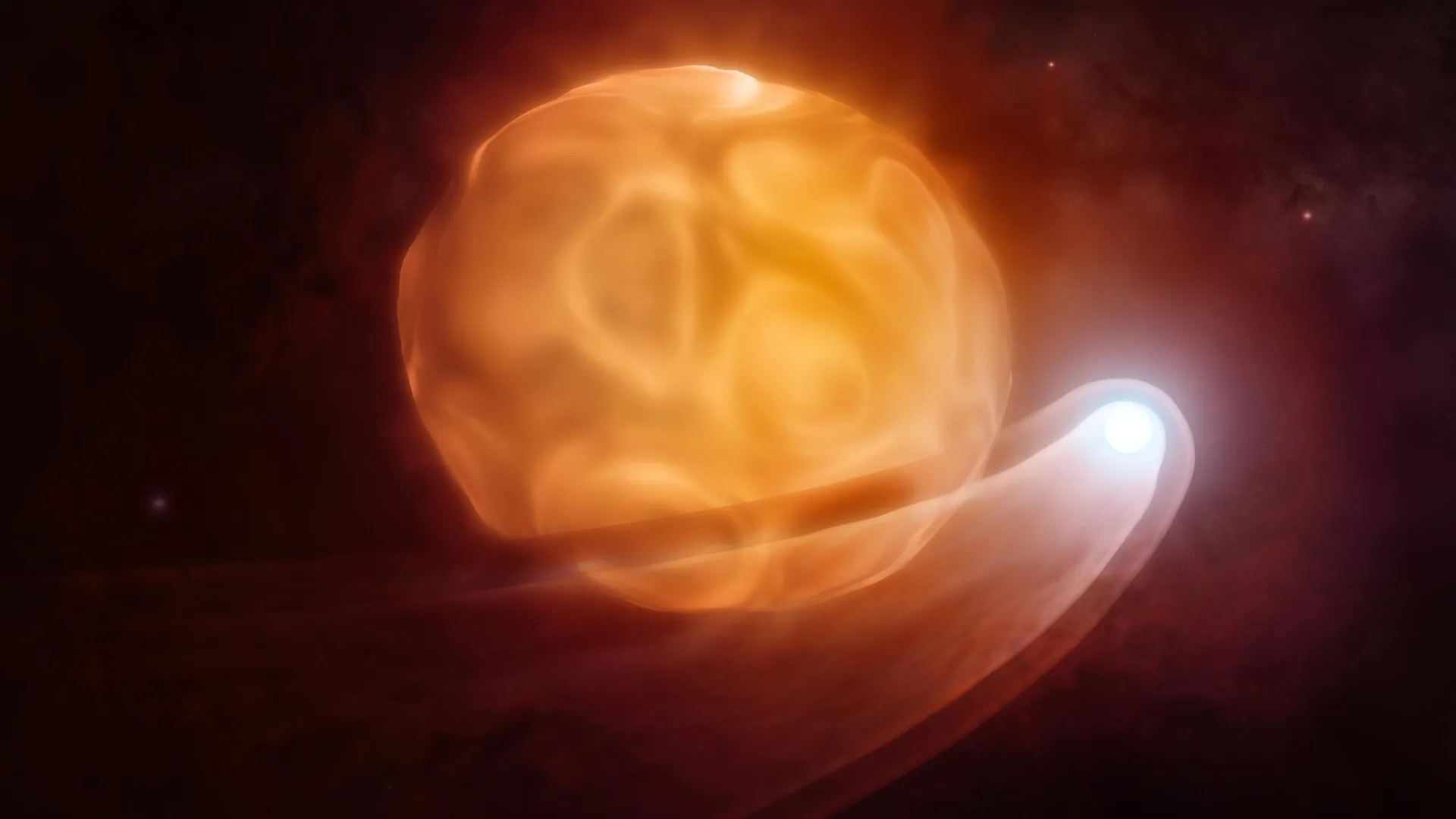
Одон орон судлаачид Бетелгейз аваргын агаар мандалд тохиолдож буй ер бусын өөрчлөлтийг ажигласны үндсэн дээр түүнийг тойрон эргэдэг Сиварха хэмээх хамтрагч одны нөлөө байж болохыг тогтоожээ.
Орион одны ордонд байрлах Бетелгейз нь улаан аварга том од бөгөөд 2019 оны сүүл, 2020 оны эхээр тохиолдсон гэрэлтэлтийн огцом бууралт буюу “Их бүдгэрэлт”-ийн дараа эрдэмтдийн анхаарлыг дахин татаад байна. MIT Haystack ажиглалтын төвийн эрдэмтэн Линн Мэттьюсээр удирдуулсан баг NSF VLA болон ALMA дуран авайг ашиглан 2021-2026 оны хооронд радио долгионы долоон өөр давтамж дээр уг одыг судалжээ. Ажиглалтын үр дүнд Бетелгейзийн агаар мандлын гадна давхарга хэвийн байдалдаа эргэн орсон болохыг тогтоосон ч, одны хэлбэрт гарч буй нарийн өөрчлөлтүүд нь нууцлаг хамтрагч одны нөлөөлөл байж болзошгүйг илрүүлэв.
Судлаачид ALMA дурангийн тусламжтайгаар одны гадаргуу болон хромосферийн хооронд 2,200 Кельвин хүртэл хүйтэрдэг “MOLsphere” гэх молекул хийн давхаргыг баталгаажуулсан байна. Энэхүү давхаргын ажиглалт нь одны агаар мандлын бүтцийг илүү нарийвчлан гаргах боломж олгожээ. Мөн Сиварха хэмээх хамтрагч од нь Бетелгейзийн радиусаас ердөө хоёр дахин их зайд, түүний сунасан агаар мандал дундуур нь дамжин эргэлддэг болохыг таамаглаж байна.
Бетелгейзийн агаар мандал нь үргэлж дугуй хэлбэртэй байдаггүй бөгөөд Сиварха одны байрлалаас хамааран зууван хэлбэртэй болох нь ажиглагдсан байна. Сиварха од нь өөрөө радио долгионоор илрэхэд хэтэрхий бүдэг тул эрдэмтэд түүнийг шууд харах боломжгүй ч, агаар мандлын хэлбэрийн өөрчлөлт нь түүний таталцлын болон биет нөлөөллийн улмаас үүсэж буй “долгион” гэж үзэж байгаа юм.
Энэхүү холбоо хамаарлыг бүрэн баталгаажуулахын тулд илүү олон ажиглалт хийх шаардлагатай гэдгийг эрдэмтэд онцоллоо. Цаашид Next Generation Very Large Array зэрэг шинэ төхөөрөмжүүд нь ийм төрлийн аварга том одод амьдралынхаа төгсгөлд хэрхэн материал алдаж, хувьсан өөрчлөгддөгийг илүү тодорхой болгох юм. Судалгааны үр дүнг The Astronomical Journal сэтгүүлд нийтэлжээ.
Дэлгэрэнгүйг эх сурвалжаас харах
↓Эх сурвалжийг нээх ↓
Something unusual is happening inside the enormous atmosphere of Betelgeuse, one of the most recognizable stars in the night sky. Astronomers have detected subtle changes in the star’s shape that suggest something is moving through its outer layers, disturbing the surrounding gas like an unseen visitor making noise inside a house. (Metaphorically speaking.) New observations point to a likely culprit: Siwarha, a recently discovered companion star that appears to be traveling through Betelgeuse’s atmosphere.
Betelgeuse is a massive red supergiant located in the constellation Orion, where it forms the famous hunter’s shoulder. Although the star has fascinated astronomers for generations, it attracted worldwide attention in late 2019 and early 2020 when its brightness unexpectedly plunged to its lowest recorded level in more than 100 years. The event, known as the Great Dimming, raised questions about what was happening inside the aging star.
Now, observations from the U.S. National Science Foundation’s Karl G. Jansky Very Large Array (NSF VLA) and the Atacama Large Millimeter/submillimeter Array (ALMA) reveal that Betelgeuse’s vast outer atmosphere has largely returned to normal. More intriguingly, the measurements provide new evidence that a nearby companion star is physically disturbing the giant star’s atmosphere.
The research was led by Dr. Lynn D. Matthews, Principal Research Scientist and Assistant Director at MIT Haystack Observatory, working with scientists from the Center for Astrophysics | Harvard & Smithsonian, the University of Manchester, and the European Southern Observatory. The team analyzed observations gathered between 2021 and 2026 at seven radio frequencies ranging from 22 GHz to 485 GHz.
Different radio frequencies allow astronomers to examine different depths within a star’s atmosphere. By combining the observations from both telescopes, the researchers reconstructed the structure of Betelgeuse’s outer layers, beginning just above its visible surface and extending outward to several times its radius.
“It was the combination of the incredible data from the NSF VLA and ALMA that gave us a convincing result here,” said Matthews. “The fact that we can use these facilities to actually resolve the disks of nearby stars is amazing.”
Betelgeuse Recovers From Its Mysterious Great Dimming
The latest measurements also help scientists understand how Betelgeuse has changed since its extraordinary fading episode. Several months before the Great Dimming (when Betelgeuse ejected a billion tons of solar material, partially blocking our view), an earlier investigation led by Matthews detected unusually low temperatures in the star’s atmosphere at radio wavelengths.
At the time, researchers suggested that turbulent convection deep inside Betelgeuse may have generated a shock wave that traveled outward and disrupted the surrounding gas. That disturbance could have helped trigger the enormous release of material that later formed dust and obscured part of the star’s light.
The new observations indicate that the atmosphere has since warmed to temperatures more typical of Betelgeuse. At a distance of approximately 2.7 times the star’s radius, the gas now has a measured brightness temperature of about 3,500 Kelvin (comparable to Betelgeuse’s own surface temperature).
Astronomers Discover an Unexpectedly Cold Atmospheric Layer
The researchers also confirmed a feature that scientists had suspected existed for years: a region of unusually cool gas between Betelgeuse’s visible surface and its higher atmospheric layer, known as the chromosphere.
Using ALMA at its highest observed frequencies, the team was able to probe closer to the star’s surface than previous radio measurements had allowed. The results revealed temperatures falling to approximately 2,200 Kelvin, more than 1,000 degrees below the temperature of the visible surface, or photosphere.
This cool region corresponds to the “MOLsphere,” a layer containing molecular gas that astronomers had previously identified primarily through infrared observations. The new radio measurements provide a much more direct examination of this elusive part of Betelgeuse’s atmosphere and confirm the long-suspected “temperature minimum.”
A Hidden Companion Star May Be Distorting Betelgeuse
One of the most intriguing discoveries involves Siwarha, the smaller star believed to orbit extremely close to Betelgeuse. Astronomers first proposed the companion’s existence in 2024 as a possible explanation for a puzzling cycle in which Betelgeuse’s brightness changes approximately every 2,100 days. Subsequent direct imaging and spectroscopic observations have provided additional support for the companion’s existence.
The name Siwarha reflects its relationship with Betelgeuse. The giant star’s name comes from the Arabic expression meaning “the hand of al-Jawza,” while Siwarha means “her bracelet.”
Unlike a planet or star traveling far from its host, Siwarha is believed to follow an orbit that takes it directly through Betelgeuse’s extended atmosphere. Its estimated orbital distance is only about twice the red supergiant’s radius.
“This companion is orbiting so close to the star that it actually passes through its extended atmosphere,” Matthews explained.
As Siwarha moves along its orbit, it may push through the surrounding gas much like a fast boat cutting through water. The resulting wake could disturb the atmosphere, producing changes that astronomers can detect even though the smaller star itself remains invisible in the radio observations.
In fact, the researchers calculated that Siwarha is likely tens to hundreds of times too faint to be detected directly with the radio measurements they collected. Instead, they searched for indirect evidence of its presence by studying the shape of Betelgeuse’s atmosphere.
Betelgeuse’s Changing Shape Reveals New Clues
The scientists discovered that Betelgeuse does not always appear perfectly round at radio wavelengths. Its atmosphere sometimes develops a slightly stretched, oval appearance, and the timing of these changes appears to match the expected position of Siwarha.
To investigate this connection, the team measured the atmosphere’s departure from a circular shape (“ellipticity”) across observations taken at different times.
They found that Betelgeuse tends to look more elongated when Siwarha is expected to be at its greatest apparent separation from the giant star. When the companion is predicted to pass in front of or behind Betelgeuse from our perspective, the atmosphere appears rounder.
This relationship provides compelling evidence that the smaller star may be influencing the shape of Betelgeuse’s outer layers through gravity and its physical passage through the gas.
The effect resembles noticing ripples spreading across a pond without being able to see what caused them. Although Siwarha remains too faint to identify directly at radio wavelengths, the changing shape of Betelgeuse’s atmosphere may reveal its movement around the larger star.
Future Observations Could Reveal More About Betelgeuse
Despite the promising results, astronomers emphasize that additional observations are necessary to confirm the connection between Siwarha’s orbit and the atmospheric distortions. Measurements covering more of the companion’s orbital cycle, particularly at radio frequencies that have not yet been studied extensively, could help establish how strongly the smaller star affects Betelgeuse.
More advanced instruments may eventually provide an even clearer picture. The Next Generation Very Large Array, an observatory currently under development, is expected to make detailed studies of nearby stars and their atmospheres much easier.
Such observations could reveal not only how companion stars influence their massive neighbors, but also how aging red supergiants lose material as they approach the final stages of their lives. Understanding these interactions may help astronomers better explain the complicated processes that shape the evolution of enormous stars like Betelgeuse.
The findings were published in The Astronomical Journal in a paper titled “New Spatially Resolved Observations of Betelgeuse from the VLA and ALMA: Evidence for Atmospheric Perturbations from a Close Companion.”

