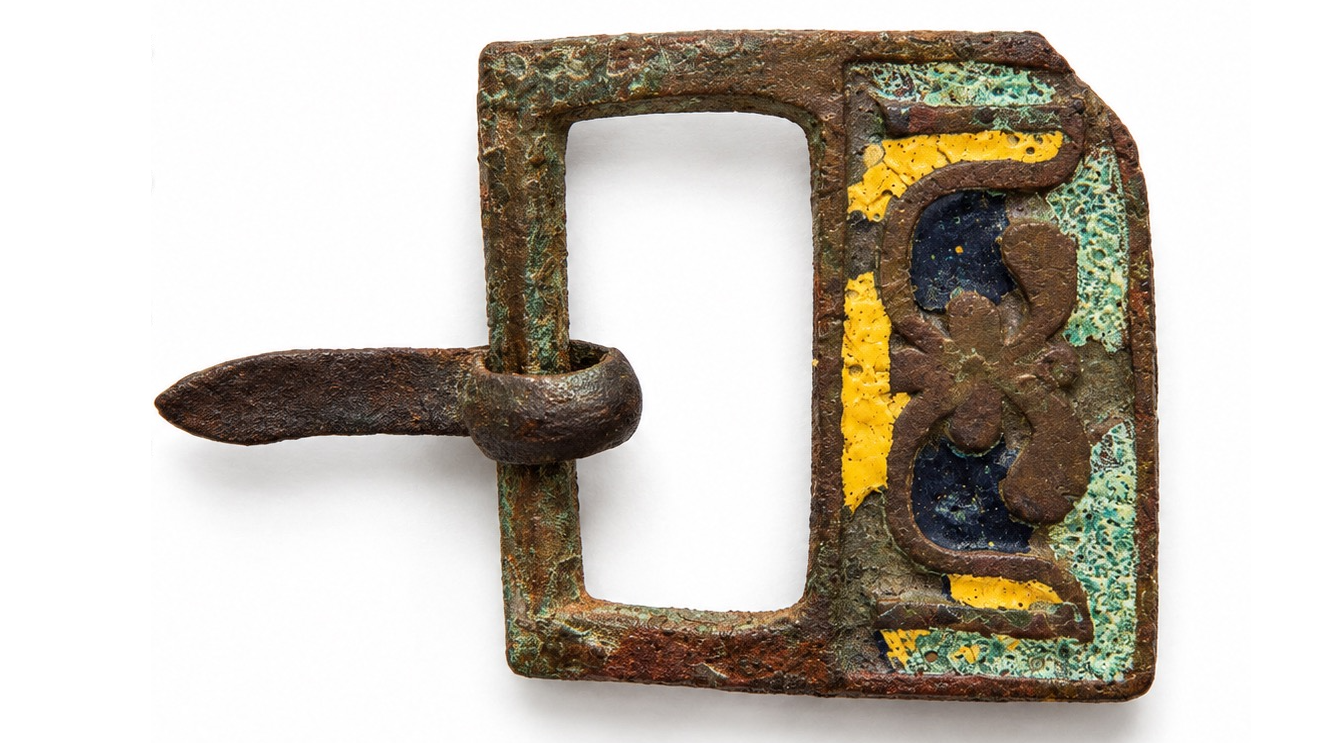
Археологчид Украин улсын зүүн өмнөд хэсэгт орших Цециний ойноос 1800 орчим жилийн настай, өнгө өнгийн паалангаар чимэглэсэн бүсний арал олсон байна.
Буковинийн улсын анагаах ухааны их сургуулийн профессор Антони Моисей уг олдворыг нутгийн оршин суугчдаас хүлээн авчээ. Ойролцоогоор 2.1 см-ийн хэмжээтэй, дөрвөлжин хэлбэртэй уг металл бүсний арал нь цэнхэр, ногоовтор болон шар өнгийн паалангийн чимэглэлтэй аж. Судалгаагаар уг эдлэлийг МЭ II-III зууны үед хамаарах бөгөөд тухайн үед энэ бүс нутаг Ромын эзэнт гүрний Дакия мужийн бүрэлдэхүүнд багтаж байжээ.
Профессор Моисей бүсний үлдэгдэлтэй хамт бүсний чимэглэлийн хэсгүүд болон гурван жижиг дугуй металл эдлэлийг олж авсан байна. Тэрээр эдгээр олдворт үндэслэн бүс анх ямар харагддаг байсныг сэргээн бүтээжээ. Одоогоор уг бүс хэнийх байсан нь тодорхойгүй байгаа ч судлаачид үүнийг Хар тэнгисийн бүс нутгаас гаралтай, морьт цэргийн дайчин Сарматынх байж болзошгүй хэмээн таамаглаж байна. Сарматчууд Ромын эзэнт гүрний хил хязгаараас гадна амьдардаг байсан бөгөөд зарим нь Ромын эсрэг тэмцдэг байсан бол зарим нь хөлсний цэргээр ажилладаг байжээ.
Уг олдвор нь Ромын мужийн гар урлалын уламжлалыг харуулж байгаа бөгөөд худалдаа наймаа эсвэл дайны олзны аль нэгээр дамжин ирсэн байх магадлалтай. Профессор Моисей олдворын гарал үүслийг нарийвчлан судалсаар байгаа бөгөөд энэхүү бүс нь Ромын эзэнт гүрний хязгаар нутагт цэргийн харилцаа ямар байсныг гэрчлэх чухал нотолгоо болж байна.
Дэлгэрэнгүйг эх сурвалжаас харах
↓Эх сурвалжийг нээх ↓
Archaeologists in Ukraine have found a colorful belt buckle that may have been worn by a nomadic equestrian warrior 1,800 years ago on the fringes of the Roman Empire.
The belt buckle was unearthed by local residents in the Tsetsyn Forest in southeastern Ukraine and given to Antonii Moisei, a professor at Bukovinian State Medical University, according to a translated statement. The roughly square metal buckle, which is about 0.8 inches (2.1 centimeters) on each side, has teal, blue and yellow enamel decorations.
The style of the decoration and the metal construction place the creation of the buckle in the second to third centuries A.D., when this part of Ukraine was in the ancient province of Roman Dacia, according to Moisei.
Under Emperor Trajan, Rome fought the Dacian Wars (A.D. 101-102 and 105-106) against the denizens of the Dacian kingdom and its leader, Decebalus. Roman legions destroyed Dacia and annexed it as a new province. Trajan celebrated his victory in Rome, complete with a famous column that depicts details of the Dacian Wars.
In addition to the buckle, Moisei collected a decorative belt fitting and three small, round metal objects that probably belonged to the same belt. Moisei created a reconstruction of what the belt might have looked like before it was lost in the forest nearly two millennia ago.
But it’s unclear who lost the belt. One of Moisei’s theories is that the belt belonged to a horse-riding Sarmatian warrior originally from the Black Sea region. The Sarmatians were a group of tribes that lived outside the borders of the Roman Empire, in what are now central Ukraine, southern Russia and the Balkans. While some Sarmatian warriors fought against the incursion of the Roman Empire, others fought with Rome as mercenaries.
The metal belt fragments are part of a Roman provincial craft tradition, according to the statement, and they may have been obtained through trade or as a trophy of war. But Moisei is still studying the artifacts to confirm whether they were Sarmatian. Either way, the military belt provides new evidence of Roman military contact on the outskirts of the empire, and future work could help experts understand how the Romans interacted with the local Dacians during wartime.
From Augustus to Nero, see how much you know about ancient Rome’s famous leaders with our Roman emperor quiz!

