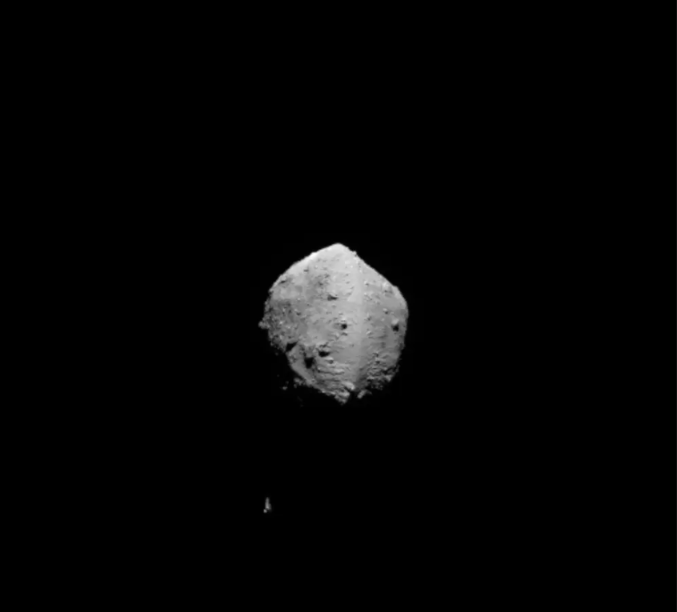
Зурагт астероидын хос системийн DART мөргөлдөөнд өртсөн дагуул биет Dimorphos бүдэгхэн харагдаж байна.
ESA 2026 оны арваннэгдүгээр сарын 5-нд Hera аппарат зорьж буй Didymos–Dimorphos системийн анхны зургийг авсныг мэдээлэв. Зураг авах үед аппарат Didymos-оос 60 км орчим зайд байсан бөгөөд жижиг дагуул Dimorphos том астероидын сүүдэрт үзэгдэж байна. NASA-гийн DART аппарат 2022 онд гаригийг аюултай астероидоос хамгаалах арга турших зорилгоор Dimorphos-той мөргөлдсөн юм.
Hera-гийн гол судлаач Патрик Мишелийн хэлснээр, зурагт DART-ийн камер мөргөлдөхөөс өмнө харуулсан талаас эсрэг тал нь буужээ. Энэ хэсэгт экваторын дагуух төв нуруу харагдсан ч бусад шинж нь өөр бөгөөд олон хадархаг биет, тогоо, ховил эсвэл нуруу мэт хээтэй байна.
ESA-гийн эрдэмтэн Михаэль Кюпперс Dimorphos-оос шидэгдсэн материал ойролцоогоор 1 км зайг туулж Didymos-д хүрсэн байж болзошгүй тул зурагт харагдах зарим шинж үүнтэй холбоотой байж мэднэ гэжээ. Гэхдээ энэ боломжийг цааш судлах шаардлагатай бөгөөд хоёр биетийн илүү олон зургийг авч, өөрчлөлтийг зураглан тогтоохоор төлөвлөж байна; дэлгэрэнгүй зургуудыг арваннэгдүгээр сарын 25-нд танилцуулахаар ESA мэдэгдэв.
Hera 2026 оны арваннэгдүгээр сард хос астероидод хүрч, зургаан сарын турш DART-ийн мөргөлдөөний үр дагаврыг судлахаар төлөвлөсөн. Энэ нь хос астероидын системд хийх анхны судалгаа бөгөөд Dimorphos-ийн нягт, найрлагыг хэмжиж, DART-ийн үүсгэсэн тогоог 10 см-ийн нарийвчлалтай зураглана. Тогоо үүсээгүй, харин мөргөлдөөн бүхэл астероидын хэлбэрийг өөрчилсөн байх боломжийг ч шалгахын зэрэгцээ Milani спектрийн ажиглалт, Juventas астероидын дотоод бүтцийн радарын хэмжилт хийнэ.
Дэлгэрэнгүйг эх сурвалжаас харах
Эх сурвалжийг нээх ↓
Hera’s 1st closeup view of Didymos and Dimorphos
On November 5, 2026, ESA said that its Hera mission has caught its first glimpse of its target, the binary asteroid system of Didymos and Dimorphos. Dimorphos, a little moonlet of asteroid Didymos, was struck by NASA’s DART mission back in 2022, in the name of planetary defense. Hera was about 37 miles (60 km) away from Didymos when it took this image. Little Dimorphos also shows a glimpse of itself, hiding in the larger asteroid’s shadow.
Hera principal investigator Patrick Michel said:
The first thing we said was wow! This is the other side of Didymos from the one that DART’s camera showed us shortly before impact, so this feels like looking at a whole new world. This side of Didymos has the same central ridge along its equator that we saw before, but otherwise appears very different, with multiple boulders and craters and what look like patterns of grooves or ridges.
ESA’s Hera mission scientist Michael Kueppers added:
Since we expect a lot of impact-ejected material to have made it across the approximately 1 km of space from Dimorphos to Didymos, it may be that some of these characteristics originate from this transport of material, and we have an exciting work ahead of us to sort it out. We look forward to seeing much more of both bodies and systemically mapping all the changes we identify.
ESA said that detailed images of both asteroids will be unveiled on November 25.
The Hera mission hits the brakes
The European Space Agency’s Hera mission has hit the brakes! The spacecraft is headed for the site of a human-made impact on the asteroid Dimorphos, created in 2022 by NASA’s DART spacecraft as a test of our ability to move an asteroid in its orbit. But — before Hera can properly reach Dimorphos — first it had to slow down.
That’s why the spacecraft will fire its thrusters on October 15, 2026. And, ESA said, the maneuver was a tricky one:
Hera will rotate around so that its ring of Orbit Control Thrusters face toward the Didymos system. Three of these hydrazine-based thrusters will be ignited at once, burning continuously for a total of 93 minutes, to reduce Hera’s velocity relative to the asteroids by a few hundred meters per second.
We’re happy to report that all went well. Now, Hera is closing in on Dimorphos to begin its investigations!
Hera is ready for its asteroid rendezvous
In 2022, the groundbreaking DART mission struck and moved an asteroid. It was a test of Earth’s ability to defend itself from an incoming asteroid threat. Two years ago, on October 7, 2024, a follow-up mission — ESA’s Hera — launched toward the asteroid impact site on Dimorphos, a little moon of the asteroid Didymos. Now, Hera is ready for its November 2026 meeting with the asteroid pair. After it arrives, it will spend six months investigating the aftereffects from the impact.
So far in 2026, the Hera mission has undergone a deep-space maneuver to correct its course toward its target. And in July 2026, it finished receiving an upgrade to its software. The braking maneuver on October 15 worked to get the spacecraft to its target.
When Hera reaches the asteroids, it will release two cubesats, Milani and Junventas. Milani is in charge of spectral surface observations (splitting light bounced off the asteroid into a rainbow array of colors, then analyzing that light). And Juventas will take the first radar soundings in the heart of an asteroid.

When DART hit Didymos
Back in 2022, when DART hit Didymos’ little moon Dimorphos, it made a big splash. We know for sure it pushed the asteroid slightly out of its previous orbit. And the debris kicked up in the collision might even have created a new meteor shower for Earth!
Hera is going to learn more about just what happened when DART struck the little asteroid, creating a crater on its surface and moving it slightly in orbit. It’s going to learn more about Dimorphos itself, to help refine our knowledge of what DART did … to keep us safe from future asteroid collisions.
This will be the first investigation of a binary asteroid. Hera’s focus will be on Dimorphos, the moonlet that DART impacted. According to ESA — the mission planner — Hera will conduct a “crime scene investigation” at the little asteroid moon. But Hera will also check out both Didymos and the dusty environs unleashed by the impact.
Here are 3 mysteries that Hera will help solve
ESA shared three mysteries that Hera will help solve:
- Hera will measure the density and composition of Dimorphos in detail and help scientists determine whether it is a “rubble pile” loosely held together by gravity, or a solid core covered in boulders and gravel.
- Hera will map the crater created by DART’s impact down to 4-inch (10-cm) resolution to help scientists better understand how the surface material responded to the collision. It’s possible that there is no crater at all, but rather the impact reshaped the entire asteroid!
- About 15% of known asteroids are actually binary systems, but their origins remain mysterious. Hera will determine whether Dimorphos and Didymos are made from the same material, which would hint that the rapidly spinning Didymos once threw off debris into space that later formed Dimorphos.
Hera project scientist Michael Küppers
Watch EarthSky’s Deborah Byrd speak with Hera project scientist Michael Küppers below. Get the latest here about keeping Earth safe from asteroids.
The Hera mission and a missing planet
Watch a video about the Hera mission to the asteroids Didymos and Dimorphos.
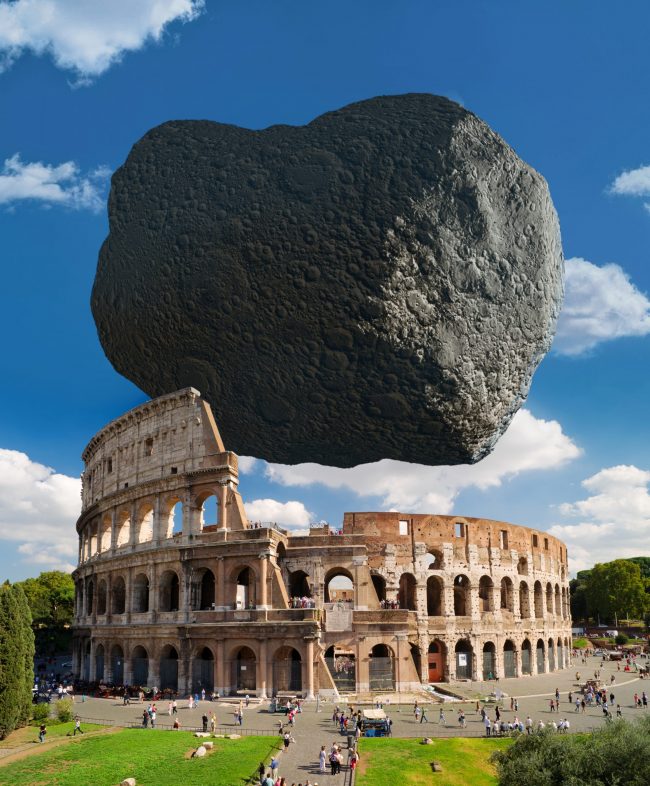
The Hera mission vs the Colosseum
The asteroid Didymos is about a half mile (800 meters) wide. So, that’s about the size of the Golden Gate Bridge. Its little companion, Dimorphos, is about 560 feet (170 meters) in diameter. And that’s about the size of the Great Pyramid. Or compare it to Italy’s Colosseum below.
Bottom line: The Hera mission just got its 1st closeup view of the asteroid Didymos and its little moonlet Dimorphos. Soon it will begin investigating the aftermath of the DART impact.
Read more: Boulders from asteroid Dimorphos, after spacecraft impact
Read more: Remember when DART struck an asteroid? New surprises!

