XIX зууны үед эрчимтэй хөгжиж байсан төмөр замын сүлжээ нь орон зайг “үгүй хийхээс” гадна цаг хугацааны тодорхойлолт, ашиглалт, үзэл баримтлалыг бүхэлд нь өөрчилсөн түүхэн үйл явдал болжээ.
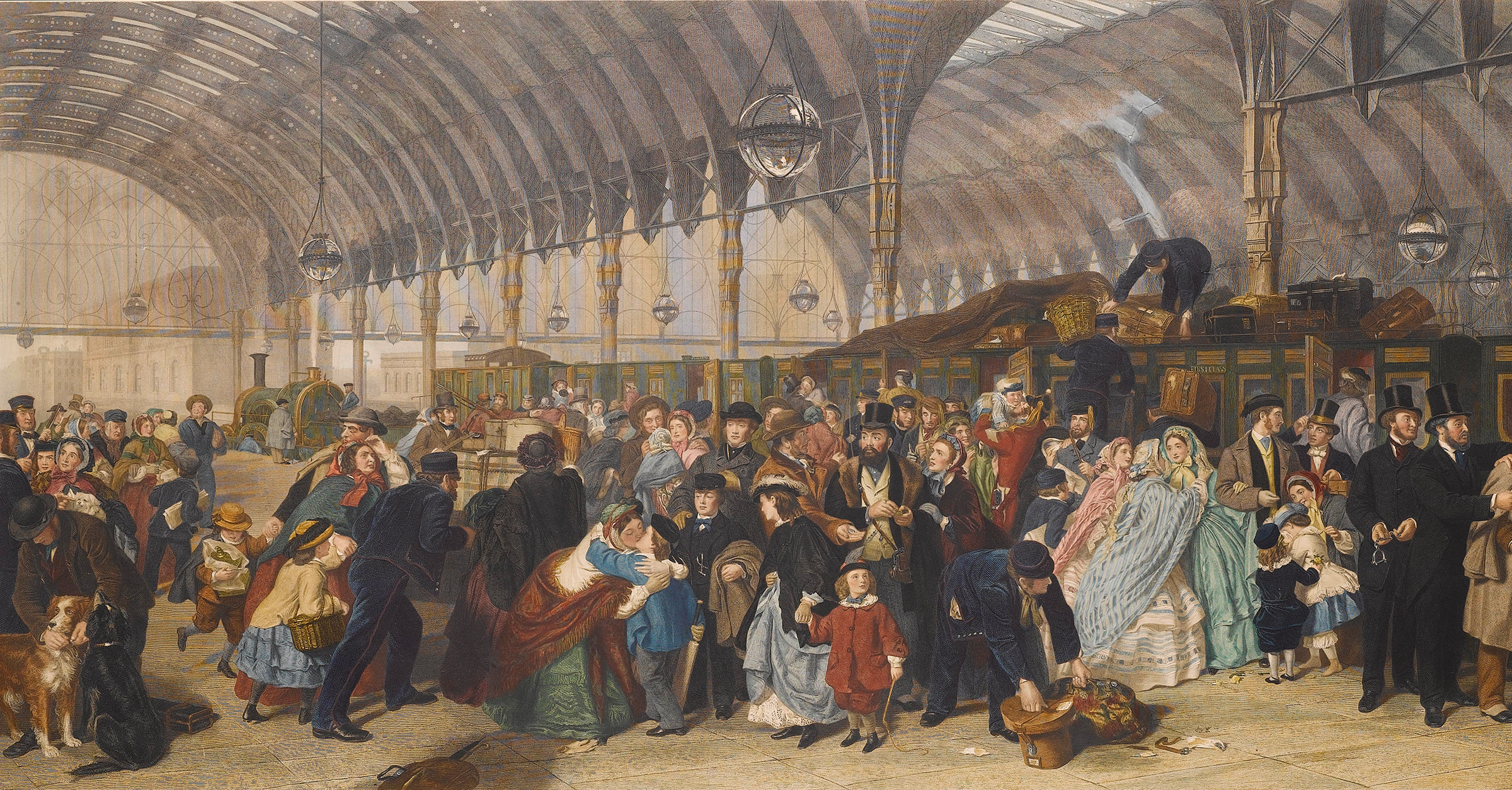
1866 оны Паддингтон өртөөний зорчигчид
### Төмөр замын цаг
Цаг хугацааг нарийн хэмжих, цаг баримтлах шаардлага нь төмөр зам үүсэхээс ч өмнө Их Британи болон Европын зарим оронд аль хэдийн бий болсон байв. Тухайлбал, Британийн тэнгисийн цэргийнхэн Жон Харрисоны тэнгисийн хронометрийг 1770-аад онд ашиглалтад оруулахаас өмнө ч уртраг, хурдыг тодорхойлохын тулд элсэн цаг, цаг тоологч төхөөрөмжүүдэд найдаж иржээ.
Харрисоны цаг нь Гринвичийн дундаж цаг (GMT)-ийн үндэс болсон бөгөөд энэ нь Гринвичийн хааны одон орон судлалын төвөөр дамжин өнгөрөх анхдагч меридиан дээр нарны байрлалыг жилийн дундаж үзүүлэлтээр тооцсон цаг юм. 1780-аад оноос Британийн шуудангийн алба тээвэрлэгчдээ GMT-ийг ашиглахыг үүрэг болгож, улмаар шуудангийн бүх салбарууд цагаа тохируулах болсон ч олон зууны турш мөрдөж ирсэн “орон нутгийн” буюу “нарны цаг” удаан хугацаанд оршсоор байв. Лондон болон Бристоль хотуудын хооронд гэхэд л цагийн зөрүү 10 минут хүрдэг байжээ.
1831 онд Британийн төмөр замын компаниуд хот хоорондын үйлчилгээг эхлүүлэхдээ цагийн хуваариа орон нутгийн цаг болон GMT-ээр зэрэг тавьсан нь зорчигчдыг ихээхэн төөрөгдөлд оруулж байв. 1846 онд Грейт Вестерн төмөр зам GMT-ийг систем даяар мөрдөх стандартаар баталж, дараа жил нь Британийн бүх төмөр замд хууль ёсны стандарт болгожээ. 1852 он гэхэд Гринвичийн одон орон судлалын төвөөс цахилгаан мэдээгээр дамжуулсан “төмөр замын цаг” буюу “Лондонгийн цаг” Их Британийн ихэнх хэсэгт үйлчилж эхэлсэн байна.
Генри Дэвид Торо “Уолден буюу ойд өнгөрүүлсэн амьдрал” (1854) бүтээлдээ: “Төмөр замын тэрэг ирэх, явах нь тосгоны өдөр тутмын амьдралын гол цаг хэмжигч болжээ. Тэд маш нарийн хуваарийн дагуу ирж очдог тул тариачид өөрсдийн цагаа тэднийг дагаж тохируулдаг болсон” хэмээн тэмдэглэжээ. 1880 онд Британийн Парламент “Цагийн тодорхойлолтын тухай хууль”-ийг баталснаар Ирландаас бусад нутагт GMT албан ёсны цаг болсон юм.
Энэхүү шинэ ертөнцөд минутын нарийн тооцоо нь амь нас, үхлийн хоорондох ялгааг ч илэрхийлж байв. Төмөр замын сүлжээ өргөжихийн хэрээр олон тооны хөдөлгөөнт хэсгүүдийг хооронд нь нарийн уялдуулах шаардлага тулгарсан бөгөөд ялангуяа XIX зууны дунд үеийн АНУ-ын нэг замтай төмөр замууд дээр эсрэг чиглэлийн галт тэрэгтэй мөргөлдөхөөс зайлсхий
Дэлгэрэнгүйг эх сурвалжаас харах
↓Эх сурвалжийг нээх ↓
The rapidly expanding 19th-century rail network not only ‘annihilated space,’ in the parlance of the day, but also altered the definition, use, and perception of time. Moreover, like much else in the burgeoning industrial world of the era, from railroad gauges to switching systems, steel rails to wall joists, time itself would become standardized by the turn of the 20th century, albeit not without opposition.
Train Passengers at Paddington Station, 1866
Railroad Time
Demand for accurate time measurement and the emphasis on punctuality had already emerged in the United Kingdom (UK) and parts of Europe well before the advent of the railroad. The British Navy, for instance, had been reliant on hourglasses and then clocks to determine longitude and speed at sea even before the adoption of John Harrison’s marine chronometer in the 1770s made the endeavor much more accurate than earlier timepieces.
The Harrison clock was also set to what became known as Greenwich Mean Time (GMT): “the yearly average (or ‘mean’) of the time each day when the Sun crosses the Prime Meridian at the Royal Observatory Greenwich (Royal Museums Greenwich)” just across from London’s Docklands. Then, starting in the 1780s, the British Royal Mail began requiring its carriers to use timepieces also set to GMT, and every post office had to adjust their clocks accordingly, though the often centuries-old ‘local’ or ‘solar time’ (set by sundials and/or “solar noon,” the sun’s “maximum height above the horizon” (Duffield Engineering) persisted for a while longer, even if the two standards sometimes differed by as much as ten minutes across the UK (i.e. between London and Bristol)
Not surprisingly then, when British rail companies began offering intercity service in 1831, they posted their timetables in both local time and GMT, presenting passengers with a confusing array of options. Only in 1846 did the Great Western Railway adopt GMT as its system-wide standard, and GMT became the legal standard for all British railways the following year. Within a decade (1852), almost all of the United Kingdom was operating on ‘railroad’ or ‘London’ time, telegraphed electronically from the Greenwich Observatory to railroad stations and post offices across the country.
The startings and arrivals of the [railroad] cars are now the epochs in the village day. They go and come with such regularity and precision, and their whistle can be heard so far, that the farmers set their clocks by them, and thus one well-conducted institution regulates a whole country.
(Henry David Thoreau. Walden, or, Life in the Woods (1854), quoted in Stephens, 103)
It would, however, take the British Parliament’s Statute (Definition of Time) Act (1880) to make GMT the official/legal time for all official activities in the UK outside of Ireland, which had its own Dublin Mean Time.
The imposition of railroad time, however, was not just about reducing the complexity of railroad timetables for the convenience of passengers, but also about the safe and efficient operation of what was, for everyone involved, an entirely new technological world. Before the expansion of rail networks, it had never been necessary to safely and smoothly coordinate to the hour and minute so many moving parts – and big, fast-moving parts at that – between and within networks spread across large geographic distances. In this new world, the correct reckoning of minutes could literally mean the difference between life and death, particularly on the mostly single-track mid-19th-century US railroads where trains needed to reach cut-outs (sidings off the main routes) within a specific time window to avoid colliding with oncoming traffic.
To maximize usage of their expensive capital investments and to better serve both their passenger and freight customers, US railroad companies ran trains in both directions on those single lines, carefully coordinating the overlaps with strict timetables, a standard time for each individual road (usually the time at the line’s city of origin), paired with accurate timepieces carried by train engineers, conductors and station agents, all of whom were supposed to coordinate and adjust those timepieces with the station clock at the system’s headquarters’ time. The system worked well enough, except when it did not, as, for example, when two trains on the Providence (Rhode Island) and Worcester (Massachusetts) Railroad crashed head-on in August 1853 because one of the conductors’ watches was running behind and he thought there was enough time to reach a switch and siding around a blind curve before the train scheduled in the opposite direction reached the same point. 14 people died in that accident, and over 150 more in other train mishaps that year alone.
Railroad Train Wreck in Rhode Island 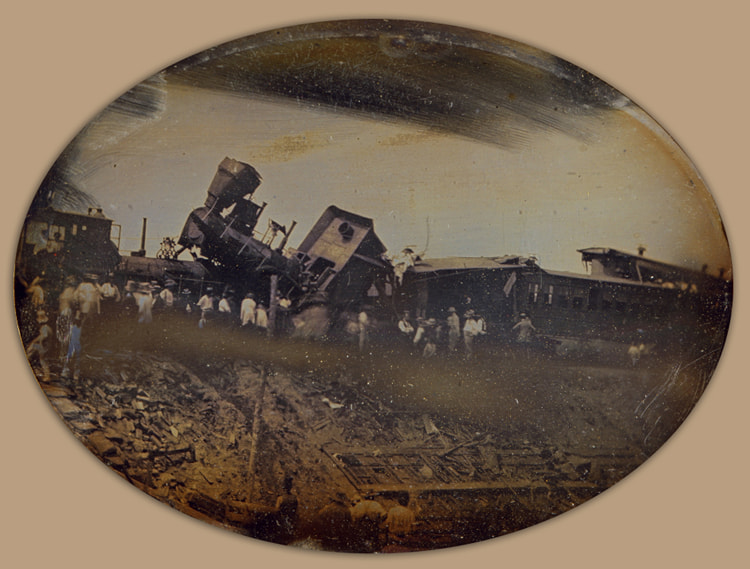
To avoid such accidents, and the public fury that accompanied them, US railroad companies, like in Britain, adopted telegraphed time signals and more double-tracking, both of which reduced the accident rate even as the US rail system became the largest in the world (over 200,000 miles or 320,000 km) in the decades before the First World War (1914-18), a position it still holds. Yet that evolving network also meant that the biggest carriers, i.e., the Pennsylvania Central or the New York Central in the east or the western transcontinentals like the Union Pacific or the Great Northern, often operated east to west across regions where the local/solar times varied by up to a half hour, not to mention that several systems with their own regional times intersected at major termini like New York, St. Louis, or Chicago (where over 25 separate railroad companies met by the end of the century). Indeed, as late as the 1870s, many American railroad stations still had at least two clocks, one showing the regional railroad’s standard time, and one for local time. Major railroad cities had even more: Buffalo, New York, for example, had one clock showing a different time for each of the three major rail lines that converged there, plus one for “local” Buffalo time as well. Pittsburgh had six.
Standardization
This crazy patchwork of times was a major inconvenience to rail passengers and freight travelling between regions. To address the issue and avoid the apparently imminent threat of federal regulatory intervention, the railroads called a General Time Convention in 1881 and voted to adopt four standard time zones for the United States, with the time changes coming at 15-degree longitudinal intervals (roughly equivalent to the one hour it takes the sun to cross that segment of the globe’s surface as the Earth rotates) from east to west starting with the 75th meridian east of GMT.
Two years later, at noon Sunday (a day with lighter rail traffic), 18 November 1883, a ball on top of the Western Union Telegraph Company’s New York City headquarters began to drop (a precursor of the still popular New Year’s Eve event in Times Square), as the company sent a simultaneous signal to the 500-plus railroad corporations directing them to replace their almost 50 network time zones with the new Standard Railway Time, thus converting almost the entire country to railroad time. It would take federal legislation in 1918 to make the zones official, however.
Meanwhile, the global spread of railway, telegraph (overland and undersea) and steamship lines in the late 19th century raised similar issues of time coordination and standardization, and in 1884 the International Meridian Conference met in Washington, D.C., to do for the world what Standard Railway Time had already done the previous year in the United States. 25 countries sent representatives who eventually agreed to adopt a 24 time-zone system with Britain’s Greenwich Mean Time denominated as 0 degrees. Britain’s arch-rival France originally opposed the adoption of the Greenwich Mean, arguing for a Paris meridian instead, but since GMT was already the standard for almost three-quarters of the world’s shipping, and since Britain already controlled much of the world’s underwater telegraph network by the 1880s (both integral parts of the globe-bestriding British Empire), most countries bowed to the inevitable and adopted the new system, though France resisted until 1911.
Greenwich Royal Observatory 
To be sure, Britain had already been exporting its communication and transportation systems, as well as its time standards (not to mention its industrial know-how and financial investment), since early in the 19th century, and not just to its current or, in the case of the United States, former colonial possessions. British engineers and managers, for example, largely designed and directed the operations, scheduling and time management systems for Japan‘s nascent railroad industry in the 1870s before being replaced by British-trained Japanese personnel in the next decade, and Japan officially adopted standard time on 1 January 1888.
British experts would do the same for the giant Indian railroad network designed and constructed in the second half of the 19th century, a system which was carrying 250 million passengers a year by 1905. Unintentionally, however, by connecting the disparate and sometimes contentious regions of the subcontinent together, the Indian rail system (and its attendant telegraphic and postal networks) helped create a sense of national identity, which gave rise to the national independence movement of the 20th century. But even after India secured its independence from Britain in 1947, the newly autonomous nation kept the single “all India railroad time” zone established in 1905 at 5 ½ hours East of Greenwich, which remains Indian Standard Time to this day.
For similarly political reasons, as the Soviets took power in Russia (1917-1922), they replaced the haphazard time standards of the vast Tsarist Russian Empire with the standard international time-zone system (geared to GMT). Up from 1925, Moscow time became the reference point for all of the Soviet Union’s eleven time zones, and the Soviet Time Service Committee sent out a daily radio signal (the BBC had started broadcasting its own ‘six-pips’ and the Big Ben ‘bong’ time signals in 1923/4, both of which are still in use today) for citizens to set their clocks and watches by. When the Chinese communists took power in 1949, however, they moved in the other direction, denominating Beijing Standard Time for the entire roughly 4,800-kilometer- or 3,000-mile-wide country in the name of national unity. China still operates under the same single time zone.
The Atomic Turn
Much of the world, meantime, has already moved on from Greenwich Mean Time. As noted above, GMT was based on the Mean Solar Time at the Royal Observatory in Greenwich. But since the Earth’s rotation, and thus the sun’s position as it crosses the Prime Meridian at Greenwich, “fluctuates in rate by a few thousandths of a second each day” (NIST), scientists in the post-World War II era began looking for an alternative standard based upon the stable frequencies of specific atoms rather than astronomical observations.
The World’s First Atomic Clock 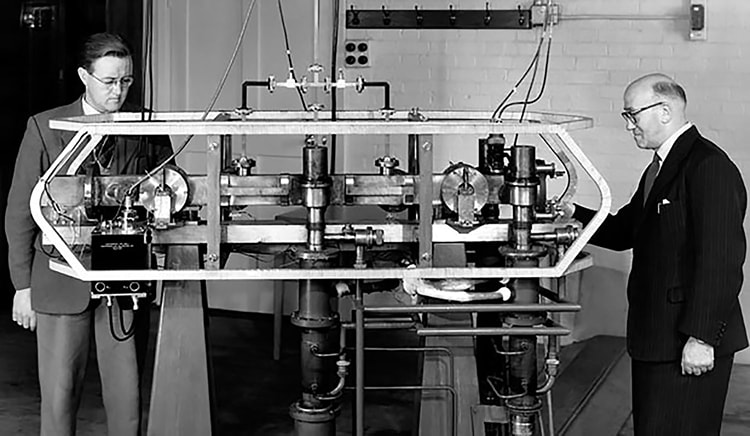
After unsuccessful experiments using ammonia, in 1967, the second was redefined using a cesium atomic clock developed by British physicists Louis Essen (1908-1997) and J. V. L. Parry (1923-1995), and that second became the basis for a new “atomic” definition of time called UTC (Universal Coordinated Time), which has since become the new global standard for both scientific, technical and digital/computer fields as well as everyday life. Somewhat ironically, given the resistance of the French to the Greenwich Mean at the turn of the 20th century, UTC is now disseminated by the International Bureau of Weights and Measures (BIPM) headquartered in Paris.

