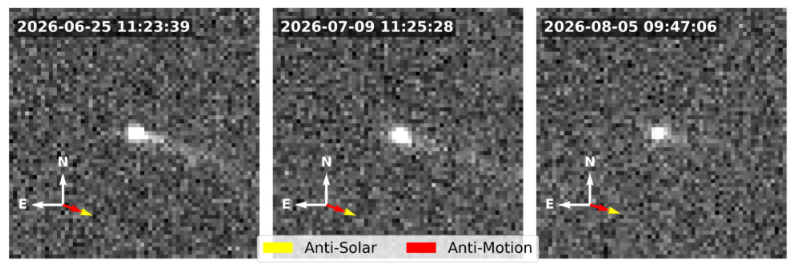
Ангараг, Бархасбадь гарагийн хоорондох гол бүсэд орших астероидод сүүл ажиглагдсан ч түүний үүссэн шалтгаан одоогоор тодорхойгүй байна.
Northern Arizona University болон бусад байгууллагын судлаачид Zwicky Transient Facility-ийн ажиглалтаас 6993 буюу 1995 BJ4 астероидын идэвхжлийг илрүүлжээ. SNAPS автомат системийн машин сургалтын загвар наймдугаар сарын 5-нд уг биетийн зургийг 99.9 хувийн итгэлтэйгээр тэмдэглэсэн байна. Өмнөх ажиглалтуудыг шалгахад сүүл 2026 оны зургаадугаар сарын 25-наас харагдаж байсан бөгөөд астероидын үндсэн биетээс цааш дор хаяж 32 нуман секунд үргэлжилжээ.
Ойролцоогоор 12 км диаметртэй энэ астероид мөс нарны гэрэлд ууршиж, тоос ба хий ялгаруулдаг сүүлт од шиг шинжтэй болох нь батлагдвал мэдэгдэж буй хамгийн том гол бүсийн сүүлт од болно. Түүнчлэн мэдэгдэж буй гол бүсийн сүүлт оддоос Нараас хамгийн хол тойрдог байх боломжтой бөгөөд Нарт хамгийн ойртох зай нь Дэлхий–Нарны зайнаас ойролцоогоор 2.85 дахин их. Одоогоор гол бүсийн 20 орчим сүүлт од л илрээд байна.
Судлаачид астероидын эргэлтээс үүдсэн материалын хаягдлыг боломжит шалтгаан гэж үзсэн ч 3.9 цагт нэг эргэдэг нь ажиглагдсан үзэгдлийг тайлбарлахад хангалтгүй гэж дүгнэжээ. Харин өөр биеттэй мөргөлдөж тоос цацсан, эсвэл гадаргын доорх мөс нарны гэрэлд халж ууршсан гэсэн хоёр хувилбар нээлттэй үлдсэн байна. Зургаадугаар, долоодугаар сард арай тод байснаа найм, есдүгээр сард бүдгэрсэн нь тоос сарниж буй мөргөлдөөний хувилбарт нийцэж болох ч сублимацийг үгүйсгэхгүй.
1995 BJ4 2027 оны нэгдүгээр сард Нарт хамгийн ойр цэгтээ хүрэх тул үргэлжилсэн ажиглалт шалтгааныг ялгахад тусална: идэвх нь нэмэгдвэл мөс уурших хувилбарыг, сүүл үргэлжлэн бүдгэрвэл мөргөлдөөнийг илүү дэмжинэ. Астероидын өнгө, гэрэл ойлгох чанар одоогийн ангиллуудад тодорхой нийцэхгүй тул гадаргын найрлага ч эргэлзээтэй хэвээр байна. Судалгааг 2026 оны аравдугаар сарын 22-нд arXiv-д нийтэлсэн бөгөөд хараахан хөндлөнгийн шинжээчдийн үнэлгээнд ороогүй.
Дэлгэрэнгүйг эх сурвалжаас харах
Эх сурвалжийг нээх ↓
This active asteroid has grown a tail!
This summer, astronomers spotted something unusual about an asteroid in the main asteroid belt between Mars and Jupiter. The asteroid, named 6993 or 1995 BJ4, appeared to be shedding material and growing a tail, much like a comet. So how should we describe this strange object?
Astronomers are calling it an active asteroid … but it might become known as a comet. More specifically, it could join the small family of main-belt comets, or objects in the main asteroid belt with cometlike features.
However, that’s not the only explanation for this activity. The tail that’s showing up in these images could be the result of a collision among bodies in the main asteroid belt.
If the object does prove to be cometary in nature — with a tail created by sunlight vaporizing ice on its surface — 1995 BJ4 would be the largest-known main-belt comet. It’s about 7.5 miles (12 km) across. That makes it larger than 99% of asteroids. 1995 BJ4 also travels farther from the sun than most known active asteroids do.
Researchers with Northern Arizona University and other institutions discovered the activity using observations from the Zwicky Transient Facility. They published their study on October 22, 2026, on arXiv. It is not yet peer-reviewed.
An asteroid with a tail
Most asteroids are static, rocky objects. The majority live in the main asteroid belt between Mars and Jupiter.
But some asteroids occasionally become active. They release dust and gas, creating a fuzzy cloud around the object or a visible tail. Astronomers call these objects active asteroids. And some are considered main-belt comets because they behave like comets while traveling among the asteroids. So far, astronomers have only found about 20 main-belt comets.
The discovery of 1995 BJ4 came through an automated system called the Solar System Notification Alert Processing System (SNAPS). Researchers trained a machine-learning model to recognize the fuzzy appearance of active asteroids. And on August 5, the model flagged an image of 1995 BJ4 with 99.9% confidence.
The team then checked earlier observations and found the tail had already been visible in images from the Zwicky Transient Facility dating back to June 25, 2026. The object showed a narrow, straight tail extending at least 32 arcseconds beyond its main body.
What is making the asteroid active?
The researchers considered several possible explanations for the activity.
One possibility that didn’t stand up to testing was the idea that the asteroid’s rotation is throwing material into space. But asteroid 1995 BJ4 rotates once every 3.9 hours. That’s not fast enough to achieve what the observations show.
But two other possibilities are still in the running.
One is that an impact with another space rock blasted dust from the asteroid’s surface. If so, the dust could gradually spread into space, causing the tail to fade over time. Because the asteroid appeared a tiny bit brighter in June and July than it was in August and September, that could point toward a collision with dust slowly dispersing.
But the possibility of sublimation — or sunlight warming buried ice — has not been ruled out. Sublimation is what causes material to vaporize on comets, carrying that material away from the surface. This process creates the familiar comas and tails of comets.
So both collision and sublimation are still possibilities, and the active asteroid’s true nature remains a secret, for now.
A possible record-setting main-belt comet
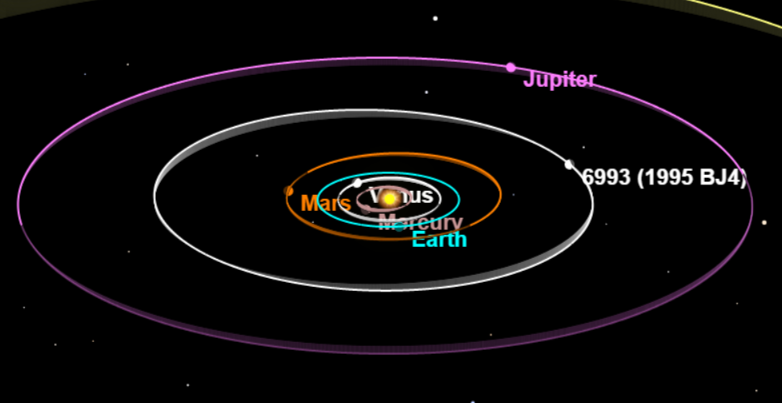
If it turns out that the tail is due to sublimation, it would make 1995 BJ4 the largest-known main-belt comet. Plus, it orbits farther from the sun than any known main-belt comet. Its closest approach to the sun, or perihelion, is about 2.85 times Earth’s distance from our star.
Watch this asteroid in 2027
The researchers said continued observations will be important for figuring out what’s driving the activity.
1995 BJ4 will reach perihelion (its closest to the sun) in January 2027. So if sunlight is vaporizing ice, astronomers might see its activity increase. But if the tail continues to fade, that would lend support to the impact explanation.
Scientists also hope to learn more about the asteroid’s composition. Its colors and reflectivity don’t fit neatly into existing classifications, leaving some uncertainty about what its surface contains.
Bottom line: The active asteroid 1995 BJ4 has developed a cometlike tail. If the tail is due to sublimating ice, it would make it the largest-known main-belt comet.
Source: Discovery of activity on Main Belt Asteroid 6993 (1995 BJ4)
The post This active asteroid has grown a tail! What happened? first appeared on EarthSky.

