Дэлхийгээс гаднах оюун ухаант амьдралтай холбоо тогтоох эрэл хайгуул болон сансрын хөлөгт үлдээсэн илгээмжүүдийн түүхийг судлах нь хүн төрөлхтний сансар огторгуй дахь байр суурийг тодорхойлоход чухал ач холбогдолтой юм.
1961 онд Фрэнк Дрэйк, Карл Саган нар танилцсанаар SETI (Гариг хоорондын оюун ухаант амьдралыг хайх) болон METI (Гариг хоорондын оюун ухаант амьдралд илгээмж илгээх) салбарын суурь тавигджээ. Дрэйк нь галактик дахь харилцаж болох соёл иргэншлийн тоог тооцоолох “Дрэйкийн тэгшитгэл”-ийг боловсруулсан бол Саган түүний радио одон орон ашиглах санааг дэмжин, хамтран ажилласан юм. Энэхүү хамтын ажиллагаа нь NASA-гийн анхаарлыг татаж, Pioneer болон Voyager хөлгүүдэд хүн төрөлхтний тухай мэдээллийг шингээх санаачилгад хүргэсэн байна.
Pioneer 10 болон 11 хөлгүүдэд байрлуулсан 23×15 см хэмжээтэй алтадсан хөнгөн цагаан ялтас нь хүн төрөлхтний анхны сансрын илгээмж болсон юм. Уг ялтас дээр нарны аймгийн байршил, хүний дүрс болон сустрын зураглалыг сийлсэн байдаг. Үүний дараа 1977 онд хөөргөсөн Voyager 1 болон 2 хөлгүүдэд илүү өргөн хүрээтэй мэдээлэл бүхий “Voyager Golden Record” буюу алтан пянзыг байрлуулжээ. Уг пянзанд дэлхийн олон орны соёл, хэл, дуу хөгжим, амьтны дуу авиа болон математик, шинжлэх ухааны ойлголтуудыг багтаасан байна.
Өнөөдөр Pioneer хөлгүүд нарны аймгаас гарч, од хоорондын орон зайд аялж байгаа бол Voyager хөлгүүд 2012 болон 2018 онд тус тус нарны аймгийн нөлөөллийн бүсээс гарчээ. Эдгээр илгээмж нь харь гаригийн иргэншилд хүрэх эсвэл хойч үеийнхэнд үлдээх цаг хугацааны капсул гэсэн хоёр зорилготой юм. Сүүлийн үед хийгдэж буй Europa Clipper номлолын “Vault Plate” нь энэхүү уламжлалыг үргэлжлүүлж, усны ач холбогдлыг илэрхийлсэн дууны долгион болон яруу найргийн бүтээлийг сансарт илгээж байна. Эрдэмтэд эдгээр илгээмжийг соёл иргэншлийн хөгжил, сансар дахь бидний хүсэл тэмүүллийн нэг илрэл хэмээн үздэг.
Дэлгэрэнгүйг эх сурвалжаас харах
Эх сурвалжийг нээх ↓
Welcome back to our continuing series on the Brief-ish History of METI, where we examine the rise, development, and possible implications of Messaging Extraterrestrial Intelligence (METI). In our first installment, we explored some of the foundational principles, how METI emerged as a possible answer to the “SETI Paradox,” and the earliest experiments. In our second, we looked at the pioneering work of Cornell Professor Frank Drake, the “father of SETI,” and how his efforts led to the first true experiment in the Search for Extraterrestrial Intelligence (SETI): Project Ozma and the Arecibo Message.
We also touched on how these efforts led to his lifelong collaboration with fellow Cornell Professor and famed science communicator Carl Sagan. Today, we will see how this collaboration attracted the attention of NASA and led to the most ambitious projects to send messages to space, ones that might even be found by an extraterrestrial civilization (ETC) someday. These are none other than the Pioneer Plaques and the Voyager Golden Records, which are now in the outer Solar System or have entered interstellar space.
Sagan and Drake
As noted in our last installment, Carl Sagan and Frank Drake first met in 1961, a year after Project Ozma took place. To build on the momentum the experiment created, Drake organized an informal symposium at the Green Bank Observatory (where Ozma was conducted) in 1961. To prepare for the event, Drake formulated an equation that summarized the challenges SETI researchers faced. This became known as the Drake Equation, which remains foundational to the fields of SETI and METI.
The equation states that the number of extraterrestrial civilizations in our galaxy that we could communicate with (N) depends on several variables. These include the annual rate of star formation in the galaxy (R*), the fraction of those stars with planets (fp), the number of planets with conditions suitable for life (ne), the fraction of planets that will develop intelligence (fi), the fraction of planets with intelligent life that will develop transmission technologies (fc), and the average length of time a civilization will be able to produce signals (L). Mathematically, the equation is expressed as:
N = R × fp × ne × fl × fi × fc × L
As one of many prominent scientists attending the symposium, Sagan was impressed with Drake’s theories and advocacy for using radio astronomy to search for possible ETCs. However, their interactions predated this meeting and included correspondence when both were young graduate astronomy students. Sagan became aware of Drake when he heard of his work measuring Venus’s high temperature. After this meeting, the two became close colleagues and professors at Cornell University, where they went on to collaborate on several landmark projects.
Pioneer Plaques
In the early 1970s, the last Apollo mission successfully landed astronauts on the Moon (Eugene A. Cernan, Harrison H. Schmitt, and Ronald E. Evans). This historic accomplishment effectively ended the “Space Race,” and NASA was busy contemplating its next moves. It was decided that the Pioneer program, which had sent nine probes to explore the Moon, Venus, Mars, and Mercury between 1958 and 1968, should shift focus to the outer Solar System, exploring the Main Asteroid Belt, Jupiter, Saturn, and the interstellar medium.
This made the probes especially significant, as they would be the first missions to achieve escape velocity from the Solar System. For this reason, journalist and science correspondent Eric Burgess (who was also the Pioneer program’s chronicler) suggested that the probes carry a message, should an extraterrestrial species find them someday. Burgess approached Carl Sagan with the idea after hearing him lecture about communicating with extraterrestrial intelligence at a conference in Crimea.
Sagan was enthusiastic about the idea and approached Frank Drake to help design a message that could be interpreted by an ETC. NASA agreed to the plan and gave them three weeks to prepare it, and the two decided to create plaques that could be mounted on the Pioneer 10 and 11 missions. Linda Salzman Sagan, Carl Sagan’s wife at the time, prepared the artwork, with additional contributions from space artist and science journalist Jon Lomberg, a long-time collaborator of Sagan’s.
The result was the Pioneer Plaques, a pair of six-by-nine-inch (~23 cm by 15.25 cm) gold-anodized aluminum plates. Each contained an engraved pictorial message identifying the probes’ place of origin, who sent them, and when they were sent. From top to bottom, left to right, the message included the following details:
- The hyperfine transition of neutral hydrogen (the most common element in the Universe)
- The location of the Sun based on its distance from 15 nearby pulsars
- A depiction of the Solar System, showing the flight path of the probe from Earth
- A silhouette of the spacecraft
- Figures of a naked man and a woman, with the man raising his hand in greeting
A detailed view of the visual message on the Pioneer plaques, developed by Carl Sagan and Frank Drake. Credit: NASA Ames
The Pioneer 10 and Pioneer 11 probes launched on March 2nd, 1972, and April 5th, 1973 (respectively), becoming the first robotic missions to explore beyond Mars and the Main Asteroid Belt. The Pioneer Plaques have the distinction of being humanity’s first interstellar message of greetings. But in a few years’ time, Sagan and Drake would take things a step further, creating something that was meant to convey what life on Earth was like.
Voyager Golden Records
The success of the Pioneer 10 and 11 missions motivated NASA to contemplate an even more ambitious mission: dual probes to explore the planets of the outer Solar System. The twin Voyager 1 and 2 probes would launch in the summer of 1977 to take advantage of a rare planetary alignment of the outer planets. The mission would conduct close-up studies of Jupiter, Saturn, Saturn’s rings, and larger moons. But as the mission progressed, NASA chose to use the alignment to include Uranus and Neptune – what came to be known as the “Grand Tour.”
Since these missions would also achieve escape velocity from the Solar System, NASA decided to follow the precedent established with the Pioneer Plaques. This led Voyager project manager John R. Casani to suggest that the Voyager 1 and 2 probes also carry a “message in a bottle” containing information about humanity. He delegated the task to Carl Sagan, who was joined again by Frank Drake and Linda Salzman Sagan, and the three created a metal phonograph record containing information encoded in its grooves.
A record was chosen because it would outlast magnetic tape in the outer-space environment. This time, Sagan and crew were given six weeks to create the records and a budget of $1,500, the equivalent of about 8,780 USD today, though Sagan and his colleagues contributed money of their own. The fruits of their labors were the Voyager Golden Records, a series of 12-inch (30.5 cm) gold-plated copper disks containing sounds and images that portrayed the diversity of life and culture on Earth.
The outer cases were etched with pictograms (see above) similar to the Pioneer Plaques, showing where the probes came from. They also contained instructions for playing the record. In the upper left corner of the case, there is a drawing of the phonograph record and the stylus in the correct position for playing it. Around it, conveyed in binary arithmetic, are the time it takes for the record to complete one rotation (3.6 seconds), the total duration (1 hour), and how it should be played from the outside in.
The upper-right corner contains instructions for constructing pictures from the record. From top to bottom, these include a representation of the signal that indicates the start of a picture, how the signals must be grouped as a series of 512 vertical lines per picture, and what the first image looks like (a circle) to confirm the signals are being processed correctly. The drawing in the lower left-hand corner of the cover is the pulsar map (similar to the Pioneer Plaques) and a drawing of the hyperfine transition of neutral hydrogen.
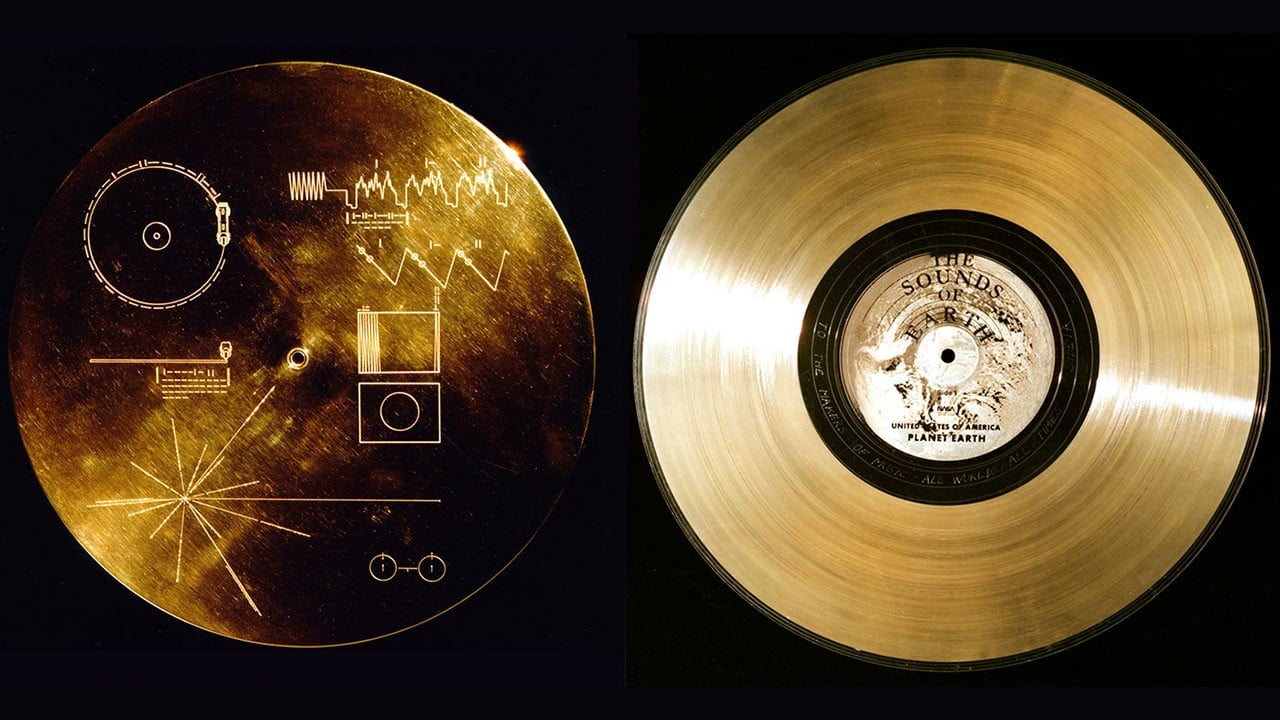 The Voyager Golden Record (right) and its protective casing with instructions on how to play along with information about its origin (left). Credit: NASA
The record contains 115 encoded images that show human anatomy (a silhouette of a man and a pregnant woman), the structure of DNA, demonstrations of eating and drinking, major locations on Earth, sports and leisure, our planet’s geography, and mathematical/scientific concepts. It also contains sound recordings of greetings in 55 languages, whale calls, and music from various cultures and eras (including Beethoven and Chuck Berry). Said then-President Jimmy Carter of the Records:
This is a present from a small, distant world, a token of our sounds, our science, our images, our music, our thoughts and our feelings. We are attempting to survive our time so we may live into yours.
The cover also features a “radioactive clock” in the form of an electroplated uranium-238 sample. Since this element has a half-life of 4.51 billion years, the recipients can calculate how long the probe has been in space. Unlike the Pioneer Plaques, the Voyager Golden Records had a dual purpose: as a message to any extraterrestrial civilization that intercepted them, or as a time capsule for future generations of human explorers should they find them first. As Sagan noted at the time:
The spacecraft will be encountered, and the record played only if there are advanced spacefaring civilizations in interstellar space, but the launching of this ‘bottle’ into the cosmic ‘ocean’ says something very hopeful about life on this planet.
Where are they now?
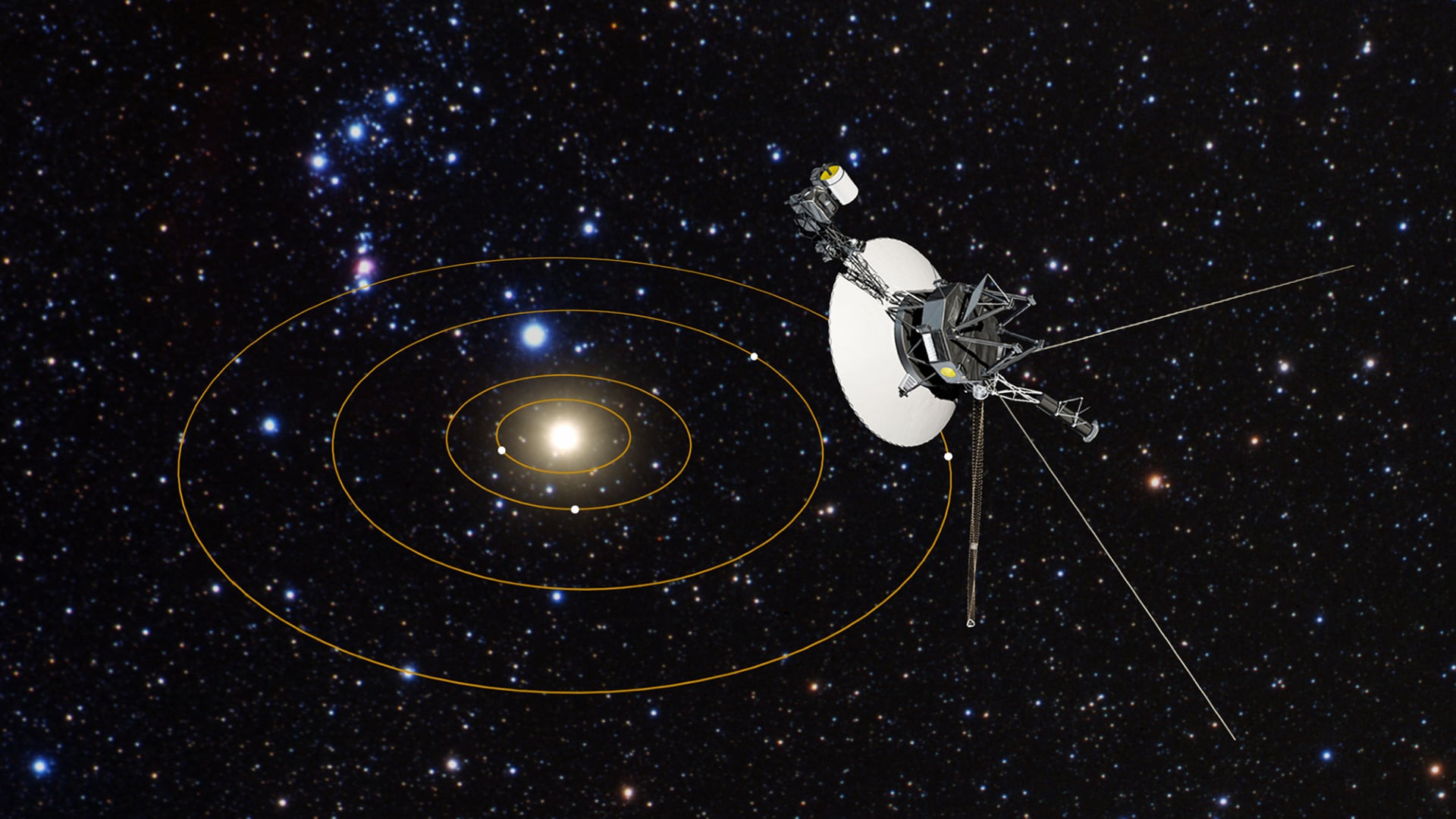
Based on its current trajectory and velocity, Pioneer 10 will reach Aldebaran, a star roughly 65 light-years away in the Taurus constellation, in over two million years. Meanwhile, Pioneer 11 is headed for the Aquila constellation and will pass near one of its stars in about 4 million years. On August 25th, 2012, Voyager 1 made history by becoming the first probe to exit the heliosphere and enter interstellar space. Voyager 2 exited from a different location on November 5th, 2018, becoming the second.
They will be joined by Pioneer 10 and 11 probes around 2057, though this will be difficult to verify since both probes are unpowered and cannot send data back to Earth. These plaques and records are unique in that they remain humanity’s first attempts to send physical messages into space intended for extraterrestrial recipients and/or future generations. They also established a legacy that continues to this day and is part of a larger debate surrounding the ethics of METI.
 This illustration shows the positions of NASA’s Voyager 1 and Voyager 2 probes outside the heliosphere, a protective bubble created by the Sun that extends well past Pluto’s orbit. Credit: NASA/JPL-Caltech
These missions have also inspired debate about what a modern message should be and have inspired some experiments. In a series of NASA-led studies that appeared in the AGU journal Earth and Space Science, an international team of scientists proposed what a modern Golden Record should contain. In the first study, titled “Message in a Bottle—An Update to the Golden Record: 1. Objectives and Key Content of the Message,” the team summarized the importance of the “Message In A Bottle” (MIAB) and what should motivate future efforts:
These records not only offer a snapshot of Earth and human civilization but also represent our desire to establish contact with advanced alien civilizations. Our goal is to share our collective knowledge, emotions, innovations, and aspirations in a way that provides a universal, yet contextually relevant, understanding of human society, the evolution of life on Earth, and our hopes and concerns for the future. Through this time and space traveling capsule, we also strive to inspire and unify current and future generations to celebrate and safeguard our shared human experience.
Modern attempts to fashion a MIAB include the message attached to the Europa Clipper mission, currently en route to rendezvous with Jupiter and study its moon Europa. The message was unveiled in March 2024, about seven months before the mission launched, and consists of a triangular tantalum plaque – known as the Europa Clipper Vault Plate – measuring about 18 x 28 cm (about 7 x 11 inches) that features graphic elements on both sides. The inward-facing side features an engraving of U.S. Poet Laureate Ada Limón’s handwritten “In Praise of Mystery: A Poem for Europa.”
The outward-facing panel contains etchings of soundwaves that illustrate Earth’s connection to Europa. Each etching is the word “water” spoken in one of 103 languages from around the world, which were converted into waveforms. Each waveform radiates outward from a symbol representing the sign for “water” in American Sign Language (ASL). Since the Europa Clipper is searching for possible evidence of life inside the icy moon, the Drake Equation is also etched into the plate.
Rather than being a message intended for extraterrestrials, this “Golden Record for Europa” honors the spirit of the original records, aiming to spark the imagination and offer a unifying vision. As Lori Glaze, director of the Planetary Science Division at NASA, said in a statement:
The content and design of Europa Clipper’s vault plate are swimming with meaning. The plate combines the best humanity has to offer across the universe – science, technology, education, art, and math. The message of connection through water, essential for all forms of life as we know it, perfectly illustrates Earth’s tie to this mysterious ocean world we are setting out to explore.
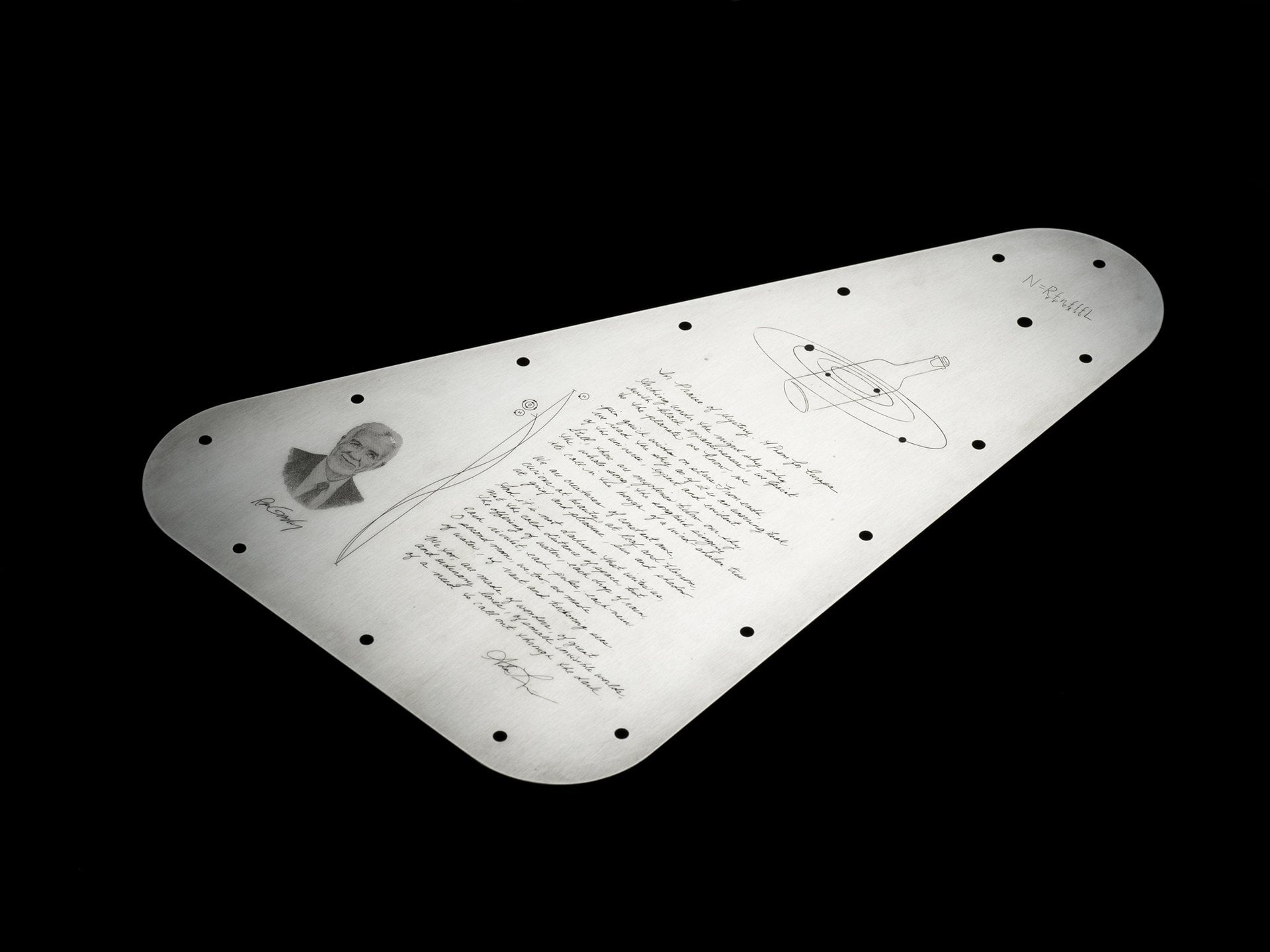 The “Message in a Bottle” plate attached to the Europa Clipper mission, currently en route to Jupiter. Credit: NASA
These messages highlight the major shift in consciousness that accompanied the Space Age. With humans now venturing out into space and exploring beyond Earth’s orbit, a new awareness was taking root, one which saw humanity in cosmological terms. We were not only pondering the existence of extraterrestrial intelligence and civilizations. We were also considering how we might communicate with them and fashioning messages that might someday reach them… unless we get to them first!
These messages also raise the question of whether ETCs might be doing the same: could advanced civilizations be sending probes with their own messages, ones that share what life is like on their respective homeworlds? The fact that we have sent out four MIABs to date has motivated some scientists to consider the possibility that space is littered with derelict spacecraft, some of which could be messenger probes. Perhaps some of them are even here in our Solar System, lingering near Earth or in the far expanse of the Kuiper Belt.

