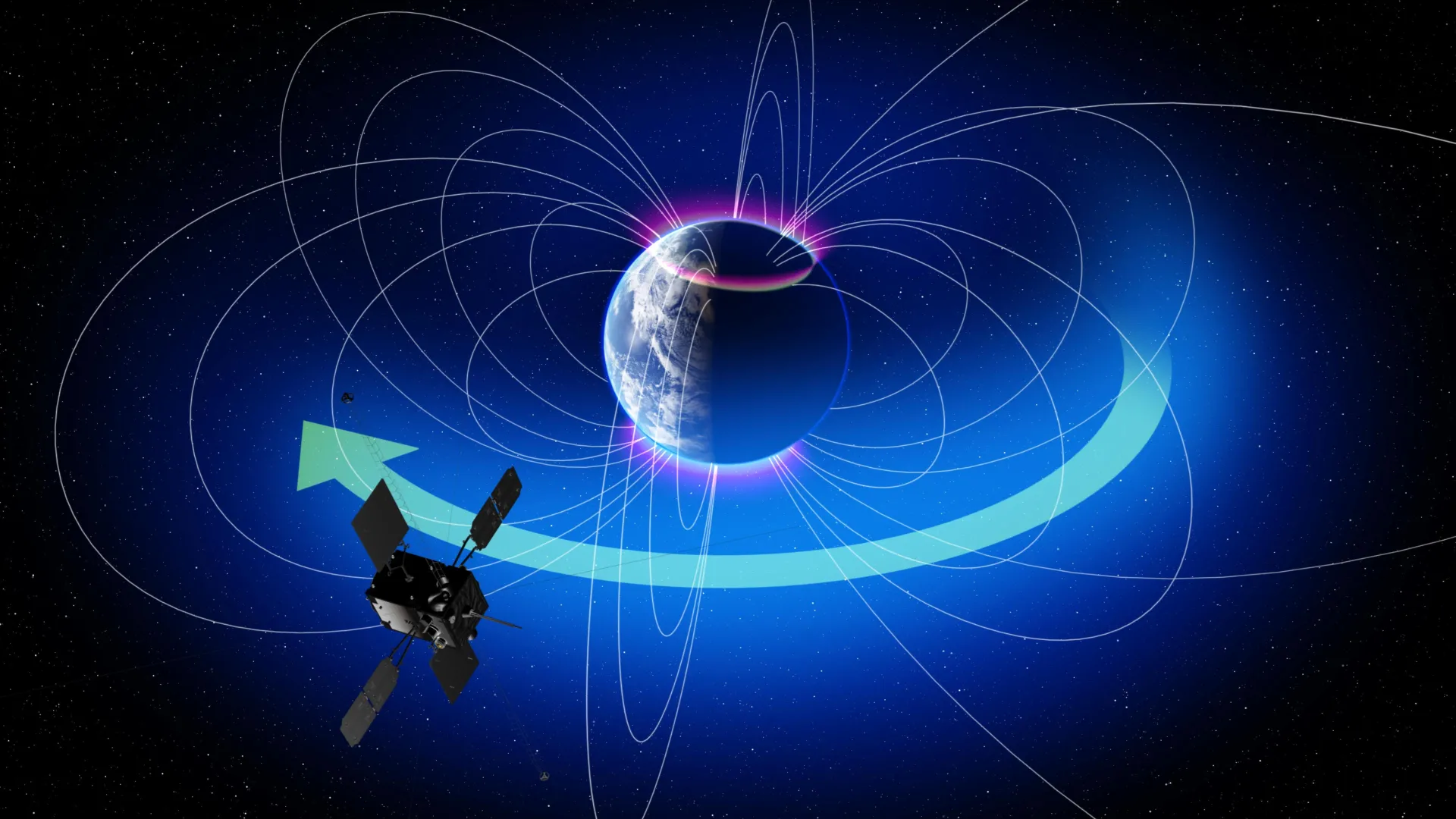
Arase хиймэл дагуулын хэмжилтээр шуурганы үеийн цагираг гүйдлийн ионуудын ихэнх нь Дэлхийн ионосфероос гаралтайг тогтоожээ.
2024 оны тавдугаар сарын 10, 11-нд нарнаас ирсэн цэнэгт бөөмсийн үүл Дэлхийн соронзон мандалтай мөргөлдөж, сүүлийн хэдэн арван жилийн хамгийн хүчтэй геосоронзон шуургуудын нэгийг үүсгэсэн. “Гэнноны шуурга” буюу “Эх үрсийн баярын шуурга” гэж нэрлэсэн энэ үзэгдлийн үеэр геосоронзон өөрчлөлтийг хэмждэг SYM-H индекс −518 нанотесла хүрч, 1981 оноос хойших хоёр дахь том өөрчлөлт болжээ.
Судлаачид Японы JAXA-гийн Arase хиймэл дагуулын тусламжтайгаар шуурганы үеийн цагираг гүйдлийн бөөмсийг судалсан байна. Цагираг гүйдэл нь Дэлхийг тойрон эргэлдэх цэнэгт бөөмсийн бүс бөгөөд түүний үүсгэх соронзон орон гараг орчмын байгалийн соронзон орныг сулруулдаг. Хэмжилтээр цагираг гүйдлийн ионы ойролцоогоор 85 хувь нь нарны салхинаас бус, Дэлхийн ионосфероос гаралтай хүчилтөрөгчийн ион байжээ.
Шуурга оргил үедээ ойртох үед Arase Дэлхийгээс 16 мянга орчим километрийн өндөрт соронзон орны хүч 40 хувиар буурсныг хэмжсэн нь ийм хэмжээний сулрал өмнө ажиглагдсан бүсээс гарагт илүү ойр байв. Мөн тухайн орон зайд эргэлддэг өндөр энергитэй электронуудын тоо цөөрснийг илрүүлсэн ч соронзон орны өөрчлөлт электронуудын бууралтад шууд нөлөөлсөн эсэх нь одоогоор тогтоогдоогүй. Дэлхийн агаар мандлаас ирсэн хүнд ионууд шуургыг эрчимжүүлж, цагираг гүйдлийг гарагт ойр бүсэд хүчтэй болгосон байж болохыг үр дүн харуулж байна.
Science Advances сэтгүүлд нийтлэгдсэн энэ судалгаа нь геосоронзон шуурганы хүчийг тооцоолоход Дэлхийн дээд агаар мандлын нөхцөл ч чухал байж болохыг示лээ. Одоогийн загварууд нарны салхины нөхцөлд голлон тулгуурладаг бол санал болгож буй FACTORS нэртэй хоёр хиймэл дагуулын JAXA-гийн төсөл агаар мандлын ионууд соронзон мандалд хэрхэн нэвтэрч, шуурганд хэрхэн оролцдогийг судлах зорилготой. Дэлгэрэнгүй ойлголт нь хиймэл дагуул, навигаци, холбоо болон эрчим хүчний дэд бүтцэд нөлөөлж болзошгүй сансрын цаг агаарын урьдчилсан мэдээг сайжруулахад тусалж мэднэ.
Дэлгэрэнгүйг эх сурвалжаас харах
↓Эх сурвалжийг нээх ↓
In May 2024, an extraordinary solar storm sent brilliant auroras across skies in parts of the world where the northern and southern lights are rarely visible. But the spectacular displays were only the most obvious signs of an enormous disturbance unfolding in space around Earth. Deep within the planet’s magnetosphere, the vast region controlled by its magnetic field, scientists were witnessing something they had never directly measured before.
The event began when a large sunspot unleashed several powerful solar eruptions in rapid succession. As enormous clouds of magnetized plasma raced through space, they combined before slamming into Earth’s magnetosphere. The resulting storm produced the strongest magnetic disturbance ever measured in Earth’s ring current, a vast region of electrically charged particles surrounding the planet.
For decades, researchers have debated where the particles that make up this ring current come from. Two major sources are known: the solar wind, which carries charged particles outward from the Sun, and Earth’s ionosphere, an electrically charged layer of the upper atmosphere. Both typically supply particles during geomagnetic storms, and some scientists expected the solar wind to remain an important contributor during an extreme event involving particularly dense solar wind.
Instead, the first direct measurements of ring current composition during a storm of this magnitude revealed something remarkable. Particles originating from the solar wind contributed very little, while those coming from Earth’s own atmosphere dominated to an extent never previously observed.
Published in Science Advances, the findings suggest that Earth’s atmosphere may play a much greater role in determining the severity of extreme geomagnetic storms than scientists previously recognized. Because the dominant ions from Earth are much heavier than the particles supplied by the solar wind, they may have strengthened the magnetic disturbance and caused the ring current to reach its greatest intensity unusually close to the planet.
The discovery also strengthens the case for a proposed Japanese satellite mission designed to investigate how atmospheric particles enter space and influence powerful geomagnetic storms.
How the May 2024 Solar Superstorm Disrupted Earth’s Magnetic Field
On May 10 and 11, 2024, enormous clouds of charged solar particles struck Earth’s magnetosphere, triggering one of the most powerful geomagnetic storms in decades. Known as the “Gannon storm” or “Mother’s Day storm,” the event pushed the SYM-H index, a measure of geomagnetic disturbance, to a minimum of −518 nanotesla. This represented the second-largest recorded disturbance since 1981. The previous storm of comparable strength occurred in November 2004.
Although the colorful auroras drew worldwide attention, the consequences of such storms can extend far beyond the night sky.
“Some super or extreme geomagnetic storms are not just impressive light shows — they pose radiation risks to spacecraft, disturb GPS signals and communications, and cause power outages. Understanding how a geomagnetic storm develops is not only a scientific question, but also one with real-world consequences,” said Naritoshi Kitamura, lead author and designated assistant professor from the Institute for Space-Earth Environmental Research (ISEE) at Nagoya University.
A major source of these magnetic disturbances is Earth’s ring current. This enormous belt of energetic charged particles, primarily oxygen and hydrogen ions, slowly circulates around the planet thousands of kilometers above the equator.
As the ions move, they create an electrical current that generates its own magnetic field. That field partly opposes Earth’s natural magnetic field, weakening the magnetic field measured at ground level. The resulting changes are among the key signals scientists use to track the strength of geomagnetic storms.
Japanese Satellite Reveals an Unexpected Source of Storm Particles
Scientists were able to investigate the May 2024 storm in unusual detail thanks to Japan’s Arase satellite, which was launched in 2016 and is operated by the Japan Aerospace Exploration Agency (JAXA). The ERG (Arase) science center is jointly operated by the Institute of Space and Astronautical Science (ISAS)/JAXA and the Institute for Space-Earth Environmental Research/Nagoya University.
Arase travels through the region of space where Earth’s ring current forms. Its scientific instruments can measure both the mass and energy of individual ions, allowing researchers to determine the types of particles present during a storm.
By remarkable timing, the spacecraft passed through the ring current shortly after the May 2024 storm began and again as the disturbance approached its peak. These observations provided a rare opportunity to examine the composition of the ring current during an exceptionally powerful geomagnetic event.
“This is the first simultaneous observation of ring current ions and solar wind during a storm this large, and the data was clear — approximately 85% of ions were oxygen from Earth’s own ionosphere,” Kitamura explained.
The overwhelming contribution from Earth’s atmosphere was particularly surprising because the storm had been triggered by dense streams of material arriving from the Sun. Rather than supplying most of the ring current ions, the solar wind played a relatively minor role in the measured particle population.
Earth’s Magnetic Field Weakened by 40%
The Arase measurements revealed another extraordinary feature of the storm. The magnetic field weakened dramatically in a region much closer to Earth than where similarly severe reductions had previously been documented.
“Near the peak of the storm, Arase detected a 40% decrease in magnetic field intensity at roughly 16,000 kilometers above Earth, and much closer to Earth than similar large decreases previously documented.”
At the same time, the satellite detected a decline in the number of energetic electrons that normally circulate through this region of space.
Such an extreme weakening of the magnetic field can alter the paths followed by these electrons, causing them to drift away from their usual orbits. However, scientists have not yet determined whether the deformation of the magnetic field directly caused the observed electron loss. Further research will be needed to establish that connection.
Together, the observations provide new insight into how the ring current behaves during especially intense geomagnetic storms. They also suggest that the unusually large population of heavy ions originating from Earth’s atmosphere may have helped produce the severe magnetic disturbance so close to the planet.
A New Clue to Predicting Dangerous Solar Storms
The findings could have important implications for space weather forecasting. Current models rely heavily on conditions in the solar wind to estimate how powerful an approaching geomagnetic storm might become.
However, the new measurements suggest that conditions within Earth’s own upper atmosphere could also influence a storm’s eventual intensity. Understanding how many atmospheric ions escape into the magnetosphere, and how they contribute to the ring current, may therefore be essential for making more reliable predictions.
The researchers believe that additional satellite observations could help answer these questions. Their findings support FACTORS, a proposed mission involving two satellites that is being prepared for an upcoming JAXA proposal opportunity.
FACTORS would investigate the processes that allow ions from Earth’s atmosphere to flow into the magnetosphere and examine how those particles contribute to the development of geomagnetic storms.
By revealing how Earth’s atmosphere and incoming solar material interact during extreme events, the mission could eventually improve forecasts of dangerous space weather. More accurate predictions would help scientists better anticipate storms capable of disrupting satellites, navigation systems, communications networks, and power infrastructure.

