Цэнгэг усны загас ихээр хэрэглэсэн хүмүүсийн яс радиокарбоны шинжилгээгээр бодит наснаасаа хэдэн зуунаар эртний мэт харагдаж болохыг судлаачид тогтоожээ.
Өмнөд Данийн их сургууль болон Изотопын судалгааны төвийн эрдэмтэд Данийн дундад зууны үеийн хийдээс малтсан 27 хүний ясанд шинжилгээ хийхэд зургаан сорьцын нас онцгой зөрүүтэй гарчээ. Тухайлбал, Свендборг дахь хийдэд оршуулсан нэг хүний ясыг МЭ 1100–1155 оны үед хамааруулсан ч хийдийг 1236 онд байгуулсан байна; Виборг дахь өөр нэг хүний яс МЭ 976 оноос хожуугүй үед хамаарчээ.
Энэ зөрүүг тайлбарлах нэг шалтгаан нь цэнгэг усны «усан сангийн нөлөө» юм. Гол, нуурын усанд агуулагдах нүүрстөрөгч-14-ийн хэмжээ агаар мандлынхаас өөр байдаг тул загасаар баялаг хооллодог хүний яс бодит наснаасаа хэдэн зуунаар хөгшин мэт харагдаж болно. Нөлөө нь усан орчноос хамааран огт илрэхгүй байхаас 1,000 жил хүртэл хэлбэлздэг бөгөөд Рейн мөрний загасны жишээнд зөрүү 1,300 жил хүрч болохыг судлаач Кааре Лунд Расмуссен тэмдэглэжээ.
Судлаачид яс дахь азот-15 изотопын хэмжээг мөн шинжилж, бүх сорьцод өндөр түвшин илрүүлсэн нь усны гаралтай хүнс хэрэглэснийг илтгэх шинж байв. Дундад зууны Христийн шашинт Европт мацгийн үеэр махыг хязгаарладаг ч цэнгэг усны загасыг хүнсэнд хэрэглэхийг зөвшөөрдөг, зарим газар нэр хүндтэй хүнс гэж үздэг байжээ.
Ийм насны зөрүү Даниар хязгаарлагдахгүй байж болохыг эрдэмтэд онцолжээ: Балканы чулуун зэвсгийн үеийн дурсгалд хүний ясанд зоосон амьтны ясан сум хүний яснаас 500 орчим жилийн залуу гэж гарсан тохиолдол бий. Тиймээс малтлагаар олдсон ясанд цэнгэг усны нөлөө байгаа эсэх, хэр хэмжээтэйг шалгах шаардлагатай бөгөөд ясны азот-15-ыг хэмжиж, тохируулгын загвар ашиглах нь насыг илүү зөв тогтооход тусална. Судалгааны тайлбар өгүүлэл npj Heritage Science сэтгүүлд нийтлэгджээ.
Дэлгэрэнгүйг эх сурвалжаас харах
↓Эх сурвалжийг нээх ↓
There’s something strange about some of the skeletons buried in monasteries in Denmark.
Some seem to date back decades – or even centuries – before their final resting places were even built.
So what’s going on?
Scientists from the University of Southern Denmark and the Center for Isotope Research believe they’ve found the answer.
In a comment article published in npj Heritage Science, they’ve issued “words of warning” for archaeologists when dating medieval human remains.
Radiocarbon dating is a fairly reliable method for calculating the age of bones and artifacts, up to about 50,000 years.
The process begins in space: cosmic rays interact with nitrogen in the atmosphere, producing small amounts of a specific isotope called carbon-14, which then binds with atmospheric oxygen to form carbon dioxide.
Trees and other photosynthesizing plants then absorb this carbon from the air into their own cells, and in turn, so do the animals that eat those plants (as well as the animals that eat other animals that eat plants).
When those animals eventually die, they obviously stop eating and therefore stop adding new carbon-14 to their cells. From there, the carbon-14 levels can only decrease over time through radioactive decay.
By analyzing the carbon-14 levels inside bones and comparing them to known historical levels of the isotope in the atmosphere, scientists can calculate fairly accurately how old those bones are.
But there’s a problem.
Regular radiocarbon dating works well for humans and animals that largely eat land animals and plants, but it’s a different story for those who eat a lot of fish, thanks to a phenomenon known as the ‘reservoir effect’.
Rivers, lakes, and oceans have different ratios of carbon isotopes, due to dissolved carbonate runoff or upwelling of much older carbon dioxide. That means that rivers, for instance, can contain around 15 percent less carbon-14 than the atmosphere.
As a result, the bones of a person with a fish-heavy diet can appear to be hundreds of years older than they really are.
“In extreme cases, a fish from the Rhine [River], for example, can appear up to 1,300 years older than a land-based organism that lived at exactly the same time,” says Kaare Lund Rasmussen, an archeometrist at the University of Southern Denmark.
“But that does not mean you can simply subtract 1,300 years from the date of a person who ate freshwater fish. Quite the opposite. The particular problem with freshwater is that the effect varies enormously. It can range from zero to 1,000 years.”
The team analyzed bones from 27 individuals excavated from medieval Danish monasteries, and sure enough, six samples had especially anomalous ages. In each case, the bones appeared to be decades or centuries older than the buildings they were buried in or near.
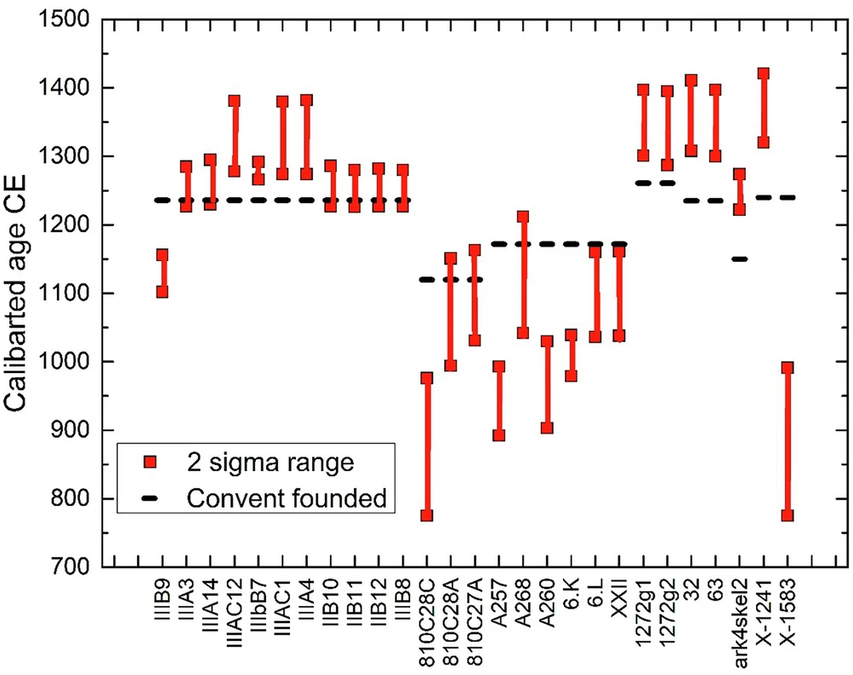
In one case, for example, a skeleton buried in the Danish town of Svendborg had been radiocarbon dated to between 1100 and 1155 CE – but the monastery wasn’t erected until 1236.
Another, in the town of Viborg, was dated to 976 CE at the latest, which is well over a century before the monastery was built on those grounds.
“In Christian medieval Europe, meat was restricted during the lent period,” the researchers write.
“However, the meat of freshwater fish was tolerated as a food source because freshwater fish were considered ‘cold’ or ‘neutral’ in comparison with meat from warm-blooded animals and marine fish. Freshwater fish was even in some Christian circles and cultures considered a prestigious food item.”
There was more direct evidence that the reservoir effect was at play, too.
The team analyzed the samples for an isotope called nitrogen-15, which is high in aquatic ecosystems – and sure enough, elevated levels were detected in all samples.
The researchers suggest that this phenomenon isn’t unique to Denmark, and is probably occurring elsewhere in Europe and the rest of the world. They use an example from a Stone Age site in the Balkans, where human remains have been found pierced by arrows made of animal bones.
You’d expect that both sets of bones would be roughly the same age – but previous studies have found that the human bones appear to be up to 500 years older than the animal-bone arrows.
Either some Stone Age prankster went and jammed then-modern arrows into bones that had been lying around for half a millennium, or the humans had been eating fish and the animals had not.
“The word of warning is that it is necessary to assess whether excavated bones are affected by a freshwater reservoir effect, and if so, how large the reservoir effect could be,” the researchers conclude.
The team recommends measuring nitrogen-15 levels in bones, especially those from the medieval period. If those levels are elevated, there are models that can help calibrate a more accurate age for the bones.
The comment article was published in npj Heritage Science.
This article was fact-checked by Rachel Garner and edited by Peter Dockrill. While we pride ourselves on our process, we are only human. If you spot a mistake, please let us know.

