Тусгай оймс хөлийн нумыг чангалснаар алхах үеийн биеийн бодисын солилцооны зарцуулалт багасаж болохыг судлаачид тогтоожээ.
АНУ-ын Техасын их сургуулийн Остин дахь салбарын судлаачид дунджаар 28 настай, эрүүл 12 оролцогчийг гүйлтийн зам дээр таван минутын турш алхуулахдаа хөлийн өлмийг чангалдаг тусгай оймсыг энгийн оймстой харьцуулжээ. Судалгааны гол зорилго нь алхалтыг хөнгөвчлөхөөс гадна хүний хөл бусад приматынхаас илүү хөшүүн болсон хувьслын шалтгааныг судлах байв. Хөлийн хөшүүн байдал хоёр хөл дээрээ алхахад бага хүч зарцуулахад тусалдаг гэсэн таамгийг үр дүн дэмжжээ.
Proceedings of the Royal Society B: Biological Sciences сэтгүүлд нийтэлсэн судалгаагаар тусгай оймс өмсөхөд биеийн нийт бодисын солилцооны хурд энгийн оймстой харьцуулахад 2 хувиар буурсан байна. Судлаачид амьсгалсан хүчилтөрөгч болон ялгаруулсан нүүрсхүчлийн хийг хэмжиж энерги зарцуулалтыг тооцжээ. Энэ бууралтыг бүсэлхийд 2 кг жинтэй ачаа үүрэхгүй байхтай дүйцүүлсэн байна.
Оймсны хөлийн өлмий хэсгийн нягт сүлжсэн бүслүүр нь өлмийг хажуу тийш тэлэхээс сэргийлж, хөлийн дотор талын уртааш нумын хөшүүн чанарыг 65 хувиар нэмэгдүүлжээ. Гэсэн ч алхмын төгсгөлд хөл нугарч, түлхэх хөдөлгөөн хийх боломж хэвээр байсан гэж судлаачид мэдээлсэн байна. Шилбэний булчин арай их хүч гарган, удаан агшсан нь нийт энерги зарцуулалтыг бууруулсан байж болохыг тэд тайлбарлажээ.
Өмнөх туршилтуудад хатуу улавч болон нумын тулгуур алхах үеийн энерги зарцуулалтыг бууруулж чадаагүй байна. Судлаачдын үзэж буйгаар хөлийг чангалах оймс нь хямд, хэрэглэхэд хялбар хувилбар байж болох ч энэ удаагийн туршилтад оролцогч цөөн, алхалтын хугацаа богино байв. Ийм оймс алхах тэсвэрийг нэмэгдүүлэх, цаашлаад гүйхэд хэрэг болох боломжтой гэж судлаачид дурдсан бөгөөд загварт нь патентын хүсэлт гаргажээ.
Дэлгэрэнгүйг эх сурвалжаас харах
↓Эх сурвалжийг нээх ↓
Researchers have developed a sock that squeezes the ball of the foot to stiffen the arch, the part that bends when we walk, and demonstrated that it can reduce the body’s energy expenditure for each step – potentially helping anyone walk for longer and with less effort.
However, rather than attempting to boost walking endurance, the original motivation for the research was to investigate an evolutionary mystery: Our human feet are stiffer than those of other primates, but it has never been fully clear why.
One leading theory is that this helps us walk upright with less effort, and these latest experiments support that idea.
A team from the University of Texas at Austin recruited 12 healthy participants with an average age of 28 to spend 5-minute sessions walking on a treadmill, comparing the custom stiffening socks with ordinary pairs.
The results, published in Proceedings of the Royal Society B: Biological Sciences, show that the stiffening socks can indeed reduce energy use by keeping the foot more tightly locked.
“These custom socks applied more pressure to the user’s forefoot than commercially available socks, which in turn increased medial longitudinal arch stiffness through cross-axis coupling,” write the researchers in their published paper.
“Walking with foot-stiffening socks reduced whole-body metabolic rate 2 percent versus the use of commercial socks.”
That 2 percent reduction might not seem like a lot, but the researchers equate it to removing a 2-kilogram (4.4-pound) weight from around your waist. That’s something you’d notice if you were hiking.
The tight, knitted band around the ball of the foot was designed to prevent foot splay (widening). The experiments showed the arch of the foot was stiffened lengthwise by 65 percent, but the foot was still able to bend and push off with each step.
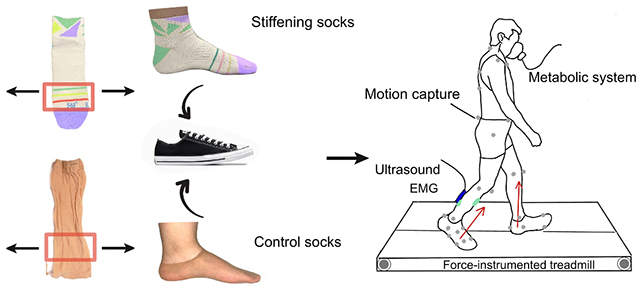
“These socks mitigated forefoot splay and stiffened the medial longitudinal arch without apparently limiting late-stance foot mobility,” write the researchers.
“Supporting our hypothesis, walking with stiffer feet reduced user metabolic rate by eliciting more economical ankle extensor muscle contractions.”
Observations by the researchers showed the calf muscles pushing with a little more force, but also contracting more slowly, which uses less energy overall. It’s similar to shifting to a higher gear on a bike.
Energy expenditure was analyzed through breath measurements, indicating how much oxygen was breathed in and how much carbon dioxide was exhaled.
“Stiffer feet theoretically make walking less effortful,” write the researchers.
“By resisting midfoot dorsiflexion, greater foot stiffness typically yields more mechanical work by the foot per step.
“In turn, leg muscles require less mechanical work to sustain steady-state walking, which may reduce whole-body metabolic rate.”
Research teams have previously been frustrated in their attempts to test whether a stiffer foot means a more energy-efficient walk. Earlier experiments with rigid insoles for shoes and arch supports have failed to cut energy use.
It’s evidence that the stiffer human foot evolved as a better way of pushing off between strides when walking on two legs, as further stiffening makes the locomotion even more efficient.
These socks, or garments similar to them, may even be useful in the real world in the future – in fact, a patent for their design has already been filed.
They could improve endurance for walkers, and perhaps make it easier for people of all levels of mobility to get around, in a simpler and cheaper way than other options.
“Rigid shoes are unable to reduce metabolic rate during walking at ecologically valid speeds, and exoskeletons are relatively expensive and difficult to use throughout daily life, despite their greater metabolic benefits,” write the researchers.
“Thus, we present foot-stiffening socks as a cheap and readily adoptable technology capable of reducing metabolic rate during walking, and perhaps running.”
The research has been published in Proceedings of the Royal Society B: Biological Sciences.
This article was fact-checked by Rebecca Dyer and edited by Rebecca Dyer. While we pride ourselves on our process, we are only human. If you spot a mistake, please let us know.

