
TOI-2535 b-ийн тойрог зам хөрш экзопланетын нөлөөгөөр хазайж, одныхоо өмнүүр дайран өнгөрөх нь ажиглагдахаа больжээ.
Дэлхийгээс 1,000 гэрлийн жилийн зайд орших TOI-2535 b экзопланетыг NASA-гийн TESS сансрын дурангийн ажиглалтаар илрүүлжээ. Одон орон судлаачид долоон жилийн турш түүнийг одныхоо өмнүүр дайран өнгөрөх үеэр нь ажиглахад транзитын хугацаа тогтмол бус болж, заримдаа зургаа хүртэлх цагаар эрт эсвэл орой болсон байна. Мөн транзит богиносож, бүдэгрэн, улмаар энэ оны эхээр ажиглагдахаа больжээ.
Судлаачдын үзэж буйгаар, уг системийн үл үзэгдэж буй өөр нэг гаргийн таталцал TOI-2535 b-ийн тойрог замыг хазайлгасан байна. Хоёр гаргийн таталцал харилцан үйлчилж, тойрог замуудыг нь савлуулдаг тул тэд одооныхоо харах өнцгөөс одныхоо өмнүүр дайран өнгөрөхгүй үе гардаг. TOI-2535 b одоо ажиглагдахгүй байгаа ч алга болоогүй; дараагийн транзит нь 30–50 жилийн дараа харагдаж магадгүй, харин нуугдаж буй хөрш гаргийг үүнээс өмнө илрүүлэх боломжтой гэж судлаачид үзжээ.
TOI-2535 b одооныхоо одыг 8.25 хоногт нэг бүтэн тойрдог бөгөөд Бархасбадьтай төстэй хийн аварга гариг учраас “халуун Бархасбадь” ангилалд багтана. Ийм гаргийн үүсэлд хоёр хувилбар дэвшүүлжээ: өөр нэг гаригтай таталцлын хүчтэй харилцан үйлчилж сунасан тойрог замд орсон, эсвэл эх одны гариг үүсгэгч дискний нөлөөгөөр дотогш шилжсэн байж болно. Гэвч хоёр гаргийн тойрог зам хазайсан тул эхний хувилбар илүү магадлалтай гэж судлаачид үзэж байна; үр дүнг The Astrophysical Journal-д 2026 оны арваннэгдүгээр сарын 9-нд нийтэлжээ.
Дэлгэрэнгүйг эх сурвалжаас харах
Эх сурвалжийг нээх ↓
- TOI-2535 b is a hot Jupiter exoplanet about 1,000 light-years from Earth. This exoplanet seemed to vanish after astronomers observed multiple orbits.
- The planet didn’t really disappear, though. The gravity of another planet in the system had simply altered its orbit.
- The two planets make each other’s orbits wobble like a top. They circle their sun obliquely and vanish from view as the wobble tilts them out of alignment.
Are you a moon-watcher? Then you’ll love EarthSky’s 2027 lunarcalendar, too! Order yours today.
Disappearing exoplanet surprises astronomers
Earlier this year, astronomers from the University of California, Los Angeles (UCLA) discovered something they’d never seen before — a disappearing exoplanet! Of course, it didn’t really disappear. But this hot Jupiter exoplanet — labeled TOI-2535 b by earthly astronomers, located about 1,000 light-years from Earth — seemed to disappear.
Astronomers originally found this planet in images from NASA’s legendary TESS planet-hunter. The orbiting TESS spacecraft let them observe the planet over seven years as it transited its stary, that is, passed in front of its star as seen from Earth. Planetary transits are common. TESS has seen many, and found many exoplanets, via their transits in front of their stars. But TOI-2535 b surprised astronomers when it “disappeared.”
What happened? It seems the gravity of another planet in this system tilted the orbit of TOI-2535 b. So the transits stopped happening.
TOI-2535 b orbits its star in only 8.25 days. Our sun’s innermost planet Mercury, by comparison, takes 88 days to complete an orbit around the sun. Because it is a gas giant planet like Jupiter, astronomers call TOI-2535 b a hot Jupiter. A hot Jupiter is a class of gas giant exoplanet that is physically similar to Jupiter in mass and composition, but orbits extremely close to its host star.
The researchers published their peer-reviewed findings in The Astrophysical Journal on November 9, 2026.
Unseen planet alters TOI-2535 b’s orbit
Over the seven years the astronomers were watching the planet, they noticed its transits weren’t regular. The transits became earlier than usual or later than expected, by up to six hours. The transits also got shorter and shallower.
Then, earlier this year, the researchers suddenly stopped seeing the planet. Where did it go?
There were clues, in the way the planet’s transits and orbits changed. The researchers determined that there must be another, but unseen, planet affecting the orbit of TOI-2353. Its orbit is tilted with respect to TOI-2535 b.
And in fact, the two planets both affect each other. The gravity of each planet causes the other planet to wobble like a top. Each planet circles the star obliquely (at a tilt), so when their orbits take them out of alignment, they vanish from view. As lead author Samuel Yee at UCLA explained:
We think of the universe as resembling clockwork, where everything is regular. But that’s not true. If there are multiple planets in a system, they can affect each other’s orbits. We know of a few systems that are like this. This is the most extreme example we’ve seen because the two planets are interacting so strongly. The planet’s orbit is tilting so quickly that its transit disappeared while we were watching.
Same phenomenon as eclipses on Earth
This is the same kind of phenomenon that makes eclipses on Earth so rare. Co-author Erik Petigura said:
If the moon’s orbit around the Earth was perfectly aligned with the Earth’s orbit around the sun, we would see an eclipse every month. But because the moon’s orbit is tilted, eclipses are less common. The tilt of the moon’s orbit is a relic of its violent formation history, which resulted from a collision with the early Earth.

A long wait for the next transit
TOI-2535 b will remain out of sight for some time yet. Its next visible transit isn’t expected for another 30 to 50 years.
It’s possible that the currently hidden neighbor planet could come into view sooner than that however, the researchers said.
Astronomers have discovered hundreds of hot Jupiters so far. But most of them don’t have other planets close enough to affect their orbits as with TOI-2535 b.
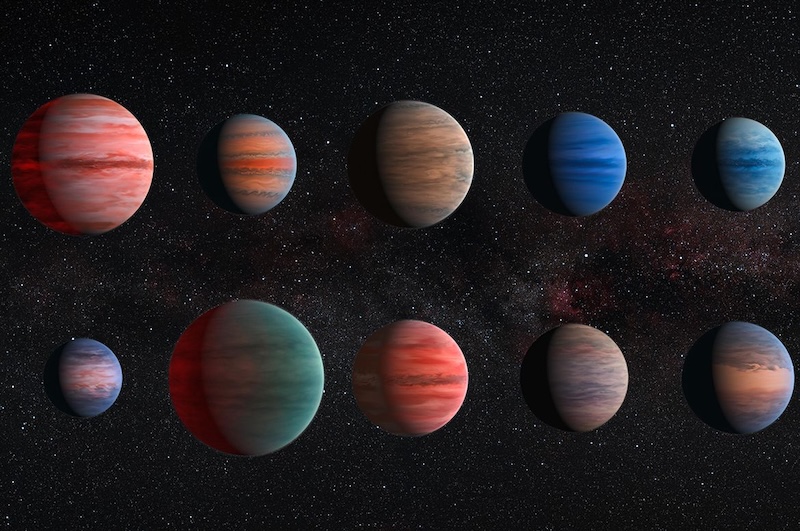
How did the disappearing exoplanet form?
Exoplanet TOI-2535 b and its neighbor provide clues about how hot Jupiters form, as well.
The first models earlier on suggested they needed a lot of ice to form. But that would mean they first formed much farther away from their stars and then migrated inward. The researchers have proposed two possible scenarios.
In the first, the Jupiter-like world almost collides with another planet. This gravitational interaction sends it into an elliptical orbit, like we see with TOI-2535 b.
The second scenario involves the protoplanetary disk that the star’s planets first formed in. In this case, all the planets get pulled inward closer to the star.
But there’s a problem. Scientists say this would create a “flat” planetary system. All the planets’ orbits would be on the same plane, with no tilted orbits. The two planets in the TOI-2535 system have tilted orbits. This makes the first scenario more likely.
Bottom line: Meet TOI-2535 b, the “disappearing exoplanet.” This hot Jupiter didn’t really disappear, but its tilted orbit determines when we can see it.
Source: A TESS Disappearing Act: The Vanishing Transits of TOI-2535 b
Via University of California Los Angeles
Read more: Hot Jupiter exoplanet has cloudy mornings and clear evenings
Read more: Double hot Jupiters: How do these rare gigantic worlds form?

