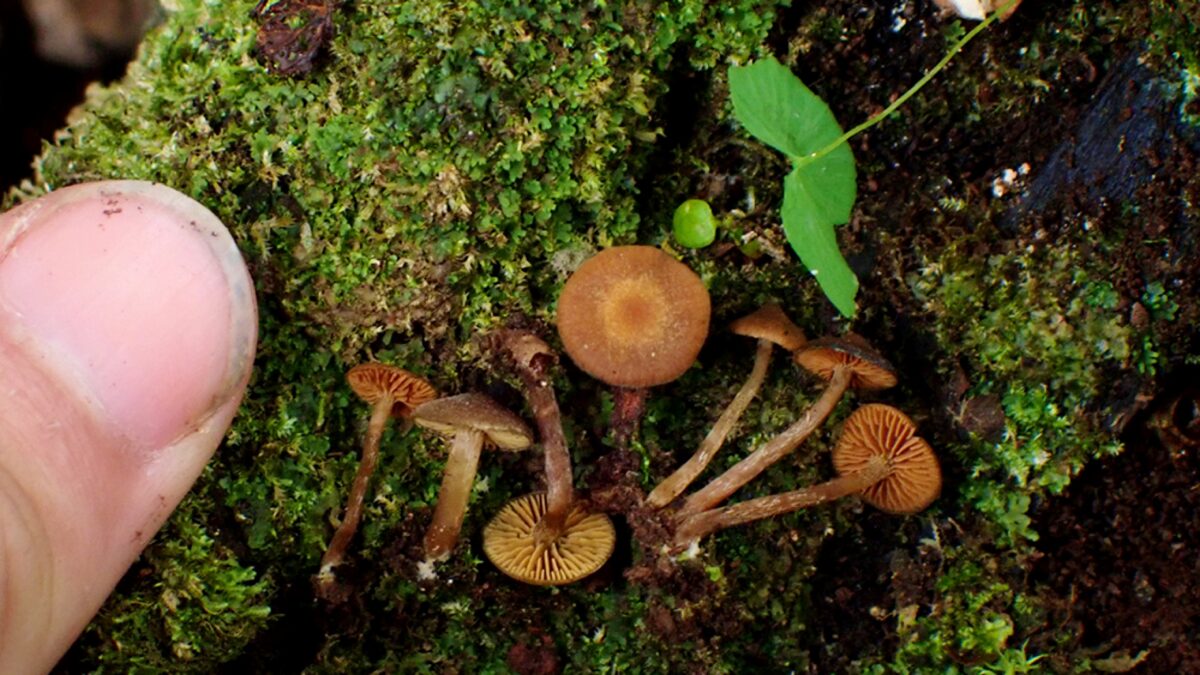
Galerina indica хэмээх мөөгнөөс псилоцибин болон үхэлд хүргэж болзошгүй аматоксин илэрсэн нь хоёр төрлийн бодисыг зэрэг агуулдаг анхны мөөгийн бүртгэл болжээ.
Зэрлэг мөөгний зарим нь идэж болох ч олон төрөл нь хортой. Харвардын их сургуулийн мөөг судлаач Эндрю Куник болон хамтрагчид Флоридагийн намгархаг газарт хөвдөөр бүрхэгдсэн дал модны их биед ургасан G. indica-г шинжлэхдээ сэтгэцэд нөлөөлөх псилоцибин, мөн хорт аматоксин байгааг тогтоожээ. Судалгааны дүн Current Biology сэтгүүлд нийтлэгдсэн байна.
G. indica зүйлийг Энэтхэгт арав гаруй жилийн өмнө анх илрүүлсэн бөгөөд Galerina төрөлд багтдаг. Судлаачид мөөгний дээжид химийн шинжилгээ хийж, геномыг нь дараалал тогтоон судалжээ. Үр дүнгээс харахад энэ мөөг хоёр өөр удаагийн хэвтээ генийн шилжилтээр, өөрөөр хэлбэл эцэг эхээс үр удамд дамжих бус, өөр организмоос ген авсан байх магадлалтай.
Судлаачдын таамгаар, аматоксин үүсгэх чадвартай G. indica-ийн өвөг дээдэс хэвтээ генийн шилжилтээр псилоцибин үүсгэх ген авсан бол Galerina-гийн өөр нэг салаа мөн ийм чадварыг бие даан олж авчээ. Хоёр төрлийн бодисыг хамтад нь үүсгэх нь мөөгөөр хооллодог амьтдаас хамгаалах олон талт арга байж болох ч энэ нь яг ямар давуу талтайг одоогоор тогтоогоогүй байна.
G. indica-ийн хорт бодис хүний биед аюултай эсэх нь судалгаагаар тодорхой болоогүй. Гэвч мөөгийг барихад хөхөрдөг бөгөөд энэ шинж псилоцибин агуулдагтай холбоотой байдаг тул хөхөрсөн мөөгийг аюулгүй гэж үзэх үндэс болохгүй. Судлаачид хөхрөлт нь аматоксин байхгүйг батлахгүйг анхааруулжээ.
Дэлгэрэнгүйг эх сурвалжаас харах
↓Эх сурвалжийг нээх ↓
The mushrooms of the world are a decidedly mixed bag, but one thing’s for sure: You don’t want to get them confused.
Far from the familiarity of grocery store varieties, if you go down in the woods today, mushrooms take a wild turn.
While some wild mushrooms are edible, many are not safe to eat.
Hundreds of different kinds are poisonous, and some are deadly – most notoriously, the world’s deadliest mushroom: the ‘death cap’ (Amanita phalloides).
But toxic mushrooms are only one side of the story. Nature also abounds with psychedelic mushrooms – aka ‘magic mushrooms’ – which have evolved hallucinogenic substances.
Until recently, scientists had never seen a mushroom that sat in both these camps, producing both psilocybin, the main psychedelic compound in magic mushrooms, and the toxins that make death caps so deadly.
But in a new study, researchers report the identification of the world’s first “dark magic mushroom” – a mysterious fungus that contains both psychedelic chemicals and poisonous amatoxins, described in Current Biology.
“We matched up our findings and confirmed that we saw both compounds,” says fungal biologist Andrew Kunik from Harvard University, who completed the research while studying at the University of Florida.
“I could hardly believe it. We knew it was possible but tried not to get too excited until we did a more rigorous analysis.”
The species in question – called Galerina indica – was first discovered in India over a decade ago.
But it wasn’t until Kunik and team closely investigated G. indica specimens found clinging to a moss-covered palm trunk in Florida’s wetlands that researchers realized how uniquely devilish this strange mushroom really is.
While the infamous death cap (from the Amanita genus) grabs most of the headlines, the world’s first dark magic mushroom hails from another deadly collective.
G. indica belongs to the Galerina genus and is related to a poisonous group of mushrooms known as the Galerina marginata species complex, commonly known as ‘funeral bells’ and ‘deadly skullcaps’, among other well-deserved handles.
Exactly why G. indica branched out from the family business of poisoning into a psychedelic side hustle remains unclear. But the same mystery basically surrounds all magic mushrooms.
“We still don’t fully understand why mushrooms produce psilocybin,” Kunik says.
“Amatoxins may help protect mushrooms from animals that eat them, but their precise ecological role isn’t entirely clear either. That’s what makes the discovery of the ‘dark magic mushroom’ so interesting. Why would a mushroom produce both of these compounds, and what advantage might that give it in nature?”
While we don’t have all the answers, we are slowly learning some of the backstory.
In the study, the researchers chemically analyzed their G. indica specimens, as well as sequencing the species’ genome.
While mushroom-forming fungal species usually inherit the genes responsible for producing specialized chemicals from their ancestors, G. indica‘s double whammy appears to be an incredibly rare instance of two separate cases of horizontal gene transfer involving the Galerina genus, in which genes were transferred between organisms rather than passed down from parents to offspring.
“Horizontal gene transfer is like if we shook hands and some of my DNA incorporated into your genome,” says co-author and mycologist Bryn Dentinger from the University of Utah.
“Two independent horizontal gene transfer events for these specialized metabolites in one mushroom genus are unheard of.”
In this case, the researchers think it’s most likely that an ancestor of G. indica, already capable of producing amatoxins, acquired the genes for making psilocybin through horizontal gene transfer. A separate Galerina lineage appears to have independently acquired those same capabilities.
It remains unknown why it would benefit G. indica to produce both toxic and psychedelic compounds, but the researchers say it may represent an example of a diversified defense strategy, in which distinct combinations of toxic compounds might help to slow down or deter animals feeding on the fungi.
While it’s not yet clear from this study whether the amounts of toxins in G. indica are dangerous or deadly to humans, the researchers warn that the mushroom does develop blue bruising when handled – a phenomenon linked to psilocybin in mushrooms.
Before now, some foragers might have assumed those blue marks meant it was safe to consume – containing psilocybin instead of poisonous amatoxins – but the existence of G. indica suggests some mushrooms aren’t so easily pigeonholed.
“From a public-health perspective, our finding cautions against interpreting blue bruising as evidence that an uncharacterized psiloid-containing mushroom is free of amatoxins,” the researchers write in their paper.
“Indeed, we show that this blueing reaction can accompany amatoxins in some rare and uncharacterized species, as is the case for the ‘dark magic mushroom’ G. indica.”
The findings are reported in Current Biology.
This article was fact-checked by Rebecca Dyer and edited by Rebecca Dyer. While we pride ourselves on our process, we are only human. If you spot a mistake, please let us know.

