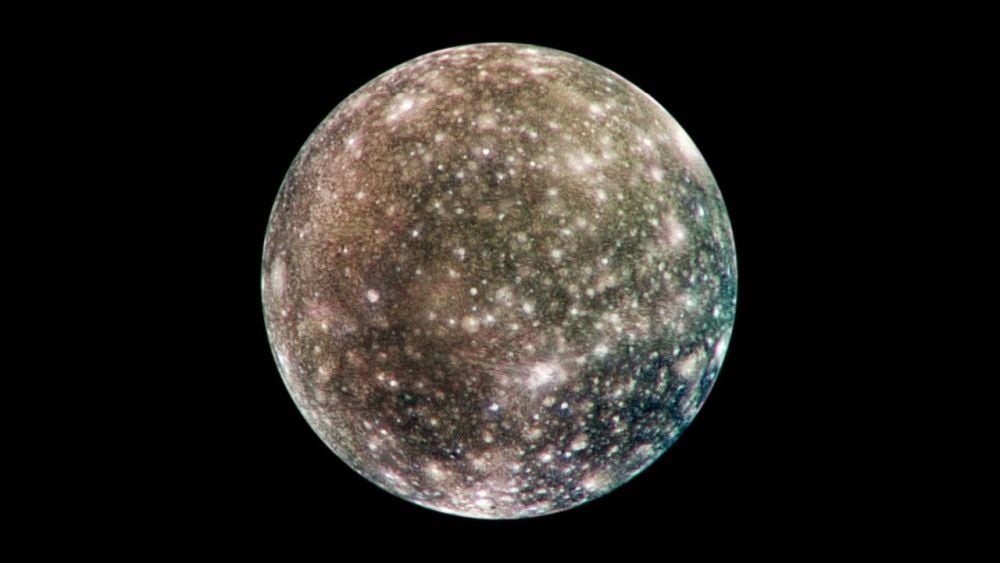
Хятадын Үндэсний сансрын захиргаа (CNSA) Бархасбадь гаригийн системд судалгаа хийх “Tianwen-4” номлолын хүрээнд Каллисто дагуул дээр газардах судалгааны төхөөрөмж илгээхээр төлөвлөж байна.
“Tianwen-4” номлолын гол зорилго нь Бархасбадь гаригийн тойрог замд орж, Каллисто дагуулыг тойрох болон гадаргуу дээр нь газардах судалгаа хийх замаар уг системийн талаарх шинжлэх ухааны мэдлэгийг өргөжүүлэх юм. Энэхүү зорилтын хүрээнд CNSA олон улсын болон дотоодын түншүүдээс шинжлэх ухааны багаж хэрэгслийн саналуудыг хүлээн авч байна. Газардагч төхөөрөмж нь чулуулгийн найрлагыг лазераар шинжлэх Раманы спектрометр болон соронзон хэмжигч зэрэг хоёр үндсэн багажийг тээхээр төлөвлөгджээ.
Каллистогийн гадаргуу нь мөс болон чулуулгийн холимог бүтэцтэй бөгөөд уг төхөөрөмжийн тусламжтайгаар гадаргуу дахь нүүрстөрөгчийн шинж чанар болон усны гаралтай өөрчлөлтүүдийг илрүүлэх боломжтой. Эдгээр мэдээлэл нь дагуулын дотоод бүтцэд давстай далай оршин байх магадлалыг тодорхойлоход чухал ач холбогдолтой юм. Хэдийгээр Бархасбадийн бусад дагуулуудтай харьцуулахад Каллистогийн дотоод бүтэц тодорхой бус байгаа ч, энэ нь нарны аймгийн хамгийн том гаригийн үүсэл хөгжлийг ойлгох гол түлхүүр болох юм.
Каллисто нь Бархасбадийн хүчтэй цацрагийн бүсээс алслагдсан, таталцлын орон нь сул тул газардахад харьцангуй хялбар байдаг. Мөн геологийн хувьд тогтвортой, галт уул болон тектоник идэвхжил багатай нь газардах ажиллагааг хөнгөвчилж байна. Гэсэн хэдий ч агаар мандалгүй орчинд газардах үйл явц нь бие даасан удирдлага шаардах бөгөөд холбооны хугацааны саатал нь 35-50 минут үргэлжлэх сорилттой тулгарч байна.
Номлолын төлөвлөгөөгөөр сансрын хөлөг 2035 онд Бархасбадь гаригт хүрч, улмаар 2038 оны хоёрдугаар сард Каллистогийн тойрог замд орж, газардагч төхөөрөмжийг салгахаар тооцоолжээ. Энэхүү төлөвлөгөө нь 2020 онд боловсруулагдсан бөгөөд цаашид багаж хэрэгсэл болон техникийн үзүүлэлтүүдэд өөрчлөлт орох боломжтой ч CNSA-ийн Каллисто дээр газардах шийдвэр тодорхой байна.
Дэлгэрэнгүйг эх сурвалжаас харах
Эх сурвалжийг нээх ↓
The China National Space Administration (CNSA) has been talking about a mission to the Jovian system since 2018. It’s named Tianwen-4, and it will build on the success of other recent missions like Chang’e 6, which collected the first sample from the lunar far side in 2024.
Tianwen-4 obviously isn’t a sample return mission. But according to recent developments, it will attempt another extremely challenging mission profile: a landing on Callisto.
The CNSA announced a new opportunity for payloads for its Tianwen-4 mission to Jupiter.
“The primary objectives of the Tianwen-4 mission are to achieve Jovian orbiting, as well as orbiting and landing exploration of Callisto, and to advance scientific research on the Jovian system,” the announcement reads. To improve the mission’s performance and success, the CNSA is asking for instrument proposals from within China and from outside partners.
The orbiter itself will carry 10 instruments, and the payload will include multiple cameras, imagers, and spectrometers, as well as a particle detector and a magnetometer. But the announcement also addresses the needs of a Callisto Lander.
“The lander is planned to carry 2 scientific payloads: Callisto Surface Composition Analyzer and Callisto Lander Magnetometer,” it reads.
The surface composition analyzer will be a Raman spectrometer. Raman spectrometers can analyze the composition of rocks with the light from a laser, and are becoming a standard part of planetary missions. NASA’s Perseverance rover uses an ultraviolet Raman spectrometer to measure fine-scale mineralogy and to detect organic matter. The ESA’s upcoming Rosalind Franklin rover will have one, and JAXA’s Martian Moons Explorer carries one in its IDEFIX rover.
Callisto’s surface is heterogenous on a small scale. There are small bright patches that seem to be pure water ice and there are other patches that appear to be a mixture of rock and ice. These are intermixed with larger, darker areas that are not ice. But spectral identification is uncertain. The Tianwen-4 lander and its Raman spectrometer should be able to determine the compositions of these components. There’s also lots of carbon on the surface, and the instrument should be able to tell if its primordial carbon or altered carbon.
This mosaic of Callisto images from the Voyager 1 mission shows a large-scale feature named Valhalla. It’s an old impact crater with concentric rings expanding outward. They extend outward for about 1,500 km, and a bright central point, probably the original impact basin, is about 600 km across. Image Credit: NASA/JPL
While Jupiter’s other moons like Ganymede, and especially Europa, have strong evidence for subsurface oceans, Callisto’s composition and structure is less certain. It appears to be partially differentiated, and magnetometer readings are ambiguous regarding an ocean. But if the Tianwen-4 lander’s Raman spectrometer can determine if some of its surface composition is aqueously altered, that would be evidence in favour of an ocean.
The lander’s other instrument will be a surface magnetometer. By combining its data with the data from the orbiter’s magnetometer, ionospheric signals and signals from the moon’s surface can be separated. That will reveal more about its interior, especially regarding its potential subsurface ocean.
It would be nice to have a better understanding of Callisto, since it and the other Galilean moons are expected to have formed in-situ, unlike some other Solar System moons. Some of those appear to be captured objects. So understanding Callisto is an avenue to understanding Jupiter itself, the dominant planet in our system.
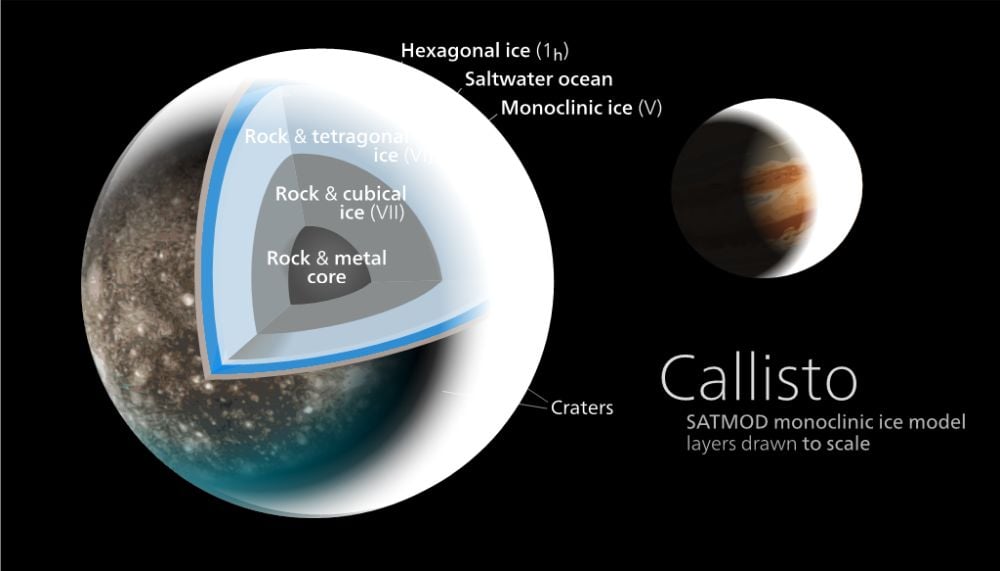 Callisto’s internal structure is uncertain, but it seems to be differentiated, with multiple ice layers and a rock and metal core. It may also have a saltwater ocean, but is far from certain. Image Credit: By Kelvinsong – Own work, CC BY-SA 3.0, https://commons.wikimedia.org/wiki/Special:Redirect/page/31643955
Landing on any of the Galilean moons is challenging, but Callisto might be the least challenging. It’s probably not the best scientific destination among them, but it is the most accessible. For one thing, it’s outside Jupiter’s extremely powerful radiation belts, where radiation is strong enough to degrade sensitive instruments after short exposure times. Think of NASA’s Juno spacecraft and its wide orbit. It only makes short dives into the radiation belts. Even then, Juno protects its most sensitive parts inside a titanium vault.
Callisto is furthest from Jupiter compared to the other three Galilean moons, so its gravity well is shallower. Less precious propellant is required to land there. Tianwen-4 can also use gravity assists at Callisto to prepare for orbital insertion.
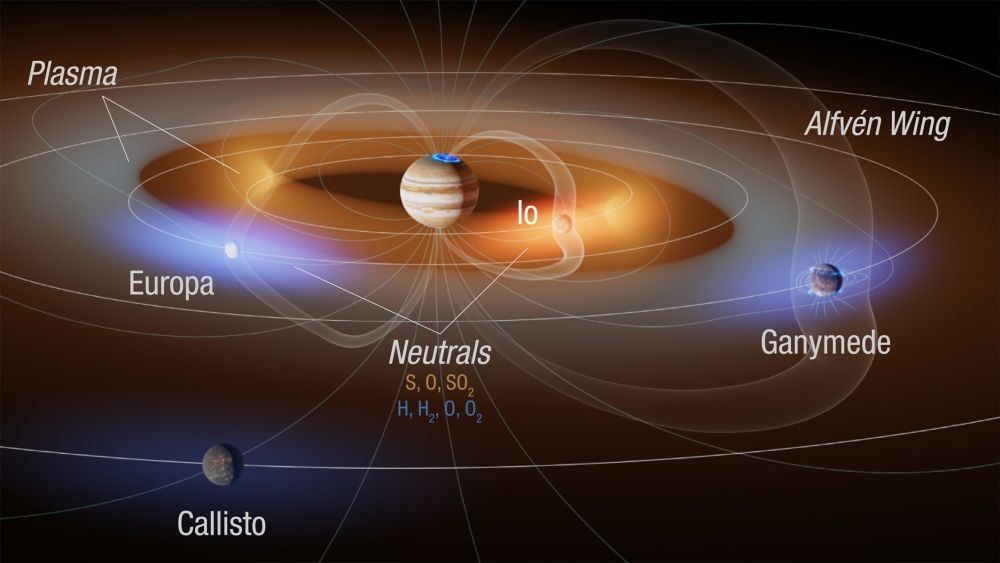 Callisto is further away from Jupiter than the other Galilean moons. The other three are deeper inside its magnetic fields and powerful radiation belts, which makes visiting them much more hazardous. The radiation dose on Callisto’s surface is weaker and won’t take such a heavy toll on sensitive electronics. Image Credit: By B. Smithin Szalay, J. R., Smith, H. T., Zirnstein, E. J., McComas, D. J., Begley, L. J., Bagenal, F., et al. (2022). Water-group pickup ions from Europa-genic neutrals orbiting Jupiter. Geophysical Research Letters, 49, e2022GL098111.
Another reason Callisto is the preferred moon for a surface mssion is the its surface. Callisto’s surface is ancient, cratered, and stable. It’s a geologically quiet place compared to Io, for instance. It doesn’t suffer from the same tidal heating and constant volcanic upheaval that Io suffers from. There are no mountains or volcanoes, only ancient crater on top of ancient crater. This makes hazard avoidance easier, since orbital images are unlikely to have changed from the time they were captured to the time the lander arrives there.
But Callisto is still challenging. It’s an airless moon, and that creates its own difficulties. Atmospheric breaking isn’t an option. The time delay also ranges from about 35 to 50 minutes, so round-trip communication is double that. That means the landing must be autonomous.
The best surface images come from the Galileo mission, and that spacecraft imaged most of Callisto at poor resolution. Only some small areas are imaged at higher resolutions of tens of meters per pixel.
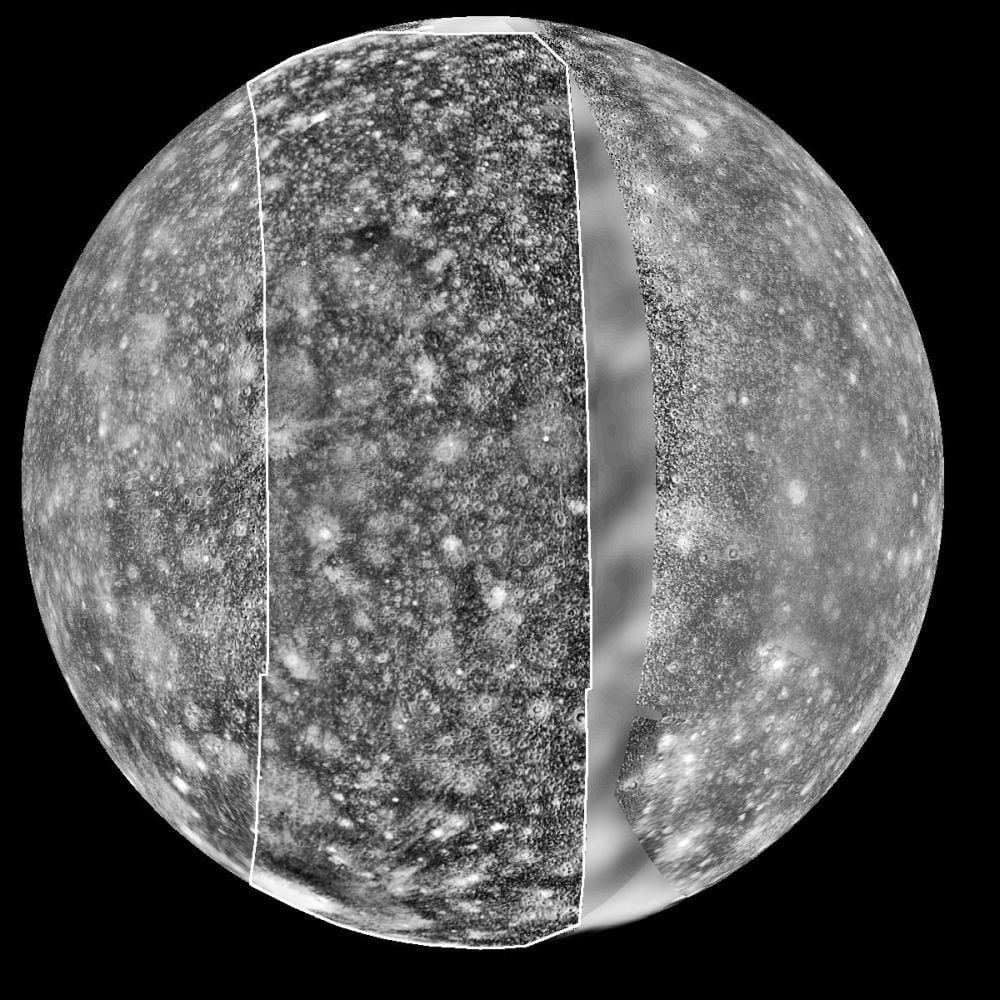 This image of Callisto is made from data from Galileo and Voyager 1 and 2. It emphasizes how heavily cratered the moon’s ancient surface is, and how uniform it is. There are a few smooth areas, and no mountains of volcanoes. Image Credit: NASA/JPL/DLR
But the mission plan calls for Tianwen-4 to orbit Callisto at an altitude of 300 km. Galileo got to within 138 km of the moon, but that was 25 years ago. Camera technology has advanced since then, and Tianwen-4 will carry a pair of visible light imaging cameras. One of them, the wide-angle camera (JWAC), is dedicated to mapping Callisto’s surface and topography. Tianwen-4’s proposed mapping orbit is 300 km in altitude. From that height, the JWAC operates at about 90 meters per pixel.
In 2020, the CNSA outlined a timeline for the Tianwen-4 mission that would see it launch in September of 2029. To preserve precious propellant, the spacecraft will perform a slingshot flyby of Venus in April 2030, then a pair of slingshots with Earth in 2031 and 2033.
In 2035 it will reach Jupiter and enter an orbit around the gas giant, also making flybys of irregular moons. That’s phase one. Phase two starts with two gravity assists with Callisto, then in February 2038, it will enter an orbit around the moon. At some point after that, the Callisto lander will be released.
This plan was first outlined in 2020, so it will likely be changed. The instrumentation on the orbiter could be changed, too, and that includes its mapping camera and its resolution. But with their call for instrument proposals, the CNSA is making one thing clear: they intend to land on Callisto.