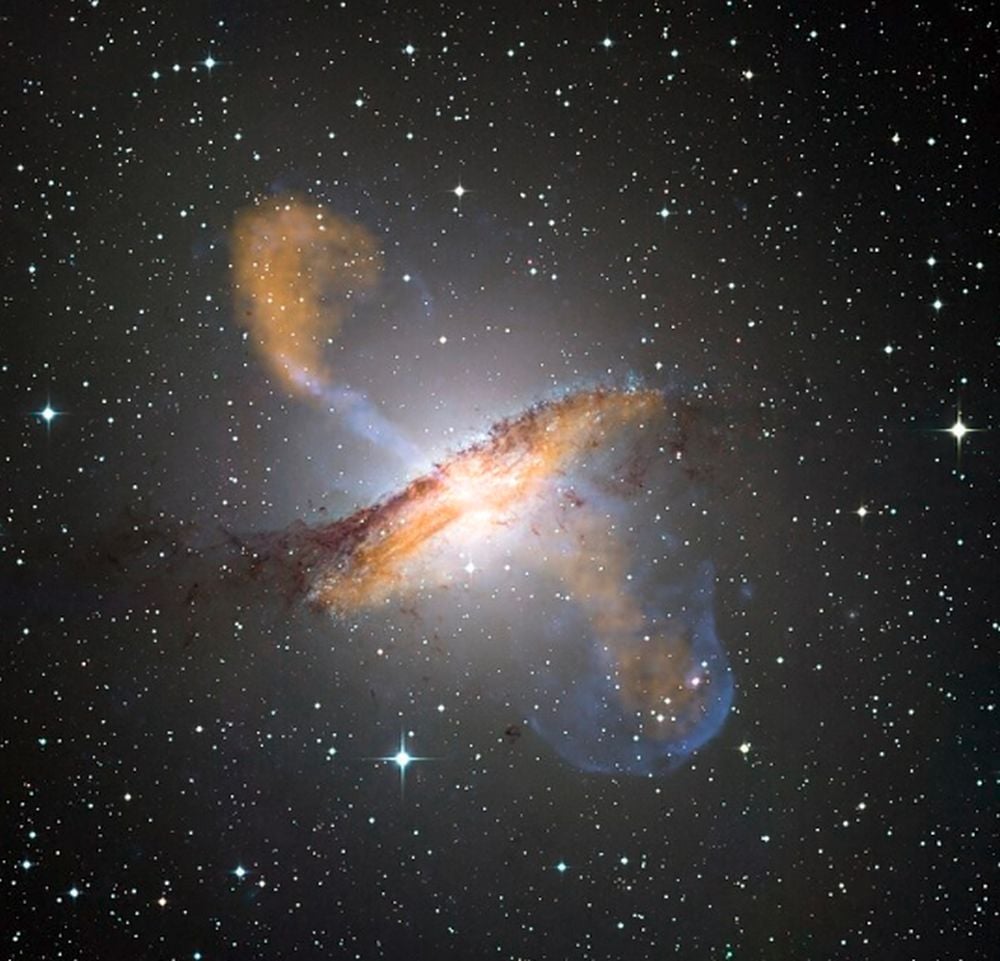
Хар нүхнээс цацагддаг асар хүчтэй энерги бүхий тийрэлтэт урсгалын ирмэг яагаад төв хэсгээсээ илүү тод харагддаг болохыг одон орон судлаачид тодрууллаа.
Хар нүхнүүд нь сансар огторгуй дахь цахилгаан соронзон энергийн хамгийн удаан үргэлжилдэг, хамгийн тод эх үүсвэрүүдийн нэг юм. Идэвхтэй галактикийн цөмөөс ялгардаг эдгээр асар хүчтэй тийрэлтэт урсгал нь хар нүхний эргэлтийн энерги болон соронзон орны нөлөөгөөр үүсдэг бөгөөд оддын үүсэлд сөргөөр нөлөөлөхүйц хэмжээний турбулент болон дулааныг сансрын орон зайд түгээдэг. Гэвч эдгээр урсгалын бүтэц яагаад төв хэсэгтээ биш, харин ирмэгээрээ илүү тод харагддаг (limb brightening) нь эрдэмтдийн анхаарлыг олон жил татаж ирсэн билээ.
Германы Вюрцбургийн их сургуулийн одон орон судлалын тэнхимийн оюутан Феликс Глазер тэргүүтэй судлаачид Centaurus A радио галактикийн тийрэлтэт урсгалыг загварчлан энэхүү үзэгдлийн шалтгааныг тайлбарлажээ. Event Horizon Telescope (EHT)-ийн олон жилийн ажиглалтын өгөгдлийг ашиглан хийсэн магнетогидродинамик симуляцийн үр дүнд, урсгалын ирмэг тод харагдах нь электронуудын хөдөлгөөн болон соронзон орны харилцан үйлчлэлээс үүдэлтэй болохыг тогтоов. Тодруулбал, тийрэлтэт урсгал дахь электронууд нь соронзон орны шугамын дагуу жигд бус тархдаг бөгөөд энэ нь “синхротрон цацраг” ялгарахад нөлөөлдөг байна.
Энэхүү судалгаа нь бичил түвшний плазмын физик үзэгдлүүд нь хар нүхний тийрэлтэт урсгал гэх мэт асар том хэмжээний бүтцэд хэрхэн нөлөөлдгийг харуулсан нь чухал ач холбогдолтой юм. Судлаачдын үзэж байгаагаар Centaurus A-д ажиглагдсан энэхүү үзэгдэл нь бусад галактикийн тийрэлтэт урсгалуудад ч түгээмэл байх магадлалтай. Цаашид Square Kilometre Array болон Very Large Array-ийн шинэчлэлүүд нь энэ чиглэлийн судалгааг илүү гүнзгийрүүлэх боломж олгоно.
Эрдэмтэд хар нүхний тийрэлтэт урсгал дахь плазмын физик нь Дэлхий дээрх цөмийн нэгдлийн (fusion) реакторуудтай ижил төстэй зарчим дээр тулгуурладаг болохыг онцолж байна. Хар нүхний орчинд хийсэн энэхүү судалгаа нь зөвхөн огторгуйн нууцыг тайлаад зогсохгүй, ирээдүйн эрчим хүчний эх үүсвэр болох цөмийн нэгдлийн технологийг хөгжүүлэхэд ч хувь нэмэр оруулах боломжтой юм.
Дэлгэрэнгүйг эх сурвалжаас харах
Эх сурвалжийг нээх ↓
Astrophysical jets launched from black holes aren’t shy. They announce their presence with enormous blasts of energy that extend extreme distances into space. They’re the most long-lasting and luminous sources of electromagnetic energy in the Universe.
Supermassive black holes (SMBH) emit the largest astrophysical jets, and they come from active galactic nuclei (AGN) which are SMBH that are actively accreting material. As material gathers in an accretion disk around a SMBH, it rotates and heats up. Some of the material is ejected out of the black hole in the powerful jets.
These jets are impossible to ignore. No astrophysicist could feign their interest. Exactly how these powerful expressions of cosmic energy are created isn’t clear, though some things are known.
Astrophysicists know that they’re powered by a SMBH’s rotational energy and their extremely powerful magnetic fields. They know that they move at relativistic speeds. And they know that they can inject gigantic amounts of energy into the intergalactic medium, heating up gas and introducing turbulence, two things that act against star formation.
One thing that puzzles researchers is how the different regions in a black hole jet have different brightnesses. The expectation is that the center of the jets would be brightest, because this is where energy is most concentrated. But when researchers examine the jets coming from the SMBH in Centaurus A, the closest radio galaxy to Earth, that’s not what they see.
Since it’s so close and so bright, Centaurus A is one of those natural laboratories for extreme physics that makes astrophysicists’ eyes light up. They’ve been observing the jets in Centaurus A in detail for many years. Observations with the Event Horizon Telescope spanning a decade have revealed that its jets are brighter at their edges than in their centers, in a phenomenon called limb brightening. Why is that?
New research in Astronomy and Astrophysics has an explanation. It’s titled “Probing anisotropic particle acceleration and limb brightening in Centaurus A’s jet.” The lead author is Felix Glaser, Master’s student at the Chair of Astronomy at the University of Würzburg in Germany.
“Relativistic jets are among the most fascinating phenomena in the universe, and recent high-resolution very long baseline interferometric (VLBI) observations, including the Global mm-VLBI Array and the Event Horizon Telescope (EHT), are able to resolve their structure close to their launching site,” the authors write. The combined observations show the black holes with brighter limbs are not only found in Centaurus A, but in M 87 and 3C 84, too.
This image shows four different looks at the central region of M 87. The top image from the Hubble is in visible light. The other three are all in polarised light. The lines mark the orientation of polarisation, which is related to the magnetic field in the regions imaged. Though the researchers focused on Centaurus A, this image highlights how magnetic fields and polarity influence astrophysical jets. Image Credit: EHT Collaboration; ALMA (ESO/NAOJ/NRAO), Goddi et al.; NASA, ESA and the Hubble Heritage Team (STScI/AURA); VLBA (NRAO), Kravchenko et al.; J. C. Algaba, I. Martí-Vidal
Each of these three galaxies are different from one another, making it difficult to understand the cause of their limb brightening. “Therefore, as a pilot study, we aimed to model the EHT observations of Cen A,” the authors explain. It’s the closest, so that makes sense.
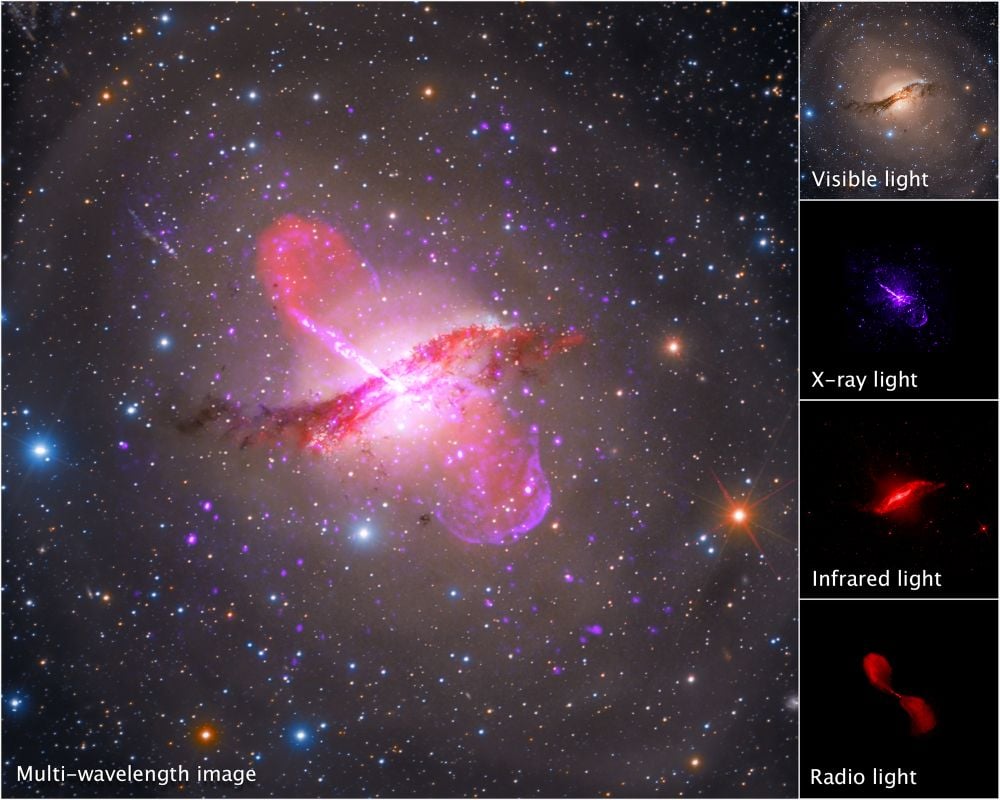 This is a composite image of Centaurus A, with the individual images and their wavelenghts on the right. The image is from the Hubble (visible), Chandra (X-ray), Spitzer (infrared), and the Very Large Array (radio). Image Credit: NASA, CXC, SAO, Astrophotography by Rolf Olsen, NASA-JPL, Caltech, NRAO, AUI, NSF, UOH, M. Hardcastle
The researchers performed a magnetohydrodynamic simulation of an accreting supermassive black hole and how it launched it jets to observe the plasma dynamics involved. Since these jets are relativistic, the simulation included general relativistic effects. They also adjusted their simulation to match the properties of Centaurus A. “In order to match our model to the EHT observations, we adjust several free parameters…” the authors write, including black hole mass and the viewing angle.
The simulation successfully mimicked the recent observations of Centaurus A with the EHT.
“Our results demonstrate that the edge-brightening observed in Cen A can be naturally reproduced by an anisotropic particle distribution,” the researchers write.
That means that the electrons emitted in the jets aren’t distributed evenly over pitch angles. Pitch angles are the difference between the magnetic field and each electron’s velocity. This is where synchrotron radiation enters the picture. Synchrotron radiation is when particles are forced to follow the curve of a magnetic field.
The emission of synchrotron radiation is strongly dependent on the pitch angle. So as a result, the observed brightness of the radiation changes depending on the viewing angle of the magnetic field the particles are forced to follow.
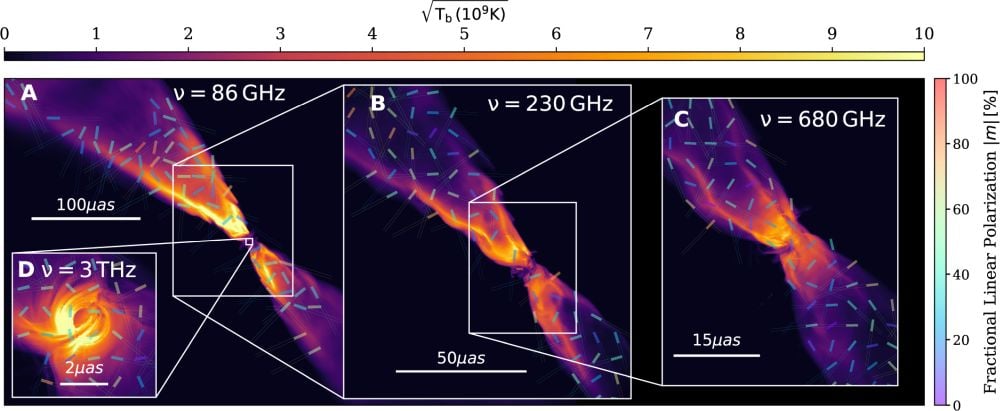 This figure from the research shows the synthetic polarized intensity images of our Cen A model at four representative frequencies: 86 GHz (panel A), 230 GHz (panel B), 680 GHz (panel C), and 3 THz (panel D). Each one zooms in closer and shows more detail in the model. Image Credit: Glaser et al. 2026.
“What is truly amazing is that microscopic plasma effects can shape structures on vastly larger scales,” said Dr. Christian Fromm, leader of the Computational Astrophysics Group. “Future observations will reveal even more of these plasma signatures, making it increasingly important to include realistic plasma physics in our models already today and to further investigate the highly nonlinear effects of relativistic plasma.”
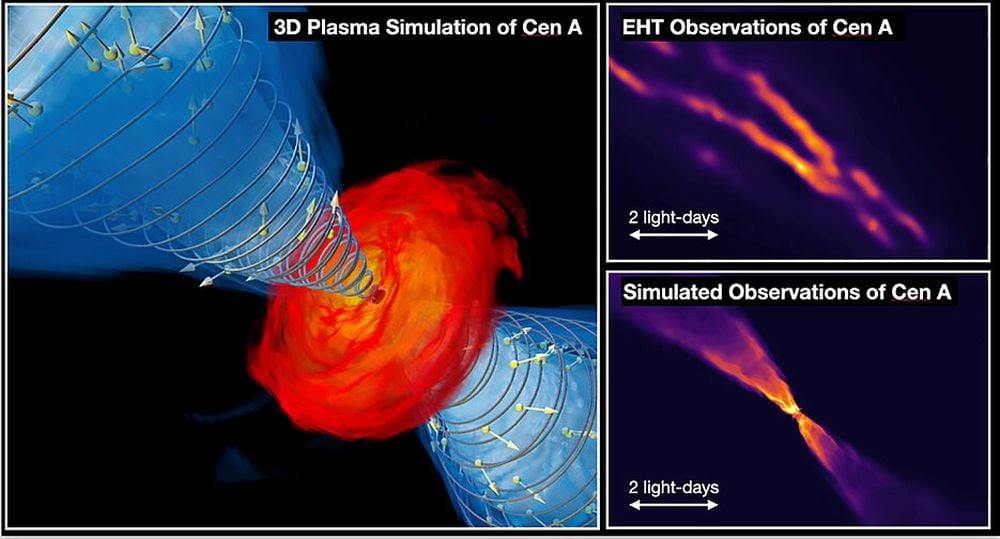 This figure shows how microscopic plasma effects can shape the large-scale structure of black hole jets. The hot accretion flow surrounding the supermassive black hole is shown in red, the relativistic jets in blue, and the magnetic field structure by gray helical field lines. Colored particles and arrows illustrate the motion of accelerated particles along the jet. Top right: The Event Horizon Telescope image of the inner jet of Centaurus A at a wavelength of 1.3 mm. Bottom right: The synthetic EHT observation generated from the new plasma-informed model. (Image Credit: Christian M. Fromm, Janssen et al. 2021 and Glaser et al. 2026)
“Cen A is our closest window into the physics of relativistic jets,” said lead author Glaser. “The fact that our plasma-informed model reproduces the observed edge brightening suggests that we are capturing an important piece of the underlying physics. These processes may not be unique to Cen A, but could be common in relativistic jets throughout the Universe.”
This study makes real progress in understanding the details of astrophysical jets, and how they exhibit things like limb brightening. It links the small scale of plasma physics with the jets and their characteristics. It’s all because of a focused, multi-disciplinary effort.
“By bringing together expertise in high-resolution observations, numerical simulations, and plasma physics, we are making progress toward understanding how black holes launch powerful jets and how these jets produce the radiation we observe. The new study is an excellent example of this approach,” said Fromm.
New telescopes are coming online that will take this work even further. The Square Kilometre Array will be the world’s largest and highest-resolution radio telescope when it comes online in 2027. Updates to the Very Large Array will also drive progress when they’re completed in 2031.
This work may affect more than our understanding of black hole jets. On a detailed plasma physics level, there are similarities between the jets and fusion. If we ever have a functioning fusion reactor, it will involve extremely powerful artificial magnets to generate powerful fields that confine the plasma.
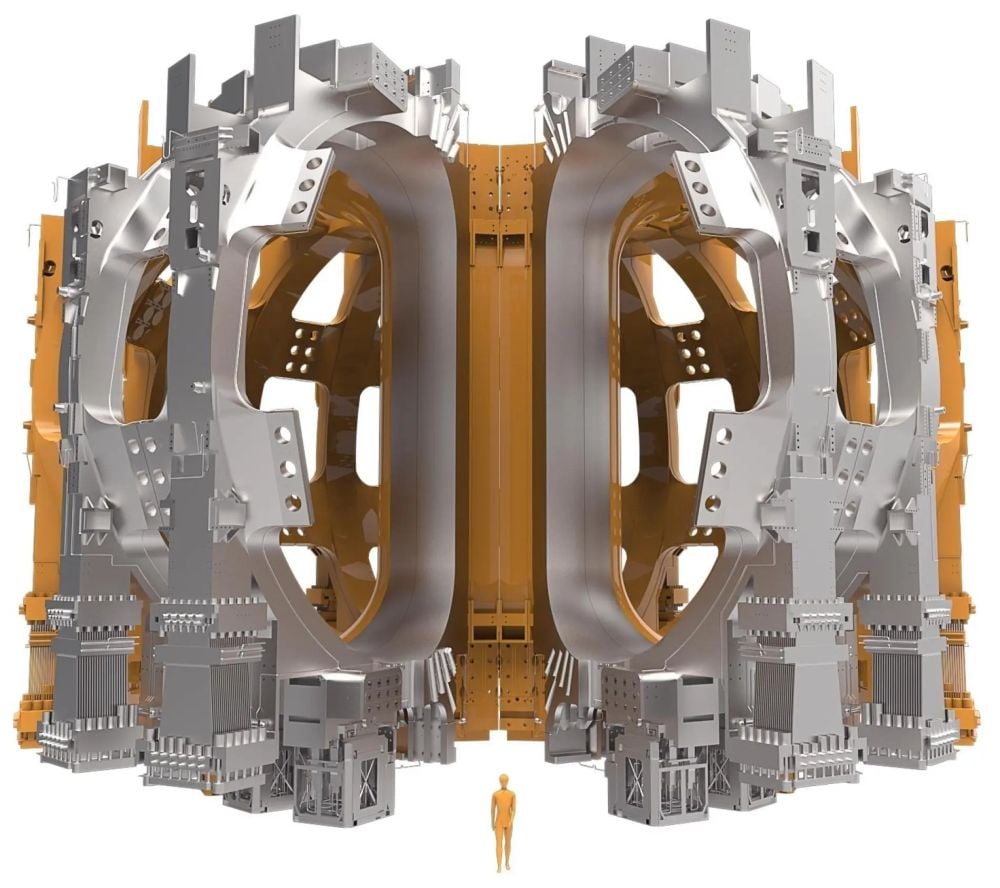 This illustration shows some of the “D”-shaped toroidal field magnets in the ITER international nuclear fusion research and engineering project being built in France. Each magnet weighs 330 tons, and their job is to confine the plasma inside ITER’s vacuum vessel. Lessons learned by studying plasma physics in black hole jets are applicable to fusion reactors. Image Credit: ITER Consortium.
“A black hole and a fusion reactor may sound like completely different worlds—but both are governed by the physics of plasma,” says Professor Karl Mannheim, holder of the Chair of Astronomy at the University of Würzburg. “At Centaurus A, we can study plasma under conditions that cannot be created on Earth. These insights not only help us understand the Universe, but may also contribute to the development of future fusion energy.”

