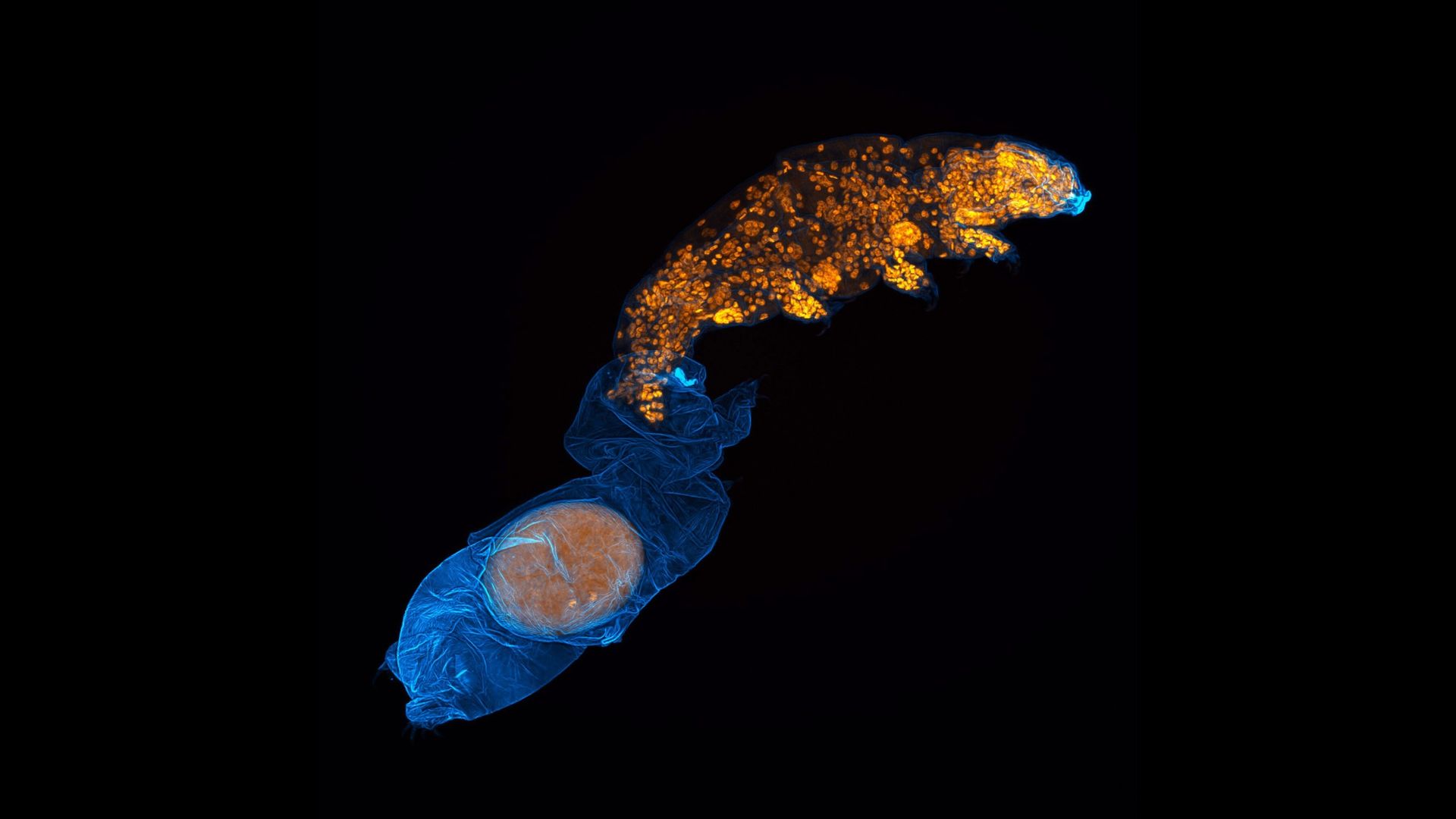
Гонсало Кирога-Артигасын гэрэл зураг бичил амьтны гуужих болон үржих үйл явцыг нэгэн зэрэг харуулжээ.
Nikon-ы 2026 оны фотомикрографийн уралдаанд 12 дугаар байр эзэлсэн зурагт Hypsibius exemplaris зүйл гуужиж, хуучин бүрхүүл дотроо өндөг гаргаж буй нь харагдана. Францын Montpellier Cell Biology Research Center-ийн докторын дараах судлаач Кирога-Артигас олон цагийн микроскопын ажлынхаа үеэр энэ ховор агшныг олж харжээ.
Зарим усны баавгайн зүйл өндгөө гуужсан бүрхүүл дотор гаргадаг бөгөөд энэ нь хөгжиж буй үр хөврөлд нэмэлт физик хамгаалалт болдог. Зурагт үзүүлсэн зүйл партеногенезээр буюу үр тогтоогүй өндгөн эсээс үр төл бий болгон үрждэг тул эр бие шаарддаггүй; үр төл нь эхтэйгээ генетикийн хувьд маш төстэй байдаг.
Hypsibius exemplaris ердөө 250 микрометр орчим урттай, хүний үсний өргөнөөс хоёр дахин их хэмжээтэй. Судлаач амьтдыг цуглуулсны дараа бэхжүүлж, будагч бодисоор боловсруулан микроскопоор ажиглажээ; тохирох гуужилтын үе шат болон дүрслэх өнцгийг олохын тулд олон цаг хайх шаардлагатай байсан. Зурагт лазерын гэрлээр дээжийн хэсгүүдийг нэг нэгээр нь гэрэлтүүлэн өндөр нягтралтай дүрс үүсгэдэг конфокал микроскоп ашигласан байна.
Кирога-Артигасын усны баавгайн өөр нэг зураг Nikon Small World уралдаанд онцлох бүтээлээр шалгарч, мөн жирэмсэн усны баавгай өөр нэгэнтэй хүрэлцсэний дараа баас гаргаж буй бичлэг нь Nikon Small World in Motion уралдааны тусгай дурдлагад багтжээ. Хүрэлцсэн үйлдэл энэ хөдөлгөөнийг үүсгэсэн эсэх нь тодорхойгүй гэж судлаач тэмдэглэв.
Тэрээр гэрэл зураг, бичлэгээрээ нүдэнд үл үзэгдэх бичил амьтад ч бусад амьтдын адил амьдарч, үржиж, өсөж, нарийн амьдралын мөчлөг туулдгийг харуулахыг зорьж байна. Цаашдын судалгаандаа усны баавгайг өөр өөр нөхцөлд дүрслэхдээ тодорхой нэг зураг авах зорилго тавихгүй бөгөөд хамгийн сайн зургууд заримдаа зориуд хайгаагүй агшнаас төрдөг гэжээ.
Дэлгэрэнгүйг эх сурвалжаас харах
↓Эх сурвалжийг нээх ↓
It’s not often we get to peer into the tiny world of tardigrades (also known as water bears). But through his photography, biologist Gonzalo Quiroga-Artigas is unmasking the secret lives of these creatures in stunning detail.
In one photo, which won Quiroga-Artigas 12th place in Nikon’s 2026 Photomicrography Competition, a tardigrade (Hypsibius exemplaris) is seen shedding its tough outer layer, known as a cuticle or an exuvium, while laying an egg in the discarded skin.
“A large part of my research involves imaging, and during the many hours I spend at the confocal microscope, I have come across some incredibly beautiful and unexpected scenes,” Quiroga-Artigas, a postdoctoral researcher at the Montpellier Cell Biology Research Center in France, told Live Science in an email.
“An interesting feature of tardigrade reproduction is that some species lay their eggs inside the shed cuticle, or exuvium. The exuvium can therefore provide an additional layer of physical protection for the developing embryos.”
In some species, males may place sperm inside the cuticle of a molting female before egg laying, according to National Geographic. In others, the males fertilize the eggs after they have been left inside the cuticle. And some don’t even need males to reproduce at all.
“Many species reproduce through parthenogenesis,” Quiroga-Artigas said, which is when an embryo develops from an unfertilized egg, also known as a virgin birth. “This means that males are not required for reproduction, and the resulting offspring are genetically very similar to their mothers,” he added. The species in the photograph falls into this category.
Molting and egg laying often take place over several hours, but the shedding itself is a relatively fast process. Capturing it on camera is, therefore, no mean feat.
“Once I had collected animals that were laying eggs, I had to fix, stain, and mount the specimens before imaging them,” Quiroga-Artigas said. “I then spent a long microscopy session searching for the right specimen and the right orientation to obtain a high-quality image. Finding a specimen at exactly the right stage of molting, and in an orientation that allows the process to be clearly visualized, is largely a matter of patience and luck.”
Photographing these animals is also challenging due to their tiny size. “Working with tardigrades in the lab requires a lot of experience with micromanipulation, as they are extremely small,” Quiroga-Artigas said. “Hypsibius exemplaris, for example, is only about 250 µm [micrometers] long.” That’s about twice the width of a human hair.
This particular photo was taken using confocal microscopy, which uses a focused laser beam to light up one section at a time to create a detailed, high-resolution image. Quiroga-Artigas used this technique for a second tardigrade photo that was listed as an Image of Distinction in the same competition.
He also received an Honorable Mention in the Nikon Small World in Motion Competition for a video of a pregnant tardigrade making contact with another tardigrade, which can then be seen pooping. However, it’s not clear whether the contact between the two individuals caused this movement, Quiroga-Artigas said.
Quiroga-Artigas hopes his photography and videos give viewers an idea of just how beautiful and complex the microscopic world really is. “There are tiny animals all around us that we cannot see with the naked eye, yet they live, reproduce, grow, and undergo complex life cycles just like the animals we are more familiar with,” he said.
“I will continue capturing images of tardigrades in different contexts related to my future research, without necessarily having a specific photographic goal in mind,” he added. “In my experience, some of the best images I have captured were not necessarily the ones I was actively looking for.”

