Радио долгионы ажиглалтын шинэлэг аргачлал нь хоёр одны харилцан нөлөөлөл болон тэдгээрийн эргэн тойрон дахь гаригийн тогтолцоонд үзүүлэх нөлөөг судлах боломж олгожээ.
Эрдэмтэд Дэлхийгээс 59 гэрлийн жилийн зайд орших DG CVn хэмээх хос одны системийн хөдөлгөөнийг 18 жилийн турш ажигласны үр дүнд тэдгээрийн тойрог замыг урьд өмнө байгаагүй нарийвчлалтайгаар зураглалаа. Лейдений одон орон судлалын хүрээлэн болон JIVE-ийн судлаачдын баг радио долгион ялгаруулдаг эдгээр улаан одой одны өвөрмөц шинж чанарыг ашиглан тэдгээрийг тус тусад нь хянах боломжтой болсон юм. Энэхүү судалгааг Astronomy & Astrophysics сэтгүүлд нийтэлжээ.
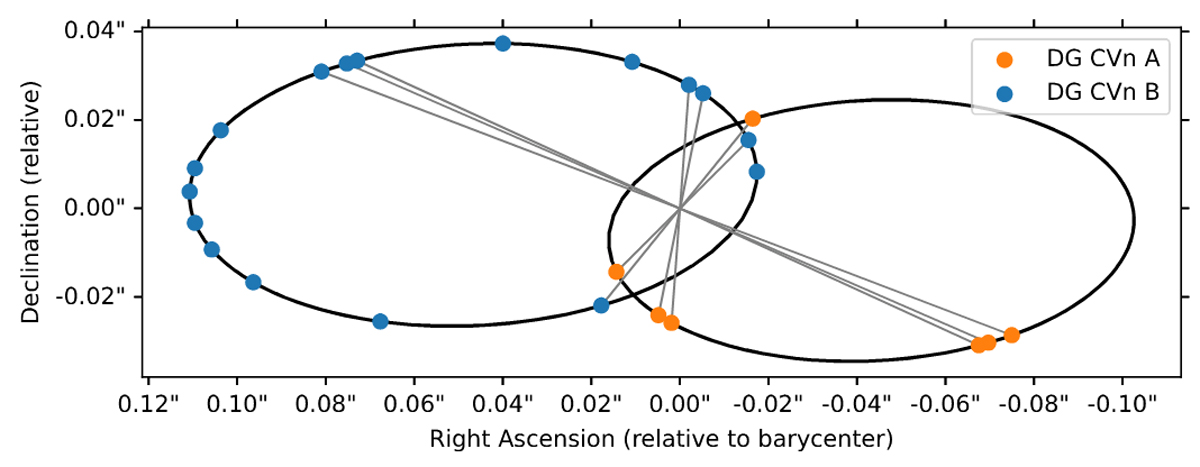
Судалгаанд 2007-2010 онд хийгдсэн архивын мэдээлэл болон 2023-2025 онд Very Long Baseline Array (VLBA) ашиглан авсан 27 удаагийн хэмжилтийг нэгтгэн ашиглав. Үр дүнд нь хоёр од 4.511 жилийн хугацаанд сунасан зууван тойрог замаар эргэлддэг болохыг тогтоосон бөгөөд DG CVn A нь Нарны массны 39 хувь, DG CVn B нь 36 хувийг тус тус эзэлдэг байна. Тэдний тойрог замын хамгийн ойр цэг нь 0.59 одон орны нэгж буюу Дэлхийгээс Нар хүртэлх зайнаас бага байгаа нь гариг үүсэх үйл явцад хэрхэн нөлөөлж болохыг харуулж байна.
Эдгээр одны ойрхон давхцал нь үүсэл хөгжлийн үед хий, тоосны дискийг хязгаарлаж, гариг бүрэлдэхэд тохиромжгүй нөхцөлийг бүрдүүлсэн байж болзошгүй гэж судлаачид үзэж байна. Одоогоор тус системд гариг илрээгүй байгаа боловч энэхүү аргачлал нь соронзон идэвхжил өндөртэй оддыг тойрон эргэх экзопланетуудыг илрүүлэхэд чухал ач холбогдолтой юм. Ирээдүйд Next Generation Very Large Array (ngVLA) болон Square Kilometre Array (SKA) зэрэг шинэ төхөөрөмжүүд нь илүү алс холын одод болон тэдгээрийн гаригуудыг нарийвчлан судлах боломжийг нээж өгнө.
Дэлгэрэнгүйг эх сурвалжаас харах
↓Эх сурвалжийг нээх ↓
Astronomers have mapped the movements of two highly active red dwarf stars with extraordinary precision, revealing how their unusually close encounters could shape the fate of surrounding planets. The discovery also demonstrates a powerful technique for detecting worlds that conventional telescopes may struggle to find.
A Planet Hunt Reveals an Unexpected Stellar Companion
The discovery began with a search for planets around nearby stars. Astronomers studying DG CVn, a binary system located approximately 59 light-years from Earth, were initially looking for subtle stellar movements that might betray the gravitational influence of an unseen planet. Instead, they encountered a much larger and more complicated pattern of motion, eventually attributed to two stars orbiting each other. The system turned out to contain an unexpected advantage: both red dwarfs emit detectable radio waves.
Led by Paul Boven, a network system engineer at the Joint Institute for Very Long Baseline Interferometry ERIC (JIVE) and a doctoral student at Leiden Observatory, the research team exploited this unusual characteristic to track the stars independently. The work is published in the journal Astronomy & Astrophysics.
“We were really lucky to hear about this object when we had developed tools with which we could explain these motions,” said Boven. “But the real surprise came when we also detected the second radio-loud dwarf in the observations we did to confirm our model. It really allowed us to measure the system very precisely.”
Estimated to be between 30 and 150 million years old, DG CVn contains at least one exceptionally active flare star. Rapid rotation can generate intense magnetic fields within red dwarfs, triggering powerful eruptions accompanied by radio waves and X-rays. Astronomers have yet to establish which of the two stars is responsible for the system’s most distinctive activity.
Credit: Astronomy & Astrophysics.
Eighteen Years of Observations Reveal a Remarkable Orbit
To reconstruct the stellar movements, researchers combined archival observations collected between 2007 and 2010 with seven new observing sessions conducted between 2023 and 2025. The resulting dataset contained 27 precise positional measurements, spanning approximately 18 years and covering several complete revolutions of the binary system.
The observations relied on the National Science Foundation’s Very Long Baseline Array (VLBA), a network of ten radio telescopes distributed across North America. By combining signals from widely separated antennas, the array achieves the resolving power of a virtual telescope thousands of miles across. This capability allowed astronomers to distinguish the two stars despite their exceptionally small apparent separation.
“DG CVn is a beautiful example of what precise radio astrometry can reveal,” said Jay Blanchard, NSF NRAO astronomer and co-author. “By following these two stars over many years, we can see their orbital motion directly and use that motion to determine properties that would otherwise be extremely difficult to measure.”
The measurements establish that the stars complete an orbit every 4.511 years, following a highly elongated elliptical trajectory. DG CVn A contains approximately 39% of the Sun’s mass, while DG CVn B contains about 36%. Using stellar parallax, the researchers also refined the system’s distance to 59.3 light-years, obtaining exceptionally precise dynamical measurements for this type of binary.
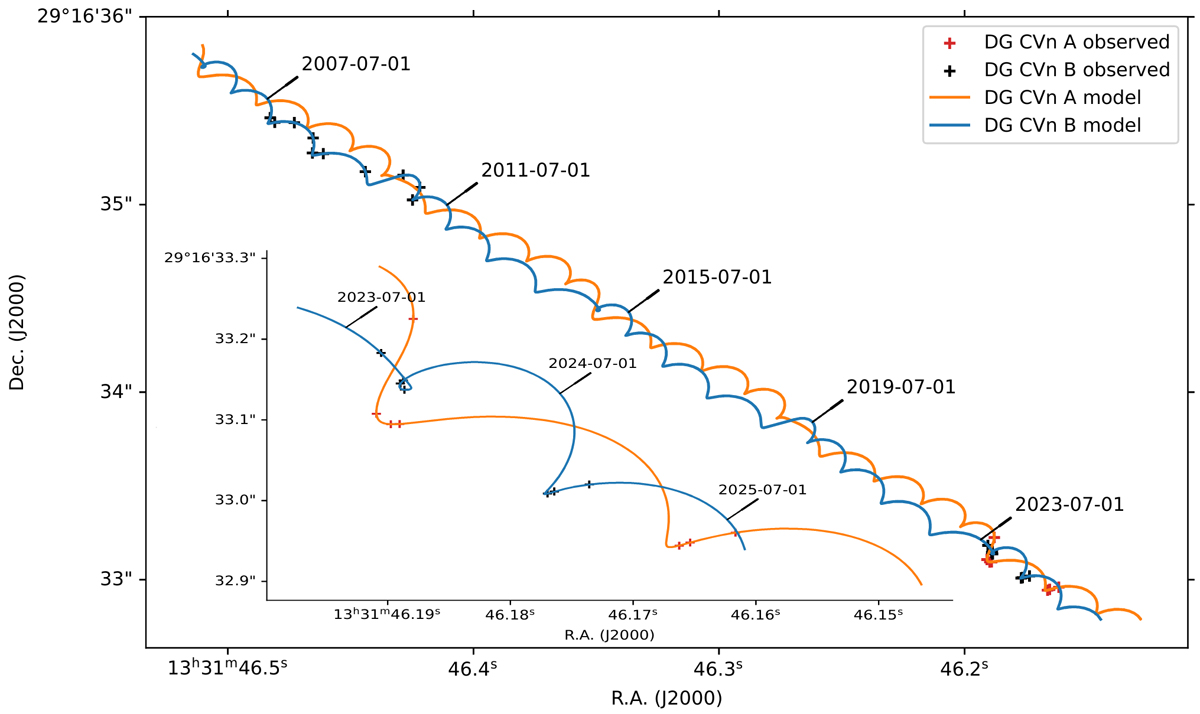
Credit: Astronomy & Astrophysics.
Two Stars That Come Dangerously Close for Planet Formation
One of the most striking features of DG CVn is the distance separating its stars during their closest encounters. At certain points in their orbit, the two red dwarfs approach within 0.59 astronomical units, considerably less than the average distance between Earth and the Sun.
Such encounters could have profoundly affected the gas and dust disks surrounding the stars during their formation. Gravitational interactions between the stellar companions would have restricted the extent of these disks, limiting the regions where planetary building blocks could accumulate and survive.
The researchers estimate that a planet orbiting either individual star would require an orbital period shorter than approximately 23 days to remain gravitationally stable. A circumbinary planet, traveling around both stars, would instead require an orbital period of at least 36 years. These calculations identify a wide range of intermediate orbits where planetary stability would be difficult to maintain, although no planets have been confirmed within the system.
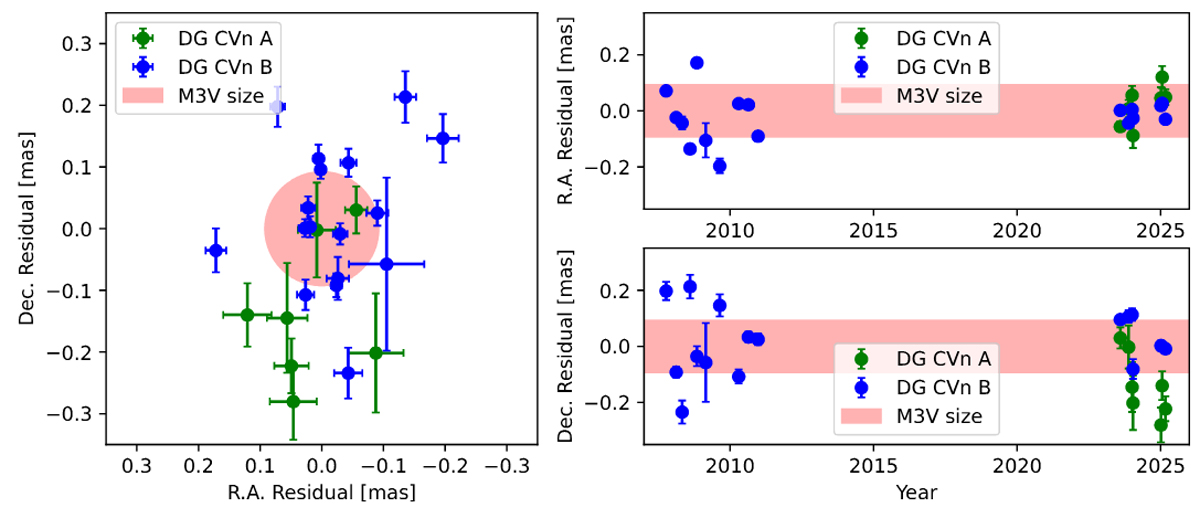
Credit: Astronomy & Astrophysics.
A Powerful New Approach to Finding Hidden Planets
Beyond revealing the architecture of DG CVn, the findings demonstrate how very long baseline interferometry (VLBI) could expand the search for exoplanets around magnetically active stars. An orbiting planet generates a small gravitational wobble in its host star, known as reflex motion, which sufficiently sensitive radio observations could detect.
Upcoming observatories, including the Next Generation Very Large Array (ngVLA) and the Square Kilometre Array (SKA), could extend these measurements to larger populations of stars at greater distances.
“And in the future, we hope to make measurements precise enough to detect planets in orbit around such radio-loud dwarfs,” said Huib van Langevelde, JIVE chief scientist and Leiden Observatory professor. “We think that when the ngVLA and the SKA become part of the VLBI network, we can do even more precise measurements, for many more, more distant stars.”
What began as an unsuccessful planet search has now provided astronomers with a compelling demonstration of how future radio telescopes could uncover planetary systems hidden from conventional observations.
Enjoyed this article? Subscribe to our free newsletter for engaging stories, exclusive content, and the latest news.

