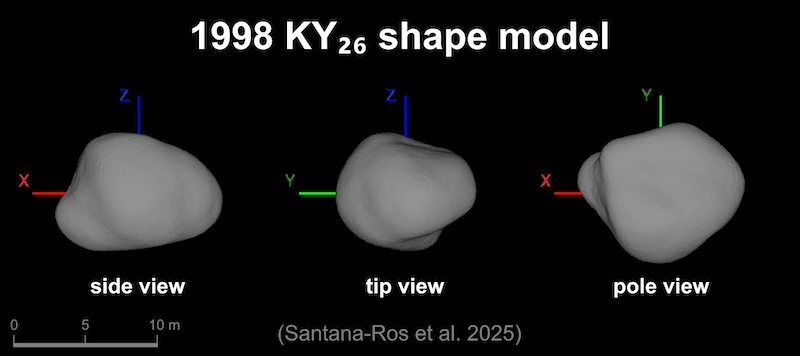
Дэлхий, Ангараг хоёрын хооронд Нарыг тойрдог жижиг биетийн хөдөлгөөнд таталцлаас өөр хүч нөлөөлж байж болзошгүй.
Ойролцоогоор 11 метрийн диаметртэй 1998 KY26 биетийн тойрог зам дахь хурдатгалыг зөвхөн таталцлаар тайлбарлах боломжгүй байгаа нь одон орон судлаачдын анхаарлыг татжээ. Жоржиа Технологийн Институтийн Корбин Хансен, Масатоши Хирабаяши нарын судалгаа 2026 оны аравдугаар сарын 28-нд Icarus сэтгүүлд хэвлэгдсэн бөгөөд уг биетийг сүүлт од, астероид эсвэл хуучин сансрын аппарат байж магадгүй гэж үзсэн таамгуудыг авч үзсэн байна.
Судалгаагаар 1998 KY26-ийн гадаргын температур ойролцоогоор -47 хэм тул мөс оршиход хэт дулаан, иймээс сүүлт од байх магадлал бага гэж үзжээ. Эрдэмтэд үүнийг астероид байх магадлалтай гэж үзэж байгаа ч Дэлхийд ойр биетүүд жижиг, бүдэг учраас судлах өгөгдөл хязгаарлагдмал байдаг.
2025 оны нэгэн судалгаагаар уг биет өмнө тооцоолж байснаас гурав дахин жижиг болохыг тогтоосон нь таталцлаас өөр хүчний нөлөөг авч үзэх үндэслэл болжээ. NASA-гийн Jet Propulsion Laboratory-ийн Давиде Фарноккья нарны фотонуудын үүсгэх цацрагийн даралт биетийг түлхэж болохыг санал болгосон бол нарны гэрэл шингээсний дараа дулаан ялгаруулах Ярковскийн нөлөө ч оролцож магадгүй; эдгээр хүч нийлж хурдатгалыг тайлбарлах боломжтой.
Харвардын их сургуулийн Ави Лёб 1998 KY26 нь 1998 онд Ангараг руу илгээсэн боловч сураггүй болсон Зөвлөлтийн “Фобос-1” аппарат байж болох хувилбар дэвшүүлжээ. Гэвч NASA-гийн захирал Жаред Айзекман үүнийг астероидоос өөр зүйл гэж үзэх нотолгоо байхгүй гэсэн бол судлаач Брайс Т. Болин биет сансрын хог хаягдал байхад хэт хүнд, нягт гэж мэдэгджээ. Японы “Хаябуса2” хөлгийг 2031 онд уг биетэд хүргэхээр төлөвлөж байсан ч хөдөлгүүрийн асуудлын улмаас энэ сард төлөвлөгөөг цуцалсан байна.
Дэлгэрэнгүйг эх сурвалжаас харах
Эх сурвалжийг нээх ↓
- 1998 KY26 is an unusual object that orbits the sun between Earth and Mars. What is it?
- The mystery space object sometimes accelerates in ways that gravity alone doesn’t explain.
- Photons of light from the sun might explain the strange movements of 1998 KY26, a new study suggests.
EarthSky’s famous lunar calendar is now available. Our beautiful blue and silver poster shows every day’s moon phase for 2027. Order yours today!
Mystery space object puzzles astronomers
An unusual object is orbiting the sun between Earth and Mars. It’s called 1998 KY26, and it’s not particularly big; it’s only about 36 feet (11 meters) across. But it accelerates around the sun in ways that gravity can’t account for. What is this object, and why’s it moving like that?
This object has been theorized to be a comet, an asteroid, or even an old space probe. But scientists now think it’s most likely an asteroid. And as for its strange movements, a new study suggests photons from the sun might be the key.
KorbinHansen and MasatoshiHirabayashi at the Georgia Institute of Technology published their new peer-reviewed paper in Icarus on October 28, 2026.
Alexander Nazaryan wrote about the latest findings in The New York Times on November 16, 2026.
Unusual accelerations
It’s the movements of 1998 KY26 that made it stand out to astronomers. It exhibits peculiar accelerations that cause it to deviate from its normal orbit around the sun. Johannes Kepler’s laws of planetary motion say that it should maintain a nice, neat orbit.
So why is it accelerating?
Various hypotheses for mystery space object
Scientists have proposed various hypotheses for the mystery space object. Is it a comet? 1998 KY26 doesn’t have a tail, which we’d expect a comet to have. But dark comets don’t have tails. Could it be a dark comet?
The researchers think not. In the new study, they show that the object is too warm to be a comet. Its temperature is -53 degrees Fahrenheit (-47 degrees Celsius). That’s cold, but it’s too warm for ice to exist on the object in space. Darryl Z. Seligman at Michigan State University said in The New York Times:
If something has ice, then it’s a comet. But no ice means no comet. The surface of KY26 is too warm.
Near-Earth Objects (NEOs) like 1998 KY26 are difficult to study, even though they are relatively close. That’s because they are typically very small. As Seligman noted:
There’s not tons of data on very Near-Earth Objects. They’re super small and faint.
Is 1998 KY26 powered by the sun?
In 2025, another paper showed that the object was actually only 1/3 the size that scientists thought it was. That was significant. It meant that other forces could be at work besides gravity to explain the acceleration.
Davide Farnocchia, a navigation engineer at NASA’s Jet Propulsion Laboratory in Pasadena, California, came up with an intriguing idea. Is the sun causing the unusual movements of 1998 KY26? If so, then photons — the smallest possible particles of electromagnetic energy — might be pushing the object. This phenomenon is called radiation pressure.
David Jewitt is the director of the Institute for Planets and Exoplanets at the University of California, Los Angeles. He explained:
Light photons carry momentum; it’s very small per photon, but there’s a hell of a lot of photons. That pressure is enough to push bodies around if they’re not too big.
There’s another force too, called the Yarkovsky effect. That’s when an object radiates heat after absorbing sunlight. That could be at play on the object as well. And the combination of the two forces might explain the accelerations of 1998 KY26.
Phobos 1?
There’s another very different possibility that has been floated as well. Could the object be the old Soviet Phobos-1 probe? The Soviet Union launched it back in 1998. Its mission was to visit Mars. But it was lost and never heard from again.
Avi Loeb at Harvard University has offered this as a possible explanation. You remember Avi? He famously suggested that the interstellar comet ‘Oumuamua was more likely to be an alien spaceship.
But he doesn’t think 1998 KY26 is a spaceship. Instead, he thinks it could be the Phobos 1 probe. He first proposed this last May in a paper that he co-authored.
NASA Administrator Jared Isaacman, however, said there is no evidence that it is:
… anything but an asteroid.
Bryce T. Bolin, a scientist at Eureka Scientific Inc., added:
There’s all sorts of space junk out there, but this object is way too heavy, way too dense.
Japan’s Haybusa2 spacecraft was supposed to visit 1998 KY26 in 2031. But just this month, the Japanese space agency called off that plan due to reported engine problems.
Bottom line: 1998 KY26 is a mystery space object that accelerates in ways that gravity alone can’t explain. A new study suggests light photons from the sun as the cause.
Read more: Tally of near-Earth asteroids passes 40,000
Read more: Tracking an oddball group of near-Earth asteroids

