
Газын Хөдөө аж ахуйн яамны мэдээллээр, дайны улмаас чидуны мод, боловсруулах үйлдвэрүүдийн ихэнх нь устаж, бүс нутгийн хүнсний хангамжид сөргөөр нөлөөлжээ.
Дайны өмнө Газын зурваст чидун тариалсан талбай 50 мянган дунам орчим байсан бол 2026 оны улиралд 5 мянган дунам болж буурсан байна. Хөдөө аж ахуйн яамны статистикаар, дайны өмнө байсан хоёр сая орчим модны 1.85 саяыг хүнд техникээр булгалж, устгаснаар чидуны модны нөөц 92.5 хувиар багасжээ. Үүний улмаас жилийн чидуны ургац 40 мянган тонноос 5 мянга, чидун жимсний тосны үйлдвэрлэл 5 мянган тонноос 700 тонн болж буурсан гэж мэдээлэв.
Израилийн арми чидуны төгөл, тариалангийн газрыг чөлөөлөхийг цэргийн зайлшгүй шаардлага гэж тайлбарлаж, ургамлыг зайлуулах нь харагдах орчныг сайжруулж, ХАМАС-ын нуусан байж болзошгүй хонгилын ам, пуужин харвах байрлалыг илрүүлэх зорилготой гэж мэдэгджээ. Харин тариаланчид газар нутгийнхаа зарим хэсэгт нэвтрэх боломжгүй, бусад хэсэг нь бульдозероор тэгшлэгдсэн гэж ярьсан байна. 2025 оны аравдугаар сард гал зогсоох хэлэлцээр хэрэгжиж эхэлсний дараа ч тариалангийн талбайд нэвтрэх боломж хязгаарлагдсан бөгөөд НҮБ-ын Хүнс, хөдөө аж ахуйн байгууллагын мэдээллээр 2026 оны зургаадугаар сард нийт талбайн ердөө 3 хувь, наймдугаар сард 2.2 хувьд нэвтрэх боломжтой байжээ.
Усалгааны зориулалттай 2,261 худгийн 86.7 хувь нь устсан бөгөөд үлдсэн худгуудаас тариаланчид 195-д нь л хүрч байгаа аж. Газын зурваст өмнө нь 40 орчим чидун боловсруулах үйлдвэр ажиллаж байсан бол одоо долоо нь хязгаарлагдмал хүчин чадлаар ажиллаж, үйлдвэрлэлийн хэмжээ эрс буурчээ. Үүний зэрэгцээ зах зээлд нэг килограмм шинэ чидуны дундаж үнэ дайны өмнөх 1.5 ам.доллараас энэ улиралд 10 ам.долларт хүрсэн бөгөөд НҮБ-ын шинжээчид тариаланчдыг газар нутагтаа аюулгүй нэвтрүүлж, үр, бордоо, усалгааны хэрэгсэл, түлшээр хангах шаардлагатайг онцолсон байна.
Дэлгэрэнгүйг эх сурвалжаас харах
↓Эх сурвалжийг нээх ↓
Want to bookmark your favourite articles and stories to read or reference later? Start your Independent Membership today.
Already a member?
This article first appeared on our partner site, Independent Arabia
On a crowded street corner in the battered city of Gaza, Zaher Kashko stands over a pan of boiling oil, selling freshly flipped falafel patties to passers-by so he can put food on the table for his family.
Before the war, October meant something different to Zaher. He used to welcome the start of the month with the scent of fresh green oil flowing from his own olive oil press to the east of the city.
Now, however, Zaher’s land and oil press lie behind the ‘Red Zone’, which is under Israeli military control. The five dunam olive grove (a dunam is around 1,000 square metres) has been passed down Zaher’s family for nearly two centuries.
The land was home to 40 mature olive trees, yielding between 10 and 12 tonnes of fruit in rainy seasons, and no less than six tonnes in leaner years. The war has claimed the lives of 150 members of the Kashko family and destroyed the orchard and olive press, forcing Zaher off his land to sell falafel on the pavement.
A few kilometres to the south, farmer Haidar Abu Madin bends down to pick up a dried olive branch from the ground and tosses it onto the barren soil. “Before the war, this land was one of the most fertile and thriving olive groves in Gaza,” he says.
Before the war, Haidar and his brothers co-owned an expansive grove that stretched over 924 dunams. Its trees yielded up to 1,500 tonnes of olives every year, producing nearly 900 barrels of pure olive oil once pressed.
The ‘yellow line’ split his land in two: he is banned from accessing one half, which is now occupied by Israeli forces, while the other half has been levelled by bulldozers, leaving only 30 trees, which are not expected to yield more than two barrels.
Haidar mourns the loss of his land, telling Independent Arabia: “The harvest used to be enough to supply the entire central region, with both oil and olives.”
Gaza’s ‘green lungs’
For years, the olive tree has been known as the “crown jewel” of Gaza’s agriculture. Its groves account for nearly 60 per cent of the total orchard area. They were the green lungs of Gaza’s densely populated cities, providing local self-sufficiency in oil and olives.
According to data from the Ministry of Agriculture in Gaza, analysed by value chain and food security specialist Mohammed Abu Odeh, the area planted with olive trees in the Strip has shrunk by 90 per cent as a result of military operations, falling from around 50,000 dunams before the war to just 5,000 dunams in the 2026 season.
The ministry’s statistics show that bulldozers uprooted and destroyed around 1.85 million trees, leaving only around 150,000 trees in Gaza out of the two million that existed before the war. Consequently, the Strip has lost 92.5 per cent of its olive tree stock.
As a result of this bulldozing campaign, olive production has plummeted from 40,000 tonnes to 5,000 tonnes per year, while olive oil production has shrunk from 5,000 tonnes to just 700 tonnes. This has created a food deficit of 85 per cent of what Gazans need to feed their families.
IDF ‘reorganising area for better visibility’
The destruction of olive groves during the war appeared to be intentional. Last January, Israeli newspaper Yedioth Ahronoth revealed a rare internal dispute within the Israeli army’s Southern Command, after a military division borrowed heavy agricultural machinery from Israeli civilians and had soldiers operate it to clear land and vegetation in the Gaza Strip.
At the time, an Israeli military official justified this by saying: “This type of equipment is normally used to remove vegetation and level the ground. The forces are reorganising the area to allow for better visibility.”
However, agricultural researcher Nizar al-Wahidi tells Independent Arabia: “The Israeli army treats olive trees as an obstacle that obstructs visibility and must be cleared to secure firing lines. But what the machinery clears in a matter of hours takes years to restore.
“Olive trees in Gaza, particularly the Al-Suri and Al-Nabali Baladi varieties, are not seasonal crops that are sown and harvested in the same year. These are perennial trees which, under natural conditions, take between five and nine years from the planting of the sapling until they begin to bear fruit, and only reach their peak production after many decades of care, pruning and irrigation.”
Al-Wahidi emphasises that uprooting such a vast number of trees would condemn the Gaza Strip to a food and agricultural deficit that would last for an entire generation.
‘I can hear gunfire’
Before the war, the three governorates of Khan Yunis, Deir al-Balah and northern Gaza alone were home to 75 per cent of the Strip’s olive groves. Most of these were concentrated in the eastern and northern stretches along the border fence.
This geographical location made the groves the first victims of the ground operations, as Israeli forces now control around two-thirds of the Gaza Strip’s territory and prevent residents from approaching the ‘yellow line’.
In eastern Deir al-Balah, farmer Atiya al-Attar oversees five workers picking Chemlali olives from the 50 remaining trees on his four dunam plot. Al-Attar works under the watchful eye of an Israeli military crane, which monitors every movement in the open fields.
Among the few remaining trees near Salah al-Din Street, harvester Ahmed Khader picks olives and reminisces about life before the war. “When times were good, I used to work on this land for two months. This season, however, I’m working right next to the yellow line and I can hear gunfire. I feel scared and terrified, but I have to provide for my children.”
Agricultural land has continued to shrink even after the ceasefire agreement came into effect in October 2025. According to data from the Food and Agriculture Organisation of the United Nations (FAO), although large-scale military operations had ceased, access was permitted to only three per cent of Gaza’s total agricultural area in June 2026. However, by August, tighter access restrictions had reduced this area to just 2.2 per cent.
Last July, satellite images taken by Planet Labs showed Israeli forces setting fire to fields in central and northern Gaza, resulting in the burning of around 16 square kilometres of agricultural land, particularly in East Jabalia.
Farmer Tahani al-Najjar says this has far-reaching consequences: “People have lost not only their homes, but also their livelihoods. The whole of Gaza has lost its food production.”
‘Lawnmower’ protocol
Israel regards the large-scale bulldozing operations as a “military necessity”, emphasising that the aim is to uncover and destroy tunnel entrances and rocket launch sites which it accuses Hamas of concealing within agricultural land.
Israeli army spokeswoman Ella Waweya said: “There is a consensus in Israel on the need to deal with Hamas decisively, to prevent a repeat of 7 October and to prevent the Movement from rebuilding.”
The Times of Israel quoted an Israeli defence source as saying: “We have a military protocol along the Gaza border that acts as a lawnmower to nip any threat in the bud. This clearing is being carried out in coordination with the army’s legal department, in preparation for the legal defence of the decision to carve out these areas from the Strip.”
However, in its report entitled The Perimeter, the Israeli advocacy group Breaking the Silence documented testimonies from Israeli soldiers and officers who served inside Gaza, revealing that the levelling of orchards was a comprehensive engineered operation that began after control of the area had been established.
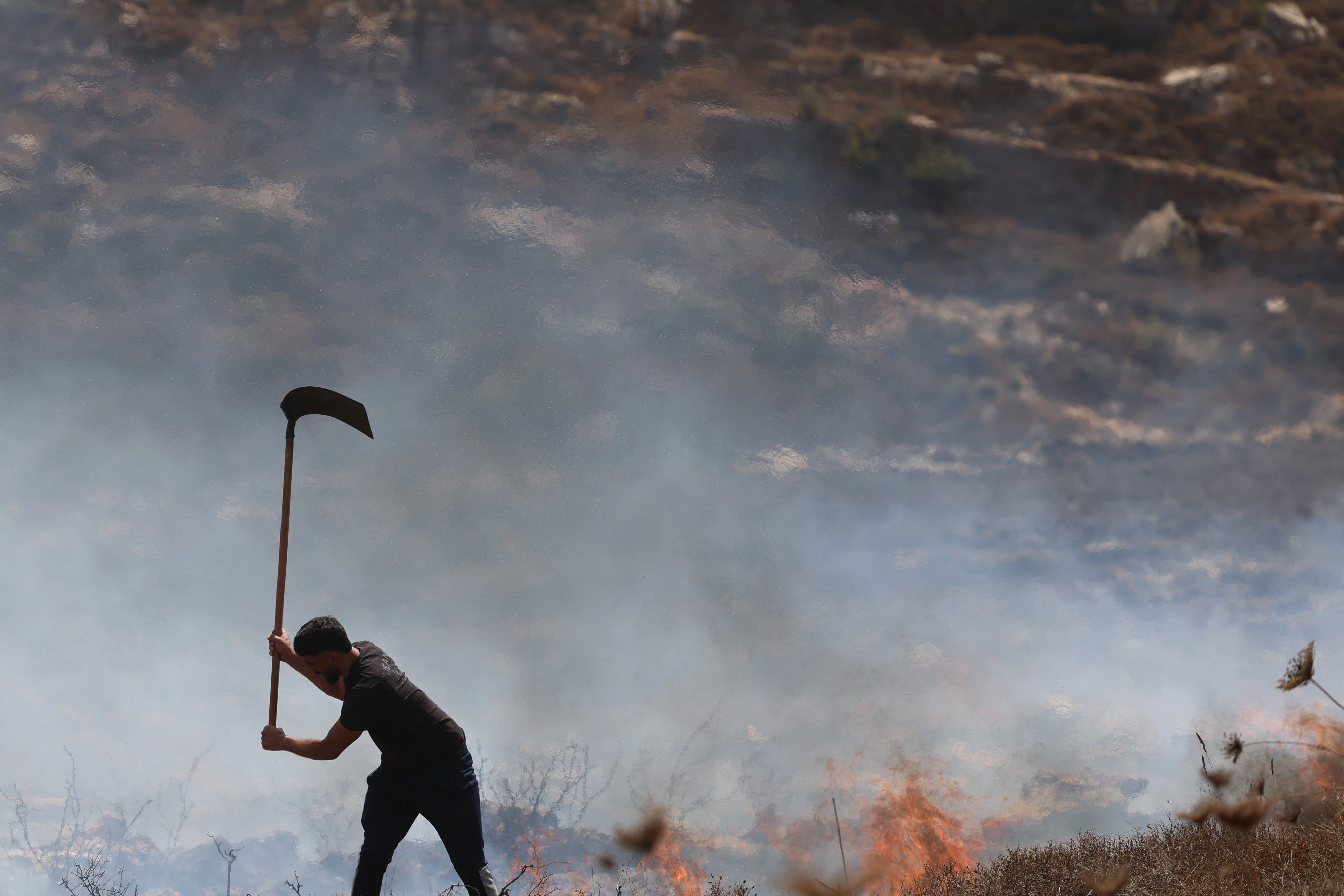
A major in the Israeli army stated in his testimony: “D9 bulldozers are levelling the ground to create a sterile strip. We spend between 8 and 12 hours a day scraping and levelling the soil where fields and orchards once stood, in order to create barren buffer zones.”
The disappearance of ancient cultivars
On his land in central Gaza, farmer Kamel Baraka inspects what remains of his damaged trees, comparing this season’s yield with that of previous years. He says, “A tree that used to produce around 100 kilograms of olives before the war now yields no more than 30 kilograms.”
The decline in yield per tree is primarily due to drought. FAO data shows that 86.7 per cent of agricultural wells in the Gaza Strip have been destroyed; of the 2,261 agricultural wells that used to irrigate the orchards, only 301 remain intact. However, farmers can only access 195 of these.
With the water cut off, farmers have lost their ancient cultivars, which gave the Strip’s olive oil its historic reputation. According to data from the Ministry of Agriculture, the greatest loss is that of the Al-Suri variety, which is classified as the finest olive oil in Gaza, with an oil content of 38.8 per cent of the dry pulp weight.
Alongside Al-Suri, the Nabali al-Baladi variety – locally known as ‘Rumi’ – has also disappeared from the presses and dining tables. This variety is distinguished by its small stone, which accounts for no more than 17 per cent of the fruit’s volume. Also missing is the Chemlali variety, which has changed and adapted to the salinity and aridity of the Strip’s soil.
Ahed Al-Rifi, director of the olive department at the Ministry of Agriculture, says: “Farmers’ inability to access their fields, coupled with a lack of fertilisers and pesticides and the inability to prune the trees to aerate their branches, are factors that have left the remaining orchards vulnerable to agricultural diseases and pests.”
He adds: “The olive fruit fly has infested the Al-Suri variety, which has not been sprayed with pesticides, while the peacock spot and stem borers have attacked Al-Nabali trees, resulting in leaf drop and the withering of the olives before the harvest season.”
An empty landscape
In the southern governorate of Khan Yunis, which alone accounted for 34 per cent of the Strip’s total olive-growing area, satellite images show that 93 per cent of the buildings and orchards in the town of Abasan al-Kabira to the east of the city, have been destroyed.
During periods of respite, farmer Amr Abu Nasira tried to reach his land to check on his trees. “I found nothing,” he says. “The fields have turned into a desert, the equipment has vanished and the sheep are dead. Everything has been wiped out.”
Nearby, farmer Suhail Qadih managed to visit his land once. He says, “I found that the soil, which used to produce dozens of varieties of olives and fruit, had been mined and was littered with unexploded ordnance. Replanting it now seems impossible.”
The Israeli army, meanwhile, framed the destruction of this agricultural area east of Khan Yunis as a “security necessity”, declaring that its forces had destroyed more than 100 pieces of “Hamas infrastructure” and uncovered dozens of tunnel entrances there.
Military spokesperson Avichay Adraee emphasised that the policy in those fields is “not to allow anyone to approach Israel’s borders”.
The silent presses
At 1pm, the Abu Zeidan olive press in Deir al-Balah begins to turn, after hours of waiting for a five-tonne batch of farmers’ olives to be gathered in the press yard, after which the pressing process can begin.
The machines operate for just two hours, during which the olives pass through four stages: first, they are washed and the leaves and dust are removed; then they are crushed in a stone mill to turn them into a paste; next, they pass through a centrifuge to separate the oil from the water; and finally, they are sorted, after which the green oil emerges ready for bottling.
Fawaz Zidan, the owner of the press, says: “Compared to all the years before the war, this season is a complete washout because there are no olives. Even this year’s oil does not seem pure; it has likely been contaminated by the chemicals used in the rockets.”
According to data from the Ministry of Agriculture, the number of operational olive presses in the Strip has fallen from around 40 in previous seasons to just seven, which are currently operating at limited capacity.
This destruction has led to a decline in the number of pressing and production lines from 68 to just 15. The total operational capacity of the presses has fallen from 150 to 25 tonnes per hour, and the operating season has been reduced from three consecutive months to only two intermittent weeks.
Olive-related industries have not been spared, as only three out of 14 pickling factories remain, with their production capacity falling from 1,500 tonnes to just 200 tonnes.
This shutdown has also affected the workforce: the number of farmers involved in the olive sector has fallen from around 20,000 to just 100. Meanwhile, the number of harvest workers has dropped from 3,000 to around 200, most of whom do not receive a full day’s wages.
12 kilograms on a stand
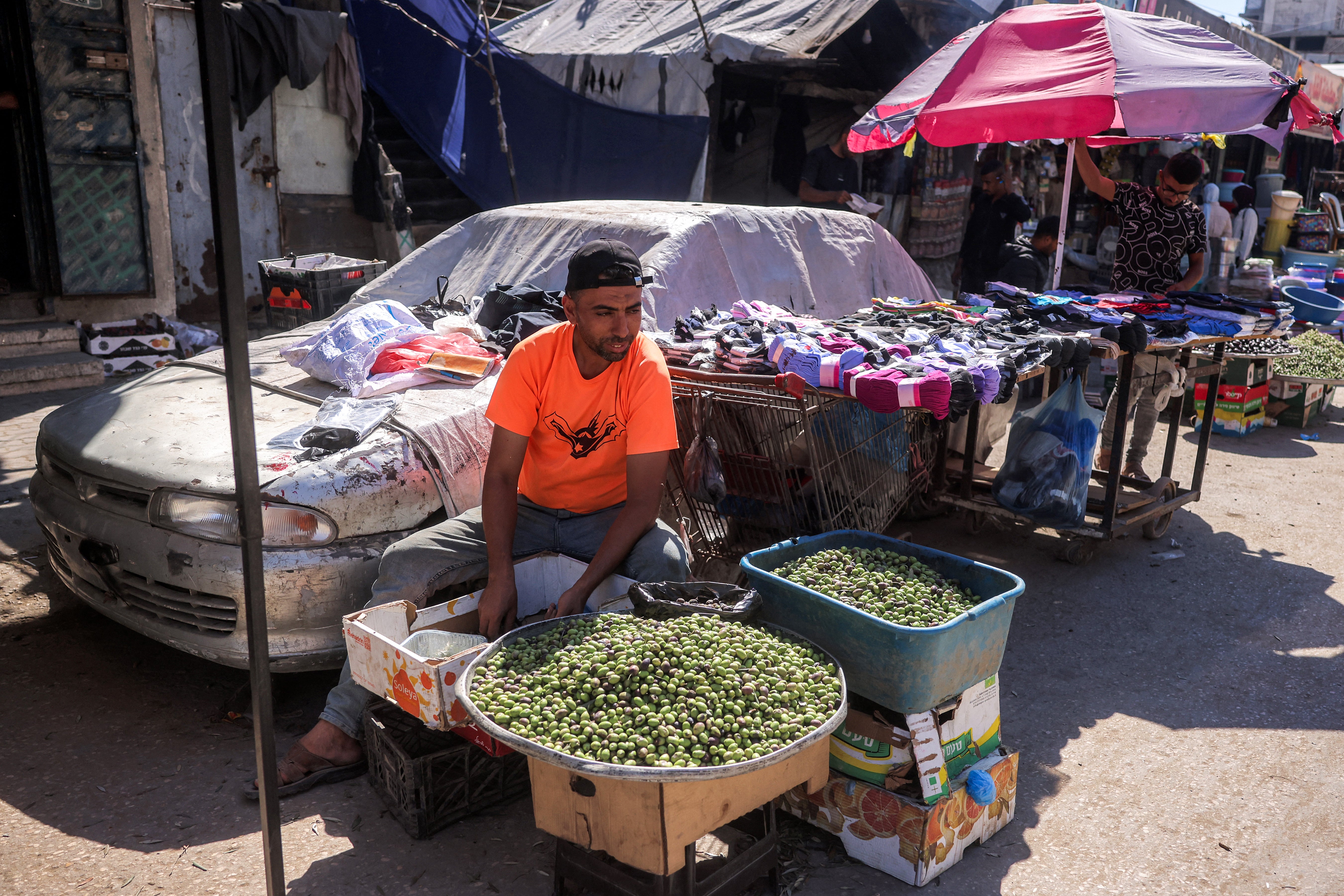
On the pavement of Al-Saraya market in the centre of Gaza City, young Khaled Abu Kamil sits behind a small wooden stand, displaying a quantity of olives weighing no more than 12 kilograms.
Speaking to Independent Arabia, Khaled says: “In previous years, we used to sell olives in large sacks that filled the pavement in October. But today my entire stock weighs only a few kilograms, which people buy by the ounce or the pound so that their homes don’t run out of olives.”
Leila Arhim, a local resident, stops in front of the stall to ask about the price, then moves on. The average price per kilogram of fresh olives in the Strip’s markets has shot up from $1.50 (£1.15) before the war to $10 (£7.60) this season, despite the olives’ reduced size.
In a statement released by the OHCHR, UN experts said: “The olive harvest should be a time when farmers can enjoy, in safety and dignity, the food and livelihoods their nature and land provide, not another season of fear, loss, violence and destruction.”
The statement further emphasised that restoring local food production in Gaza depended on farmers being granted safe and unrestricted access to their land, which is currently blocked by military lines. It also depended on them being provided with seeds, fertilisers, irrigation equipment and fuel.
Translated by Mirane Abou Zaki; Reviewed by Tooba Khokhar and Celine Assaf

