
1986 оны 11 дүгээр сарын 22-нд 20 нас дөрвөн сартай Майк Тайсон Тревор Бербикийг буулган авч, хүнд жингийн дэлхийн хамгийн залуу аваргаар тодорч байв.
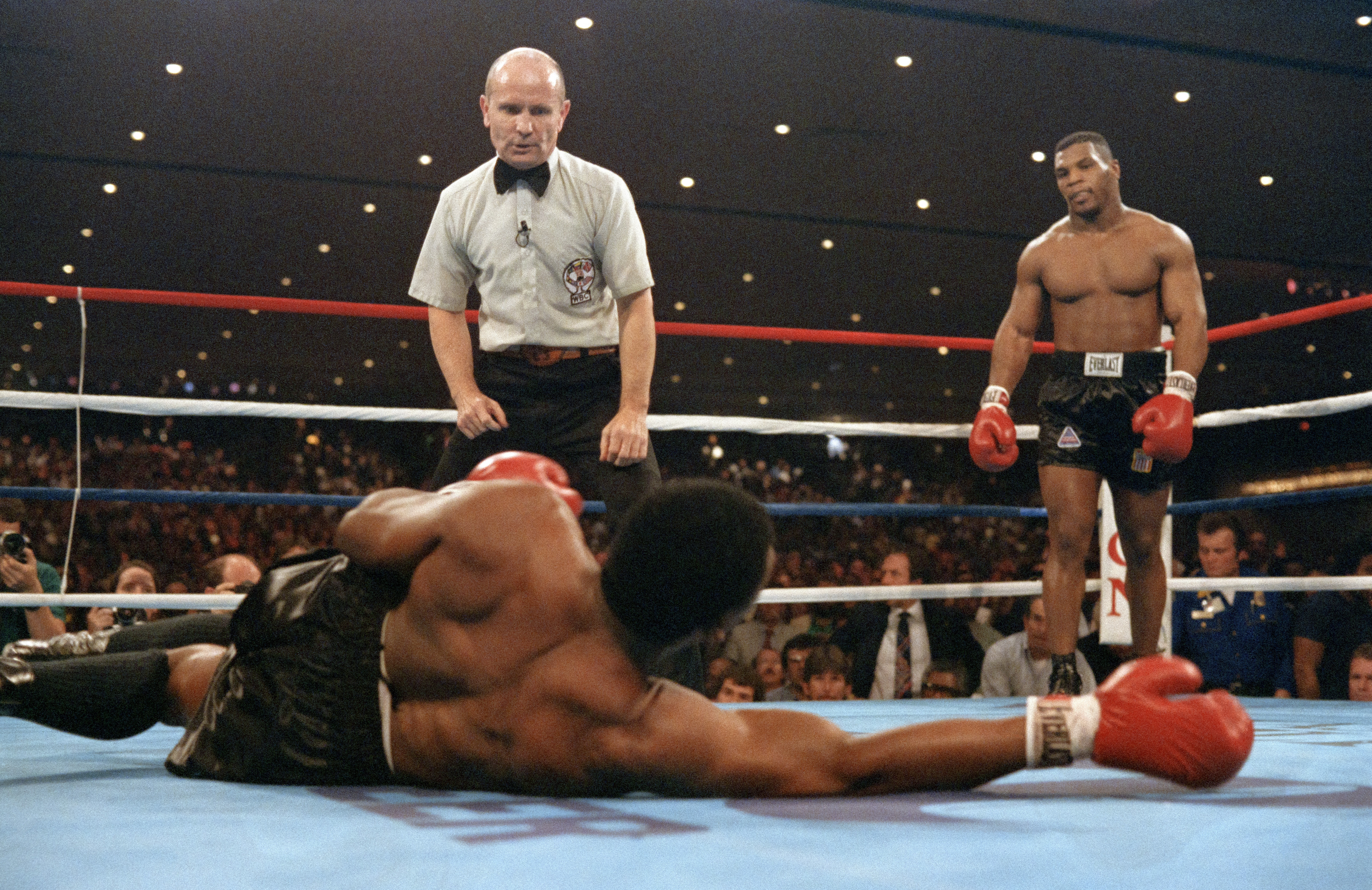
Лас-Вегас хотноо болсон тус тулааны хоёрдугаар раундад Майк Тайсон хүчтэй зүүн гараараа цохилт өгч, Тревор Бербикийг хүнд байдалд оруулснаар шүүгч Миллс Лэйн тулааныг зогсоож, ялалтыг Тайсонд олгосон юм. Энэхүү ялалт нь боксын ертөнцөд жинхэнэ утгаараа шинэ эрин үеийг эхлүүлж, Тайсоныг тухайн үеийн боксын спортын хамгийн том од болгосон билээ.

Тайсон тухайн үед 28-0 гэсэн амжилттай байсан бөгөөд үүний 25-ыг нь нокаутаар шийдвэрлэсэн байв. Түүний дасгалжуулагч асан Кас Д’Аматогийн боловсруулсан хамгаалалтын өвөрмөц хэв маяг болон хүчирхэг цохилтууд нь түүнийг өрсөлдөгчдийнхөө хувьд дийлдэшгүй хүчин болгосон юм. Энэхүү тэмцээн нь 1978 оноос хойших анхны үнэмлэхүй аваргаа тодруулах зорилготой байсан бөгөөд Тайсон өөрийн гайхалтай тулааны үзүүлэлтээрээ хүнд жингийн боксыг давамгайлж эхэлжээ.
Дэлгэрэнгүй эх сурвалжийг харах
Эх сурвалжийг нээх ↓
Looking back on it 40 years later, you miss the tuxedos for the occasion. The HBO broadcast crew of Barry Tompkins, “Sugar” Ray Leonard and Larry Merchant, in their finest evening dress, dapper down to the cufflinks, gathered at the Las Vegas Hilton for what Merchant called a “coronation more than a contest.”
On Nov. 22, 1986, Mike Tyson, just 20 years and four months old, was set to become boxing’s youngest ever heavyweight world champion.
It felt like a chandelier affair, even if, as Tompkins points out, it was in fact the “diametric opposite.” Tyson, a kid from the Brooklyn who’d been taken under wing by Cus D’Amato, stalked toward the boxing ring for his title bout with Trevor Berbick wearing his trademark white towel as a shirt, crudely slit down the middle to slip over his head. He was in the iconic black trunks, which would earn him a $5,000 fine for insubordination because Berbick had elected to wear black, and Mike wasn’t yet the champion.
The heightened sense of anticipation belonged to that word: Yet.
Invincibility is a fool’s notion, after all, while inevitability is straight terror.
Even at 20 years old — especially at 20 — Tyson brokered in the kind of doom that could do 50 shares for HBO, which means that 50% of all households with HBO would tune in. He dealt in the kind of doom that didn’t belong to the tamer confines of sport, but to a savagery that instead delved deeper into man’s innermost darkness. Fighting from the shell, he would hold his palms at his chin and nuzzle into his opponent, only to explode from the inside with an uppercut or right hook, from his legs through the knuckle, and from the cruelest of angles, to snap a man’s head back from his shoulders.
Everyone knew Berbick, the WBC heavyweight champion heading into what was being billed as the Heavyweight World Series, was in well over his head. Berbick, considered a decent enough defensive strategist, would need to incorporate something more like self-preservation to survive against Tyson, who by November had already won a dozen fights that year alone.
There was the one against Joe Frazier’s son, Marvis Frazier, where the “myth of Tyson” — as HBO’s longtime blow-by-blow man Jim Lampley believes — really began. That fight aired on ABC, which meant a lot of people saw Frazier fall in 30 seconds after a ferocious right uppercut. There was that win over Jesse Ferguson, the first Tyson fight Lampley ever called, in which “Iron” Mike tried to “knock his nose bone into his brain,” a recommendation of the late D’Amato. When Tyson relayed this line in his cartoonish lisp after landing the uppercut that felled Ferguson, it only added dimension to the many sadisms in play.
There was the clubbing of poor Reggie Gross, who managed to last two-and-a-half minutes, and David Jaco, who was lucky to come out of Albany with his life. Tyson had already viciously bludgeoned, hooked, battered, and psychologically warped everyone he stood in there with, through the who’s who of woodwork fighters leading to Berbick.
“In the early going, I saw him win fights before a punch was ever thrown, and that’s not an exaggeration,” Tompkins says. “I remember he fought a guy in Atlantic City named Jose Ribalta. He was a Cuban guy, and he was OK. He was ranked, I don’t know, fourth or fifth, somewhere in there.”
Tyson was already wearing the towel as a shirt even then, which carried with a not-so-subtle note of foreboding.
“Once he got in the ring, he would pace like a tiger and never take his eyes off his opponent for the whole time,” Tompkins says. “They played the anthem and they introduced all the celebrities and the judges and the referee. It probably took 10 or 12 minutes, and through that entire time he would just pace and never take his eyes off his opponent.
“It was literally if looks could kill. It’s not an exaggeration. I remember looking across at Jose Ribalta right before the opening bell. He was sitting on his stool, and he was looking for a way out. I had that feeling — you know how on stages there’s a door that opens up, and you go down from the stage? That’s what he was looking for.”
Ribalta was knocked down three times over the course of the fight, yet somehow made it into the 10th round before being knocked out.
HBO first broadcast Tyson shortly before his 20th birthday, for his bout against Mitch Green. It was one of the rare times in the early days that an opponent survived to hear the scorecards. (Tyson met the toothpick-chewing Green again in a street fight in 1988, which was far more entertaining.) It happened very fast, but the Tyson era was well underway by the time he stood in against Berbick, to kick off a tournament that had been made to crown the first undisputed heavyweight champion since Leon Spinks in 1978.
It had kicked off, but what he did to Berbick that night to win the first of the three heavyweight belts was his arrival. It wasn’t just the Tyson era; it was a new era of heavyweights.
Looking back, you can’t help but miss the storytelling of the day. The literary feeling of sophistication that rooted all narratives to the broader human story.
“Think about it,” Lampley says. “In the culture in which Barry [Tompkins] and I operated, you had to be ready to go to dinner on Thursday and Friday night with Larry Merchant and all the other top writers. You had to be able to be on their turf and having the same conversation with literate writers who wrote books as well as boxing and stuff like that. It was quite a playing field.
“And Larry [Merchant] was sort of the kibitzing dean of all that. He was a really cryptic, close, piercing commentator. No one was better at that than Larry. It was a fun thing to be around, but guys like Larry, Jon Saraceno [who passed away earlier this month], Ron Borges, and various others who were in the boxing writing cult at that time, were fun because they were literate and intelligent and knew how to make less of what the rest of the world was making very big.”
Before Tyson took Berbick out 40 years ago with a short left hand to the temple, a shot the writer Chris Jones said sent Berbick “across the ring like a man falling down a flight of invisible stairs,” you knew that the 32-year-old Berbick was a preacher at the Moments of Miracles Church. There was a spotlight feature about it. A Jamaican fighting out of Miami, he was the first fighter to take Larry Holmes to the scorecards. He’d taken the WBC title from Pinklon Thomas in March, outpointing him.
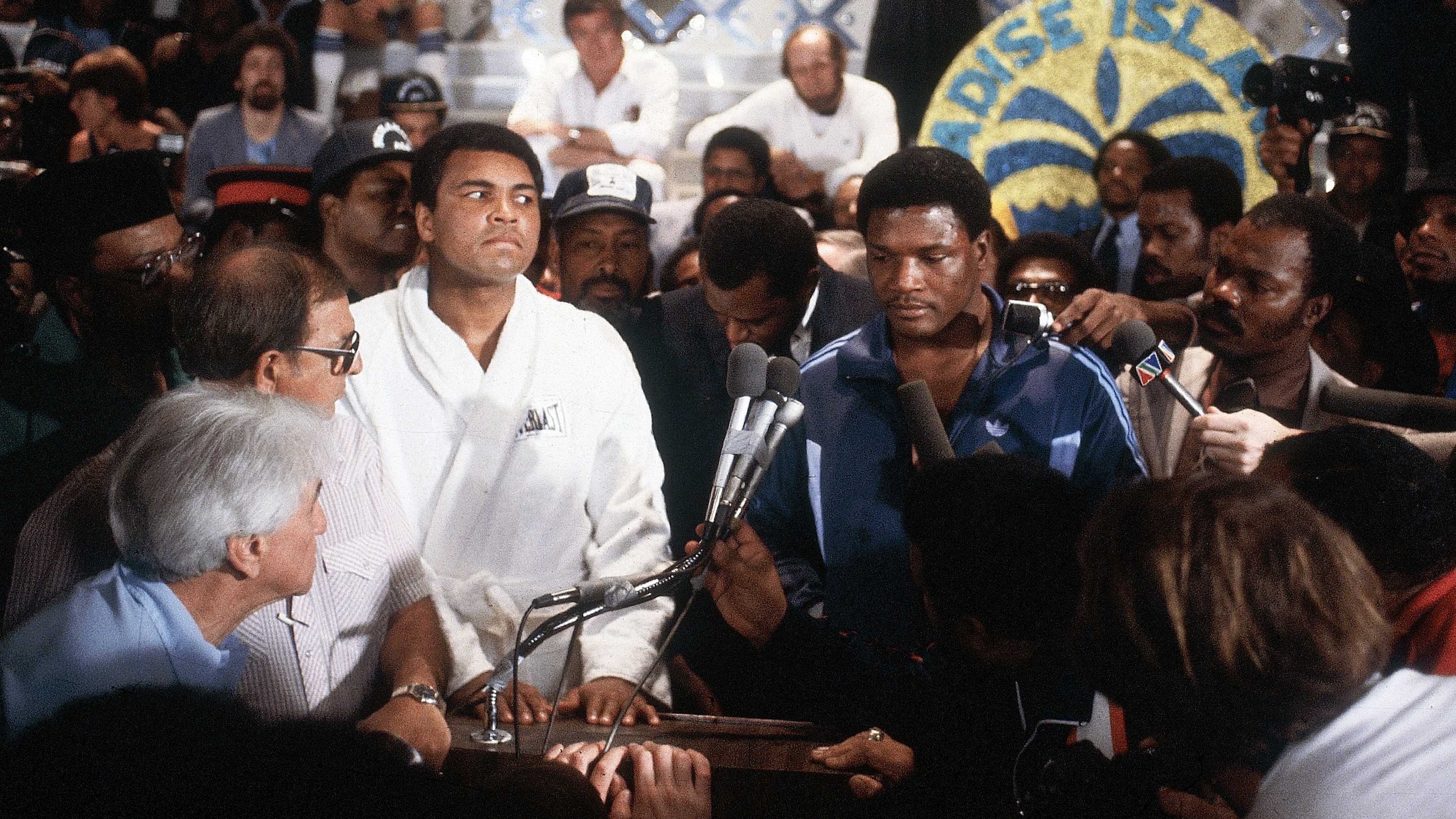
You also knew that Angelo Dundee, famous for training Muhammad Ali, was in the corner of Berbick, and that Ali — sitting ringside in the $1,000 VIP seats — was the reason a black cloud hung over Berbick to begin with. It was Berbick who battered Ali in Ali’s last professional fight in 1981, one of boxing’s saddest spectacles.
And you knew that Cus D’Amato, Tyson’s father figure who’d died a year before he won the title that night against Berbick, was the single madcap orchestrator behind Tyson’s worldview and style. Old Cus was still at work on Tyson’s emotional levers, still getting his points across through the last protégé he knew in this world.
“With me, a guy comes to me with a spark,” D’Amato said in the video feature HBO put together. “I fan the spark until it becomes a flame. I feed the flame until it becomes a fire, then I feed the fire until it becomes a roaring blaze. That’s what I have to do.”
HBO’s Vice President at the time, Ross Greenburg — who would go on to head HBO Sports from 2000-2011 and win 56 Emmys — was the producer of that big night 40 years ago. The magnitude of those events in the mid-to-late 1980s, which set the bar so high, was in large part due to Greenburg, who made storytelling a priority. He also made sharp commentary a must.
“You have to understand, particularly being live on HBO in prime time, we felt as if we were doing a Super Bowl every time that Tyson climbed into the ring,” says Greenburg. “Same as with [Ray] Leonard and [Marvin] Hagler and all the rest.
“These were major events and parties because people were having 10 or 12 people over. That was the height. And in the 1980s, particularly when Tyson hit, that was really the glamor period of the sport. I always like to say that the average sports fan was tuning in and paying attention because the star power of these boxers was real, and it was electric.”
Greenburg was there for many big fights, from Leonard-Thomas Hearns to Leonard-Hagler to the great Hagler-Hearns war. Vegas, in the mid-1980s, was only on the verge of becoming what it is now. There wasn’t an MGM Grand Garden Arena or a Mandalay Bay or a T-Mobile Arena available. Caesars Palace would build a makeshift outdoor arena for events, and the Las Vegas Hilton would convert a contention center into an epicenter for the era’s biggest stars.
Ringside that night were Rob Lowe, Eddie Murphy, Kirk Douglas, Sylvester Stallone. Boxers, past and present, like Tommy Hearns. Hector “Macho” Camacho, the under-sung Larry Holmes and Michael Spinks, who ducked out of the unification series to avoid fighting Tony Tucker. Ali was there, too, and the great Archie Moore.
As so much within that fight connected to the history of the sport, it was Moore who lost his title 30 years earlier to the then-youngest heavyweight champion of the world, Floyd Patterson. When Patterson won it in 1956, he was nearly 22 years old, a full year and seven months older than Tyson was as he stared down Berbick.
“Tyson had already hit as a phenomenon in the world of boxing and had really become a major force, even at that tender age, because of the story with Cus D’Amato and the fact that we had given him three fights of exposure on HBO,” Greenburg says. “When we launched into the heavyweight World Series, he was in his zenith, not only as a personality that had just burst upon the scene and the American public took to him, but also as a prize fighter. You’re looking at his absolute prime.”
“And Cus D’Amato had passed, but the bobbing and weaving and the speed of his hands and the power of his punch that came up from his legs, which Cuss had taught him and molded him, were all there. And he was impossible to hit defensively.”
Even though Tyson had only been a pro fighter for 21 months, the tournament was built on an educated hunch — which is to say, the near certainty — that he would beat any man in his path. Berbick, just as Pinklon Thomas and James Smith and Tony Tucker and Tim Witherspoon and (eventually) Michael Spinks, were the nondescript old guard of the division, there to make up Tyson’s casualty list, one thundering uppercut at a time.
The champ Berbick refused to meet Tyson’s eyes during the instructions, which was perhaps a wise thing. What he would have seen was Tyson’s eyes tracking his every sway, never leaving the the target he was moments away from obliterating.
“Trevor and all of the other heavyweights in that Heavyweight World Series were really pawns for Mike Tyson, in order to wrap those three belts around his waist in that regard,” Greenburg says. “Once Spinks took the chicken route out of the series with Butch [Lewis], it was pretty clear that Tyson was the odds-on favorite to wrap all three belts. So, I think Trevor was no different than any of the others.”
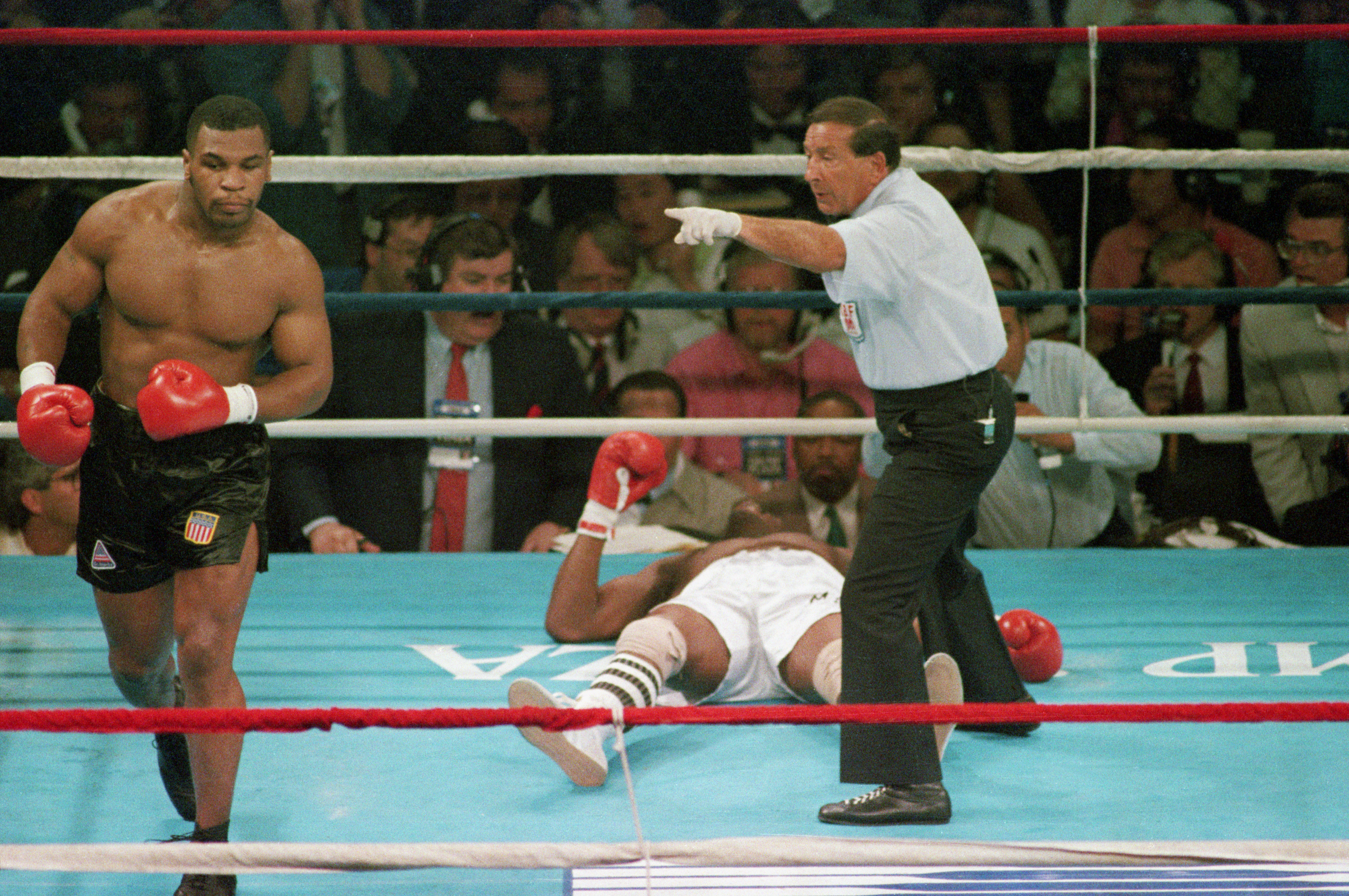
To his credit, Berbick tried. He came in and swung at Tyson, showing the kind of “bravado” that felt a little incautious to Tompkins on the call. He was hurt in the first round, and late in the second, after a hard shot to the body followed by a clean left hook, he couldn’t get back to his feet. Referee Mills Lane waved it off, and Tompkins, in a moment that shifted Tyson from being a contender into the baddest man on the planet, delivered one of boxing’s most celebrated calls.
“It’s over! That’s all. And we have a new era in boxing …”
When they announced the world’s youngest ever heavyweight champion, they called him “Michael Tyson,” which is a fun footnote within the swirl of all the things changing at once.
“We knew that Tyson’s ratings were just blowing our register,” Greenburg says. “And we knew that this was a, electric moment for the company and for boxing in general. The heavyweight champion of the world can dictate in many ways the power of the sport of boxing. And in this case you had Mike Tyson. So much like Ali had kind of electrified the world, the baddest man on the planet was the heavyweight champion.”
“I never really thought of it as any kind of an epic line,” the now 80-year-old Tompkins says of his fight-ending call. “Truly, I never did. And then people started feeding that line back to me over the years. But until somebody told me about it, I didn’t even remember what it was.”
You miss the hysteria that could be felt, not just in Las Vegas, but everywhere. Tyson was 28-0, with 25 knockouts, and it was inconceivable in that moment that he would lose anytime soon. Not with who was out there. Not with who he was.
Going in, Tyson beating Berbick was a near certainty, but you had to see it just to share in the communal awe.
“It did feel like Berbick was a foregone conclusion,” Tompkins says. “I used to say this all the time, Tyson’s punches, when you’re wearing headsets, they sounded like nothing I’d ever been around in 40 years of doing boxing. His punches sounded like it was like dropping a watermelon off a building.”
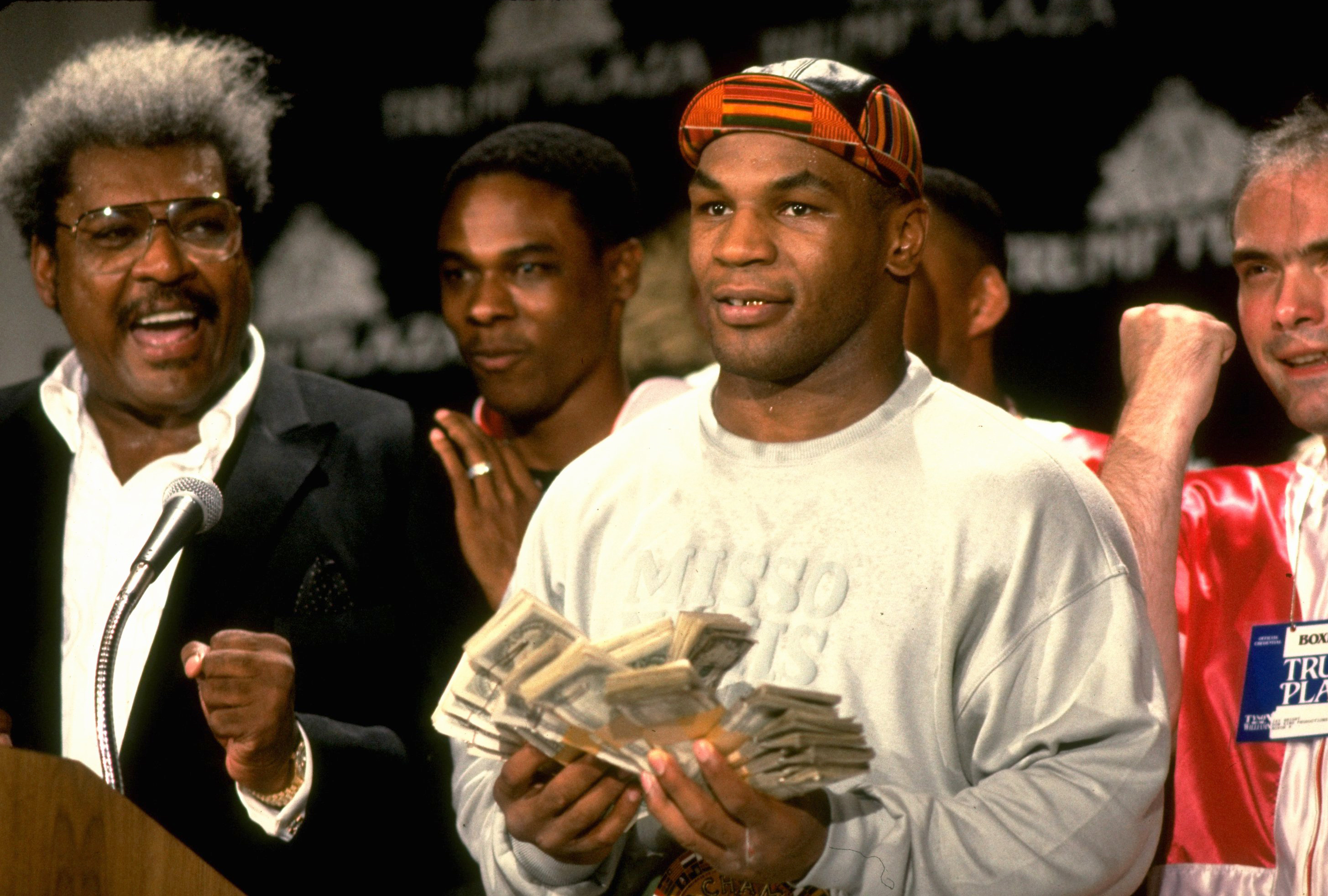
That’s how it sounded when he hit Berbick. That’s how it sounded when Tyson hit Pinklon Thomas shortly before his 21st birthday, too, and when he clubbed Tyrell Briggs and Larry Holmes, Tony Tubbs and (eventually) Michael Spinks, whom he baptized in 91 seconds in 1988 to officially hold all the belts. By then he was the biggest name in sports. Bigger than Michael Jordan. Bigger than Joe Montana. Bigger than just about anybody on the planet.
Lampley didn’t call the Berbick fight, but he called many Tyson fights on HBO before and after. He was on the call for the Spinks fight, and he was in Tokyo when Tyson lost to Buster Douglas, in the greatest upset of all time, and knows more about Tyson’s psychological makeup than just about anyone.
“Absolutely bizarre scene in Tokyo,” Lampley says. “And what the public didn’t know, and a lot of people don’t know, is that Mike, until several days before the fight, was obsessively watching in the hotel room a movie called ‘Faces of Death.’ He was obsessively watching ‘Faces of Death’ over and over and over before he went in to fight Douglas.”
Mike Tyson has transformed many times since losing to Douglas. There was the Robin Givens marriage, and the fallout. There was the rape conviction that sent him to prison for three years, which tainted his legacy forever. There was the comeback in the mid-to-late 1990s, the biting of Evander Holyfield’s ear, all the way to the 57-year-old relic who met Jake Paul in 2024.
Tyson in 2026 is a full saga.
But the Tyson who beat Berbick that night 40 years ago at the Las Vegas Hilton is the one who most people remember. The vicious, most enigmatic heavyweight of all time, who transcending the sports world by becoming the baddest man on the planet.

