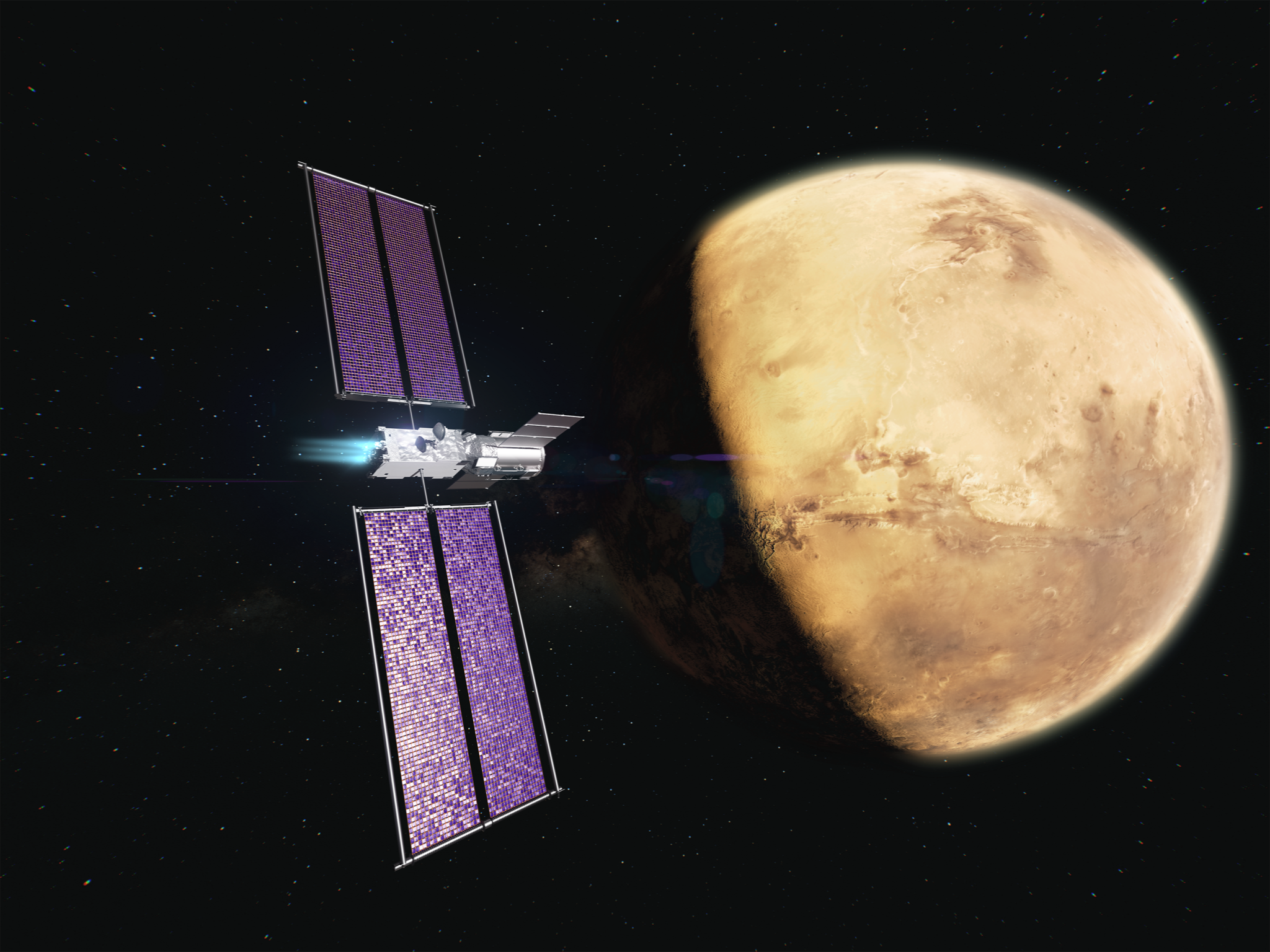
Цөмийн хуваагдалд суурилсан хөдөлгүүрийн технологийг гүн сансарт анх удаа туршихаар төлөвлөж буй SR-1 Freedom хөлгийн үндсэн загвар эцэслэгдлээ.
NASA, АНУ-ын Эрчим хүчний яам (DOE) болон салбарын мэргэжилтнүүд Кливленд дэх Гленн судалгааны төвд уулзаж, Space Reactor-1 (SR-1) Freedom хөлгийн дизайны томоохон хяналтыг аравдугаар сард хийж дуусгалаа. Энэхүү хөлөг нь 2028 оны сүүлээр хөөрөх бөгөөд цөмийн болон нарны эрчим хүчийг хослуулан ашиглаж, Ангараг гараг руу “SkyFall” капсулыг хүргэх зорилготой юм. Уг капсул нь Ангараг гарагийн геологи, уур амьсгалын түүхийг судлах, гадаргын доорх мөсний шинж тэмдгийг хайх зориулалттай шинэ үеийн гурван нисдэг тэргийг тээвэрлэнэ.
Төслийн хүрээнд хөлгийн загварт хэд хэдэн чухал өөрчлөлт оруулсан нь жинг бууруулж, угсралтыг хялбарчлахад чиглэжээ. Тухайлбал, цөмийн реакторыг хөлгийн үндсэн биеэс тусгаарлах “boom” буюу холбогч хэсгийг богиносгож, хамгаалалтын давхаргыг сайжруулснаар реакторыг хөлгийн бусад хэсэгтэй илүү ойр байрлуулах боломж бүрдлээ. Мөн Johns Hopkins их сургуулийн Хэрэглээний физикийн лабораторид 39.3 сая ам.долларын өртөгтэй дулаан ялгаруулах системийг хөгжүүлэх гэрээг олгосон байна.
SR-1 Freedom нь дэлхийн тойрог замаас цааш аялах анхны цөмийн хуваагдлын хөдөлгүүртэй хөлөг болох юм. Энэхүү технологи нь нарны гэрэл хязгаарлагдмал эсвэл байхгүй орчинд урт хугацааны судалгаа хийх, цаашлаад саран дээрх суурин болон нарны аймгийн гүн рүү чиглэсэн хүн төрөлхтний ирээдүйн судалгааны ажлуудад шаардлагатай эрчим хүчний найдвартай эх үүсвэр болно гэж төслийн удирдагч Стив Синакор онцоллоо. Хөлөг Ангараг гарагт хүрснийхээ дараа цөмийн реактораа дахин ажиллуулж, гүн сансар дахь гүйцэтгэлийн нэмэлт мэдээллийг цуглуулах юм.
Дэлгэрэнгүйг эх сурвалжаас харах
Эх сурвалжийг нээх ↓
5 min read
NASA completed a major review for Space Reactor-1 (SR-1) Freedom and locked in key elements of the spacecraft, which is targeted to launch in 2028 and demonstrate nuclear electric propulsion in deep space for the first time.
Experts from across the agency, the U.S. Department of Energy (DOE), and industry met at NASA’s Glenn Research Center in Cleveland for a major SR-1 mission design review in October. Several key decisions were made, propelling the mission from an early concept toward a defined spacecraft design.
“SR-1 marks a pivotal step in how we travel through the solar system,” said Steve Sinacore, SR-1 Freedom program director. “This mission will be the first freight run on the railroad of the solar system, and the decisions we’re making now are laying the tracks for every nuclear-powered spacecraft that follows.”
Planned for launch in late 2028, SR-1 will use both nuclear and solar power to deliver SkyFall, a capsule carrying three next-generation helicopters, to Mars. Once deployed, the helicopters will study Martian geology and climate history, explore new terrain, and search for signs of subsurface ice.
As NASA prepares for more ambitious exploration missions, future spacecraft and surface operations will require significantly more power than current systems can provide, particularly in environments where sunlight is limited or unavailable. SR-1 will demonstrate how fission power can enable long-duration missions, pave the way for reliable surface power systems to support NASA’s future Moon Base, and enable exploration deeper into the solar system.
The SR-1 Freedom spacecraft design has evolved since NASA Administrator Jared Isaacman first introduced the concept in March at the agency’s Ignition event, where leadership shared plans to develop a fission-powered spacecraft in time for the next Mars launch window.
One significant change is to use a shorter boom than the one shown in early illustrations. The boom separates the reactor from the spacecraft’s main body, known as the Power and Propulsion Element. The shorter boom will reduce weight, simplify assembly, and help streamline the spacecraft’s design.
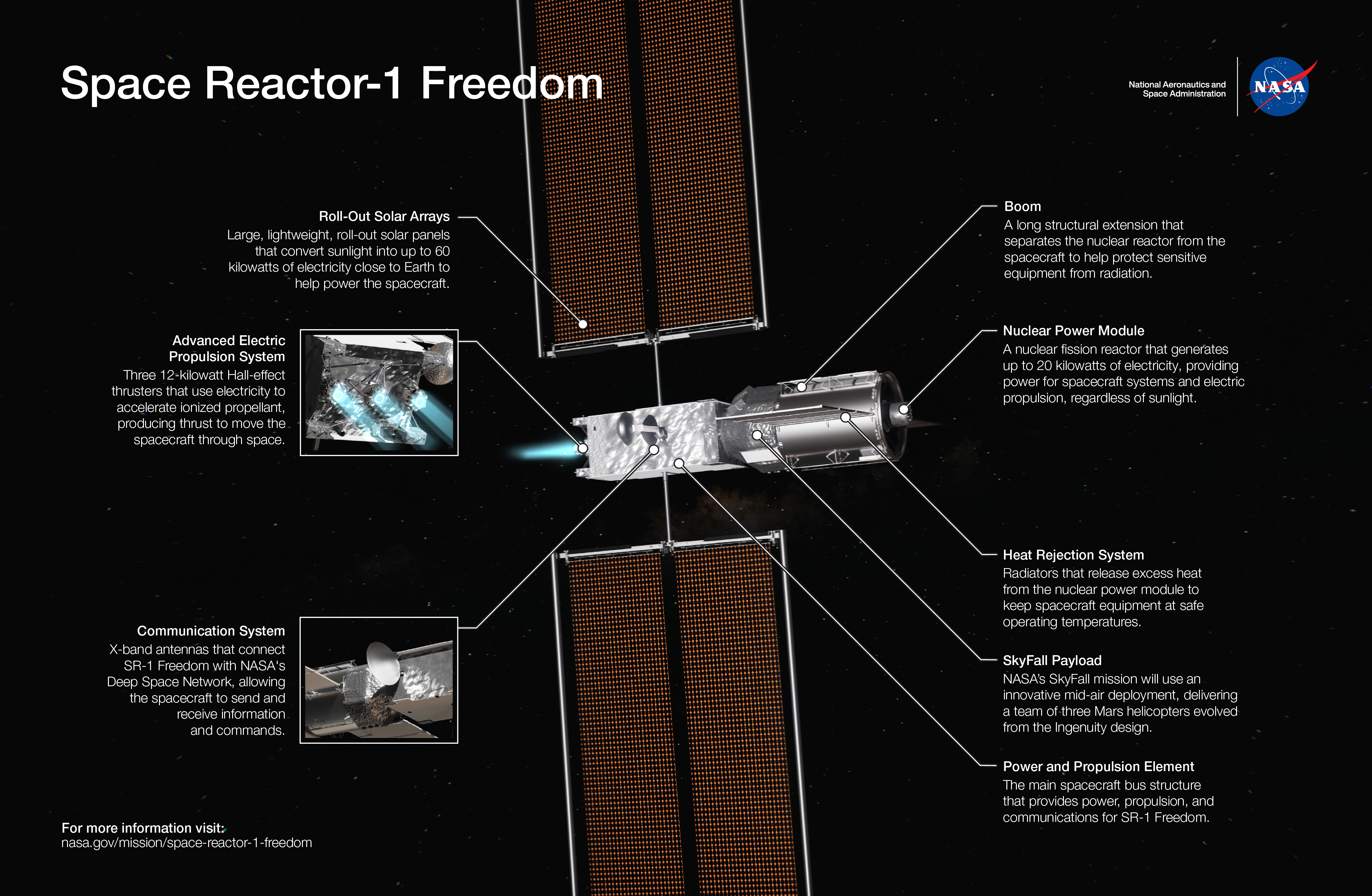
NASA and DOE experts also determined that improvements in shielding and spacecraft design will allow the reactor to operate closer to the rest of the spacecraft. This will simplify integration while maintaining the radiation protection needed for spacecraft electronics and the SkyFall payload.
Teams are continuing to evaluate other key design features, including the number of radiator panels on SR-1, output power levels of its nuclear power module, and how long its reactor will operate. These decisions will help shape the final spacecraft design and ensure it meets mission objectives.
In addition, the team is modifying the spacecraft’s Power and Propulsion Element by updating its communications system for the journey to Mars. SR-1 Freedom will use larger X-band antenna dishes to send data across deep space back to Earth. Further maturation of the spacecraft plans will focus on reducing risk, simplifying the design, and staying on schedule.
NASA awarded a $39.3 million contract to Johns Hopkins University’s Applied Physics Laboratory to develop the heat rejection system for the spacecraft’s nuclear power module. The system will remove excess heat generated by the spacecraft’s nuclear power system, allowing it to operate safely and efficiently. The lab is working with the company Advanced Cooling Technologies as a key strategic commercial partner for providing the critical heat pipe and composite radiator technologies that will enable the system to meet the demanding mission requirements.
Awarded under the Aerospace Research, Development, and Engineering Support II contract, the contract action ensures the Applied Physics Laboratory team will design, build, test, and evaluate the system, along with producing the hardware needed for flight. The heat rejection system is a key part of demonstrating nuclear electric propulsion in space and will help lay the groundwork and industrial production foundation for future high-power nuclear systems used in deep space exploration.
Along with the spacecraft design, teams have defined the mission timeline and planned operations.
After launch and once the spacecraft has left Earth orbit, SR-1 Freedom will activate and gradually increase reactor power. The reactor system will operate for an initial period of time before shutting down. During this period, the spacecraft will collect and send performance data back to Earth. Solar arrays will then provide power as it cruises to Mars.
After delivering SkyFall to Martian orbit, SR-1 Freedom will restart its fission reactor, collecting additional data on the spacecraft’s performance in deep space.
“By refining the design and advancing this architecture, we’re not just building a spacecraft, we’re establishing the foundation for a new era of reliable, efficient transport beyond Earth orbit,” Sinacore said. “What we learn from SR-1 Freedom will shape the future of exploration for decades to come.”
With key design decisions advancing and teams across NASA, DOE, and industry working together, SR-1 Freedom is moving toward its 2028 launch goal. The mission will demonstrate new capabilities for nuclear-powered transportation and help establish the foundation for future exploration beyond Earth.
To learn more about NASA’s efforts in nuclear power in space, visit:
https://www.nasa.gov/space-nuclear

