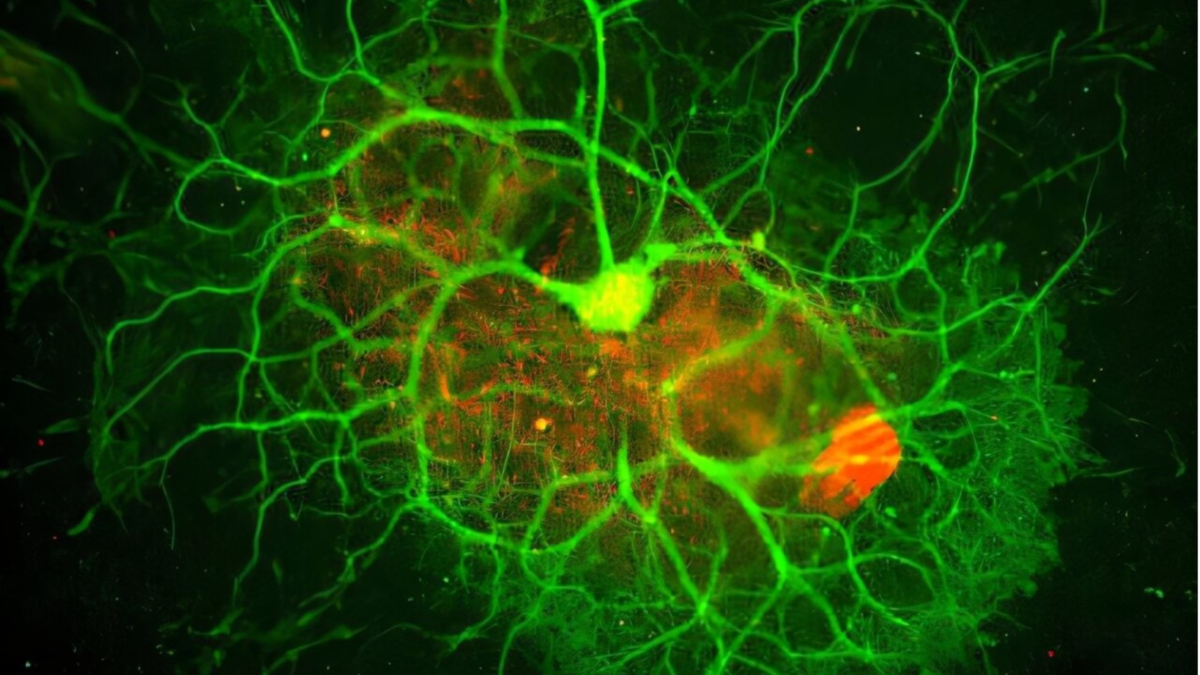
Олон улсын сансрын станцад 40 хоног байсан тархины органоидод өвчинтэй холбоотой молекулын өөрчлөлт илэрсэн ч судалгаа эхний шатандаа байна.
Калифорнийн их сургууль, Сан-Диегогийн эрдэмтдийн баг Альцгеймерийн өвчинтэй холбоотой зарим генийн өөрчлөлтийг дуурайлган лабораторид ургуулсан тархины органоидыг Олон улсын сансрын станцад 40 хоног байлгажээ. Харьцуулахын тулд хэвийн хувилбарын органоидыг мөн ашигласан бөгөөд сансарт байсан дээжийг битүү лабораторийн саванд, биеийн температурт хадгалсан байна. Хяналтын дээжүүдийг Дэлхий дээр ижил нөхцөлд байлгажээ.
Дээжийг буцаан авч шинжлэхэд сансарт байсан Альцгеймерийн загвар органоидын химийн найрлага, молекулын зохицуулалтад өөрчлөлт илэрсэн байна. Заримд нь өвчтэй хүмүүсийн тархинд хуримтлагддаг амилоид-бета болон фосфоржсон тау уураг ихэссэн байв. Мөн өвчний эхэн үеийн явцтай холбоотой дохиолол илэрч, эсүүд сансрын нэмэлт стрессэд хариулахдаа энерги үүсгэх зэрэг дотоод үйл явцаа эрчимжүүлсэн шинж ажиглагджээ.
Сансрын бичил таталцал, цацраг, соронзон орны хэлбэлзэл, өдөр-шөнийн хэм алдагдах зэрэг хүчин зүйл физиологийн олон төрлийн стресс үүсгэж болдгийг судлаачид тэмдэглэсэн байна. Тэдний үзэж буйгаар, сансрын нислэгийн орчин мэдрэлийн эсийн хариу урвалыг судлах боломж олгож болох ч эдгээр үр дүнгийн утгыг бүрэн ойлгоход эрт байна.
Органоид нь хүний тархийг яг хуулбарладаггүй бөгөөд судлаачдын оруулсан генийн өөрчлөлт Альцгеймерийн цөөн тохиолдолд хамаардаг тул үр дүнг тайлбарлахдаа энэ хязгаарлалтыг тооцох шаардлагатай. Цаашид өсгөвөрлөх орчныг автоматаар шинэчилдэг систем ашиглан илүү нарийн органоид турших, мөн бичил гли хэмээх дархлааны эсийг нэмж өвчний явцыг бодитой загварчлах боломжийг судлаачид дурджээ. Судалгааг Science Advances сэтгүүлд нийтэлсэн байна.
Дэлгэрэнгүйг эх сурвалжаас харах
↓Эх сурвалжийг нээх ↓
There are multiple difficulties in studying Alzheimer’s disease: it takes a long time to develop, involves many different neural processes, and happens deep in the brain where live tissue analysis is particularly tricky.
Donor brains can be studied, but by then everything has stopped.
One way to overcome these challenges could be to study Alzheimer’s-affected brain cells in space, researchers think, and it’s not as strange an idea as it might appear at first.
We have plenty of evidence that space speeds up cell aging and puts our biological systems under more pressure, with radiation and other stresses.
Space may give us the opportunity to better understand neurodegeneration, the way that brain cells wear down and lead to conditions such as dementia.
In a new study in Science Advances, researchers led by a team from the University of California, San Diego have reported on a batch of ‘mini brains’ (called organoids) that spent 40 days on board the International Space Station (ISS).
The lab behind it, led by Alysson Muotri, a neuroscientist and senior author of the study, has been flying brain organoids for years, and an earlier run helped set up a clinical trial of a candidate treatment for Rett syndrome.
When the organoids were analyzed upon their return, they showed shifts in their chemistry and composition that suggest this is an area of research worth pursuing.
“Spaceflight provides a unique environment to study neural responses relevant to neurodegenerative diseases,” write Muotri and team in their published paper.
“These exploratory findings indicate that spaceflight reshapes neuronal regulation in human brain organoids, revealing coordinated molecular responses relevant to Alzheimer’s disease biology.”
The mini brains were grown in the lab to mimic some of the genetic mutations associated with Alzheimer’s disease, with normal, ‘healthy’ versions included as controls.
Nothing special was done to the organoids while they were on board the ISS.
They were kept sealed inside a laboratory box for the course of the visit and kept at body temperature, while more controls were kept in the same conditions on Earth.
“The space environment, characterized by microgravity, radiation exposure, variable magnetic fields, and circadian disruption, produces a combination of physiological stresses, including increased oxidative stress and mitochondrial impairment, as well as changes in the inflammatory systems,” write the researchers.
When the space organoids returned, the Alzheimer’s samples showed some notable differences.
For example, some contained more of the amyloid-beta and phosphorylated (chemically tagged) tau proteins that congregate in the brains of people with Alzheimer’s.
Some of the signaling associated with early Alzheimer’s development was spotted too. Cells in the organoids seem to respond to the extra stress of life in orbit by ramping up certain internal processes, including those generating energy.
We’re still at the early stages in terms of understanding what all of this means, but the mini brains showed enough Alzheimer’s-related changes to indicate we could use them to study the disease in the future.
“Our results demonstrate that spaceflight exposure induces coordinated neuronal and molecular remodeling in Alzheimer’s disease-derived organoids,” write the researchers.
It’s worth bearing in mind that these organoids aren’t exact copies of our brains, and the genetic changes the researchers engineered in them relate to a very small number of Alzheimer’s cases in humans. These factors have to be taken into account when interpreting the findings.
However, now that these experiments have concluded with encouraging results, more complex organoids can be tested on the ISS, using a system that automatically refreshes their growth medium.
One potential next step is to add immune cells called microglia, to provide a more realistic simulation of Alzheimer’s and its progression.

It’s looking more probable than ever that the brain changes we see in astronauts might be beneficial to health research.
Figuring out how to keep humans protected on long-distance space missions could well overlap with research to treat the most stubborn diseases that we deal with here on Earth.
“[Further studies] will include mature neuroimmune assembloids and cortical organoids infused with microglia, thereby enabling a more comprehensive investigation of maturation, inflammation, and aging processes across diverse brain cell types under spaceflight conditions,” write the researchers.
The research has been published in Science Advances.
This article was fact-checked by Rebecca Dyer and edited by Rebecca Dyer. While we pride ourselves on our process, we are only human. If you spot a mistake, please let us know.

