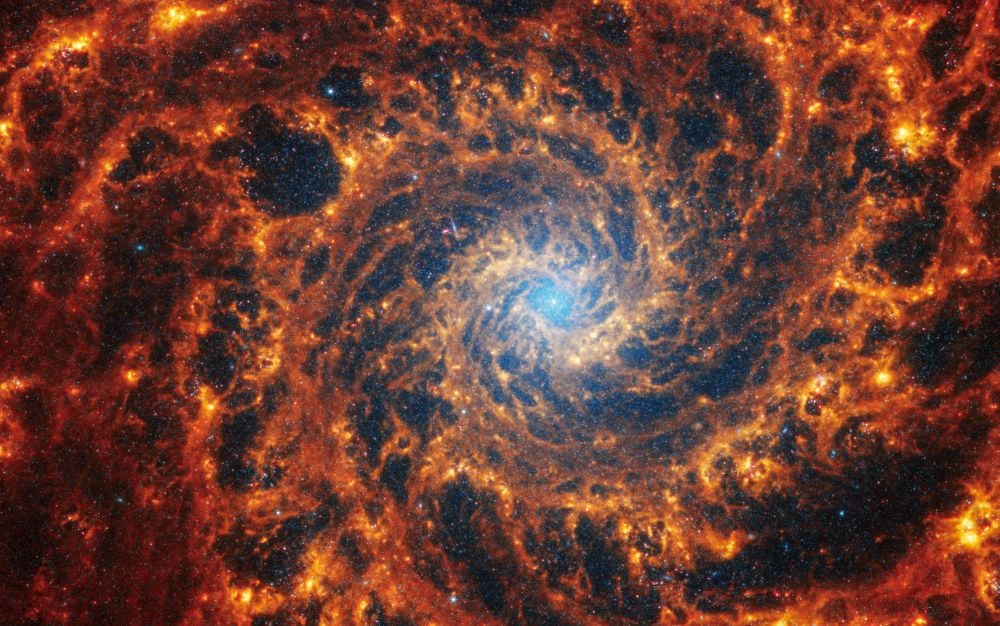
Эрдэмтэд хиймэл оюун ухаан болон гурван суперкомпьютерийн хүчийг нэгтгэснээр бие даасан оддын түвшинд галактикийн бүтцийг симуляци хийх боломжтой болжээ.
Японы RIKEN хүрээлэнгийн судлаач Кейя Хирашима болон Токиогийн их сургуулийн профессор Мичико Фүжи нарын удирдсан баг Aurora, Frontier, JUPITER гэсэн гурван өндөр хүчин чадалтай суперкомпьютерийг ашиглан Сүүн зам галактикийн загварчлалыг гаргажээ. Өмнөх судалгаануудад галактикийн бүтцийг 100 нарнаас бүрдэх оддын бөөгнөрөл буюу “бөөм”-өөр төлөөлдөг байсан бол энэхүү шинэ аргачлалаар 5.4 их наяд бөөм ашиглан бие даасан оддын үйл хөдлөлийг нарийвчлан харуулах боломж бүрдэв.
Энэхүү нарийвчлалд хүрэхэд супернова дэлбэрэлтийн үеийн хийн төлөв байдлыг урьдчилан таамаглах PHEASANT хэмээх хиймэл оюун ухааны загварыг ашигласан нь гол түлхүүр болсон байна. Супернова дэлбэрэлт нь маш богино хугацааны алхамаар тооцоолол хийхийг шаарддаг тул уг загвар нь симуляцийн тооцооллын ачааллыг эрс багасгаж, цаг хугацааны алхамыг уртасгах боломж олгожээ. Ингэснээр судлаачид галактик доторх хий болон оддын харилцан үйлчлэл, оддын үүсэл, хөгжил, мөн оддын бөөгнөрөл хэрхэн бүрэлддэгийг илүү бодитоор судлах боломжтой болсон юм.
Энэхүү ололт нь зөвхөн астрофизикийн салбараар хязгаарлагдахгүй бөгөөд хиймэл оюун ухааныг ашиглан нарийн төвөгтэй физик процессуудыг загварчлах аргачлалыг цаг уурын загварчлал, сансрын урьдчилсан мэдээ зэрэг бусад салбарт ч нэвтрүүлэх боломжтойг судлаачид онцоллоо. Гэсэн хэдий ч галактикийн хэмжээний нарийн төвөгтэй бүтцийг бүрэн дүүрэн симуляци хийх нь цаашид ч тооцооллын өндөр хүчин чадал болон алгоритмын сайжруулалтыг шаардсан хэвээр байна.
Дэлгэрэнгүйг эх сурвалжаас харах
Эх сурвалжийг нээх ↓
In the early days, astronomers kept sketchbooks close at hand when they looked through their telescopes. They drew what they saw and shared their drawings. Modern astronomy, with its enormous segmented lenses, gigabyte cameras, and cryogenically-cooled infrared space observatories, makes those days seem more distant than they really are. But one of the latest efforts in astronomy makes astronomy’s sketch-pad days seem so far in the past, they’re almost red-shifted.
In an impressive technological maneuver, astronomers have harnessed three different supercomputers together to simulate the Milky Way at a level of detail never before achieved. They used the supercomputers and AI together to simulate the Milky Way down to the level of individual stars. Up until now, the smallest level of detail in simulations, called particles, was clusters of stars with the mass of about 100 Suns. The behaviour of individual stars was averaged out in those simulations (Auriga, FIRE, etc.)
These results are in a paper titled “Architecture-Agnostic Exascale Star-by-Star Simulation of Our Galaxy,” from the SC26: International Conference for High Performance Computing, Networking, Storage and Analysis. The lead author is Keiya Hirashima, from RIKEN in Japan.
In simulations, achieving a level of individual stars means that individually simulated particles have one solar mass. So it’s like a proxy for the population of stars. But regardless of that important distinction, the new simulations are extraordinary.
“Our highest-resolution Milky Way simulation used 5.4 trillion particles, ∼ 10, 000× those in the state-of-the-art simulations,” the authors write.
“We expect better simulations as computational power increases, but this still requires work on improving resolutions, and for a Milky Way-sized galaxy, it’s not straightforward,” said Professor Michiko Fujii from the Department of Astronomy at the University of Tokyo. “When we look at smaller regions in detail, we encounter areas where the gas is denser and changes rapidly. This means the simulation needs to take much shorter steps in time, which greatly increases the amount of calculation required.”
This figure from the paper shows different structures of disk galaxies at different scales, emphasizing the complexity necessary for accurate simulations. Top left and middle: NGC 4414, a disk galaxy similar to the Milky Way Galaxy, taken with the Hubble Space Telescope. Top right: NGC628, a disk galaxy with spiral arms and bubble structures taken with the JWST. Bottom left: Carina star forming region taken with the JWST. Bottom middle: Cassiopeia A supernova remnant taken with the JWST. Bottom right: turbulent innterstellar gas around Cassiopeia A taken with Wide-field Infrared Survey Explorer. Image Credit: Hirashima et al. 2026. SC2026.
To achieve this fine particle resolution, simulations need ever shorter time steps, and time steps are like simulation currency; the shorter they are, the more computing resources they demand. To supply the resources for that, the researchers harnessed the power of three exascale supercomputers together: Aurora, Frontier, and JUPITER. Each one ran the same software on different hardware: Intel, NVIDIA, and AMD graphic processing units (GPUs) and central processing units (CPUs).
But linking three supercomputers was only part of the solution.
“We overcame this problem by using an AI model to predict how gas around supernova explosions evolves,” said Fujii. “This allowed us to carry out the simulation more efficiently and achieve a level of detail where individual stars can be represented.”
By using this model, the larger simulation was able to skip over many small timesteps. It’s called PHEASANT, and it was developed by postdoctoral researcher Keiya Hirashima from RIKEN. Supernovae are complex and require their own detailed simulations with very small timesteps. By plugging PHEASANT into the larger simulation, it relieved that simulation of a lot of work.
“With trillions of particles, we resolve individual stars and model their SN feedback self-consistently within a galactic-scale simulation,” the authors write. “Such a simulation reveals how individual stars, such as the Sun, contribute to the overall structure of the MW through multiple physical processes.”
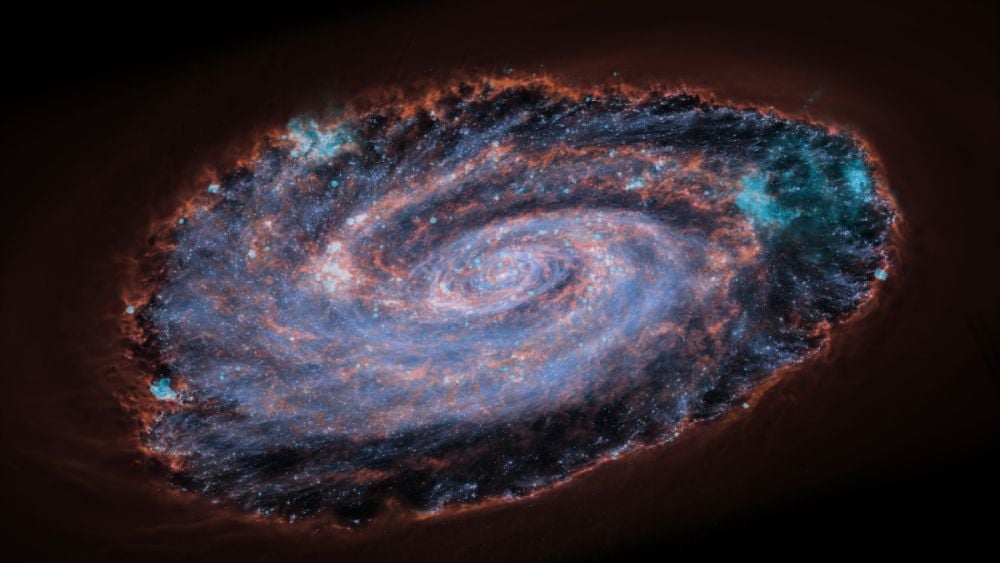 This image from PHEASANT shows the Milky Way’s disk. Galaxies are complex structures, with different types of structures at different scales. They have thin and thick disks, bulges, halos, spiral arms, star clusters, nebulae, and individual stars and gas clouds. In this work, the researchers divided the galaxy into smaller regions that could be processed by different parts of a supercomputer. ©2026 PHEASANT/Hirashima/Fujii CC-BY-ND
“One of my parts was to develop an AI model that predicts how the gas surrounding a supernova explosion changes over time. If we calculate this process directly, we need time steps of around 100 years,” said Hirashima. “My model predicts gas distribution after 100,000 years. This means that, rather than having to calculate every small step, we can use a much longer time step for the entire galaxy simulation. Making this work efficiently on different supercomputers was a challenge because each system uses different AMD, Intel, or NVIDIA CPUs and GPUs. Achieving good performance across all three systems required some specific optimizations.”
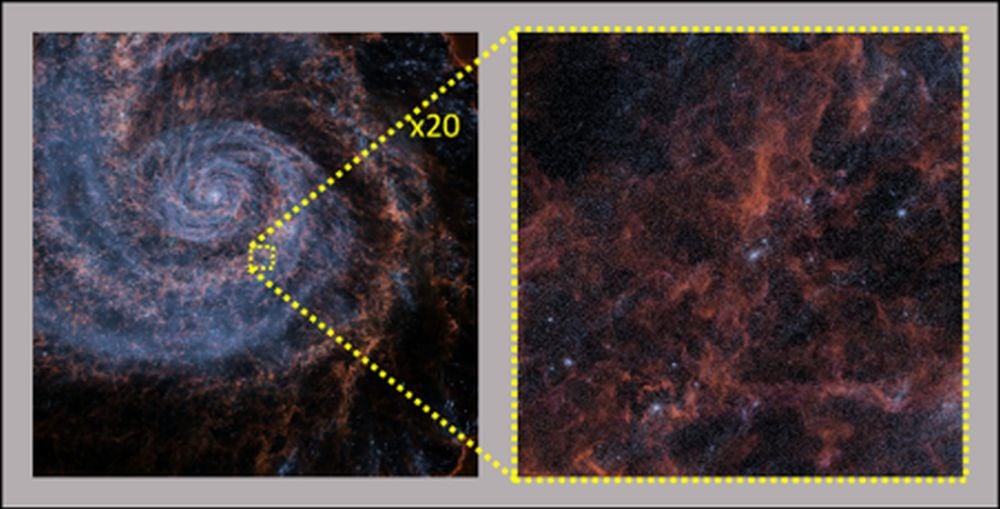 These panels are snapshots from PHEASANT. The panel on the left shows the distribution and temperature of gas across a model galaxy. The panel on the right is a close-up view, where individual stars are visible as dots. Image Credit: ©2026 PHEASANT/Hirashima/Fujii CC-BY-ND
We can’t understand the Milky Way, or galaxies in general, without a detailed understanding of how its gas and stars behave. Stars are born, drift away from their clusters, and evolve. Depending on their masses, they can remain on the main sequence for trillions of years, leave the main sequence after a few billion years and then linger as white dwarf cinders, or exhaust their fuel rapidly and explode as supernovae.
Gas is also complex. It collects in clouds where stars form, can be funnelled into the galactic center and “recycled” by supermassive black holes, or blasted away by explosions. Stars and gas are linked, and there’s an extraordinary amount of detail involved.
Supernovae are among the most complicated events. In some regions, the massive young stars that eventually explode as supernova are born in the same region. When they exhaust their fuel, they explode and carve massive bubbles in the interstellar medium. That can drive gas away to form more new stars elsewhere. They can even propel gas outside of the galaxy. It’s all part of the life of the Milky Way, and simulations that struggle to recreate all of the detail in supernova explosions can lead astronomers astray.
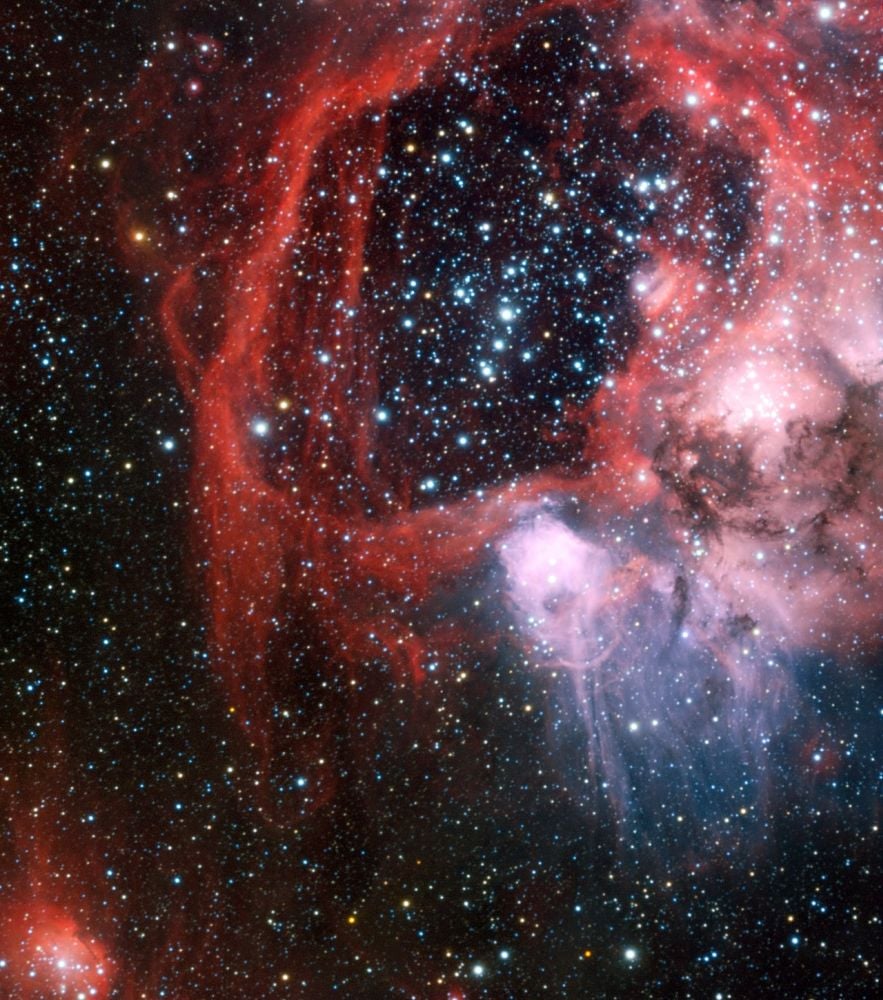 This is LHA 120-N44 (N44) in the Large Magellanic Cloud, imaged by the ESO’s Very Large Telescope. It features a massive bubble excavated in the interstellar medium by exploding young stars in its center. Some of the stars are still there, and they’re still expanding the bubble with their powerful winds. Simulating all of the complexity involved is an enormous challenge. Image Credit: ESO/Manu Mejias
“Something we want to understand is how events on the scale of individual stars connect to the larger structure of the Milky Way,” said Fujii. “With this simulation, we can investigate how individual supernovae affect the number of stars that form, the size of these giant gas bubbles and the material that flows out of the galaxy. We can also study how groups of stars form and how they may eventually develop into star clusters.”
The PHEASANT AI surrogate model plays a critical role in this work, and that’s part of a broader trend in science.
“The surrogate modeling approach can also be generalized beyond astrophysical problems to other research fields,” the authors write.
“AI surrogate modeling accelerates simulations and bridges wider physical scales, opening new pathways in various real-world applications, including climate modeling, space forecasting, and low-temperature plasma,” the authors conclude.

