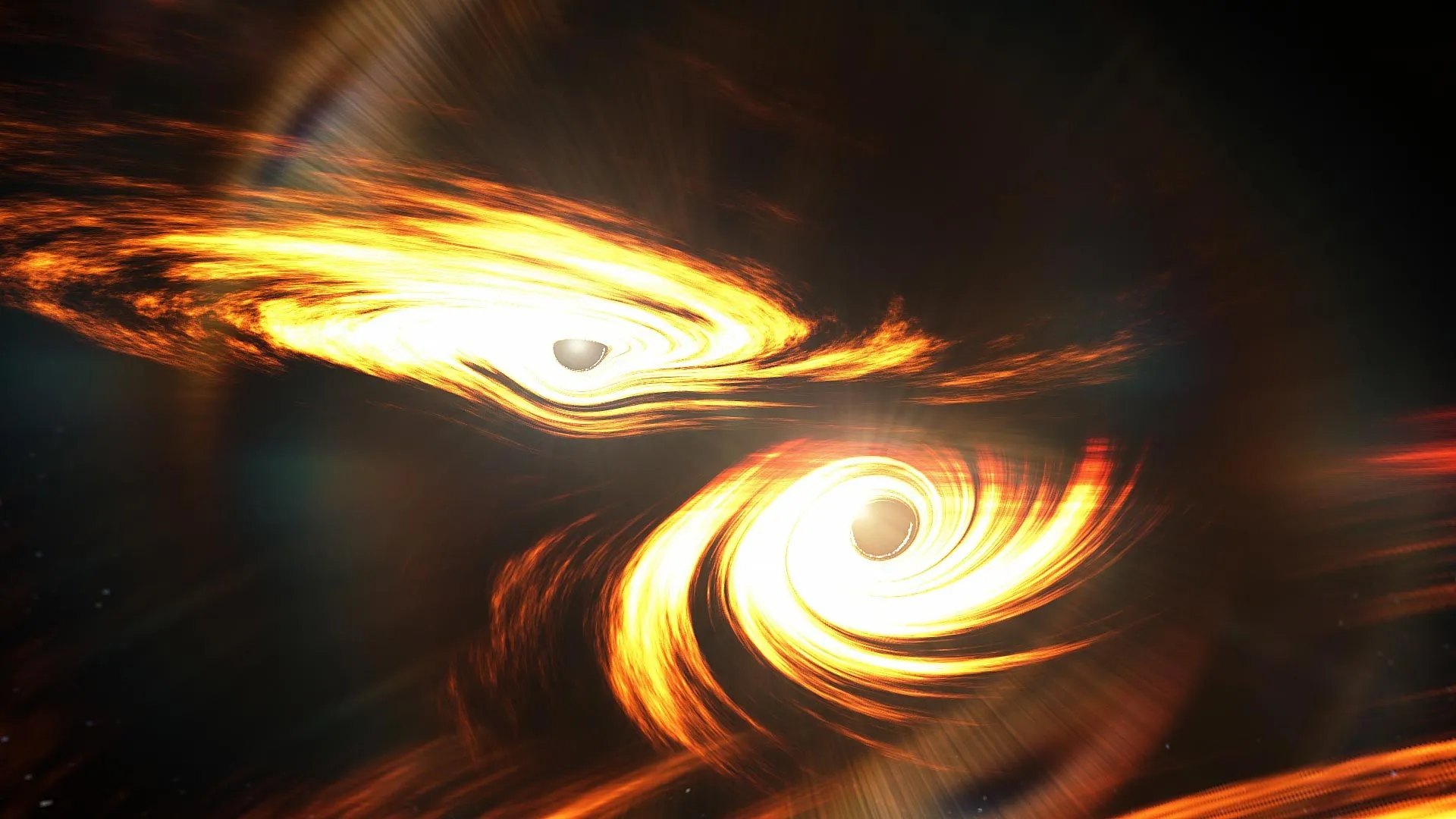
Хар нүхнүүд мөргөлдөх үед үүсэх эцсийн төлөвийг термодинамикийн энтропийн зарчмаар урьдчилан таамаглах боломжтойг эрдэмтэд тогтоожээ.
Пенн Стэйт их сургуулийн физикчдийн баг хар нүхний нэгдлийн үр дүнг тодорхойлохдоо Эйнштейний харьцангуйн онолын нарийн төвөгтэй тэгшитгэлүүдийг ашиглахын оронд термодинамикийн үндсэн зарчмыг ашиглаж болохыг илрүүлжээ. Энэхүү судалгааны үр дүн Physical Review Letters сэтгүүлд нийтлэгдсэн бөгөөд хар нүхний харилцан үйлчлэлийг ойлгоход шинэ гарц нээж магадгүй юм.
Хоёр хар нүх тойрог замаар ойртож нэгдэн, илүү том хар нүх үүсгэх үед асар их энерги ялгарч, сансрын орон зайг гажуудуулсан таталцлын долгион үүсдэг. Өмнө нь эдгээр үйл явцыг судлахын тулд суперкомпьютер ашиглан нарийн төвөгтэй тооцоолол хийдэг байсан бол шинэ судалгаагаар хар нүхний нэгдлийн эцсийн төлөв нь “энтропийн дээд хэмжээ”-нд хүрэх хандлагатай болохыг тогтоосон байна.
Эрдэмтдийн баг таталцлын долгионоор алдагдсан энерги болон өнцгийн моментыг тооцсоны дараа хар нүх тогтвортой төлөвт шилжихдээ энтропи буюу эмх замбараагүй байдлын хэмжээг хамгийн дээд цэгт нь хүргэдэг болохыг ажиглажээ. Энэхүү гипотез нь хийн молекулуудын зан төлөвийг термодинамикийн хуулиар тайлбарладагтай төстэй зарчим дээр суурилсан бөгөөд хийсвэр эргэлдэгч хар нүхнүүдийн загварчлал нь бодит симуляцийн үр дүнтэй хэдхэн хувийн зөрүүтэй таарчээ.
Хар нүх нэгдсэнийхээ дараа өөрийн үүсэлтэй холбоотой мэдээллээ “мартдаг” бөгөөд зөвхөн масс болон эргэлтийн хурдаараа тодорхойлогддог. Судлаачдын үзэж буйгаар энтропийг дээд хэмжээнд хүргэх зарчим нь хар нүхний харилцан үйлчлэлийг удирдан чиглүүлдэг үндсэн зарчим байж болох бөгөөд энэ нь таталцал болон термодинамикийн огтлолцол дээрх шинэ нээлт болж байна.
Дэлгэрэнгүйг эх сурвалжаас харах
↓Эх сурвалжийг нээх ↓
Black hole collisions are among the most violent events in the universe, yet the physics governing their outcome may be surprisingly simple. A team of researchers led by Penn State physicists has found that a fundamental principle of thermodynamics could offer a shortcut for predicting what happens when two black holes merge. The discovery may also reveal deeper insights into the nature of gravity and the physics underlying Einstein’s equations.
As two orbiting black holes gradually spiral toward each other, they eventually collide and combine into a single, larger black hole. The immense energy released during the merger distorts spacetime, generating ripples known as gravitational waves. Sensitive instruments on Earth can detect these waves even when the collision occurs billions of light-years away.
Scientists analyze gravitational waves to predict the properties of the newly formed black hole, known as a remnant. Making accurate predictions, however, typically requires supercomputers to solve the extraordinarily complicated equations of Einstein’s theory of general relativity. The new research suggests that a much simpler approach may be possible.
The study was published in the journal Physical Review Letters, where it was selected as an “editor’s suggestion.”
“The final black hole after a merger is ringing like a struck bell, and it radiates away more gravitational waves until it settles into a calm, stable state described by just two numbers — its final mass and spin,” said Monica Rincon-Ramirez, a postdoctoral scholar in physics in the Penn State Eberly College of Science and the first author of the paper. “The question we asked is: Can we predict what that final state looks like using arguments from thermodynamics?”
An Unexpected Connection Between Black Holes and Thermodynamics
Thermodynamics describes how energy, heat, entropy, and other physical quantities govern the collective behavior of systems made up of many interacting particles. Its principles help explain everything from the behavior of atmospheric gases and the operation of engines to what happens when we cook food.
General relativity takes a very different approach. It explains gravity in terms of the curvature of spacetime and is essential for understanding many astronomical phenomena. For years, black holes were generally considered beyond the reach of thermodynamics. That understanding changed when Stephen Hawking demonstrated that black holes could emit radiation and lose energy.
In a separate recent study from Penn State, researchers addressed a limitation in Hawking’s formulation of black hole mechanics, extending its applicability to dynamic black holes that form, merge, and evaporate.
“The concepts and laws of thermodynamics apply to systems with many particles, like gases,” said Nathan K. Johnson-McDaniel, a postdoctoral researcher at the University of Mississippi who earned a doctorate in physics at Penn State in 2011 and an author of the paper. “Usually, we are interested in predicting the coarse-grained properties of these gases and not what every molecule is doing. Black holes, on the other hand, are described by the deterministic equations of general relativity and seemingly have no relationship with the gases. But starting in the 1970s, leading physicists found an interesting parallel between the properties of black holes and those of gases. We wanted to extend this analogy to binary black hole systems.”
The Universe’s Tendency Toward Disorder
The researchers found evidence that the outcome of a black hole merger may be governed by a familiar thermodynamic principle: the maximization of entropy.
Entropy is often described as a measure of disorder, although more precisely, it reflects how many microscopic arrangements are consistent with a system’s overall state. Because disordered states generally have far more possible arrangements than highly ordered ones, physical systems naturally tend toward states of higher entropy.
The new findings suggest that after accounting for the energy and angular momentum carried away by gravitational waves, the final black hole appears to settle into a state that maximizes entropy. Angular momentum is a physical quantity that describes rotational motion.
“Entropy is essentially a measure of disorder, or more precisely, of how many ways something can be arranged,” said Vaishak Prasad, a postdoctoral researcher in astronomy and astrophysics at Penn State and an author of the paper. “A messy room has high entropy — there are countless ways things can be strewn about. A perfectly tidy room has low entropy — there are only a few arrangements that count as ‘tidy.’ Nature tends to drift toward high entropy states simply because there are more of them. Our results suggest that black hole mergers do something similar.”
A Surprisingly Simple Way To Predict Black Hole Mergers
Based on their findings, the physicists formulated what they call the “maximum entropy conjecture for black hole mergers.” The proposed principle closely resembles the thermodynamic rules that govern much more familiar physical systems.
“When two hot gases are brought into contact, one does not need to track every microscopic interaction of the molecules in the gases to determine the final state of the combined gas,” said Eugenio Bianchi, professor of physics at Penn State and an author of the paper. “Maximizing entropy, while accounting for other physical laws, predicts the outcome.”
The new conjecture proposes that a similar approach could predict the outcome of merging black holes without requiring scientists to solve every detail of the extraordinarily complex collision.
To investigate this possibility, the researchers examined a series of hypothetical rotating black holes representing possible remnants. They analyzed how the changing mass and angular momentum of the merging black holes corresponded to these potential final states. Remarkably, the state with the highest entropy closely matched the outcome calculated independently using sophisticated numerical relativity simulations.
“The central finding emerged from studying how the merging black holes’ evolving mass and angular momentum map onto those of a sequence of hypothetical rotating black hole remnants,” Rincon-Ramirez said. “Remarkably, we observe that the entropy of this sequence reaches a maximum at values strikingly close to the mass and angular momentum of the actual final remnant predicted independently by numerical relativity simulations. The agreement is within a few percent.”
What Black Holes Remember After a Collision
Despite the extreme complexity of a black hole merger, the object that remains appears to “forget” nearly everything about the event that created it. Once the remnant settles into a stable state, its defining properties are its mass and spin.
The researchers suggest that thermodynamics may provide a particularly natural way to understand these remaining properties. More broadly, their findings raise the possibility that entropy maximization could play a fundamental role in governing how black holes interact.
“We found that the most natural way to describe what it does remember can be explained using thermodynamic concepts,” said B.S. Sathyaprakash, Elsbach Professor of Physics and professor of astronomy and astrophysics in the Penn State Eberly College of Science, the leader of the research team. “This work explores a surprising possibility at the intersection of gravity, black hole physics and thermodynamics that goes beyond the established laws of black hole mechanics and thermodynamics and raises a potentially transformative question: Could entropy maximization be a fundamental organizing principle governing black hole interactions more generally?”
In addition to Rincon-Ramirez, Johnson-McDaniel, Prasad, Bianchi, and Sathyaprakash, the research team included Ish Gupta, a postdoctoral researcher at the University of California, Berkeley, who received his doctorate in physics from Penn State in 2025. The research was funded by the U.S. National Science Foundation.

