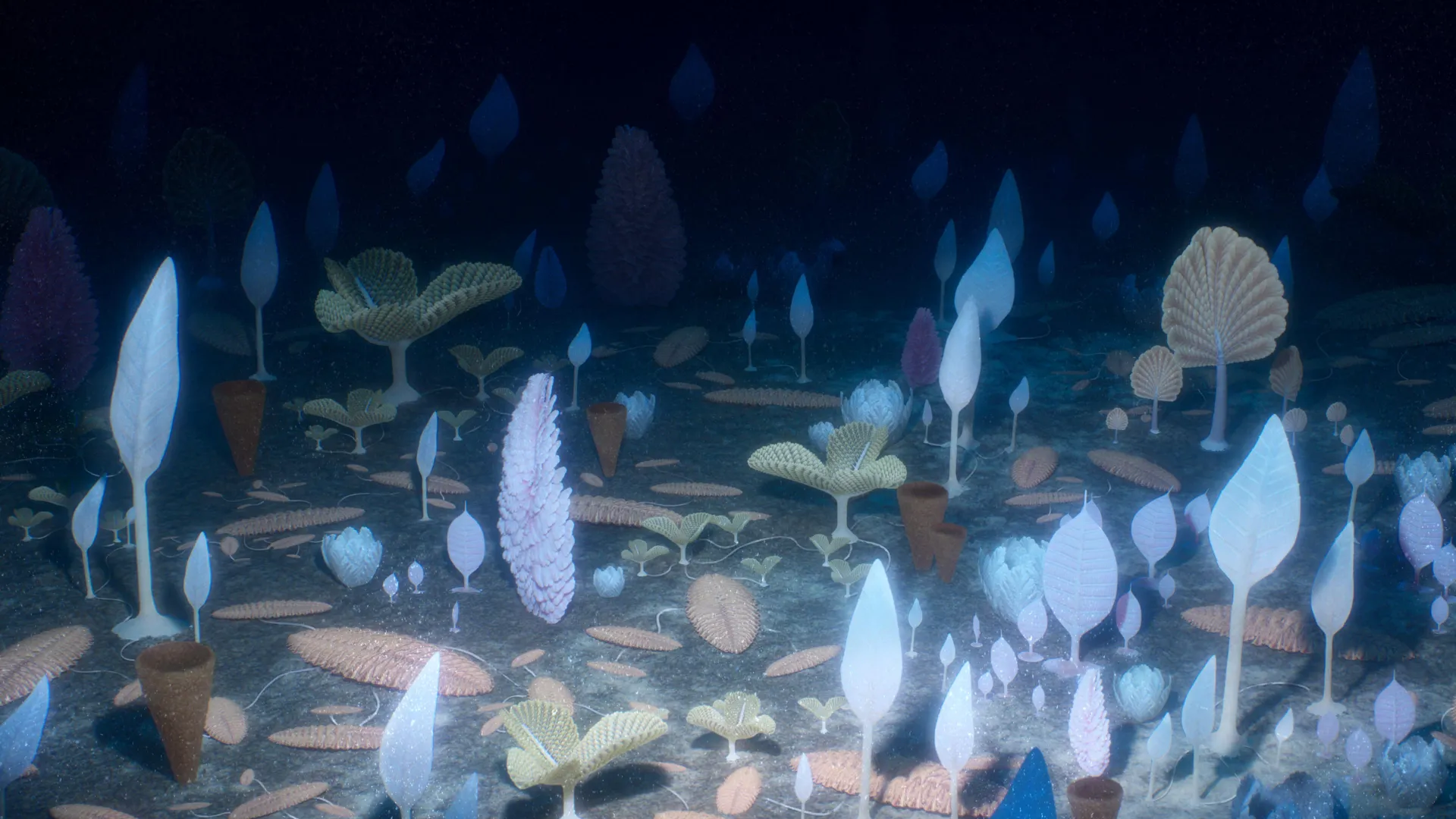
Эртний амьтад бэлгийн бус замаар нөхөн үрждэг байсан нь өрсөлдөөнийг бууруулж, хувьслын явцыг олон сая жилийн турш удаашруулсан болохыг Кембрижийн их сургуулийн судлаачид тогтоов.
Эдиакарын галавын үед (635–539 сая жилийн өмнө) амьдрал анх үүсэж эхэлсэн ч биологийн олон янз байдал тун удаан хөгжиж байсан нь палеонтологийн томоохон нууц байсаар ирсэн юм. Судлаачид “Nature Ecology and Evolution” сэтгүүлд нийтлүүлсэн судалгаандаа лазер сканнер, хиймэл оюун ухаан болон компьютерын загварчлал ашиглан 540 сая жилийн өмнөх эртний экосистемийг судалжээ. Эдгээр амьтан нь ам, эрхтэн системгүй, далайн уснаас шууд тэжээл авдаг, гүзээлзгэний ургамал шиг “гүйлгүүр” буюу үндэслэг иштэй төстэй бүтцээр дамжуулан генетикийн хувьд ижил хуулбар үүсгэж үрждэг байсан байна.
Судалгааны багийн ахлагч, доктор Эмили Митчелл болон профессор Андреа Маника нарын тайлбарласнаар, ийм аргаар нөхөн үржих нь амьтдын хоорондох өрсөлдөөнийг үгүй хийж, хувьсан өөрчлөгдөх шаардлагагүй таатай нөхцөлийг бүрдүүлж байжээ. Гэвч амьдрал далайн гүнээс гүехэн хэсэг рүү шилжиж, цаг уурын өөрчлөлт, байгалийн хүчин зүйлсээс үүдэлтэй дарамт нэмэгдэхэд амьтдын нөхөн үржихүйн стратеги өөрчлөгдсөн байна.
Байгалийн хүнд нөхцөл байдал нь бэлгийн замаар үржихэд түлхэц өгснөөр төрөл зүйлийн тархалт нэмэгдэж, улмаар хувьслын хурд огцом өссөн байна. Энэхүү шилжилт нь Кембрижийн галавын үеийн амьтдын гайхалтай хөгжил, олон янз байдлын тэсрэлтэд суурь нөхцөлийг бүрдүүлж өгчээ.
Дэлгэрэнгүйг эх сурвалжаас харах
↓Эх сурвалжийг нээх ↓
A new study suggests that the earliest animals on Earth may have unintentionally slowed the rise of biodiversity. According to researchers from the University of Cambridge, the way these ancient organisms reproduced limited competition and kept evolution moving at a remarkably slow pace for millions of years.
The findings, published in Nature Ecology and Evolution, offer a possible solution to a long-standing paleontological mystery. Although animals first appeared during the Ediacaran period, their diversity remained relatively limited for a surprisingly long time before a later burst of evolutionary innovation dramatically expanded life on Earth.
Life’s Early Experiment
After billions of years dominated by microscopic organisms, the Ediacaran period, which lasted from about 635 million to 539 million years ago, saw the emergence of the first animals. Some of these creatures, including Fractofusus, reached heights of up to two meters, although most were much smaller.
These early animals looked very different from anything alive today. Many resembled ferns more than modern animals and appear to have lacked mouths, organs, and the ability to move. Scientists believe they absorbed nutrients directly from the surrounding seawater.
Like many other Ediacaran organisms, they vanished from the fossil record at the start of the Cambrian period roughly 540 million years ago. Their disappearance has made it difficult for researchers to determine whether they are related to any animals living today.
Previous studies showed that many of these organisms reproduced asexually. They spread by producing genetically identical offspring connected by stolons, or runners, much like modern strawberry plants. In the nutrient-rich oceans of the Ediacaran, this strategy worked extremely well.
“Life was pretty nice during the Ediacaran, so the need for sex was rather limited,” said lead author Dr. Emily Mitchell from Cambridge’s Department of Zoology. “There was relatively little competition, so there was no real pressure to change anything.”
Fossils, AI, and Ancient Ecosystems
To investigate why evolution appeared to slow during this period, Mitchell and co-author Professor Andrea Manica studied fossils from Mistaken Point in Newfoundland, one of the world’s most important Ediacaran fossil sites.
The researchers combined laser scanning, spatial analysis, and artificial intelligence to examine how these ancient communities were organized and how they may have interacted.
They first demonstrated that asexual reproduction through runners reduced competition among neighboring organisms. The team then created computer simulations to test how early animal communities might have developed under different reproductive strategies.
Thousands of simulations were run while a simple neural network identified which scenarios most closely matched the fossil evidence. Using a technique known as Approximate Bayesian Computation, the researchers worked backward from the fossil record to estimate how far organisms spread and how intensely they competed for resources.
Why Competition Matters
The results showed that limited dispersal caused by asexual reproduction could explain why early animal ecosystems contained relatively few species. Later, when organisms began spreading over greater distances and reproducing sexually, diversity increased dramatically.
Competition has long been one of evolution’s most important drivers. However, the runner-based lifestyle of many Ediacaran organisms reduced the need to compete.
“If you’re connected to your neighbor by these runners, then you’re sharing nutrients and you don’t need to compete with them,” said Manica.
As life gradually expanded from deeper waters into shallower marine environments, conditions became much more challenging. Tides, storms, shifting temperatures, and changing nutrient availability introduced new pressures that made survival less predictable and increased competition for resources.
Stress and the Rise of Sexual Reproduction
The researchers argue that these harsher conditions may have encouraged a transition toward sexual reproduction.
“If you’re suddenly in an environment where you’re essentially getting killed a couple of times per year, then that changes everything,” said Mitchell. “Stress essentially leads to sexual reproduction, and when that happens, we can see a massive increase in dispersal distances as animals attempt to colonise new areas due to an increase in competition.”
As early animals adapted to new habitats and new reproductive strategies, species diversification accelerated. This period marked a second major wave of Ediacaran evolution and helped lay the groundwork for the even more dramatic evolutionary expansion of the Cambrian period, when animals became mobile and ecosystems grew far more complex.
The research was supported by the Natural Environment Research Council (NERC), part of UK Research and Innovation (UKRI). Emily Mitchell is a Fellow of Newnham College, Cambridge. Andrea Manica is a Fellow of Clare College, Cambridge.

