Олон улсын судлаачдын баг тархины холболтын хэв шинжид үндэслэн аутизмын хоёр өөр дэд хэлбэрийг илрүүлсэн нь эмчилгээний арга барилыг илүү нарийвчлалтай болгох боломжийг бүрдүүлж байна.
Италийн Технологийн хүрээлэнгийн судлаач Алессандро Гоззи болон түүний баг хүн болон хулганы тархины дүрс бичлэгийн мэдээлэлд харьцуулсан дүн шинжилгээ хийжээ. Судалгаанд 940 аутизмтай хүүхэд, залуучууд, 1,036 хэвийн хөгжилтэй хүн болон аутизмтай төстэй шинж тэмдэг бүхий 20 төрлийн хулганы загварыг ашигласан байна. Үр дүнд нь тархины үйл ажиллагаатай холбоотой хоёр үндсэн бүлэг илэрчээ.
Эхнийх нь тархины эсүүдийн харилцаа холбоог хариуцдаг синапсын үйл ажиллагаатай холбоотой “тархины холболт сулрах” (hypoconnectivity) бүлэг юм. Хоёр дахь нь дархлааны тогтолцооны генүүдтэй холбогдож, тархины холболт нэмэгдсэн “тархины холболт хэт ихсэх” (hyperconnectivity) бүлэг бөгөөд энэ нь эмгэгийн илрэл арай хүнд байх магадлалтайг харуулжээ.
Child Mind Institute-ийн судлаач Адриана Ди Мартиногийн тайлбарласнаар, хулганы загварууд нь биологийн түлхүүр болж, аутизмын өөр өөр механизм, генетик хүчин зүйлсийг таньж мэдэхэд тусалсан байна. Судалгааны баг энэхүү нээлт нь аутизмыг “бүгдэд ижил” гэж үзэх хандлагыг халж, тухайн хүний биологийн онцлогт тохирсон эмчилгээ, дэмжлэг үзүүлэх хөтөлбөрийг хөгжүүлэхэд чухал алхам болно гэж үзэж байна.
Гэсэн хэдий ч судалгаанд хамрагдсан хүмүүсийн дөрөвний нэг нь л эдгээр хоёр бүлэгт багтсан тул цаашид илүү өргөн хүрээтэй мэдээллийн санд тулгуурлан илүү олон дэд хэлбэрийг тодорхойлох шаардлагатай байгааг тэмдэглэжээ. Судалгааны үр дүнг Nature Neuroscience сэтгүүлд нийтэлсэн бөгөөд бусад судлаачдад зориулан ашигласан аргачлал, мэдээллийн санг нээлттэй болгосон байна.
Дэлгэрэнгүйг эх сурвалжаас харах
↓Эх сурвалжийг нээх ↓
Autism is a complex condition that can affect different people in very different ways.
While researchers have learned a lot about the condition in recent decades, classifying distinct subtypes of autism – which could help those diagnosing, living with, and trying to understand it – has remained a challenge.
But we might have just made a breakthrough.
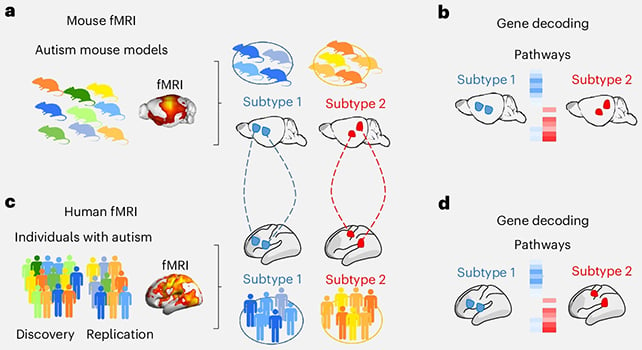
In a new study, an international team of researchers has identified two subtypes of autism, based on evidence in the brains of both humans and mice, using cross-species analysis to verify their findings and confirm how the subtypes differ biologically.
The researchers are hopeful that the discoveries will help in the development of more precise therapy and support programs for autism, and in moving away from the ‘one size fits all’ approach that is often taken with the condition.
“For decades, we’ve observed tremendous variability in how autism manifests, but we lacked direct evidence that these differences reflected distinct underlying biology,” says neuroscientist Alessandro Gozzi, from the Italian Institute of Technology.
“Our approach enabled us to isolate specific genetic and immune factors, then translate those signatures to human brain scans, showing that different connectivity patterns encode different mechanistic pathways underlying autism.”
The researchers analyzed brain scans from mice carrying 20 different models of autism-like brain characteristics, 940 children and young adults with autism, and 1,036 neurotypical individuals to look for differences in brain connectivity patterns.
Two groups of similar patterns emerged.
First was the hypoconnectivity group, where autism was associated with reduced brain connectivity. Here, brain activity was linked to genes involved with the synapse junctions that enable brain cells to communicate.
Then there was the hyperconnectivity group, associated with increased connectivity across the brain. This group’s brain patterns were linked to genes related to the immune system and showed measures of slightly more severe autism.
That the findings were replicable across mice and humans, and across different datasets in people, is strong evidence that these are genuine subtypes of autism.
However, there may be more to find: Around one in four of the human brains with autism that were analyzed fell into the hypoconnectivity or hyperconnectivity groups.
“The mouse models gave us a biological ‘Rosetta Stone’,” says neuroscientist Adriana Di Martino, from the Child Mind Institute in the US.
“We could see which biological pathways drive which connectivity signatures, then search for those same patterns in humans.”
There’s still a lot of work to do, but if these hypoconnectivity and hyperconnectivity subtypes can be confirmed and diagnosed, therapies could be developed for these categories of autism specifically – based on the biological traits found in the study.
This isn’t the first time that researchers have tried to spot matching patterns and split autism up into several types.
A study published in 2025 found four kinds of autism in 5,000 children, though it defined the categories using more than 230 different behavioral traits rather than the brain imaging approach used here.

Other research has looked at how the way autism manifests can depend on when it develops – early childhood, late childhood, adolescence, or young adulthood. All these studies can feed into the goal of better identifying and understanding autism.
You may have heard autism described as a spectrum, in an attempt to encompass the wide variety of ways that autistic people communicate and act.
However, some experts suggest that it’s not the most helpful way of describing what it means to be neurodiverse in this way, and are pushing for new approaches.
Larger datasets and more refined analysis techniques should make it possible to identify more subtypes in the future, the researchers suggest. In the meantime, they’ve made the data they gathered and the tools they used to analyze it available for other scientists to use, so it’s easier to build on top of this study in the future.
Related: Magnetic Brain Pulses Help Kids With Autism to Communicate, Study Finds
“Our cross-species approach provides an advanced translational framework for a multidimensional, biologically grounded stratification of autism,” write the researchers in their published paper.
“Our database is openly available to the research community, supporting future investigations into autism-related connectivity alterations.”
The research has been published in Nature Neuroscience.