Германы Vertigo and Balance Disorders (DSGZ) төвийн эрдэмтдийн судалгаагаар олон арван жилийн турш тайлагдаагүй “The Hum” хэмээх нам давтамжийн чимээ нь чихний дүнгэнэх эмгэг буюу тиннитусын нэг төрөл байж болохыг тогтоов.
Олон улсад 1970-аад оноос хойш бүртгэгдэж эхэлсэн энэхүү үзэгдлийг хүмүүс ихэвчлэн 50 Герц орчим давтамжтай, нам гүм орчинд сонсогддог, тогтмол үргэлжлэх чимээ хэмээн тодорхойлдог байна. Эрдэмтэн Бонифац Бауман болон Маркус Дрекслаар удирдуулсан судалгааны баг 28 сайн дурын оролцогчийг хамруулан уг үзэгдлийн шалтгааныг тодруулахаар ажиллажээ. Тэд оролцогчдын сонсголын мэдрэмж болон чихний доторх “otoacoustic emissions” буюу чихний дунгийн үсэрхэг эсүүдээс ялгардаг сул дуу авиаг хэмжсэн байна.
Судалгааны үр дүнд оролцогчдын ихэнх нь нам давтамжийн дууг хэт мэдрэг хүлээн авдаг гэх онол болон чихний бүтэцтэй холбоотой физиологийн өөрчлөлт нь уг үзэгдлийг тайлбарлах хангалттай нотолгоо болоогүй байна. Судлаачид “The Hum” нь гадны нөлөөтэй дуу чимээ гэхээсээ илүүтэй, хүний сонсголын систем дотор үүсдэг нам давтамжийн тиннитус (tinnitus) байх магадлалтай гэж үзжээ.
Тиннитус нь ихэвчлэн өндөр давтамжийн чимээгээр илэрдэг ч нам давтамжийн хэлбэрээр илрэх нь ховор боловч боломжтой хувилбар юм. Энэхүү дүгнэлт нь тус үзэгдлийг “төсөөллийн зүйл” гэж үзэхээс илүүтэй, сонсголын системийн эмгэг хэмээн хүлээн зөвшөөрч, цаашид үүнтэй тэмцэх, зохицуулах арга замыг олоход чухал ач холбогдолтой юм. Уг судалгааг PLOS One сэтгүүлд нийтэлжээ.
Дэлгэрэнгүйг эх сурвалжаас харах
↓Эх сурвалжийг нээх ↓
For decades, some people around the world have reported hearing a strange, sonorous background tone that others could not.
Named ‘The Hum‘, the phenomenon regularly appears on lists of the most perplexing unsolved mysteries, and has even been the topic of documentary investigations.
Proposed explanations have ranged from industrial noise to extra-sensitive hearing – but now, a new scientific exploration of several leading theories suggests that the source of The Hum may be a lot closer to home, at least for some people.
According to a team led by auditory scientist Bonifaz Baumann of the German Center for Vertigo and Balance Disorders (DSGZ), some reports of The Hum may be a form of underrecognized low-frequency tinnitus.
That doesn’t mean every report of The Hum has the same cause, but the findings suggest the source may often lie inside the auditory system, rather than in the outside world.
“Based on our results, although we haven’t ruled out cases of physical external sound sources, we suggest that subjective tinnitus in the low-frequency range is often the cause of hearing pulsations of low-frequency sound perceptions,” says neuroscientist Markus Drexl of DSGZ and the Norwegian University of Science and Technology.
The Hum first broke through into public discourse in the 1970s, when people in Bristol in the UK began complaining about a low-frequency sound in the background of their hearing, hovering at around 50 Hertz.
In the ensuing decades, further reports emerged from around the world, including Australia, New Zealand, and multiple locations across North America.
People report it as a persistent, low-frequency sound that can be a hum, a drone, or a rumbling. Often, other people around them do not hear it, and in some cases it comes and goes – it may be heard in a bedroom at night, for example, but no longer be audible on the subway the next morning.
Although a great deal of effort has gone into identifying the source of The Hum, the phenomenon remains stubbornly elusive. Many investigations have found no obvious cause, while others have identified sounds that ultimately failed to account for what people were hearing.
“We know that there are people who hear low-frequency sounds that can actually be measured, even if other people don’t hear them,” Drexl says.
“But it’s not so easy to find the source of these sound waves, because it’s a struggle to localize low-frequency sounds.”
Instead of trying to hunt down the sound itself, the researchers turned to the people who hear it.

They recruited 28 volunteers via a social media campaign, all of whom reported experiencing unexplained low-frequency sounds, and conducted a series of tests to determine whether two major theories held up.
The first theory was that people who hear The Hum have unusually sensitive low-frequency hearing.
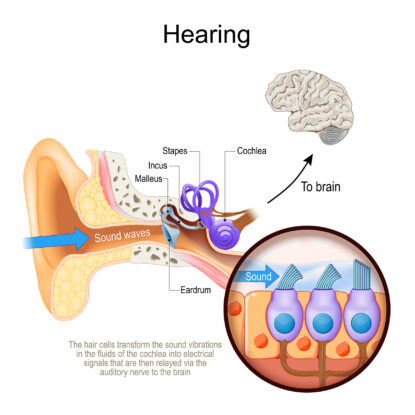
The other theory was that they are hearing a sound produced within their own bodies – otoacoustic emissions from the sensitive hairs in their cochleae. These sounds are a normal by-product of the inner ear’s operation, but are generally so faint that people are unaware of them.
The first test was a fairly standard hearing test, with a focus on lower ranges. Most had fairly average low-frequency sensitivity, except for two of the volunteers.
So that suggests that exceptional hearing does not play a significant role in most cases of The Hum.
“Even though the group we tested was small, it still means that the hypothesis of having especially good hearing for low-frequency sounds does not hold for most people,” Drexl says.
Next, the researchers measured the participants’ otoacoustic emissions.
Monitoring these tiny sounds is actually a useful tool for gauging aural health, so the equipment was already available: tiny microphones that are lowered into the ear canal to record whatever might be making noise in there.
Again, there was nothing unusual about the sounds in the ears of the study participants.
This suggests that, for some people at least, The Hum is a subjective experience.
Persistent, subjective perceptions of sound with no identifiable external source already have a name: tinnitus.
When you think of tinnitus, you may think of a high-frequency whine; that’s how it is best known.
That doesn’t mean tinnitus always presents in the upper register, though. Although it is rarer, some patients do experience tinnitus at lower frequencies, and the researchers believe that this is likely what is happening with some people who experience The Hum.
“While not directly tested in this study, low-frequency tinnitus might serve as a good explanation for many, but not all, cases,” the researchers conclude.

This is not a new idea, but has mostly been left by the wayside in favor of explanations of external sources. This might be because tinnitus is usually thought of as high-frequency, or possibly because low-frequency sounds are easier to interpret as external, rather than internal.
Recategorizing The Hum as tinnitus in some cases doesn’t mean the experience is imaginary. Tinnitus is a very real phenomenon, in many cases originating from, or affecting, the brain’s auditory pathway and processing centers.
Scientists don’t know what causes tinnitus, and there is currently no cure, but it’s an existing, active area of research, which means the search for answers is already in full swing.
Related: Tinnitus Is Somehow Connected to a Crucial Bodily Function
There are also established interventions and tools that can help people live more easily with the condition.
For people who hear The Hum, the experience is no less real if the source is internal.
But if the researchers are right, recognizing it as a form of tinnitus could open the door to treatments and coping strategies that have largely been overlooked.
The research has been published in PLOS One.