Эрдэмтэд молекулын үүлэн дэх соронзон орны шугамууд хийн урсгалыг хэрхэн чиглүүлж, оддын үүсэлд оролцдог болохыг тогтоожээ.
Манай галактик дахь оддын үүсэл нь молекулын үүлэн дэх хийн нягтрал нэмэгдэж, цөмийн нэгдэл эхлэх үйл явц юм. Гэвч хийн багахан хэсэг нь л од болон хувирдаг энэхүү үйл явцыг бүрэн тайлбарлахад соронзон орон, турбулент урсгал болон таталцлын хүчний харилцан үйлчлэлийг ойлгох нь чухал юм. MIT Haystack ажиглалтын төвийн эрдэмтэн Тушара Пиллэй болон түүний баг “The Astrophysical Journal” сэтгүүлд нийтлүүлсэн судалгаандаа DR21 нэртэй молекулын үүлэн дэх соронзон орны бүтцийг судалжээ.
Дэлхийгээс 6000 гэрлийн жилийн зайд орших DR21 нь 80 гэрлийн жилийн өргөнтэй, одод хурдацтай үүсдэг бүс юм. Судлаачид SIMPLIFI төслийн хүрээнд SOFIA болон HAWC багажуудын цуглуулсан өгөгдлийг ашиглан тус бүсийн соронзон орны шугамыг анх удаа өндөр нарийвчлалтайгаар зурагласан байна. Энэхүү зураглалаар соронзон орон нь хийн хөдөлгөөнийг хязгаарлах бус, харин төв хэсэг рүү чиглүүлэгч “төмөр зам” мэт үүрэг гүйцэтгэж байгааг илрүүлжээ.
https://iopscience.iop.org/article/10.3847/1538-4357/ae6a97
Судалгааны үр дүнд соронзон орны шугамууд болон таталцлын хүчний чиглэл нь орчны нөхцөл байдлаас үл хамааран үргэлж давхцдаг болох нь тогтоогдсон. Энэхүү соронзон орноор удирдуулсан нэгдэл нь дэд судал бүхий хийнүүдийг төв хэсэг рүү жилд хэдэн мянганы нэг нарны масс хэмжээгээр шахаж, их масстай одод үүсэх таатай нөхцөлийг бүрдүүлдэг аж.
Тус судалгааны багийн ахлагч Тушара Пиллэй галактик даяарх оддын үүслийг бүрэн тайлбарлахын тулд ирэх арван жилд туйлшралыг хэмжих чадвартай сансрын дуран авайг бүтээх нь чухал ач холбогдолтойг онцолсон байна. Одоогийн үр дүн нь молекулын үүлс өөр өөр орчинд хэрхэн бүтэцжиж, одыг хэрхэн хооллодог талаарх бидний ойлголтыг илүү гүнзгийрүүлж өглөө.
Дэлгэрэнгүйг эх сурвалжаас харах
Эх сурвалжийг нээх ↓
It’s obvious that star formation is a defining feature of the Universe, and so we’re bound to try to understand it. Stars form in molecular clouds, where cool gas collapses in on itself, and eventually becomes dense enough to trigger fusion. But that simple explanation glosses over a lot of detail, and astrophysicists are still trying to fill in some important gaps in their understanding of the process.
A number of difficult physics questions lie at the heart of star formation. Magnetism is part of that stubborn knot of questions. Exactly how gas moves around in a molecular cloud, and why so little of a cloud’s gas actually becomes stars, are both unanswered questions.
One of the difficulties in understanding star formation is that it’s multi-scale and multi-physical. To understand it, astrophysicists have to account for chemistry, radiation, turbulence, gravity, and magnetism.
New research in The Astrophysical Journal examines magnetic field lines in one well-known star formation region and how magnetism guides gas flows in molecular clouds. It’s titled “SIMPLIFI—Study of Interstellar Magnetic Polarization: A Legacy Investigation of Filaments. I. Magnetically Guided Accretion onto the DR21 Ridge,” and the lead author is Thushara Pillai. Pillai is a research scientist at MIT Haystack Observatory.
DR21 is a large molecular cloud about 6,000 light years away that’s known for rapid star formation. It’s about 80 light years across and holds some of the most massive stars we’ve found in the Milky Way. This research focuses on a feature called the main ridge.
Ridges are massive, dense filaments that are gravitationally unstable and have other filaments feeding into them. They could be sites where massive stars preferentially form. Scientists have known about DR21’s main ridge for a long time.
*The image on the left shows DR21 in context. The image on the right shows some of the detail, including filaments that feed into the ridge. Image Credit: ESA/Herschel/SPIRE/PACS/HOBYS*
“Understanding what regulates star formation in molecular clouds remains a central question in astrophysics,” the authors write. Star formation is remarkably inefficient, with only a few percent of the gas in a molecular cloud ever transforming into stars. “Magnetic fields, alongside turbulence, have long been recognized as potentially playing a crucial role in regulating the gravitational collapse of star-forming gas,” the authors explain.
Gas cloud anisotropy is at the heart of the problem. Many things introduce anistropy into gas clouds, including shocks, supernovae, self-gravity, and stellar feedback. But magnetism may play the main role and that’s what this work focuses on.
“Magnetic fields play a particularly pervasive role, imposing a preferred direction on gas dynamics across a wide range of scales,” the researchers explain. “The Lorentz force preferentially resists gas motion perpendicular to magnetic field lines while allowing gas to flow freely along field lines.”
Astrophysicists use polarimetry to detect magnetic field lines in molecular clouds. It doesn’t directly detect magnetic field lines; instead it traces the emissions from warm dust, which aligns with the magnetic field lines. This research is based on SIMPLIFI (Study of Interstellar Magnetic Polarization: a Legacy Investigation of Filaments). It’s based on data from SOFIA and HAWC.
The researchers mapped the magnetic field lines in the DR21 main ridge and the surrounding filaments. While this has been done before, this is the first time that the mapping has extended beyond only high-column-density regions, generating a more comprehensive view of the field lines and how they funnel gas into the main star-forming region.
“Working with SOFIA’s polarization data was challenging,” said Jens Kauffmann, who is also a research scientist at MIT Haystack Observatory. “We had to characterize the data reduction systematics from scratch. But the result was worth it: a homogeneous map of the magnetic field across an entire star-forming complex, at a level of detail that no other facility could provide.”
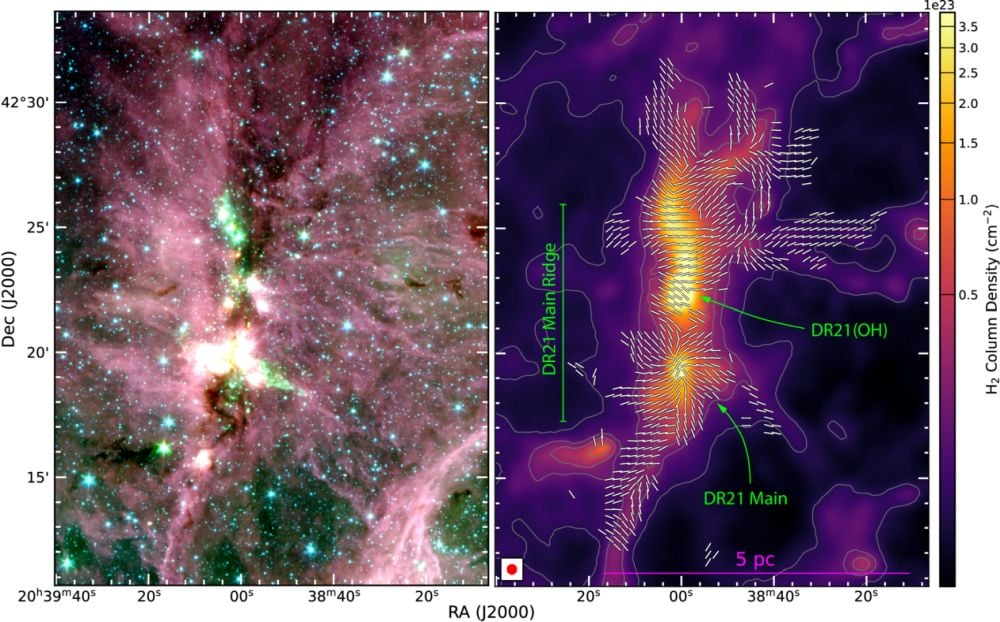 *The image on the left is a three-color Spitzer image of DR21. The image on the right shows the magnetic field lines. In the main ridge, the field lines are perpendicular. In the secondary filaments, the lines tend to align with the filaments. Image Credit: Thushara G. S. Pillai et al 2026 ApJ*
“The magnetic field acts like a set of railroad tracks,” said lead author Pillai in a press release. “Gas flows along the tracks toward the central ridge, building it up over time. Across the tracks, the field resists motion. So the field doesn’t stop star formation — it channels it.”
The researchers’ main finding is that the orientation of the magnetic field lines and gravitational acceleration remain aligned with one another despite changes in the environment or in the column density of gas. “This persistent alignment is consistent with magnetically guided accretion: subfilaments channel material along field lines at several 10−3 M⊙ yr−1, sufficient to assemble the Ridge within ∼106 yr and sustain high-mass star formation,” the authors explain.
This paints a picture where subfilaments channel star-forming gas into the main ridge. They’re like river tributaries in a hierarchical structure that goes from large-scale cloud → subfilaments → dense ridge → star-forming cores. The rate of mass accretion into the main ridge is a few thousandths of a solar mass per year. That may sound small, but it’s actually orders of magnitude larger than the rate for a typical, single, lower-mass protostar. But it has to be, since it’s feeding gas into an entire massive ridge rather than a lone protostar.
The results show that the sub-filaments themselves were unlikely to have formed any stars before the gas moved through them into the main ridge. It’s all consistent with magnetically-induced accretion onto the main ridge. The results are also consistent with what astrophysicists see in lower-mass star forming clouds, showing that “magnetic fields play a similar role in structuring molecular clouds across a wide range of star-forming environments,” according to the authors.
These are the first results from SIMPLIFI, and more are on their way. Future results will determine the strength of the magnetic fields, analyze polarization more thoroughly, and build on the understanding generated by this work.
But to extend our understanding of how magnetic field lines shape star formation, more comprehensive observations on a wider scale are necessary.
“To really understand how magnetic fields shape star formation across the galaxy, we need to go further — to fainter emission, larger areas of sky, and clouds at every stage of evolution,” Pillai says. “That requires a space-based far-infrared mission with polarization capability. We don’t have one. Building one should be a priority for the next decade of astrophysics.”