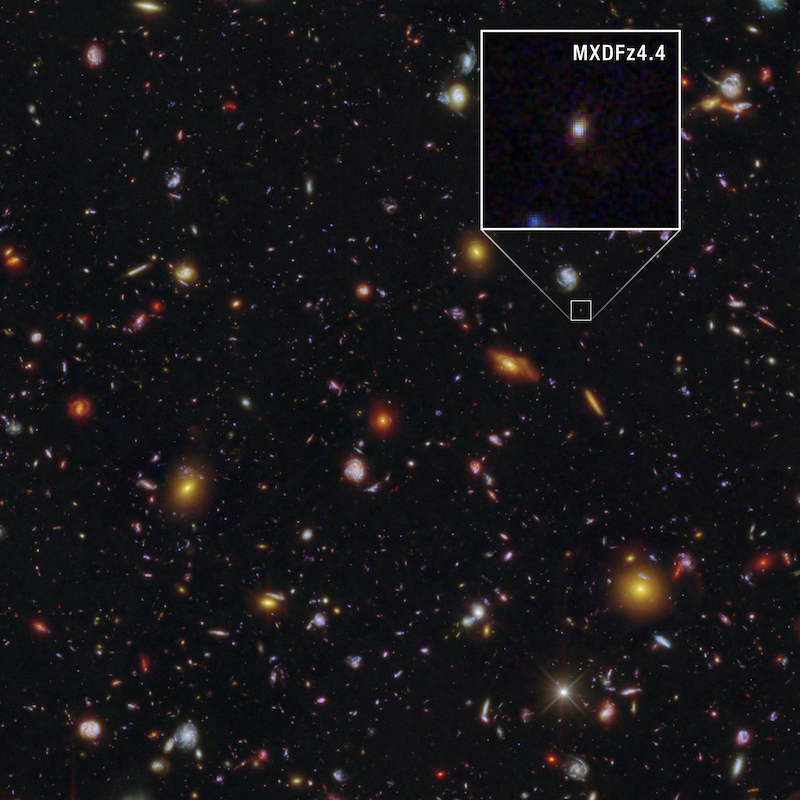
Эрдэмтэд орчлон ертөнцийн эхэн үеийн өтгөн манан дундаас гэрэл цацруулж, орчлонг тунгалаг болгоход нөлөөлсөн анхны галактикуудын нэгийг илрүүлжээ.
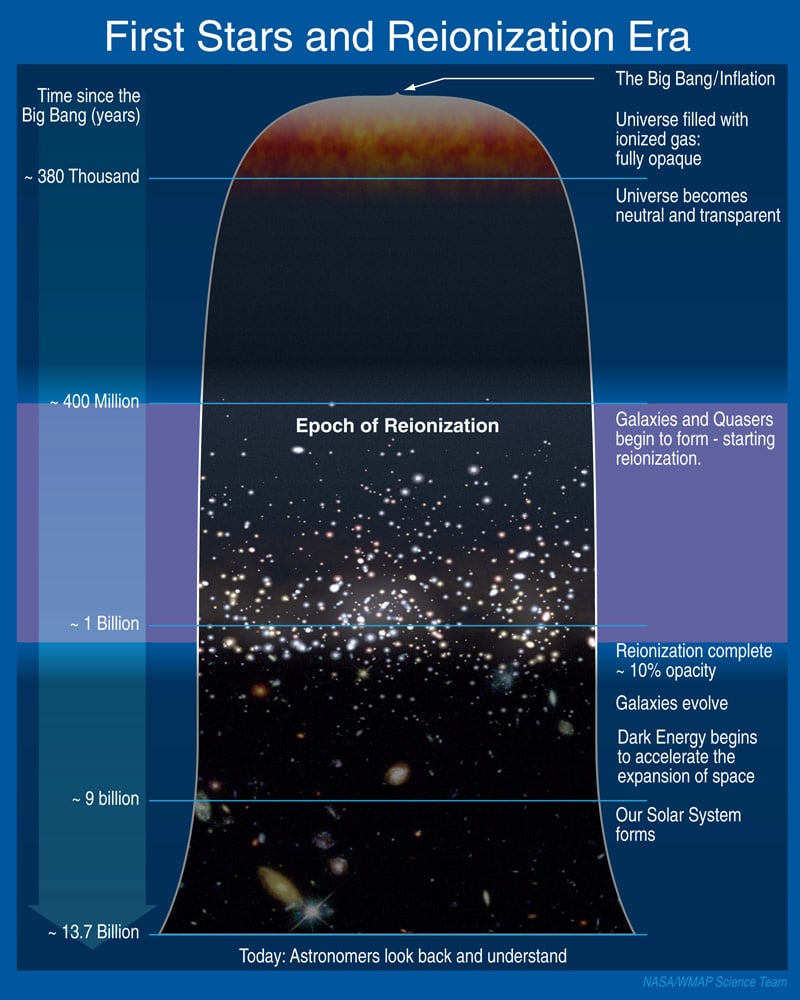
Орчлон ертөнц үүссэнээс хойшхи эхний тэрбум жилийн хугацаанд устөрөгчийн хийн өтгөн манангаар дүүрэн байсан тул хэт ягаан туяа нэвтрэх боломжгүй байв. Хаббл дурангийн илрүүлсэн MXDFz4.4 хэмээх галактик нь их тэсрэлтээс хойш 1.4 тэрбум жилийн дараах төлөв байдалтайгаар ажиглагдсан бөгөөд устөрөгчийн хийг тунгалаг болгох чадалтай ионжуулагч гэрлийг ялгаруулж байна. Энэхүү олдвор нь орчлон ертөнцийн “дахин иончлолын эрин” хэрхэн эхэлснийг ойлгоход чухал ач холбогдолтой юм.
MXDFz4.4 галактик нь Сүүн замаас 100 дахин жижиг хэдий ч од үүсгэх үйл явц 10 дахин хурдан явагддаг, маш идэвхтэй биет юм. Энэхүү жижиг орон зайд төвлөрсөн олон тооны халуун оддын хүчтэй цацраг болон супернова дэлбэрэлтүүд нь орчмын хийн мананг нэвтлэн сансарт гэрэл гаргах “цонхыг” нээж өгдөг байна.
Эрдэмтэд Хаббл дурангаар илрүүлсэн энэхүү гэрлийг Жэймс Вэбб дурангийн тусламжтайгаар галактикийн жин болон түүхэн өгөгдлийг тодорхойлж, Чили дэх “Very Large Telescope”-ийн тусламжтайгаар байршлыг нь нарийвчлан тогтоожээ. Урьд өмнө нь ийм төрлийн гэрэл ялгаруулдаг галактикийг их тэсрэлтээс 1.6 тэрбум жилийн дараах үеэс олж байсан бол MXDFz4.4 нь энэхүү хязгаарыг урагшлуулж байна. Судлаачид сансрын гүн дэх ийм “бяцхан зуухнууд” нь орчлон ертөнцийн мананг арилгаж, гэрэл нэвтрэх боломжийг бүрдүүлсэн гэж үзэж байна.
https://www.universetoday.com/article_images/Reion_diagram_20260625_224836.jpg
https://www.universetoday.com/article_images/1280px-STS-109-HST-s109e5700_20260625_224544.jpg
Дэлгэрэнгүйг эх сурвалжаас харах
Эх сурвалжийг нээх ↓
How did the universe learn to let light through? For its first billion years or so, the universe was not the clear, starry place we see today. It was filled with a thick fog of hydrogen gas, so dense that ultraviolet light could not pass through it. Then, slowly, the fog lifted. Astronomers call this the Era of Reionisation, and for decades they have argued about what did the clearing. Hubble may finally have caught the culprit in the act.
The galaxy at the heart of this story is called MXDFz4.4, and we see it as it was just 1.4 billion years after the big bang, deep in the fogbound early universe. What makes it remarkable is that Hubble detected its ionising light, the very ultraviolet glow capable of burning hydrogen gas transparent. That was thought to be impossible because the fog of the early universe was expected to smother such light long before it could reach us. Yet here it is, the first galaxy of its kind ever spotted this close to dawn of time.
Schematic timeline of the universe, depicting reionisation’s place in cosmic history (Credit : NASA)
MXDFz4.4 achieved this because, despite being small, it was ferocious. It’s around a hundred times smaller than our Milky Way, yet it forges new stars ten times faster. Cram that many young, hot, massive stars into so tiny a space and you create a furnace, and the researchers believe that anywhere from half to all of its searing ultraviolet light is punching clean through the surrounding gas and escaping into space.
Those same stars help in death as well as in life. Massive stars burn fast and die young, exploding as supernovae within a few million years. Each blast tears a colossal hole in the gas, opening yet another window for light to pour out. A galaxy like this is, in effect, blasting its own neighbourhood clear.
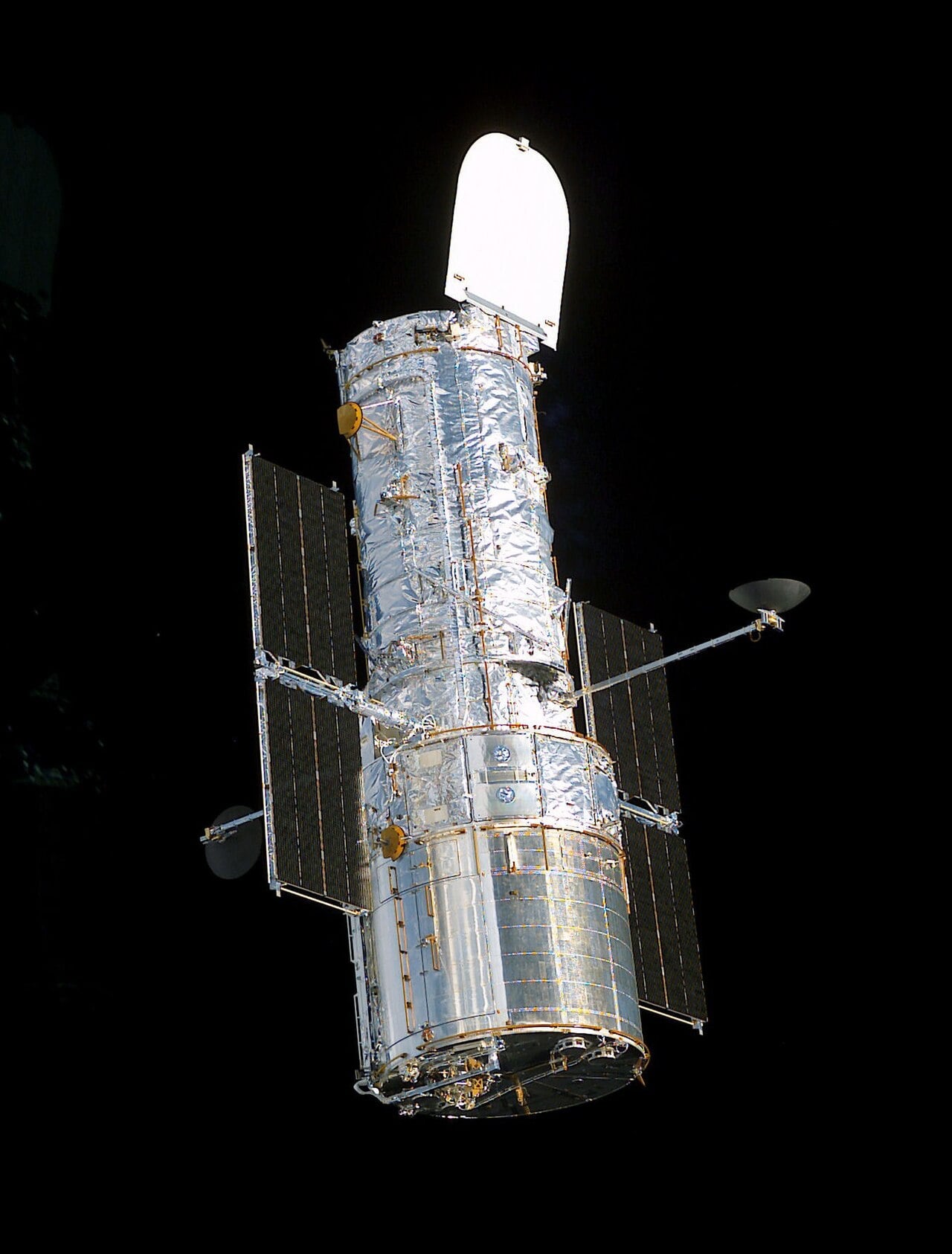 Hubble Space Telescope as seen from the the Space Shuttle Columbia on mission STS-109 (Credit : NASA)
Hubble could not crack the case alone. The light from MXDFz4.4 had travelled more than 12 billion years to reach us, stretched by the expanding universe from ultraviolet into the visible light that Hubble is uniquely able to catch. Astronomers then used the James Webb Space Telescope to weigh the galaxy and read its history, and the Very Large Telescope in Chile to pin down its exact location.
The find matters because it is the closest look yet at the moment the universe cleared. Until now the earliest galaxy caught leaking this kind of light sat 1.6 billion years after the big bang. MXDFz4.4 pushes that frontier back, and the astronomers suspect it is far from alone. Somewhere in the deep field, more of these little furnaces are waiting to be found, each one a lamp that helped burn away the fog and let the universe, at last, be seen.
Source : Hubble Details Early Galaxy Transforming Neighbourhood