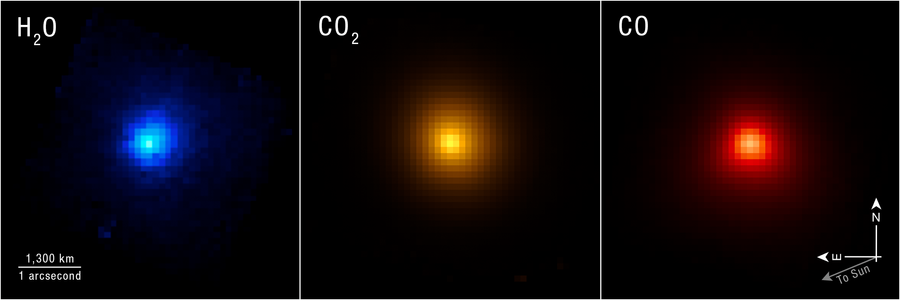
Жэймс Вэбб сансрын дуран авайг ашиглан манай нарны аймгаар дайран өнгөрсөн гариг хоорондын 3I/ATLAS сүүлт одны химийн найрлагыг судалж, түүний эртний гарал үүслийг тогтоожээ.
2025 онд Дэлхий болон Ангараг гаригийн хоорондуур 1.8 одон орны нэгжийн зайд дайран өнгөрсөн 3I/ATLAS сүүлт од нь манай нарны аймгийн гаднаас ирсэн биет болохыг эрдэмтэд тогтоов. NASA-гийн Жэймс Вэбб дуран алайн NIRSpec төхөөрөмжөөр хийсэн шинжилгээгээр уг сүүлт одны найрлагад манай нарны аймгийн сүүлт одуудаас 30 дахин их дейтери агуулагдаж байгаа нь илэрчээ. Энэхүү химийн өвөрмөц бүтэц нь тус биет 10 тэрбум гаруй жилийн өмнө, манай Нар болон нарны аймаг бүрэлдхээс ч өмнөх үед үүссэн байж болзошгүйг харуулж байна.
Дейтери нь халуун орчинд задардаг устөрөгчийн изотоп тул түүний өндөр агууламж нь сүүлт од сансрын гүн хөлдүү орчинд удаан хугацаагаар байсныг гэрчилдэг. Түүнчлэн, уг биетээс илэрсэн нүүрстөрөгч-13 изотопын бага түвшин нь түүнийг оддын хувьслын эрт үед төрсөн болохыг баталж байна. NASA-гийн Годдардын сансрын нислэгийн төвийн астрохимич Мартин Кординерын үзэж буйгаар, энэхүү нээлт нь манай нарны аймаг сансар огторгуйд хэрхэн онцгой эсвэл түгээмэл болохыг ойлгох чухал ач холбогдолтой юм.
ESO-гийн “Very Large Telescope”-ийн тусламжтайгаар сүүлт одны найрлагаас амьдралын үүсэлд нөлөөлж болох цианид зэрэг органик нэгдлүүдийг илрүүлжээ. Энэ нь манай галактикийн алс холын системүүдэд амьдралын химийн үндсэн бүрэлдэхүүн хэсгүүд оршин байх боломжтойг харуулж байна. Судлаач Стефани Миламын тэмдэглэснээр, энэ нь амьдралд шаардлагатай химийн нөхцөлүүд сансар огторгуйд хэр түгээмэл байгааг судлах томоохон алхам болж байна.
NASA’s Webb Finds Clues to Ancient, Distant Origin of Comet 3I/ATLAS
https://www.nature.com/
Дэлгэрэнгүйг эх сурвалжаас харах
Эх сурвалжийг нээх ↓
Comets have played an interesting role in astronomy history. From antiquity, many cultures saw them omens or spirits, portending good or bad news for kings, queens, and emperors. Over the past few hundred years, however, astronomers have studied them intently to understand the science behind these visitors to the inner Solar System. Today we know that these ghostly apparitions in the sky are made of dirty balls of ice and rock blasting through space, scattering dust and gases as they go.
A section of the Bayeux Tapestry showing people pointing out the comet of 1066, commonly thought to be Comet Halley.
It turns out that comets also have a part to play in solar system history. Each one has a treasury of clues locked in its ice and dust about conditions in our solar system, particularly when they formed in the protosolar nebula some 4.5 billion (or more) years ago. And, if our “home” comets do that, think about what “alien” ones from other planetary systems can tell us about distant places in the galaxy!
Introducing an Alien Comet
We have a perfect example in Comet 3I/ATLAS, the interstellar intruder that skimmed through the inner solar system between Earth and Mars in 2025. It passed within 1.8 AU of Earth, and developed a thick coma (cloud of gas and dust). Astronomers used the James Webb Space Telescope (JWST) and its highly sensitive NIRSpec to study the chemical makeup of that comet and found that it was enriched by the element deuterium. In fact, it contains more than 30 times the amount of deuterium seen in our “home” solar system comets. That tells astronomers quite a bit about conditions where the comet formed in its own home system, how old it is, and even a little something about our own solar system.
“This was a unique opportunity to study an ancient object from the distant Galaxy, probably pre-dating our Sun and Solar System,” said astro-chemist Martin Cordiner of NASA’s Goddard Space Flight Center in Greenbelt, Maryland. “On the one hand, we get direct insight into that distant time and place, and on the other, we learn something about how unusual our own Solar System may be.”
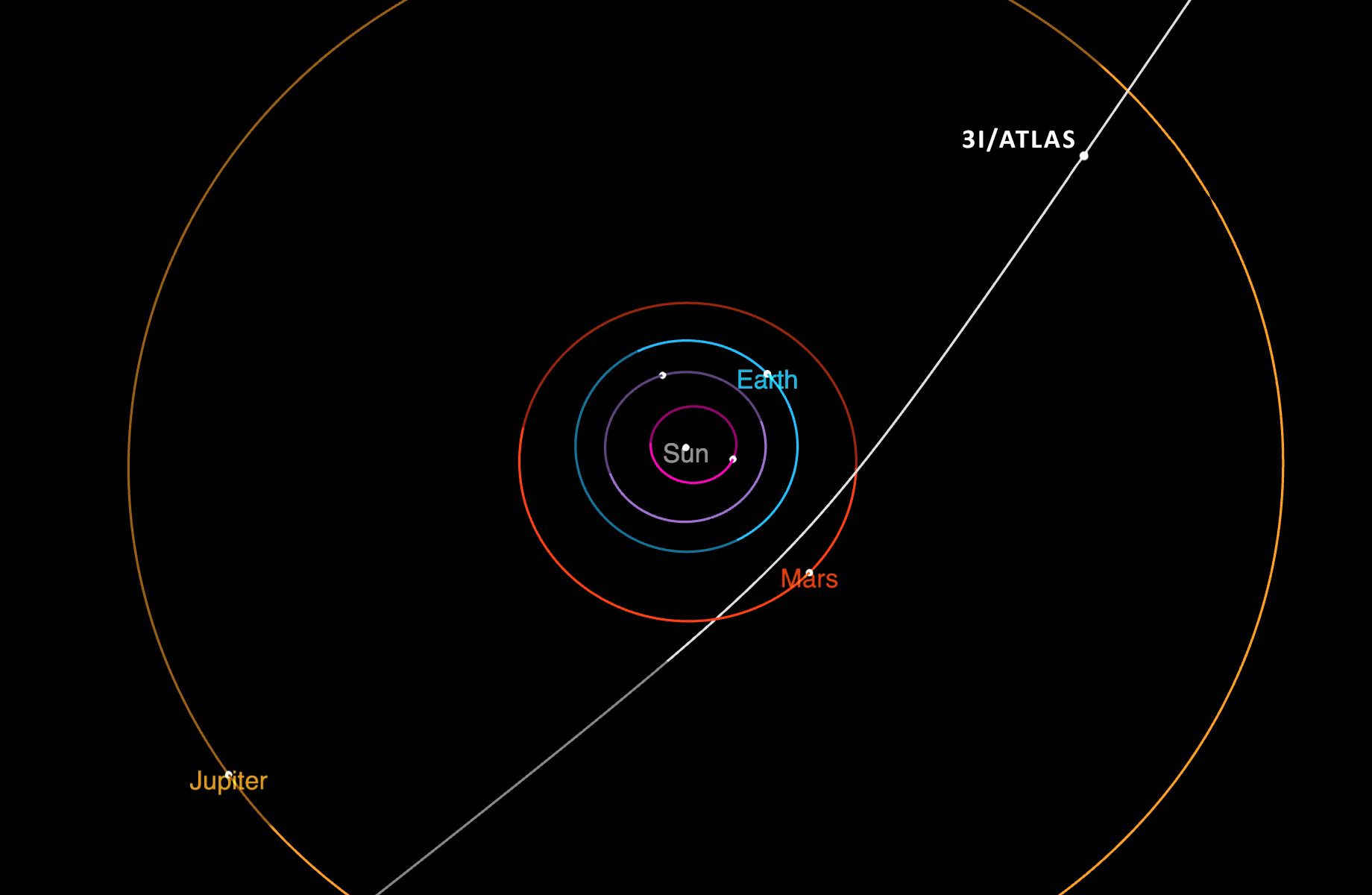 3I/ATLAS’s path through the inner part of the Solar System. The shape of its path told astronomers that it originated from outside our solar system. Courtesy NASA.
Deuterium in a Comet
As any comet gets close to a source of heat, it starts to sublimate and “outgas” some of its material. 3I/ATLAS was no different. Its passage between Earth and Mars warmed the ices and that puffed up a gas coma. The NIRSpec on JWST captured spectra of the light emitted by the coma and that data was used to determine the ratios of carbon and deuterium in the comet.
Deuterium is a useful element to study. It’s an isotope of hydrogen that doesn’t exist well in the presence of heat. Most of it that we see in nature was formed in the Big Bang. It can also be formed in stars, but the fusion reactions quickly destroy it. Thus, it likes things cold. Once its exposed to any kind of long-term heating, it gets reprocessed into the hydrogen that makes up water. If you take a sample of water here on Earth (or in any “home built” comet from our system), it has a certain ratio of deuterium to hydrogen. The more hydrogen there is, the less deuterium exists. That’s a valuable ratio to figure out the conditions under which the comet formed.
Nobody has pinpointed the home system of 3I/ATLAS yet, but the high deuterium to hydrogen ration indicates that it very likely formed in a very cold system very early in the history of the Milky Way. Based on its trajectory, some astronomers have suggested that its home system could have been in the thin or thick disk of the Milky Way. In addition, they suspect it formed at least 10 billion years ago or longer. That’s a time when stellar formation was really kicking off across the galaxy, which provided the comet with its birthplace around a now-ancient star. Its travel through interstellar space hasn’t subjected it to very much heating, which is why it still has its high “birth” ratio of deuterium. In other words, it’s been in a deep freeze most of its existence.
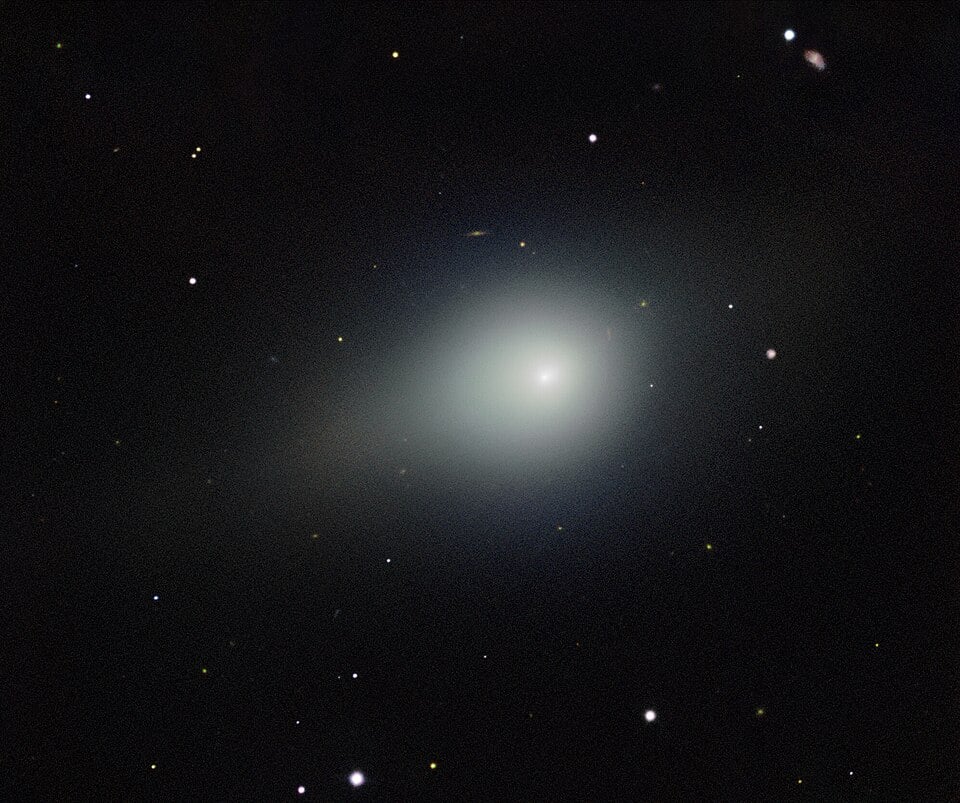 A Gemini North image of 3I/ATLAS taken on November 26, 2025. Credit: International Gemini Observatory/NOIRLab/NSF/AURA/B. Bolin Image Processing: J. Miller & M. Rodriguez (International Gemini Observatory/NSF NOIRLab), T.A. Rector (University of Alaska Anchorage/NSF NOIRLab), M. Zamani (NSF NOIRLab) –
Carbon Fills Out the Story
Deuterium isn’t the only age and chemical tracer that the science teams used JWST to study the alien comet. Isotopes of carbon also provided insight into the comet’s past. NIRSpec showed only traces of carbon-13 compared to lighter-weight carbon-12. This also points to a very old origin for 3I/ATLAS. That’s because stellar systems become enriched with carbon-13 over time as generations of stars are born and die in the galaxy. When stars die, they lose their carbon (and other elements to space) and eventually that material gets taken up in new generations of stars (and planets). That is why there are higher levels of carbon-13 in our system, around our Sun, which formed relatively recently, 4.5 billion years ago.
JWST wasn’t the only telescope to study this fascinating comet. ESO’s Very Large Telescoped looked at the comet and found a carbon and nitrogen compound called cyanide. That’s a pre-biotic compound involved in the formation of life and indicates that wherever this comet formed, it might have the conditions that could have led to life. According to team member Stefanie Milam of NASA Goddard, finding such chemicals elsewhere in the galaxy is a rare discovery. “For us as scientists, finding these rare isotopes is fascinating, but the bigger picture here is looking at the possibilities of prebiotic chemistry elsewhere in the galaxy,” said Milam of NASA Goddard. “So far, we know of only one place in the vast cosmos where chemical ingredients led to life – our Solar System, our Earth. Analysis of these interstellar objects is a major step towards learning how common, or uncommon, the conditions for the evolution of life are in the Universe.”
For More Information
NASA’s Webb Finds Clues to Ancient, Distant Origin of Comet 3I/ATLAS

