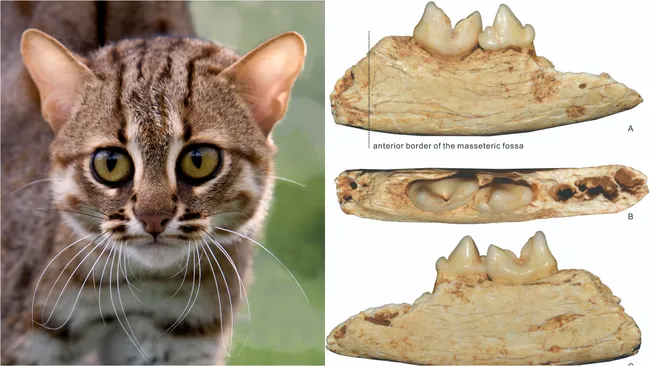
Хятадын Аньхуй мужийн Хуалундун агуйгаас олдсон эрүүний хэлтэрхий нь палеонтологичдод муурын овгийн цоо шинэ зүйлийг тодорхойлох боломж олгожээ.
Хятадын Шинжлэх ухааны академийн Сээр нуруутан амьтдын палеонтологи ба палеоантропологийн хүрээлэн болон Шведийн Байгалийн түүхийн музейн судлаачид уг олдворыг Prionailurus kurteni хэмээн нэрлэж, “Annales Zoologici Fennici” сэтгүүлд нийтлүүлсэн байна. Ойролцоогоор 300,000 жилийн тэртээх Дундад Плейстоцений үед хамаарах энэхүү олдвор нь өнөөг хүртэл олдсон муурын овгийн хамгийн жижиг амьтдын нэгд тооцогдож байна. Ураны аргаар он цагийг тогтооход уг олдвор 275,000-аас 331,000 жилийн настай болох нь тогтоогджээ.
Тус олдвор нь дөрөв дэх шүд ба нэгдүгээр араа шүд бүхий эрүүний жижиг хэсэг юм. Түүний нэгдүгээр араа шүд нь 6.37 мм урттай бөгөөд энэ нь өнөө үед амьдардаг хамгийн жижиг муур болох зэвэрсэн толбот муур болон хар хөлт мууртай ижил хэмжээтэй аж. Гэсэн хэдий ч шүдний бүтэц, эрүүний хэлбэр болон булчингийн бэхлэгдэх байршил нь орчин үеийн муурнуудаас ялгаатай байгаа нь уг амьтныг шинэ зүйл болохыг баталж байна.
Хуалундун агуй нь эртний хүмүүсийн үлдэгдлээс гадна аварга хулсны баавгай, бар, ирвэс, хүрэн баавгай зэрэг олон амьтны олдвороор баялаг юм. Энэхүү нээлт нь Ази тив дэх муурын овгийн хувьсал ба олон янз байдлыг ойлгоход чухал ач холбогдолтой. Мөн уг олдвор нь Prionailurus төрлийн анхны чулуужсан олдвор болж байгаагаараа шинжлэх ухааны өндөр ач холбогдолтой юм.
Дэлгэрэнгүйг эх сурвалжаас харах
↓Эх сурвалжийг нээх ↓
A tiny jaw fragment recovered from a cave in southern China’s Anhui Province has led paleontologists to identify an entirely new species of wild cat, one that ranks as the smallest member of the family Felidae ever documented in the fossil record. The find comes from Hualongdong Cave, a site already well-known for its archaic human remains, and pushes back what scientists know about the diversity of small cats in prehistoric Asia.
The new species, named Prionailurus kurteni and described in the journal Annales Zoologici Fennici, dates to roughly 300,000 years ago, during the late Middle Pleistocene. Uranium-series dating of the fossil hominin layers where the specimen was found places it between 275,000 and 331,000 years old. The cat lived alongside an archaic human population at the site, as well as giant pandas, tigers, leopards, clouded leopards, and brown bears, making Hualongdong one of the most carnivore-rich fossil localities known from that period in East Asia.
A Single Jaw Fragment, a New Species
The entire specimen consists of a small mandibular fragment with two teeth preserved: a fourth premolar and a first molar. Despite its size, the piece carries enough distinct features for researchers at the Institute of Vertebrate Paleontology and Paleoanthropology at the Chinese Academy of Sciences, together with collaborators from the Swedish Museum of Natural History, to establish it as a previously unknown species.
At its largest dimension, the first molar measures just 6.37 millimeters in length. That places P. kurteni in the same size range as the two smallest living cats on Earth: the rusty-spotted cat (Prionailurus rubiginosus) of South Asia and the black-footed cat (Felis nigripes) of southern Africa.
What separates the fossil from its modern relatives, however, is a cluster of structural details that do not appear in any known living species. These include unusually weak accessory cusps on the premolar, a near-absence of the distal cingulid (a shelf-like ridge behind the rear cusp), and a notably deep jaw relative to its overall dimensions. The position of the masseteric fossa, the depression on the jaw where a major chewing muscle attaches, also sits further back than in any modern member of the genus.
Why Small Fossil Cats Are So Rarely Found
The scarcity of fossil records for small cats in southern China and Southeast Asia has long frustrated researchers trying to understand how the group evolved. Felini, the subfamily that includes leopard cats, golden cats, and their relatives, are the dominant small felids across forested Asia today, yet their prehistoric history in the region is almost entirely blank. The reasons are partly geological and partly taxonomic.
Small cat bones are fragile and rarely survive in cave deposits, where most fossils from this region are found. When isolated teeth do turn up, they are difficult to assign to species because small cats share broadly similar dental shapes. Compounding the problem, paleontologists historically lumped nearly all small Asian cat fossils under a single genus, Felis, without close examination.

The authors of the new study note that a careful review of existing collections is still needed, and that some specimens previously assigned to Felis microtis or Felis sinensis may represent different species entirely.
What the Discovery Suggests About Ancient Cat Diversity
The genus Prionailurus currently includes four or five living species, all confined to Asia, and molecular dating traces the group’s radiation back to the Late Pliocene or Early Pleistocene, roughly two to five million years ago. Until now, no fossil species had ever been formally assigned to the genus. P. kurteni is the first, and its presence at Hualongdong around 300,000 years ago indicates that the genus was already more diverse than its modern representatives suggest.
The description also notes that P. kurteni was not alone at the site. A larger cat jaw previously recovered from the same location, once labeled Felis microtis, may actually belong to a golden cat relative in the genus Catopuma, based on its size and morphology.
A broader carnivore study of Hualongdong, published separately in 2025, counted six felid species coexisting at the cave locality, ranging from approximately one kilogram (the estimated weight of P. kurteni) up to roughly 200 kilograms for tigers. The study was named in honor of Björn Kurtén, a Finnish paleontologist whose work on Pleistocene carnivores influenced the lead researcher’s approach to the study of statistics in paleontology.
Enjoyed this article? Subscribe to our free newsletter for engaging stories, exclusive content, and the latest news.

