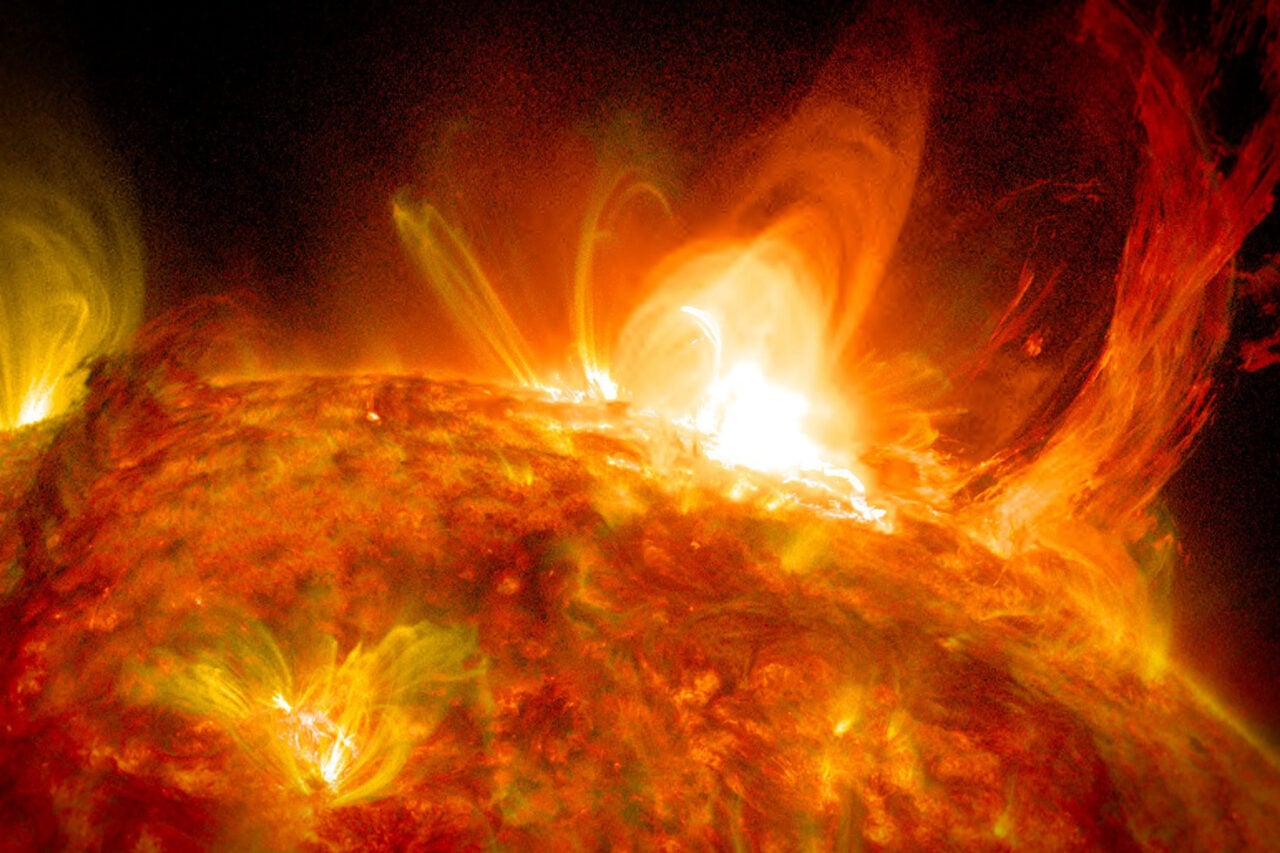
Шинэ судалгаагаар Нар улаан аварга од болон тэлэх үед дэлхий таталцлын хүчнээс мултарч, илүү өргөн тойрог замд шилжих боломжтойг тогтоожээ.
Одоогоос таван тэрбум орчим жилийн дараа Нарны амьдралын мөчлөг дуусч, одоогийнхоос хэдэн зуу дахин том болох төлөвтэй байна. Энэ үйл явц нь Буд болон Сугар гарагийг залгиж, нарны аймгийн дотоод бүтцийг эрс өөрчлөх юм. Гэвч KU Leuven-ийн Одон орон судлалын хүрээлэнгийн эрдэмтдийн “Astronomy and Astrophysics” сэтгүүлд нийтэлсэн шинэ судалгаагаар дэлхий гараг энэхүү гамшгаас мултарч үлдэх магадлалтайг дэвшүүлжээ.
https://www.aanda.org/articles/aa/full_html/2026/06/aa60576-26/aa60576-26.html
https://fys.kuleuven.be/ster/news/2026/will-earth-survive-the-suns-death-new-study-suggests-it-might
Судалгааны багийн ахлагч Матс Эсселдерс (Mats Esseldeurs)-ийн тайлбарласнаар, дэлхийн хувь заяа нь одны таталцлын хүч болон массын алдагдал хоёрын тэнцвэрээс хамаарна. Нар тэлэх явцдаа массын тодорхой хэсгээсээ салснаар дэлхийд үзүүлэх таталцлын нөлөө нь суларч, манай гараг аюулгүй тойрог зам руу шилжих боломжтой аж. Хэрэв таталцлын харилцан үйлчлэл давамгайлбал дэлхий Наранд залгигдах эрсдэлтэй бөгөөд энэхүү таамаглалыг батлахын тулд L2 Puppis хэмээх ойролцоох одны ажиглалтыг ашиглажээ.
Хэдийгээр дэлхий гараг өөрөө сүйрлээс мултарч үлдэх боломжтой ч, амьдрал оршин тогтнох нөхцөл нь эртнээс алдагдах болно. Нарны хэмжээ томорч, гэрэлтэлт нь нэмэгдэхийн хэрээр дэлхийн гадаргуугийн температур хэт халах тул Нарны мөхлийн эцсийн шат болох улаан аварга одын үе ирэхээс өмнө ч манай гараг амьдралд тохиромжгүй болох юм. Судалгаагаар Буд, Сугар гарагууд Наранд залгигдах нь тодорхой боловч Ангараг гараг ч мөн адил дэлхийн адил тойрог замаа өөрчлөн үлдэх магадлалтайг дурджээ.
Дэлгэрэнгүйг эх сурвалжаас харах
Эх сурвалжийг нээх ↓
In about five billion years, the Sun will reach the end of its life and grow to hundreds of times its current size. The star’s looming death will dramatically reshape the inner solar system, engulfing Mercury and Venus in a fiery sphere. The fate of Earth, however, remains a point of debate. Now, new research suggests our planet may have a chance of escaping the Sun’s blazing outer layers.
An international team of astronomers reassessed Earth’s chances of survival using models of stellar evolution and tidal interactions. The findings, published in Astronomy and Astrophysics,offer an alternative scenario in which our planet drifts farther away from its dying star if the Sun loses its gravitational grip on Earth. While the planet itself may endure, life on Earth will become impossible as the Sun reaches its final, giant phases.
Death of a star
The Sun is currently about halfway through its life. Over the next billions of years, the star will continue to evolve and undergo gradual changes before it reaches the end of its life. The Sun’s outer atmosphere will drift away into space, and its remaining core will be a white dwarf.
Once the Sun has exhausted the hydrogen at its core, its outer layers will expand enormously as it turns into a red giant. At this point, there are two possible outcomes for the fate of Earth. As the Sun expands, that could increase the gravitational tidal forces that pull our planet inward. Conversely, the Sun could rapidly lose its mass, allowing Earth to escape its gravitational grip, according to the new study.
“The fate of Earth depends on a delicate balance between these two effects,” Mats Esseldeurs, researcher at the Institute of Astronomy of KU Leuven and lead author of the new study, said in a statement. “If tidal interactions dominate, Earth is engulfed. If mass loss dominates, Earth escapes to a wider orbit.”
Previous research has leaned toward Earth meeting a fiery doom as it is engulfed by the Sun’s expanding outer layers. Based on the internal structures and dynamics of evolved stars, the researchers behind the new study showed that Earth could end up in a wider orbit around the ensuing white dwarf.
It’s a close call
Earth’s outcome largely depends on how fast the Sun loses its mass during its last giant phase. As the Sun expands, it will lose some of its material to space through stellar winds. With less matter, the Sun’s gravitational pull on Earth will be reduced, allowing the planet to drift to a farther orbit and avoid being swallowed by the expanding star.
For that to happen, the Sun needs to lose its mass rather quickly. The rate at which aging stars lose their mass remains poorly understood, leading to a level of uncertainty regarding the results of the study.
To help confirm the fate of Earth, the researchers turned to a nearby star called L2 Puppis that is believed to offer a rare glimpse into the Sun’s future. “Observations of Sun-like giant stars currently point towards Earth’s survival, but we need better observations before we can be certain,” Esseldeurs said.
As the innermost planets, the fate of Mercury and Venus is more certain than that of Earth’s. The new study shows that the two planets will get engulfed by the expanding Sun, even if Earth survives. Mars, on the other hand, has a good chance of surviving the Sun’s giant phases and could also end up in a wider orbit.
Now, here’s the bad news. As the Sun continues to fuse hydrogen into helium, it will increase in brightness. As a result, Earth is expected to become much hotter and more inhospitable to life long before the Sun reaches its giant phases. So while the new study offers a potentially optimistic outcome for the planet itself, it’s not such a happy ending for Earth’s inhabitants.

