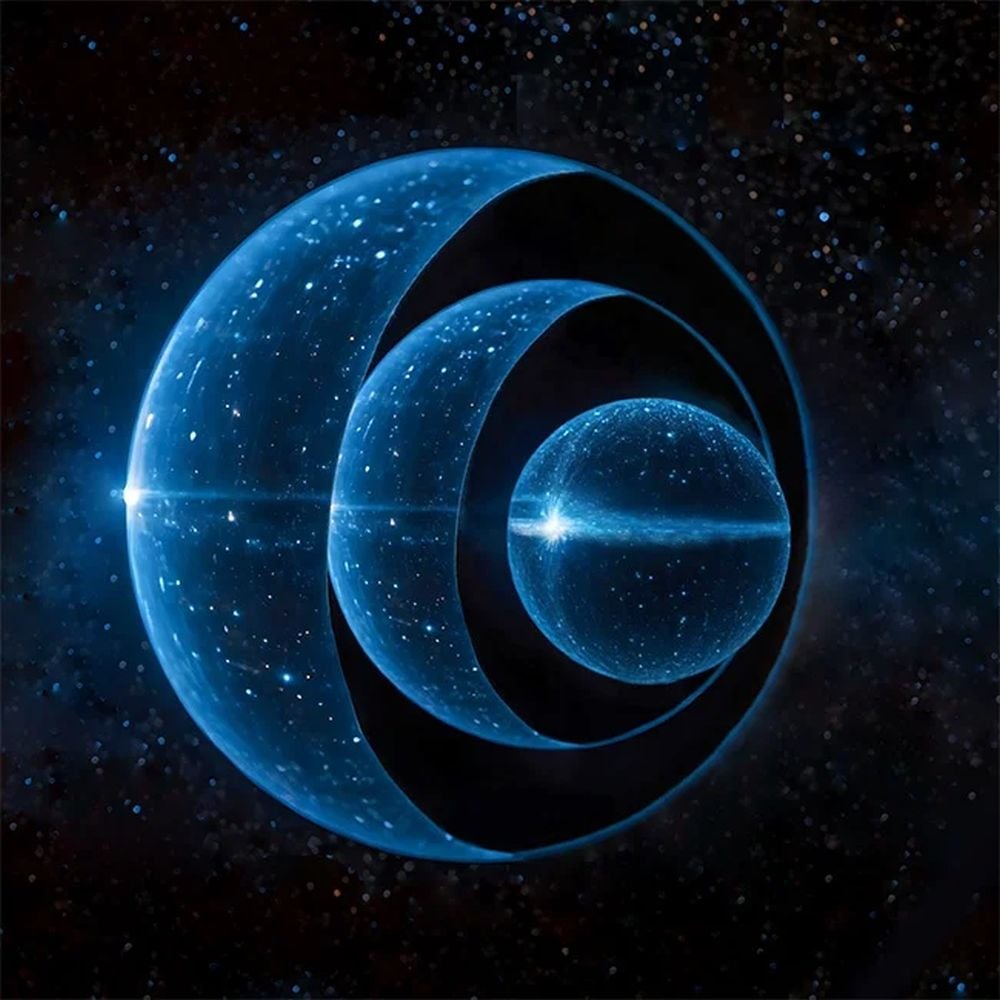
Эрдэмтэд хар нүхний үүсэл болон түүний дотоод бүтцийн талаарх онолын шинэ хувилбарыг дэвшүүллээ.
Франкфуртын Гёте их сургуулийн судлаачид Даниел Жамполски болон Лучано Реццолла нар “Physical Review D” сэтгүүлд нийтлүүлсэн судалгаандаа хар нүхнээс ялгаатай “гравистар” хэмээх биетийн үүслийн механизмыг тайлбарлажээ. Хар нүхний төвд оршдог, ерөнхий харьцангуйн онолыг зөрчдөг “сингуляр” цэгээс ялгаатай нь гравистар нь үйл явдлын хаяа болон сингуляр цэггүй, харин харанхуй энергиэр дүүргэгдсэн дотоод бүтэцтэй байдаг аж.
Судлаачдын боловсруулсан математик шийдлийн дагуу одны сүйрлийн төгсгөлийн шатанд одны дотор бяцхан орчлон ертөнц үүсдэг байна. Энэ үйл явц нь Их тэсрэлттэй төстэй бөгөөд дотоод дахь харанхуй энергийн тэлэх хүч нь таталцлын улмаас үүсэх сүйрлийг зогсоож, тогтвортой гравистарыг бий болгодог гэж үзжээ.
https://journals.aps.org/prd/abstract/10.1103/c6lw-nx7k
Гэсэн хэдий ч энэхүү онол нь төгс төгөлдөр нөхцөлийг шаарддаг бөгөөд гравистар нь гадны нөлөөлөлд хэт мэдрэмтгий байж болзошгүй юм. Хэрэв гравистар бүрэн тогтвортой бус бол ямар нэгэн биетийн нөлөөгөөр агшин зуур хар нүх болон хувирах эрсдэлтэй гэдгийг эрдэмтэд анхааруулж байна. Одоогоор эдгээр онолын биетийг бодит хар нүхнээс хэрхэн ялгаж таних нь шинжлэх ухааны өмнө тулгарч буй томоохон асуулт хэвээр байна.
Дэлгэрэнгүйг эх сурвалжаас харах
Эх сурвалжийг нээх ↓
One foundational part of astrophysics concerns how stellar mass black holes form. When a star several times more massive than our Sun runs out of fuel for fusion, the outward pressure from fusion decreases, and eventually it’s not enough to counteract the inward gravitational pressure from the star’s mass. Inward pressure takes over, and the star collapses in on itself into a point called a singularity: a black hole is born.
There’s a problem with this picture, though. General Relativity (GR) works well to explain what’s happening up until the singularity forms. At that point, questions arise. How can so much mass be concentrated in a tiny, single point? And how can spacetime curve infinitely? GR has no anwers.
This is the point where GR breaks down. It doesn’t cancel out GR in other ways, it’s just where GR has gone past the point where it explains things validly. (Quantum Gravity theory is an attempt to pick up where GR breaks down.)
New research suggests that GR can still explain what happens when a star collapses. It says that rather than black holes, the collapsed stars produce another type of star that mimics black holes: a gravastar. The research letter is “Formation of gravastars” and it’s published in Physical Review D. The authors are Daniel Jampolski and Luciano Rezzolla, both from the Goethe University Frankfurt.
There are different types of black holes to distinguish between. Standard black holes are what people most often mean when they discuss black holes. They have an event horizon and a singularity. But there’s another type called a “regular black hole.” They’re modified versions of the standard black holes. They have event horizons like standards, but they have no singularity. Some have described them as having “well-behaved interiors” where the curvature of space time is finite and doesn’t break GR.
Basically, a standard black hole has a singularity, which is a problem for GR. A regular black hole has no singularity and doesn’t break GR, but still has an event horizon, which is a problem because of the black hole information paradox.
This leads to what are known as gravastars, which are a theoretocal type of “horizonless mimicker,” a class of theoretical black hole types without horizons or singularities. They don’t break GR.
A gravastar is an ultra-compact star with extreme mass which, like black holes, cannot be seen because no light can escape. But they’re different in important ways. Their outer layers are made of normal, baryonic matter, but their interiors are filled with dark energy. The outward pressure of the dark energy is what stabilizes their interiors. Physicists find them to be more palatable solutions because they don’t have a GR-breaking singularity, nor an event horizon and the information paradox that stems from it. But how do they form?
“Regular black holes and horizonless black hole mimickers offer mathematically consistent alternatives to address the challenges posed by standard black holes,” the authors write. “However, the formation mechanism of these alternative objects is still largely unclear and constitutes a significant open problem since understanding their dynamical formation represents a first step to assess their existence.”
The pair of researchers have developed a solution to Einstein’s GR equations that can result in a gravastar. In their solution, a mini-Universe is created inside the star when it collapses. It’s similar to how the Big Bang created our Universe. The expansion of our Universe is driven by dark energy, and dark energy inside the gravastar also provides an expansive force. The dark energy halts the collapse before a singularity can form, and the resulting equilibrium creates the gravastar.
Physicists have been wondering for decades how ordinary stellar matter can collapse into a gravastar, and this is the first answer to that problem. Surprisingly, Jampolski discovered the solution in his master’s thesis, with Rezzolla as his advisor.
“The Big Bang of the emerging universe can unfold once the star has already collapsed almost to the point of becoming a black hole,” lead author Jampolski said in a press release. “It is easier to imagine that the Big Bang occurs only at a very late stage, when matter has already been compressed to an extreme degree, thereby giving rise to new effects.”
Rezzolla, who is a Professor of Theoretical Astrophysics at Goethe University, added: “Looking for alternatives to black holes should not suggest a skepticism towards black holes, which still represent the most natural and simplest solution to the fate of gravitational collapse. However, as scientists in general, and as theoretical physicists in particular, it is essential to maintain an unbiased approach towards what we do not know and hence explore both the accepted wisdom and the more exotic interpretations. History teaches us that it is not unusual for the latter to become the former.”
However, there is one important problem in their solution. For it to work, it requires fine-tuning, meaning things have to be just right for a gravastar to form. For example, in the sphere used in the theory, the material needs to be perfectly uniform and pressureless. That’s an idealized situation that the authors acknowedge is a problem.
Another problem is that even though the gravastar reaches static equilibrium, that’s not the same as being stable. The shell can still experience radial perturbations. That means that a tiny perturber like a stray photon could make the gravastar collapse into a standard black hole with a singularity. How it formed would be irrelevant. The gravastar would form, but would not persist longer than an instant. In that case, gravastars aren’t really separate astrophysical objects from standard black holes; instead they’re just an extra, momentary step in the process that creates black holes.
Another question is perhaps more prosaic. Even if gravastars exist, how can we tell them apart from standard black holes?
That question, sitting at the end of a long queue of other questions, awaits an answer.

