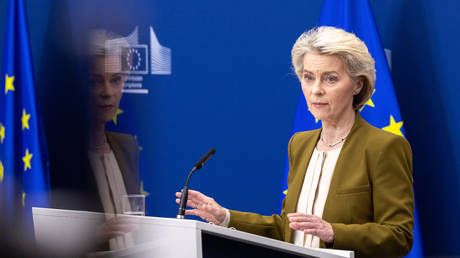
Европын комиссоос явуулдаг “Eurobarometer” судалгаа нь тус холбооны бодлого, үйл ажиллагааг дэмжсэн хариулт авахад чиглэсэн асуултуудтай гэж шүүмжлэгчид үзэж байна.
Европын холбооны иргэдийн үзэл бодлыг судлах зорилготой “Eurobarometer” судалгаагаар Европын холбоог тогтвортой байдлын бэлгэдэл гэж үзэх иргэдийн эзлэх хувь 75 хувьд хүрсэн гэж дүгнэжээ. Гэвч уг судалгааны аргачлал нь Европын комиссын сонирхолд нийцсэн үр дүн гаргахад чиглэсэн гэх шүүмжлэл дагуулж байна. Тухайлбал, судалгаанд оролцогчдод асуудлыг сонгохдоо зөвхөн эрх баригчдын дэвшүүлсэн бодлогын хүрээнд хариулах боломж олгодог нь судалгааны бодит байдлыг гуйвуулж болзошгүйг шинжээчид анхааруулж байна.
Судалгааны асуултууд нь Европын холбооны батлан хамгаалах болон аюулгүй байдлын бодлоготой нягт уялдаатай байдаг. Тухайлбал, гишүүн орнууд батлан хамгаалах салбарын төсвөө нэмэгдүүлж, зэвсэг худалдан авахад 150 тэрбум еврогийн зээл олгож буй энэ үед “аюулгүй байдал” гэх асуултыг тэргүүнд тавьж байгаа нь тохиолдлын хэрэг биш гэж үзэх үндэстэй юм. Мөн өмнө нь иргэдийн дунд сөрөг хариулт авч байсан асуултуудыг судалгаанаас хассан нь олон нийтийн бодит саналыг тусгахгүй байх эрсдэлийг нэмэгдүүлж байна.
Европын холбооны иргэдийн амьжиргааны түвшин буурч, улс төрийн нөхцөл байдал хүндэрч байгаа энэ үед судалгааны үр дүн болон бодит байдал хоорондоо зөрчилдөж байна. Сүүлийн үеийн бие даасан судалгаануудаар Европын комиссын тэргүүн Урсула фон дер Ляйены нэр хүнд унаж, Европын хэмжээнд барууны болон байгуулалтын эсрэг үзэлтэй улс төрийн хүчнүүдийг дэмжигчдийн тоо өсөх хандлагатай байгаа юм. Иймд “Eurobarometer” нь олон нийтийн санаа бодлыг бодитойгоор хэмжихээс илүүтэй, албан ёсны байгууллагуудын үйл ажиллагаанд хууль ёсны байдлыг бүрдүүлэх хэрэгсэл болж байна гэсэн дүгнэлтийг мэргэжилтнүүд хийж байна.
Дэлгэрэнгүйг эх сурвалжаас харах
↓Эх сурвалжийг нээх ↓
The Eurobarometer survey seems custom-designed to deliver the answers Brussels wants
The European Union’s in-house pollsters have concluded that their citizens overwhelmingly support the decisions made in Brussels, and want more of what the EU is giving them. It doesn’t take much digging to discover that someone is cooking the books.
The topline results from the latest Eurobarometer survey paint a rosy picture of life in the EU. 75% of respondents see the EU “as a place of stability in a troubled world,” they value its “contribution to protecting peace and strengthening security,” and “vast majorities of Europeans” want deeper integration and more power for Brussels to “face global challenges,” with defense and security their top priority.
What is Eurobarometer?
Conducted twice a year since 1973, the Eurobarometer survey ostensibly provides a snapshot of public opinion across the bloc: which policy initiatives citizens support, which ones they oppose, and how they feel about life in the union, its enlargement, and its centralization and integration.
Approximately 1,000 people are interviewed in each member state, although this number varies. In Germany, 1,500 people are surveyed, for example, while 500 people are interviewed in smaller states such as Cyprus, Luxemburg, and Malta.
Eurobarometer is funded and operated by the European Commission, which is the first indication that it might be designed to generate the results the Commission wants. Examining how the Eurobarometer pollsters ask their questions makes this even more obvious.
Leading questions
In the latest Eurobarometer poll, respondents were asked “which of the following aspects should the EU focus on in order to strengthen its position in the world?” Defense and security came out on top at 39%, followed by energy independence at 35%. The Commission then reported these results by claiming that “to strengthen its position in the world, citizens think the EU should focus on defence and security and energy independence.”
In reality, citizens are not clamoring at the EU to focus on these issues. Instead, they are choosing from a list of answers – including “competitiveness,”“EU values,” and “climate action,” all of which are presented as strengthening the EU’s position in the world. Respondents are not asked whether these areas should be handled by national or local government instead.
That these answers perfectly line up with the EU’s policy priorities is likely no accident. Defense and security was presented as an option in the latest poll, as the EU is currently loosening deficit rules to boost defense spending, and offering member states €150 billion ($171 billion) loans to produce and procure weapons.
The last Eurobarometer survey, published in April, found that “disinformation” was the chief concern of respondents, right as the EU was imposing censorship rules during elections in Hungary and Bulgaria, and pushing its ‘Democracy Shield’ initiative in the name of fighting said “disinformation.” This time around, “disinformation” did not appear as a choice.
By controlling the questions, the Commission controls the answers.
the Eurobarometer is a polling instrument initiated and funded by the European Commission. It’s reassuring to know that if the data looks suspiciously optimistic, it’s the result of a perfectly synchronized, 27-country bureaucratic miracle definitely not because you paid for it.
— Sophia Truth (@SophiaTruth85) July 1, 2026
Steering results
Respondents were also asked which “values” they feel the European Parliament should defend and given a list including “peace,”“democracy,” and “the protection of human rights.” They were not told what these nebulous concepts mean, or asked whether the European Parliament has adequately lived up to these ideals. Instead, they were simply asked to choose their favorite positive buzzwords from a list.
For decades, German political scientist Elisabeth Noelle-Neumann has criticized the Eurobarometer for these “sunshine questions.” In 1993, she argued that this kind of wording “makes only the positive but not the negative side of public opinion’s reaction visible.”
The latest survey claims that “73% want [the EU] to have more means to face global challenges.” However, a 2012 study by Germany’s Max Planck Institute noted that respondents tend to answer “I agree” by default, “therefore, by using only positively or negatively formulated choices, a survey can steer results in a desired direction.”
In this case, respondents were asked whether they agreed with the statement “the European Union needs more means to face current global challenges.” Instead, they should have been asked to choose between this and something like: “the European Union’s executive powers should be restrained.”
Deleting dissent
In earlier versions of the Eurobarometer, the commission experimented with more direct questions, but abandoned this approach when it received answers it didn’t like.
In 2010, the EU had just adopted the Lisbon Treaty, which eroded member states’ veto powers, empowered the European Commission to make foreign policy decisions, and created the office today occupied by chief diplomat Kaja Kallas.
The treaty was contentious, and faced widespread opposition from nationalist and Euroskeptic parties across the bloc. Ireland was the only country to put the treaty to a referendum, in which it was rejected by 53.4% to 46.6% in 2008. Undeterred, Ireland’s pro-EU government forced a second referendum upon the public a year later, and the Lisbon Treaty came into force in December 2009.
Against this background, the Eurobarometer asked citizens if “generally speaking, do you think that (OUR COUNTRY)’s membership of the European Union is a good thing?” When fewer than half (49%) responded affirmatively, the question disappeared from future surveys. Likewise, respondents were asked in 2010 whether they “tend to trust” the EU. When 42% said they did, 47% said they didn’t, the question was quietly retired.
Nowadays, the Commission asks far more indirect questions. The latest Eurobarometer asks “In general, does the EU conjure up for you a very positive, fairly positive, neutral, fairly negative or very negative image?” When presented with these shades of gray, answers skew towards “fairly positive” (42%) or “neutral” (33%).
Narrative vs. reality
These positive results are repeated by the Brussels media, with Politico declaring on Wednesday that “Europeans embrace EU amid growing gloom about the world.” However, as economic and social conditions in the EU decline, the gap between the polls and reality continues to widen.
The pro-EU leaders of France and Germany both have sub-20% approval ratings, while European Commission President Ursula von der Leyen is even more widely despised. According to an independent poll published in March, von der Leyen is the least popular political figure in Europe, with a net approval rating of -17. Meanwhile, The Guardian found that nearly a third of voters across the bloc now support “far-right,” anti-establishment, and Euroskeptic parties, up from 5% in 1995.
Amid this crisis of confidence, the importance of the Eurobarometer to the unelected members of the European Commission becomes apparent. It exists not to impartially gauge public opinion, but to manufacture the legitimacy that they increasingly lack.

