Украинд үргэлжилж буй дайн болон эдийн засгийн хүндрэлтэй нөхцөлд ОХУ-ын эрх баригч нам нөлөөгөө хадгалахын тулд сонгуулийн өмнөх сорилтуудтай тулгарч байна.
Есдүгээр сарын 18-20-ны өдрүүдэд ОХУ-д Төрийн Думын сонгууль, бүс нутгийн удирдлагын болон орон нутгийн парламентын сонгуулиуд нэгэн зэрэг болох гэж байна. Энэ удаагийн сонгуульд Оросын эзэлсэн Украины бүс нутгийн оршин суугчид анх удаа оролцох юм. Сонгуулийн гол зорилго нь эрх баригч “Нэгдсэн Орос” намын олонхын байр суурийг баталгаажуулах боловч дайны улмаас үүссэн эдийн засгийн дарамт, Украины дроны довтолгоо зэргээс шалтгаалан иргэдийн дэмжлэг буурч болзошгүй байгааг шинжээчид тэмдэглэж байна.
Сонгуулийн үр дүн нь Владимир Путин болон эрх баригч намын легитим шинжийг харуулах чухал ач холбогдолтой юм. Хэдийгээр “Нэгдсэн Орос” нам 450 суудлын 321-ийг эзэмшиж байгаа ч сүүлийн саруудад тус намын нэр хүнд буурсан үзүүлэлттэй байна. Кремль сонгуулийн дараа дайчилгааны шинэ давлагаа зарлаж магадгүй гэх таамаглал байгаа нь эрх баригчдын хувьд улс төрийн ялалтыг илүү чухал болгож байна.
Сонгуулийн комисс 17 улс төрийн нам өрсөлдөх боломжтой гэж мэдэгдсэн ч “Шинэ хүмүүс” нам нэр хүндээрээ коммунист намыг ардаа орхиж, хоёрдугаар байрт бичигдэж эхэлсэн нь анхаарал татаж байна. Олон улсын ажиглагчид болон шинжээчид ОХУ-д улс төрийн уур амьсгал “хурцадмал” байгааг онцолж, сонгуулийн ирцийг 50 хувьд хүргэх даалгаврыг бүс нутгуудад өгсөн тухай мэдээлж байна. Үүний зэрэгцээ электрон санал хураалтын системийг 33 бүс нутагт нэвтрүүлэхээр төлөвлөсөн нь сонгуулийн луйвар гарах эрсдэлтэй гэх шүүмжлэлийг дагуулж байна.
Дэлгэрэнгүйг эх сурвалжаас харах
↓Эх сурвалжийг нээх ↓
Russians will head to the polls in September to elect a new State Duma and regional officials in a vote that the ruling United Russia party is expected to dominate but which could offer insight into how four years of war in Ukraine have reshaped the country’s political landscape.
The vote comes at a fraught time. The war is taking a mounting toll on the economy, while long-range Ukrainian drone strikes have led to a widespread fuel crisis. Half of Russians now describe the political climate as “tense.”
Russia’s regions have reportedly been instructed to secure high voter turnout and a majority win for United Russia. Nevertheless, the vote remains an important instrument for the Kremlin to project popular legitimacy and demonstrate support for President Vladimir Putin and United Russia as both face unstable approval ratings.
Reports have suggested the Kremlin could announce another round of mobilization after the elections, making a convincing electoral victory politically important for the ruling party. Other reports claim that senior officials were allegedly seeking to convince Putin to postpone the State Duma elections due to the Ukrainian drone campaign, though the Kremlin has denied this.
The Moscow Times looks at the key trends to watch in the months leading up to September’s vote as well as what these elections could mean for the future of Russian politics.
Which offices are up for election?
State Duma and regional lawmakers, as well as the heads of 11 regions will be elected to office this Sept. 20 on the country’s Unified Voting Day.
The most significant event will be the three-day State Duma elections on Sept. 18 to 20, which will see 225 lawmakers chosen in single-member constituencies and another 225 through party lists.This year’s parliamentary vote will be the first in which residents of the Russian-occupied regions of Ukraine will take part.
The vote will coincide with gubernatorial elections in 11 regions. Direct elections are scheduled in the Tver, Belgorod, Bryansk, Penza and Ulyanovsk regions, as well as in the republics of Mordovia, Tyva and Chechnya.
In the North Caucasus republics of Dagestan, North Ossetia and Karachayevo-Cherkessia, regional leaders will be chosen by local legislatures rather than through a popular vote.
Central Election Commission chief Ella Pamfilova.
Yaroslav Chingaev / Moskva News Agency
Voters in 39 regions will also elect members of regional parliaments, while municipal elections, including contests for city dumas, are expected to take place in nearly a dozen regions.
Turnout expectations
The Central Election Commission (CEC) says 17 political parties are eligible to take part in the parliamentary elections.
The five major parties represented in the State Duma — United Russia, the Communist Party, the Liberal Democratic Party (LDPR), A Just Russia – For Truth and New People — are all automatically qualified to contest the election.
Russia has about 111 million registered voters. The state-run pollster VTsIOM said that 66% of respondents said they planned to vote, while turnout intentions among young people were even higher (73%.) Yet 66% also said in May they did not know when the election would take place.
Regional officials have reportedly been instructed to keep turnout at around 50%, the Vedomosti newspaper said.
Electronic voting, which critics have accused of being a tool for vote rigging, has been approved in 33 regions covering roughly 48 million eligible voters.
The ruling party
United Russia, which holds 321 out of 450 seats in the State Duma, appears to be grappling with its approval ratings as Russia confronts mounting economic pressures, internet restrictions and a widening campaign of Ukrainian drone attacks.
Although wartime polling is difficult to independently verify, support for United Russia currently stands at almost 34% and even fell to 29.3% in March, compared to around 40% after the start of the war in 2022.
Polling by late Kremlin critic Alexei Navalny’s Anti-Corruption Foundation (FBK) estimates United Russia’s support at just 16%.
President Vladimir Putin at the 22nd congress of the United Russia party on Sunday. kremlin.ru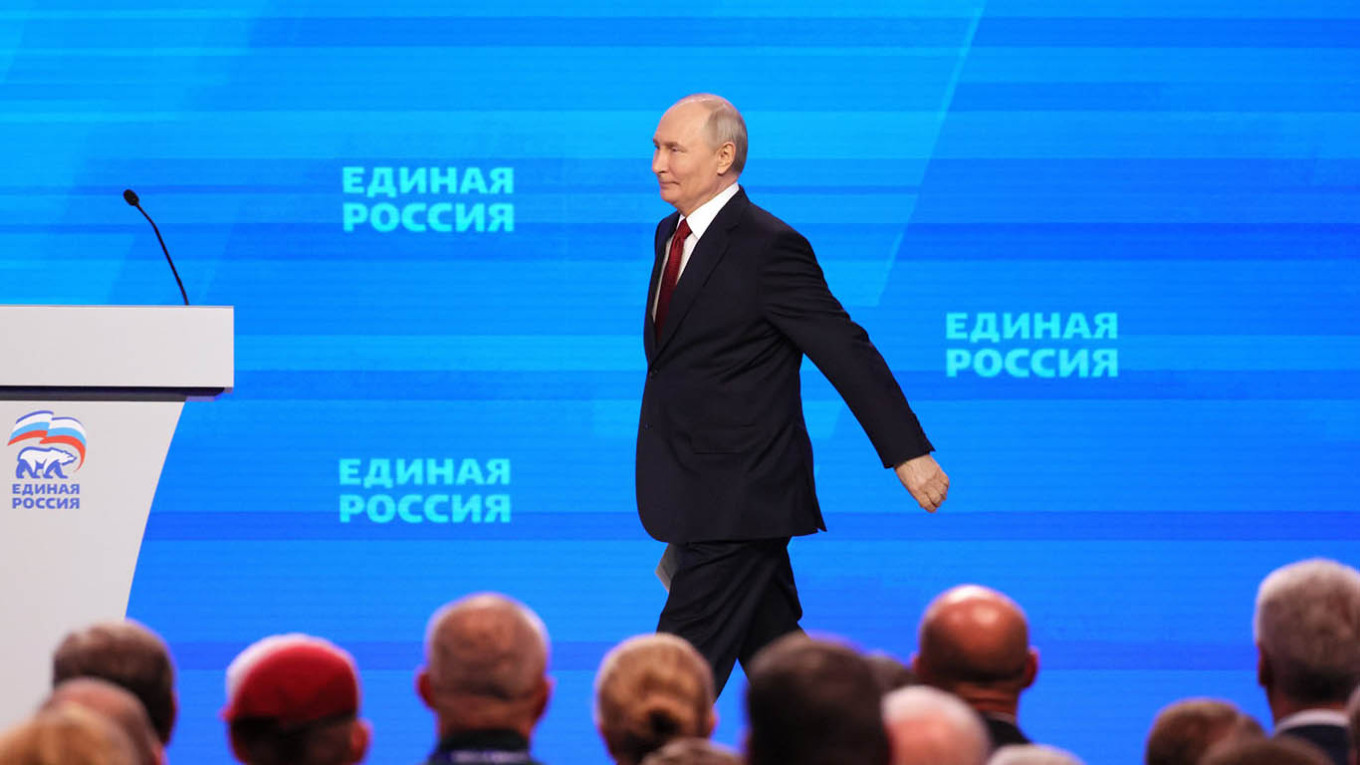
The approval rating of Putin, who formally led the party in 2008-2012, has also shown signs of declining — yet even according to the most unfavorable polling, his approval rating never fell below 65%.
As a result, authorities have lowered target benchmarks for United Russia’s projected performance, especially in regions where its support is weaker, Vedomosti reported, citing sources close to the presidential administration and regional authorities.
The party is reportedly heading into the elections with a lack of clear political direction, which caused frustration among the presidential administration, regional governors and party members.
Formally led by former President Dmitry Medvedev, United Russia did notpresent its list of approved candidates for the parliamentary election until after its pre-election congress on Sunday.
“This is complete idiocy. In previous Duma campaigns, it was already broadly clear who would run by November. If it was an incumbent, they would start actively engaging with voters. If it was a newcomer, they would gradually enter the political agenda,” a political strategist overseeing United Russia’s campaigns in several regions told the exiled news outlet Meduza.
“The entire [election] cycle has been disrupted,” the strategist added.
Deputy Security Council Deputy and United Russia leader Dmitry Medvedev. er.ru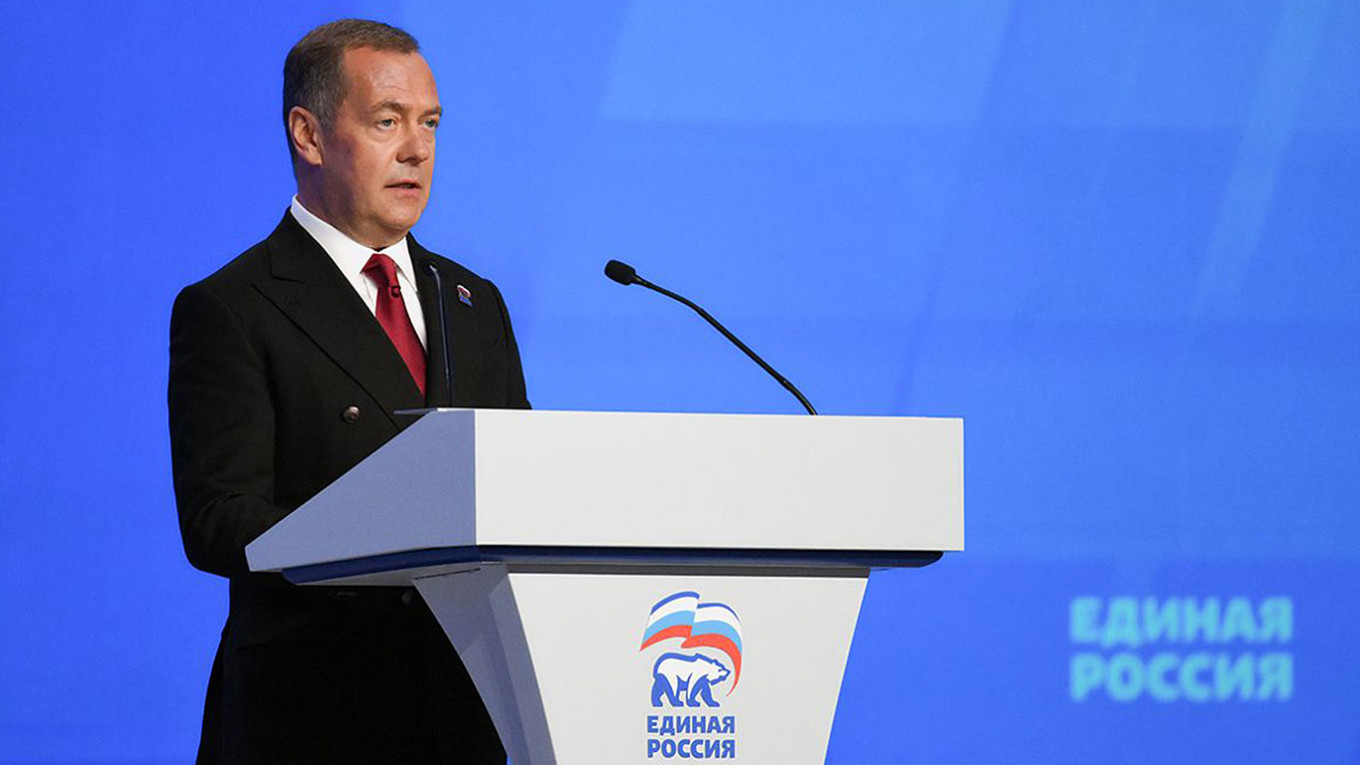
The candidate list —which serves as the public face of the party’s campaign rather than a guarantee of parliamentary seats — starts with Foreign Minister Sergei Lavrov, Moscow Mayor Sergei Sobyanin, Ukraine war veteran and Yunarmiya (“Youth Army”) military movement head Vladislav Golovin, children’s rights commissioner Maria Lvova-Belova and war correspondent Yevgeny Poddubny.
Notably, Medvedev, who holds little real political power, was not included in the top five despite earlier reports suggesting that he planned to head the party list.
While the five-year campaign is also expected to be announced only later in August during the party’s second congress, Medvedev outlined “challenges” for the party such as demography, economic and technology issues, the uneven development of the country’s regions and security.
The election plan — the People’s Program — will be designed by an expert council, while proposals can also be submitted by ordinary citizens, he said.
The move is intended to involve the public in drafting the program so “instead of ‘we still haven’t come up with anything,’ it becomes ‘we’ve decided to consult you’,” a source working with the presidential administration’s domestic policy bloc told Meduza.
The second-most popular party
The main contest may not be over who wins — United Russia is widely expected to retain control — but which party finishes second. While the runner-up would not be able to meaningfully influence lawmaking in the State Duma, the result could offer a useful barometer of public sentiment.
Polls suggest that New People, founded in 2020, has overtaken the Communist Party to become Russia’s second-most popular parliamentary party, with around 12% support, according to VTsIOM.
While it is hardly an anti-war or opposition party, New People has distinguished itself by criticizing internet shutdowns, tax increases and anti-abortion measures, positions analysts say have broadened its appeal.
The party has also focused on pressing issues like mortgages, supporting small businesses and domestic violence.
From left: LDPR head Leonid Slutsky, Communist Party leader Gennady Zyuganov and New People chairman Alexei Nechayev. duma.gov.ru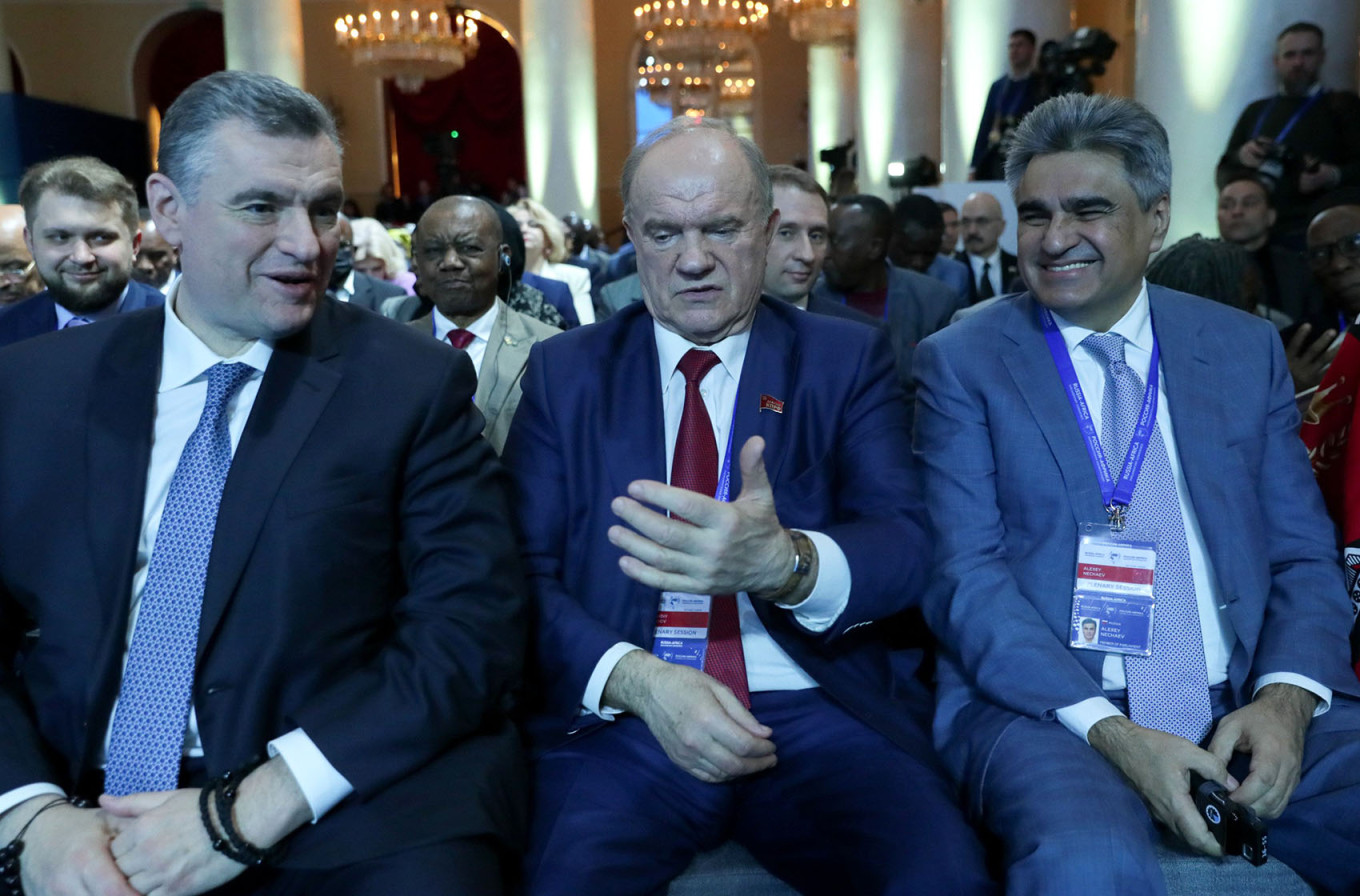
New People unveiled its list of leading candidates in March, naming party chairman Alexei Nechaev, State Duma Deputy Speaker and former presidential candidate Vladislav Davankov, and lawmaker Sardana Avksentieva.
The other parliamentary parties eligible to run without collecting voter signatures are polling at similar levels.
As of last week, VTsIOM put the Communist Party at 10.7%, the Liberal Democratic Party (LDPR) at 9.4% and A Just Russia – For Truth at 5.7%.
Experts say the Communist Party has struggled to define its role since the invasion of Ukraine and has lost support among both nationalist hardliners and civic activists.
While the party is facing pressure from United Russia in regions where it enjoys strong support, political expert Alexander Kynev said the party has also blurred its opposition identity and an emphasis on the past at a time when the public is seeking a clear vision for the future.
LDPR has likewise been seen as lacking a clear identity following the death of longtime leader Vladimir Zhirinovsky in 2022. His successor Leonid Slutsky has been described as “less charismatic” and has faced allegations of sexual harassment.
Internal reshuffles, including the removal of influential figures, and its failure to defend members like Sergei Furgal, the popularjailed ex-governor of Khabarovsk, have further weakened its standing.
Kynev said LDPR suffers from “a loss of brand distinctiveness and increasing difficulty in explaining how the party differs from others, particularly as its campaign increasingly resembles a copy of the Communist Party’s and A Just Russia’s social agenda.”
While it leaned toward the opposition in the early 2010s, A Just Russia has steadily aligned itself with the Kremlin in the years since.
A Just Russia – For Truth Party Leader Sergei Mironov. spravedlivo.ru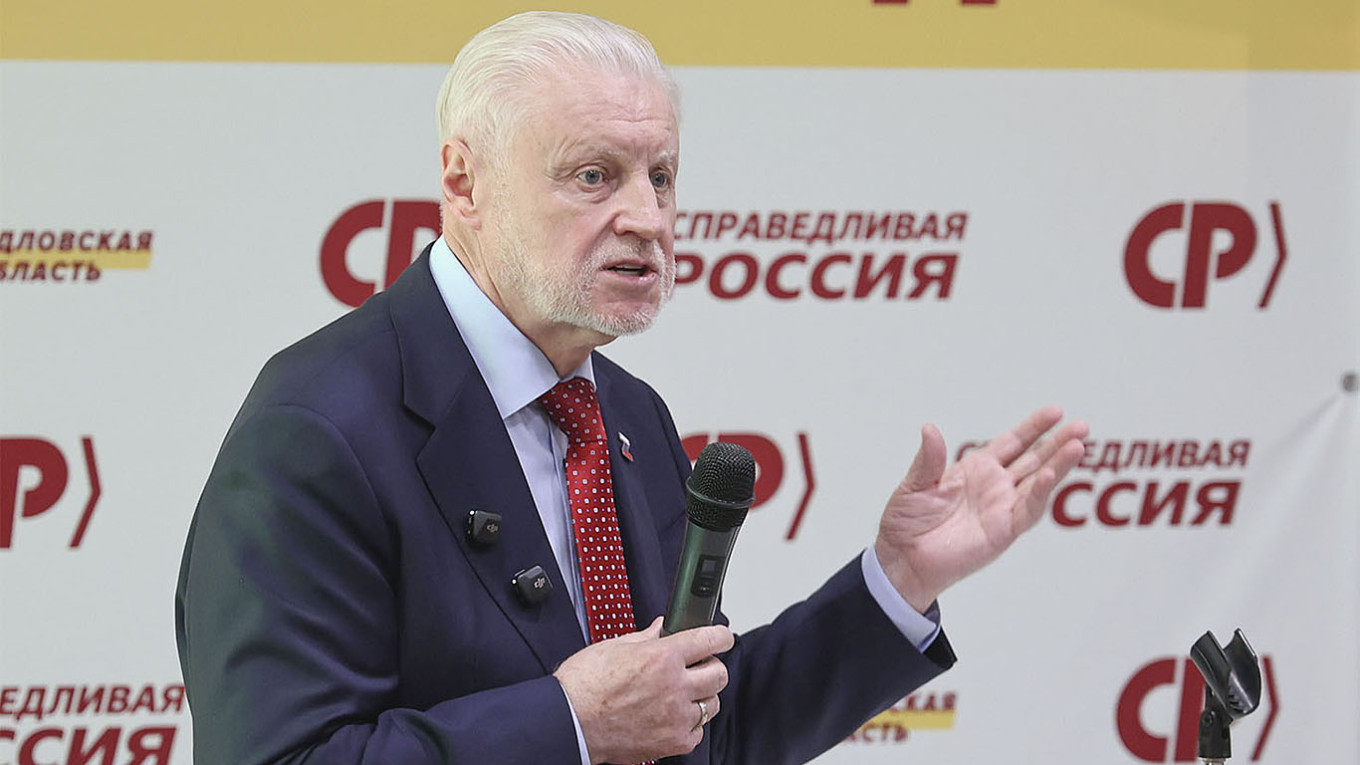
Most famously, party leader Sergei Mironov posed with a sledgehammer given to him by the Wagner Group after video showed its mercenaries brutally killing a suspected deserter in Ukraine with the same weapon.
Experts note that A Just Russia has significantly lost its electorate in the regions due “to campaign difficulties and a series of entirely unsuccessful organizational and financial campaigns.”
The liberal Yabloko party, which is not represented in parliament, plans to campaign on calls for an immediate ceasefire in Ukraine, freedom of information and an end to political repression.
The party also highlighted the political persecution of its supporters including politician Lev Shlosberg and journalist Mikhail Afanasyev.
Experts say Yabloko has little chance of winning seats, not least because it must first collect 200,000 voter signatures to qualify.
Even so, participation itself remains strategically important for Yabloko, analysts say. Russian law allows for political parties to be dissolved if they fail to contest elections for seven consecutive years.
A Message from The Moscow Times:
Dear readers,
We are facing unprecedented challenges. Russia’s Prosecutor General’s Office has designated The Moscow Times as an “undesirable” organization, criminalizing our work and putting our staff at risk of prosecution. This follows our earlier unjust labeling as a “foreign agent.”
These actions are direct attempts to silence independent journalism in Russia. The authorities claim our work “discredits the decisions of the Russian leadership.” We see things differently: we strive to provide accurate, unbiased reporting on Russia.
We, the journalists of The Moscow Times, refuse to be silenced. But to continue our work, we need your help.
Your support, no matter how small, makes a world of difference. If you can, please support us monthly starting from just $2. It’s quick to set up, and every contribution makes a significant impact.
By supporting The Moscow Times, you’re defending open, independent journalism in the face of repression. Thank you for standing with us.
Continue

Not ready to support today?
Remind me later.
×
Remind me next month
Thank you! Your reminder is set.
We will send you one reminder email a month from now. For details on the personal data we collect and how it is used, please see our Privacy Policy.