Роб Ли дэлхийн долоон тивийн хамгийн өндөр оргилуудад авирч, далайн долоон бүсийг сэлж гаталсан анхны хүн боллоо.
Тамирчин, үл хөдлөх хөрөнгийн зуучлагч Роб Ли 17 жилийн турш үргэлжилсэн аялал, бэлтгэлийнхээ эцсийн цэг болгон зургадугаар сарын 30-нд Япон улсын Хоншю болон Хоккайдо арлуудыг холбосон Цугару хоолойг 12 орчим цагийн турш сэлж гаталсан байна. Тэрээр дэлхийн хамгийн өндөр долоон оргилыг эзэлсэн “Seven Summits” болон далайн долоон аюултай бүсийг сэлж туулсан “Oceans Seven” сорилтуудыг хослуулан биелүүлсэн анхны хүн болж, энэхүү хос амжилтыг “Double Seven” хэмээн нэрлэжээ.
Түүний сүүлийн сорилт болох Цугару хоолойн сэлэлт нь цаг агаарын хүнд нөхцөл, хүчтэй урсгалын улмаас бие бялдар болон сэтгэл зүйн тэсвэр тэвчээрийг шаардсан байна. Тэрээр өглөөний 04:09 цагт усанд орж, 11 цаг 44 минутын дараа барианд орсон бөгөөд сүүлийн таван цагийн турш хүчтэй урсгалын эсрэг сэлэхэд хүндрэлтэй байсныг онцолжээ. Далайн давстай ус болон байгалийн хүнд нөхцөл нь тамирчны бие махбодод ихээхэн ачаалал өгсөн байна.
Роб Ли энэхүү урт хугацааны аялалдаа ганцаараа байгаагүй бөгөөд түүний гэргий, уулын цанын тамирчин Кэролайн Глейч дэмжлэгийн багийг удирдан, аюулгүй байдлыг ханган хамтдаа зүтгэжээ. Тэд 2019 онд Эверестийн оргилд гарч, удалгүй 46 хоногийн дараа Ла-Маншийн хоолойг сэлж гатлах зэргээр эрс тэс орчинд дасан зохицох бэлтгэлийг системтэйгээр хийсэн байна. Сэлэлтийн үеэр далайн амьтдын хатгалт, хүйтэн усны нөлөө зэрэг олон эрсдэлтэй тулгарч байсан ч тэрээр өөрийн зорилгодоо хүрч чадлаа.
Дэлгэрэнгүйг эх сурвалжаас харах
↓Эх сурвалжийг нээх ↓
“I can’t believe I did it,” Rob Lea exhales. “I am totally and utterly wrecked.”
He slumps to the shore of Hokkaido, Japan’s northernmost island,salt-crusted and green with zinc paste.
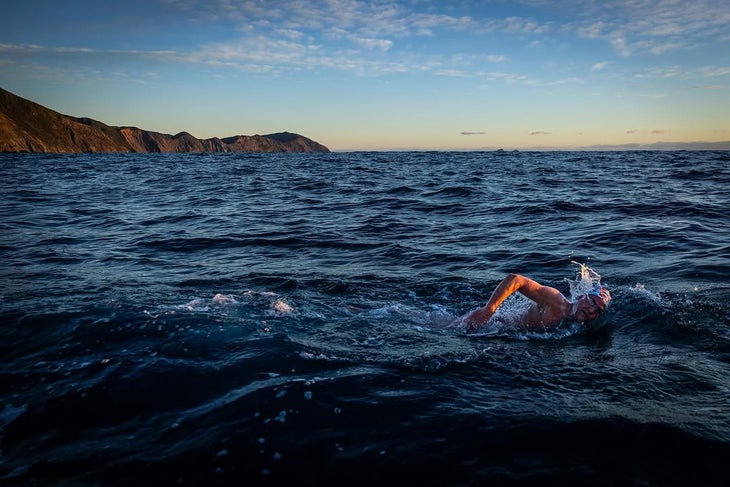
This scene played out on June 30, when Lea, 44, swam across the Tsugaru Strait in the Sea of Japan, which connects the island of Honshu to Hokkaido, over the course of 12 hours.
The open-water swim was the final leg of a challenge that Lea, a realtor and endurance athlete, has spent the last 17 years working toward.
Lea is believed to be the first person to finish both the Seven Summits and the Oceans Seven, known as the Double Seven. Lea believes he is the first person to ever complete a challenge called the “Double Seven,” which comprises both mountaineering and open-water swimming challenges. He climbed the Seven Summits, the highest peaks on all of the continents. He also completed the Oceans Seven, an open-water challenge that requires swimmers to complete unassisted solo crossings of seven iconic ocean channels.
Only some 44 people have ever finished the Oceans Seven; a few hundred have done the Seven Summits—and until now, nobody has done both, according to Lea.
Forty hours after swimming the Tsugaru Strait, Lea was exhausted. “All I want to do is lie in my bed and rest,” he tells Outside. “I really gave that swim everything”
His shoulders ached, his neck and armpits were chafed raw, and his mouth, after nearly 12 hours of saltwater exposure, was raw and swollen. “The saltwater just kind of eats away at the inside of my mouth,” he says to me over a video call from Japan. “It’s like canker sores all over my mouth.”
View this post on Instagram
A Journey Spanning Nearly Two Decades
The feat caps a 17-year journey for Lea, a Park City, Utah, resident and former Ironman 70.3 age-group world champion. In 2009, he climbed Argentina’s Aconcagua, a summit of nearly 23,000 feet, years before the Oceans Seven and Seven Summits were even on his radar. He came up with the idea for the “Double Seven” in 2017, after an ankle injury sent him into surgery and a doctor told him to stop running. He needed a goal to motivate his rehab, so he set his sights on swimming across the English Channel.
“You go from the lowest low to the highest high, and sometimes that can happen in a snap of the fingers. I feel more alive when I do these things.”
Lea’s final swim was the Tsugaru Strait, which separates Japan’s main island of Honshu from Hokkaido. He had attempted the swim once before in 2023. Regulatory groups who monitor the crossing halted his effort after determining he wouldn’t beat their 14-hour cutoff, a safety measure that prohibits night swims. Swimming during the day, though, brings stronger winds and currents. This time, he entered the water at 4:09 A.M. and finished in 11 hours and 44 minutes.
“It was a tale of two different swims,” he says. “The first half of the swim was going almost too well. I felt great. The time was passing. Then as I hit hour five of the swim, the current picked up and I was basically trying to punch through the current.”
The current reached around 4.7 knots at times, dragging him parallel to the coast, away from his goal. He kept swimming, hoping the current would release him. His first emotion after finishing “was just relief.”
Lea hasn’t done it alone. His wife, professional ski mountaineer Caroline Gleich, climbed five of the seven summits with him and crewed most of his channel swims from a support boat. She mixed his liquid feeds and threw the bottles to him on a retractable dog leash. When Gleich noticed his arm wasn’t clearing the water the way it usually does on the Tsugaru crossing, she didn’t ask about his shoulder. She pulverized an Excedrin and mixed it into his next feed bottle.
“Going across one of the world’s gnarliest open water crossings in these little boats is not for the faint of heart,” Gleich tells Outside. “I’m also very tired. It’s a different kind of fatigue, but also deeply gratifying.”
“The best way to think about a crew on a swim is being on a rope team with someone,” Lea says. “If one person goes down, the whole team’s going down.”
From Climbing Mountains to Swimming Oceans
Most people train for one extreme environment, but Lea trained his body to adapt to both mountain and open-water environments. In 2019, Lea climbed Mount Everest and then swam the 21-mile English Channel 46 days later. The turnaround time required him to gain 30 pounds on a diet of pizza and heavy cream. In frigid water, wearing only a Speedo, body fat is insulation. He knew he could swim the distance; the real crux was hypothermia. “I spent years in cold baths and cold lakes, doing whatever I could to acclimatize my body for that swim,” he says.
There were other hazards too. Jellyfish stung him more than 100 times during his Channel crossing. He almost came to appreciate the nuisance. “I kind of looked forward to these compass jellyfish stings to keep me awake on an almost 12-hour swim,” he wrote on Instagram, where he can be seen swimming face-first into one.
The post 100+ Jellyfish Stings, 7 Continents, 7 Swims: Rob Lea Just Became the First Person to Finish the Double Seven appeared first on Outside Online.