
Судлаачид Дэлхийгээс 25 гэрлийн жилийн зайд орших “GJ 3378b” экзопланетыг шинэчилсэн судалгаагаар амьдрал орших боломжтой бүсэд байгааг тогтоожээ.
2024 онд одон орон судлаачид Камелопардалис одны зүгт орших улаан одой одны тойрог замд GJ 3378b хэмээх экзопланетыг илрүүлжээ. Калифорнийн их сургууль, Ирвин (UC Irvine)-ийн судлаач Пол Робертсон тэргүүтэй багийнхан уг гаригийн масс нь Дэлхийгээс 2.3 дахин их буюу “Супер Дэлхий” ангилалд багтахыг тогтоосон байна. Өмнө нь тус гаригийг Дэлхийгээс тав дахин их масстай гэж үзэж байсан бол шинэчилсэн тооцоогоор түүнийг амьдрал орших боломжтой бүсэд (habitable zone) багтаж буйг илрүүлжээ.
Улаан одой одууд нь манай галактикийн хамгийн түгээмэл одны төрөл бөгөөд чулуурхаг гаригуудыг бүрдүүлэх өндөр чадамжтай байдаг. Гэвч эдгээр од нь идэвхтэй, цацраг ихтэй байдаг тул тойрог зам дахь гаригуудын амьдрах орчинд сөргөөр нөлөөлөх эрсдэлтэй. Судлаачид “Habitable-zone Planet Finder” (HPF) багажийг ашиглан одны таталцлын улмаас үүсэх нарийн хэлбэлзлийг хэмжих замаар энэхүү жижиг гаригийг илрүүлсэн байна.
https://astrobiology.nasa.gov/missions/hpf/
Пол Робертсоны тайлбарласнаар, HPF багаж нь хэт улаан туяаны спектрометрийн тусламжтайгаар бүдэг гэрэлтэй одуудыг ажиглах боломжийг олгодог бөгөөд энэ нь амьдралын үндэс болох усны ул мөрийг хайхад чухал ач холбогдолтой юм. Техасын их сургуулийн одон орон судлаач Майкл Эндл-ийн үзэж буйгаар, ирээдүйд ашиглалтад орох Giant Magellan Telescope (GMT), Extremely Large Telescope (ELT) зэрэг дурангууд нь эдгээр гариг дээрх амьдралын шинж тэмдгийг (biosignatures) шууд ажиглах боломжийг нээж өгөх юм. Одоогийн байдлаар эрдэмтэд манай нарны аймагтай ойр орших гаригуудыг судлах тандалтын шатанд явж байна.
Дэлгэрэнгүйг эх сурвалжаас харах
Эх сурвалжийг нээх ↓
In 2024, astronomers detected a rocky exoplanet, GJ 3378b, orbiting a red dwarf sun just 25 light-years from Earth in the direction of the northern constellation Camelopardalis. Based on radial velocity measurements, the discovery team estimated that this planet is 2.3 times as massive as Earth – making it a “Super Earth.” Thanks to revised analysis by a team led by researchers from the University of California, Irvine (UC Irvine), this planet appears to reside within its star’s habitable zone (HZ).
The research was led by Paul Robertson, an Associate Professor of Physics and Astronomy at UC Irvine. He was joined by researchers from Center for Planetary Systems Habitability at the University of Texas, the Astrophysics & Space Institute, the Anton Pannekoek Institute for Astronomy, the Center for Exoplanets and Habitable Worlds, the Astrobiology Research Center, the NSF National Optical-Infrared Astronomy Research Laboratory, NASA’s Jet Propulsion Laboratory (JPL) and Goddard Space Flight Center, and multiple universities and research institutes.
Red dwarfs are the most common class of star in the Universe, accounting for 70% to 75% of stars in the Milky Way and up to 90% in elliptical galaxies. What’s more, the study of red dwarf stars close to the Solar System suggests that they are very good at forming rocky planets that orbit within their HZs. This makes them an important target in the search for life outside our solar system. However, red dwarf stars are known for being variable and prone to flare activity, which could render planets within the HZs completely uninhabitable.
The Habitable Zone Planet Finder instrument during installation in its clean-room enclosure in the Hobby-Eberly Telescope at McDonald Observatory. Credit: Guðmundur Stefánssonn/Penn State.
In addition, the dim nature of red dwarfs makes it very difficult to detect Earth-like planets, which are very small compared to other exoplanet types (“Super-Earths,” “mini-Neptunes,” and gas giants). As a result, scientists must rely on specialized instrumentation, which includes the Habitable-zone Planet Finder (HPF) instrument on the Hobby-Eberly Telescope. This instrument conducts radial velocity measurements, which detect subtle wobbles in a star’s orbit caused by one or more planets.
As Paul Robertson explained in a McDonald Observatory press release:
Our mantra is ‘follow the water.’ It’s the one thing every known living thing on Earth needs, so that’s the first thing we look for when trying to find environments that could sustain life. The Habitable-zone Planet Finder is optimized to use infrared light. As stars get smaller, they get cooler, and most of their energy comes out in infrared wavelengths. So, we put an infrared spectrometer on a 10-meter telescope, and that gives us more raw light-collecting power to observe these faint stars.
Since 2018, the Habitable-zone Planet Finder has helped astronomers detect exoplanets and catalog those that might be “potentially habitable.”
“The name of the game is precision. In order to find those low-mass planets, you’re always looking for tiny signals,” added Michael Endl, an astronomer and planetary scientist at the Center for Planetary Systems Habitability at the University of Texas, Austin, and the McDonald Observatory. “If your instruments aren’t precise enough, you won’t find them. You can’t find them.”
When GJ 3378b was first discovered in 2024, it was thought to be about five times as massive as Earth. A Super-Earth this massive would be able to hold onto an atmosphere, but it would be so dense as to crush any life on its surface. The new analysis, however, shows that it is closer to 2.3 times Earth’s mass, which increases the likelihood that the planet lacks a smothering atmosphere. The team also refined the planet’s orbital period from 25 days to 21, which places it within the star’s HZ.
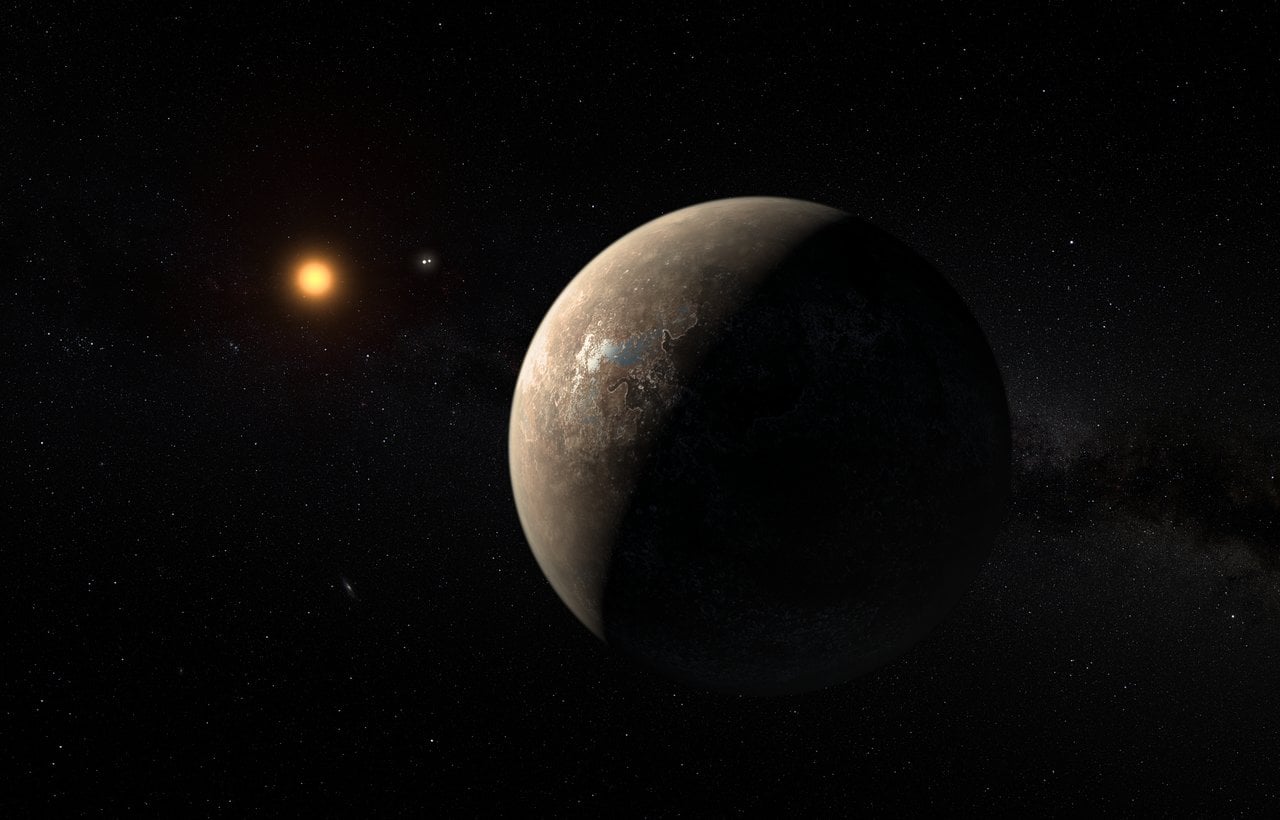 *This artist’s impression shows the planet Proxima b orbiting the red dwarf star Proxima Centauri, the closest star to the Solar System. Credit: ESO/M. Kornmesser*
On the other hand, its closer orbit may also mean that it is subject to more intense radiation, which could evaporate any atmosphere present. More observations are necessary, which will be possible as next-generation telescopes become operational in the coming years. This includes the Giant Magellan Telescope (GMT), the Extremely Large Telescope (ELT), and the Habitable Worlds Observatory (HWO), which will have access to the HPF catalog.
The powerful mirrors these observatories will host, along with adaptive optics (AO), advanced coronographs, and spectrometers, will enable direct observations of these planets for indications of life (aka. biosignatures). Said Endl:
The ultimate goal is biosignatures. We really want to know, ‘Are we alone in the universe?’ We are still in the reconnaissance phase of our solar neighborhood, trying to find the planets around the nearest stars because those will be the easiest ones to detect a biosignature on. This planet brings us one step closer to knowing all of our neighbors and, ultimately, which might be hospitable for life.
Further Reading: The University of Texas at Austin


