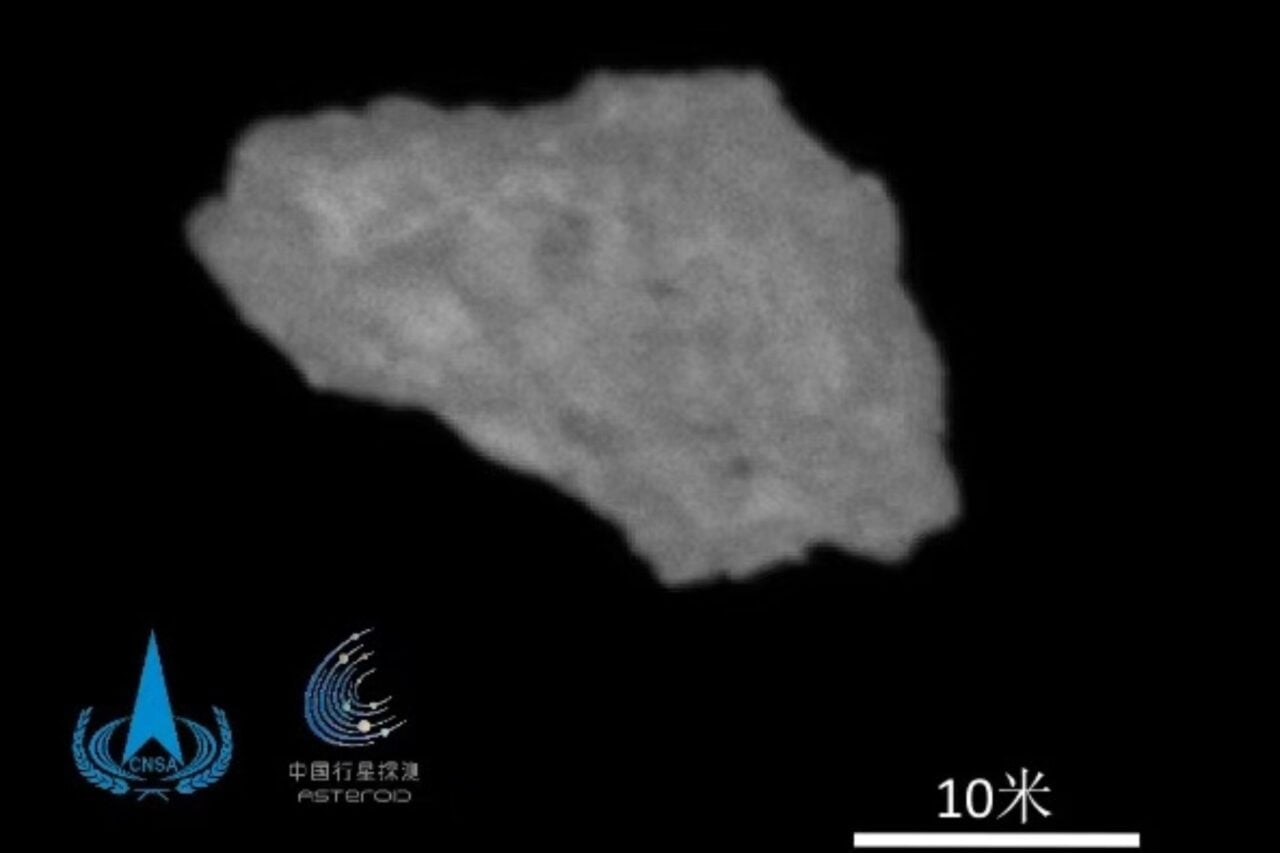
Эрдэмтэд Дэлхийн тойрог замд ойр оршдог Камооалева астероидыг сарны хэлтэрхий байж магадгүй хэмээн таамаглаж байна.
Хятадын Сансар судлалын үндэсний газар (CNSA)-ын “Тяньвэнь-2” станц 600 сая бээрийн (ойролцоогоор 965 сая км) аяллаа дуусгаж, Камооалева астероидод амжилттай хүрсэн байна. 2025 оны тавдугаар сарын 29-нд хөөргөсөн уг станц 400 хоногийн турш нисэж, пүрэв гарагт астероидоос 12 бээрийн (ойролцоогоор 19 км) зайд дөхөн очиж, анхны нарийвчилсан зургийг авчээ. Энэхүү жижиг, зууван хэлбэртэй чулуулгийн өргөн нь 20 метр орчим гэж тогтоогдсон бөгөөд “Тяньвэнь-2” нь тус биетийн гадаргуугаас дээж авч, хэдэн сарын турш алсын зайнаас ажиглалт хийхээр төлөвлөж байна.
https://gizmodo.com/china-prepares-its-first-asteroid-landing-on-earths-quasi-moon-2000779044
https://www.cnsa.gov.cn/n6758823/n6758838/c10760422/content.html
Камооалева нь Дэлхийг тойрдоггүй ч Нарыг тойрохдоо манай гаригтай ижил хурдаар, ойролцоогоор 9 сая бээрийн (ойролцоогоор 14.5 сая км) зайд дагаж явдаг тул “хуурамч дагуул” гэж нэрлэгддэг. 2021 онд хийсэн спектрийн шинжилгээгээр тус астероидын найрлага нь NASA-гийн Аполло хөтөлбөрийн үеэр цуглуулсан сарны чулуутай ижил болохыг тогтоосон юм. 2024 оны судалгаагаар уг астероид саяас 10 сая жилийн өмнө Жордано Бруно тогоог үүсгэсэн мөргөлдөөний улмаас Сарнаас тасарсан байж болзошгүй гэсэн таамаглал дэвшүүлжээ.
https://ssd.jpl.nasa.gov/tools/sbdb_lookup.html#/?sstr=2469219&view=VOPD
https://ui.adsabs.harvard.edu/abs/2017DPS….4920407R/abstract
https://arxiv.org/abs/2606.24017
https://gizmodo.com/astronomers-think-a-near-earth-asteroid-is-a-chunk-of-t-1848038668
https://www.nature.com/articles/s41550-024-02258-z
“Тяньвэнь-2” станц нь астероидын гадаргуугаас 20-100 миллиграмм материал цуглуулах зорилготой бөгөөд үүний тулд хөвөх, хүрээд буцах, бэхлэгдэх гэсэн гурван төрлийн дээж авах технологийг ашиглахаар бэлтгэжээ. Мөн уг станц камер, спектрометр, соронзон хэмжигч, радар зэрэг 11 төрлийн шинжлэх ухааны багаж хэрэгслээр тоноглогдсон. Цуглуулсан дээжийг 2027 оны дөрөвдүгээр сард Дэлхий рүү илгээх бөгөөд үүний дараа станц 311P/PANSTARRS сүүлт од руу аяллаа үргэлжлүүлж, 2035 онд үндсэн астероидын бүсэд хүрэх юм.
Дэлгэрэнгүйг эх сурвалжаас харах
Эх сурвалжийг нээх ↓
China’s Tianwen-2 probe has reached Kamoʻoalewa, one of seven known quasi-satellites that orbit near Earth. Scientists suspect the asteroid may actually be a fragment of the Moon—and Tianwen-2 will soon take a bite out of it to find out.
The China National Space Administration (CNSA) announced the spacecraft’s arrival at Kamoʻoalewa today, bringing an end to its 600-million-mile (1-billion-kilometer) journey. Tianwen-2 launched on May 29, 2025, and flew for 400 days to approach the asteroid at a distance of 12 miles (20 km) on Thursday, snapping the first close-up image of this small, oblong rocky body.
This marks the beginning of the probe’s scientific exploration of Kamoʻoalewa. Tianwen-2 will land on the asteroid, collect a sample of material from its surface, and spend several months conducting remote sensing observations to help scientists back on Earth piece together its composition and origin.
A missing piece of the Moon?
Astronomers using the Pan-STARRS 1 asteroid survey telescope on Haleakalā, Hawaii, discovered Kamoʻoalewa in 2016. Based on Tianwen-2’s close-up image, the space rock is just over 66 feet (20 meters) wide, which fits previous estimates based on observations from ground-based telescopes and the James Webb Space Telescope.
Kamoʻoalewa is not Moon-like in the sense that it actually orbits our planet. This asteroid orbits the Sun, but it does so in lock-step with Earth, maintaining a close average distance of just 9 million miles from our planet. That makes it one of Earth’s seven known quasi-moons.
In 2021, researchers analyzed Kamoʻoalewa’s spectra (the amount of light it reflects across different wavelengths) and found that its composition matched that of lunar rocks collected during NASA’s Apollo missions. Then, in 2024, a study suggested that the asteroid could have been liberated from the Moon by the same impact that created the Giordano Bruno crater between 1 million and 10 million years ago. If Tianwen-2 achieves its objectives, scientists will finally confirm whether Kamoʻoalewa is, indeed, a missing piece of Earth’s one true natural satellite.
It’s showtime, Tianwen-2
The Tianwen-2 spacecraft is equipped with 11 scientific instruments for studying and extracting samples from asteroids. Kamoʻoalewa is its primary target, and the mission will aim to collect between 20 and 100 milligrams of material from this quasi-moon.
Due to the unknown nature of the asteroid, Tianwen-2 is capable of three different sampling techniques, including hovering sampling, touch-and-go, and anchoring and attachment sampling, according to SpaceNews. This redundancy ensures that the probe will be able to extract a sample regardless of the asteroid’s surface mechanics. It’s not yet clear which technique the spacecraft will use at Kamoʻoalewa.
Tianwen-2’s remote sensing instruments include cameras, spectrometers, a magnetometer, sounding radar, particle analyzers, and laser navigation sensors. These will gather data on the asteroid’s shape, composition, and internal structure.
CNSA expects Tianwen-2 to return its samples to Earth in April 2027, dropping off a capsule filled with surface material on its way to its second target, the comet 311P/PANSTARRS. The spacecraft should reach that destination, located in the main asteroid belt, by 2035.
For now, we’ll await updates on Tianwen-2’s survey of Kamoʻoalewa. China’s first-ever asteroid return mission could finally reveal this asteroid’s origin, potentially giving scientists a pristine sample of lunar history.

