
Суррейн их сургуулийн судлаачид сансрын хиймэл дагуулын гэрэл ойлтыг эрс багасгах чадвартай, хэт хар өнгийн бүрхүүл материалыг бүтээжээ.
Ойрын жилүүдэд 1.7 сая хиймэл дагуул хөөргөх төлөвтэй байгаа нь одон орон судлал болон байгалийн экосистемд ноцтой аюул учруулж байна. Нарны гэрлийг ойлгодог хиймэл дагуулууд шөнийн тэнгэрийг бүдгэрүүлж, од эрхэс болон бусад сансрын биетүүдийг ажиглахад саад болж байгаа юм. Дэлхийн нам орбитод (LEO) өдгөө 20,000 орчим хиймэл дагуул байгаа нь одон орон судлалын том хэмжээний судалгаанууд, тухайлбал Вера С.Рубины нэрэмжит ажиглалтын төвийн хийж буй “Legacy Survey of Space and Time” (LSST) төсөлд хүндрэл учруулж байна.
Суррейн их сургуулийн эрдэмтэд болон Surrey NanoSystems компанийн хамтын ажиллагаагаар бүтээгдсэн “Vantablack® 310” нэртэй хэт хар өнгийн бүрхүүл нь хиймэл дагуулын гадаргуугийн гэрэл ойлтыг эрс бууруулдаг болохыг тогтоожээ. Monthly Notices of the Royal Astronomical Society сэтгүүлд нийтлэгдсэн судалгаагаар, энэхүү материал нь Олон улсын одон орон судлалын холбооноос зөвлөсөн гэрэлтэлтийн хязгаарт ойртох боломжтойг симуляциар баталсан байна.
Судлаач Аста Чатурведи болон доктор Ноэлиа Ноэль нарын тэмдэглэснээр, энэхүү шийдэл нь хиймэл дагуулын үндсэн хийцэд томоохон өөрчлөлт оруулахгүйгээр одон орон судлалын ажиглалтыг хамгаалах боломж олгож буй юм. Энэхүү технологийн үр нөлөөг шалгах зорилгоор Суррей, Портсмут, Саутхэмптон их сургуулиудын хамтарсан “Jovian-1 CubeSat” төслийн хүрээнд сансарт туршилт хийхээр төлөвлөж байна.
Судалгааны баг уг бүтээлээ 2026 онд Вена хотод болох НҮБ-ын “Харанхуй ба нам гүм тэнгэр” сэдэвт олон улсын хурлын үеэр танилцуулахаар бэлтгэж байна.
https://www.eso.org/public/news/eso2607/
https://www.nasa.gov/history/dawn-of-the-space-age/
https://orbitalradar.com/how-many-satellites-in-orbit
https://rubinobservatory.org/explore/how-rubin-works/lsst
https://academic.oup.com/mnras/article/550/1/stag1136/8722194?searchresult=1&login=false
https://www.surrey.ac.uk/people/s-ravi-p-silva
https://www.surrey.ac.uk/advanced-technology-institute
https://www.surrey.ac.uk/nanoelectronics-centre
https://www.unoosa.org/oosa/en/ourwork/psa/schedule/2025/UN-SKAO-dark-and-quiet-skies-2025.html
Дэлгэрэнгүйг эх сурвалжаас харах
Эх сурвалжийг нээх ↓
There’s no doubt about it: the skies are filling up with satellites that regularly pass overhead, creating light trails that can interfere with stargazing, backyard astronomy, astronomical research, and pose a significant threat to natural ecosystems. The problem stems from the design of the satellites themselves, which include solar arrays that reflect sunlight, creating an artificial, diffuse glow that brightens the night sky and obscures the light of natural objects (the Moon, the planets, and stars).
With 1.7 million satellites expected to be launched into orbit in the coming years, things may reach the point where children look up and wonder why the Moon and the few remaining natural objects still visible are not streaking across the night sky. To mitigate this problem, a team of researchers from the University of Surrey has developed a new ultra-black coating material for satellites that could drastically reduce the amount of light they reflect.
The presence of satellites in the night sky is something humanity has come to expect ever since the launch of Sputnik 1 in 1958. Sunlight reflected from these satellites can create bright streaks and flares that (at the best of times) can be visually appealing. But with the number of active satellites in Low Earth Orbit (LEO) now approaching 20,000 (and rising rapidly), there are increasing concerns that these streaks could interfere with telescope observations and large-scale surveys of the night sky.
*One hour of satellites over the northern Atacama Desert in Chile (October 2025). Credit: ESO*
Some examples include the Legacy Survey of Space and Time (LSST) currently underway by the Vera C. Rubin Observatory. Among its many objectives, this ten-year survey will create an inventory of the Solar System, including Near-Earth Asteroids (NEAs), Main Asteroid Belt objects, and many more. Another major objective is to explore the transient optical sky and study objects that move or change in brightness, which will be very difficult with so many streaks and bright spots filling the sky.
In their study, which recently appeared in the *Monthly Notices of the Royal Astronomical Society* the researchers demonstrated how Vantablack® 310, an ultra-black coating developed by a company spun off from the University of Surrey (Surrey NanoSystems), could significantly reduce light pollution from satellites in Low Earth Orbit (LEO). The technology grew out of work involving Professor Ravi Silva, the director of the Advanced Technology Institute (ATI) at the University of Surrey and the head of its NanoElectronics Center (not associated with the study).
With development and commercialization provided by Surrey NanoSystems, the team rigorously tested this material as part of a broader effort to develop and evaluate future coatings and satellite surface designs to protect astronomical observations and the night sky. Said James Whitfield, Applications Scientist at Surrey NanoSystems and co-author of the study:
Satellite constellations offer enormous benefits, but their growing brightness presents a challenge for ground-based astronomy. Vantablack® 310 combines ultra-black performance across a wide range of viewing angles with the durability needed for low-Earth orbit. We are proud to work with the University of Surrey to help protect the night sky while supporting innovation in satellite technology.
In simulations, the coating proved effective at making satellite surfaces significantly fainter, to the point that they were close to the International Astronomical Union’s recommended limit. The findings suggest that ultra-black coatings could provide a practical way to reduce the impact of future satellites on astronomy and the night sky.
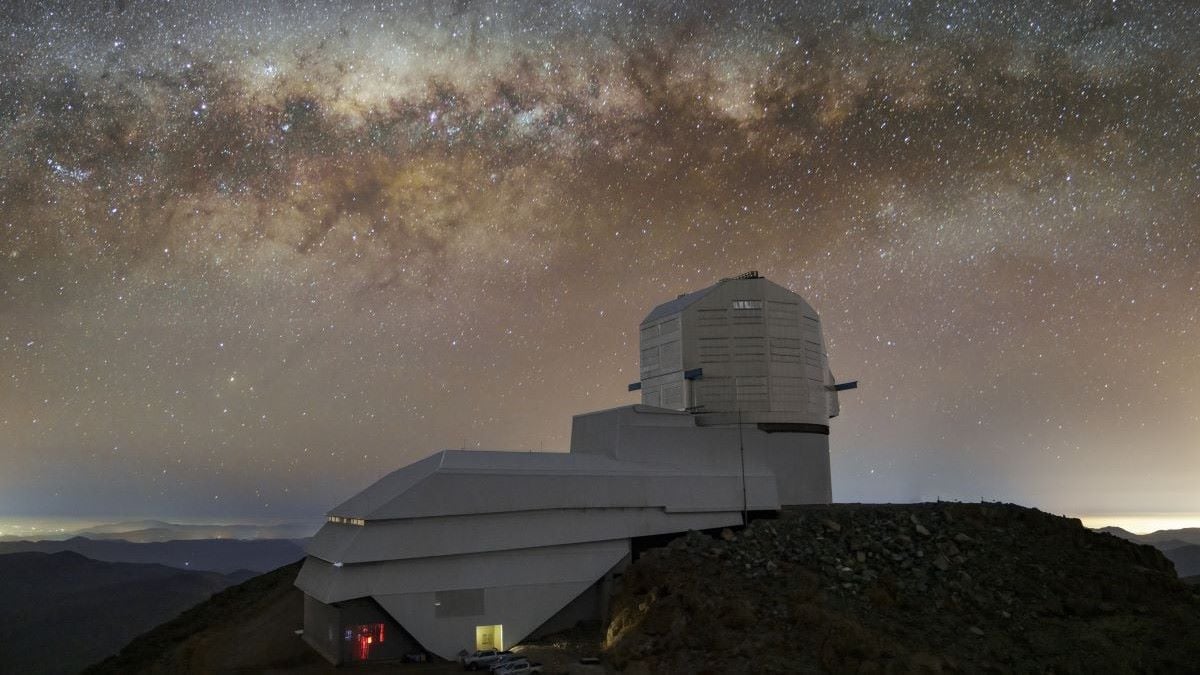 The Vera C. Rubin’s LSST survey will help scientists create a census of Solar System objects. Credit: Rubin Observatory/NOIRLab/NSF/AURA H.
“The night sky is one of humanity’s oldest windows into the Universe, but it is becoming increasingly difficult to see things,” said Astha Chaturvedi, lead author of the study and postgraduate researcher at the University of Surrey. “Our results show that relatively simple material choices could make a meaningful difference to how satellites affect astronomical observations without requiring major changes to mission design.”
Study co-author Dr. Noelia Noël, a Senior Lecturer in Astrophysics at the University of Surrey, said:
Space is becoming increasingly crowded, creating challenges not only for astronomers but for everyone who values an unspoilt night sky. What is encouraging about this research is that it moves us beyond simply identifying the problem and towards developing practical, evidence-based solutions. As an astrophysicist at Surrey, I am particularly proud that a potential solution to this astronomical challenge has emerged from pioneering materials research at our own university.
The team is now preparing an in-orbit demonstration involving the student-led Jovian-1 CubeSat mission, a cooperative satellite program involving the universities of Surrey, Portsmouth, and Southampton. The demonstration will test the coating’s performance in space and whether changes in brightness can be measured from the ground. Astha Chaturvedi, the lead author on the study, will present their research at the 2026 United Nations Workshop on Dark and Quiet Skies in Vienna. As she indicated:
Our paper is fundamentally about addressing an important challenge for astronomy through an evidence-based approach. It shows how the astronomical community is working together with engineers and industry to develop realistic, scientifically grounded mitigation strategies that benefit both space activities and the protection of the night sky.


