Аполло 10 хөлгийн багийнхан сарны тойрог замд хийсэн туршилтын дараа Дэлхийд эргэн ирэхдээ хүрсэн хурд нь өнөөг хүртэл эвдэгдээгүй хэвээр байна.
1969 оны тавдугаар сарын 26-нд Томас Стаффорд, Жон Янг, Южин Сернан нарын бүрэлдэхүүнтэй Аполло 10 хөлөг Дэлхийн агаар мандалд нэвтрэхдээ цагт 39,937.7 км буюу секундэд 11,093.8 метр хурдтай байжээ. Гиннесийн дээд амжилтын номонд бүртгэгдсэн энэхүү үзүүлэлтийг хөлөг Дэлхийн таталцлын хүчинд автан унах үед болон Сарнаас буцаж ирэх үеийн физикийн нөхцөл байдлаас шалтгаалан тогтоосон байна. Аполло 17 хөтөлбөрөөс хойш хүн төрөлхтөн Сарны тойрог замаас цааш аялаагүй тул энэхүү дээд амжилт 57 жилийн турш эвдэгдээгүй үлджээ.
Аполло 10 хөтөлбөр нь сарны гадаргуу дээр буулт хийхээс бусад бүх ажиллагааг бүрэн туршсан чухал үе шат байв. Томас Стаффорд, Южин Сернан нар сарны модулийг ашиглан сарны гадаргуугаас 14.4 км-ийн зайд хүртэл ойртон ажиглалт хийж, ирээдүйн Аполло 11 хөлгийн буух талбайг судалсан юм. Хэдийгээр тухайн үед багийнхан хурдыг биеэр мэдрээгүй ч, мисс дууссаны дараа газрын хяналтын төвийн радарын хэмжилт болон телеметрийн мэдээлэлд үндэслэн энэхүү түүхэн тоог баталгаажуулжээ.
Одоогийн байдлаар NASA-гийн Артемис хөтөлбөр нь хүн төрөлхтнийг Сар руу дахин хүргэх зорилготой байгаа бөгөөд Орион сансрын хөлөг нь Аполло хөлгүүдийнхтэй ижил төстэй өндөр хурдтайгаар агаар мандалд нэвтрэх инженерчлэлтэй юм. Артемис I даалгаврын үеэр Орион хөлөг цагт 39,400 км хурдтайгаар эргэн ирсэн нь Аполло 10-ын тогтоосон дээд амжилттай ойролцоо үзүүлэлт болжээ. Ирээдүйн Артемис III даалгавраар сансрын нисгэгчид Сарны өмнөд туйлд буухаар төлөвлөж байгаа нь Аполло-гийн үеийнхтэй дүйцэхүйц хурдны нөхцөлийг дахин бүрдүүлэх юм.
Дэлгэрэнгүйг эх сурвалжаас харах
↓Эх сурвалжийг нээх ↓
On 26 May 1969, the command module of Apollo 10 hit Earth’s atmosphere travelling at 36,397 feet per second, or 39,937.7 kilometres per hour. Guinness World Records lists that moment as the fastest speed any human has ever reached, a mark that has now stood for 57 years. Inside the capsule were Thomas Stafford, John Young and Eugene Cernan, returning to Earth after flying within about 14.4 kilometres of the Moon’s surface without landing on it.
None of them felt the speed themselves. In the vacuum of space there is no sensation of motion, only checklists, instruments, and a re-entry corridor to hit. The figure now on record was not read off a dial in real time. It was calculated afterward, by engineers reviewing telemetry and ground-based radar tracking once the mission was complete.
Apollo 10 Served as a Full Rehearsal for the Moon Landing
Apollo 10 launched from Kennedy Space Center on 18 May 1969 as the fourth crewed mission in NASA’s Apollo program. It served as a full test of the procedures and hardware needed for a Moon landing, minus the landing itself, two months before Apollo 11 carried out the real thing. Stafford and Cernan, both U.S. military officers, handled the lunar descent portion of the mission.
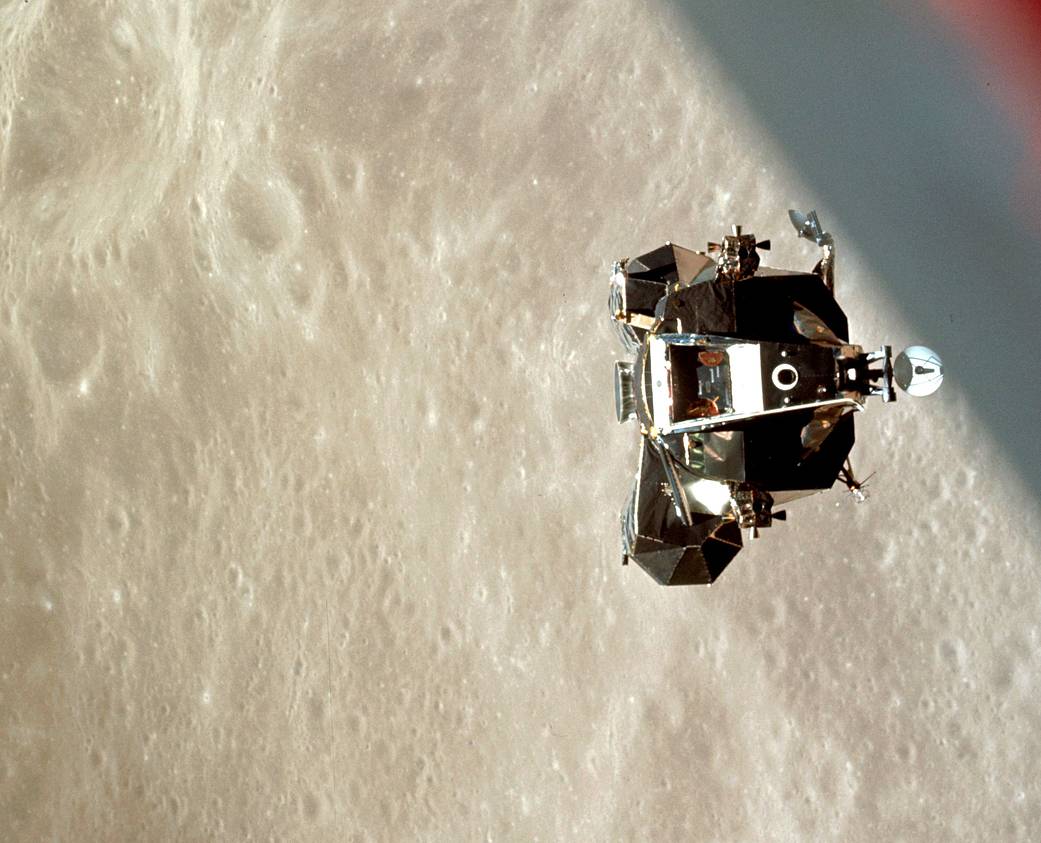
On 22 May, Stafford and Cernan boarded the lunar module, which they had named Snoopy after the Peanuts comic strip character. They undocked from the command module, named Charlie Brown, leaving Young orbiting roughly 60 miles above the Moon on his own. The lunar module’s descent engine then fired for 27 seconds, dropping the two astronauts to 47,400 feet, about 14.4 kilometres, above the lunar surface.
From that altitude, Stafford and Cernan surveyed and photographed the Sea of Tranquility, the site chosen for Apollo 11’s landing, and tested the systems that would guide a future powered descent. After separating from the descent stage, they experienced a brief, unplanned gyration caused by a faulty switch setting, according to NASA’s mission history. They fired the ascent engine and rendezvoused with Young in lunar orbit.
Once the lunar module was jettisoned, the spacecraft’s trajectory used the Moon’s gravity to accelerate it back toward Earth, building speed as it fell through Earth’s gravitational field. Cernan later described the view during re-entry as being inside “a ball of white and violet flame.” The capsule deployed parachutes and splashed down in the Pacific Ocean on 26 May, where the crew was recovered by the USS Princeton.
The Numbers Behind the Record
Guinness records the achievement with specific figures. Stafford, Cernan and Young reached their peak velocity at the 121.9-kilometre altitude interface during the spacecraft’s trans-Earth return flight, travelling at 36,397 feet per second, or 11,093.8 metres per second. That moment occurred on 26 May 1969, at the point where the capsule crossed into Earth’s atmosphere.
Converted to kilometres per hour using the 24,816.1 miles-per-hour figure, that speed comes to 39,937.7 km/h. This number marks the spacecraft’s velocity relative to Earth at the atmospheric entry interface, which is the standard reference point used for records of this kind.
NASA’s own historical materials put the number slightly lower, citing 24,791 miles per hour, which works out to roughly 39,897 kilometres per hour. The small gap between the two figures reflects differences in rounding and conversion rather than any disagreement about what occurred.
Both the spacecraft’s own instrumentation and ground-based radar tracked the re-entry. NASA’s image archive holds footage and telemetry from the mission, including the Earthrise sequence the crew photographed from lunar orbit.
Why the Record Has Not Been Broken in 57 Years
The speed is a direct result of the physics of returning from the Moon. Spacecraft coming back from lunar distance fall under the combined gravitational pull of Earth and the Moon, which pushes their atmospheric entry speed into the 39,000 to 40,000 kilometre-per-hour range. Every Apollo mission that returned from the Moon followed a similar path and reached similar speeds.
No human spaceflight since has matched it, because no human mission has travelled that far. Since Apollo 17 in 1972, crewed missions have stayed within low Earth orbit, where orbital velocity runs closer to 28,000 kilometres per hour, well short of a lunar return speed.

The International Space Station itself orbits at about 27,600 kilometres per hour. That is the pace at which every astronaut and cosmonaut since the early 1970s has travelled, regardless of how long their mission lasted or how many times they circled the planet.
It is worth separating this from the record for the fastest human-made object overall. NASA’s uncrewed Parker Solar Probe reached roughly 692,000 kilometres per hour relative to the Sun in December 2024, but it carries no crew, so it does not count toward the human speed record. The Apollo 10 figure remains specific to a piloted vehicle carrying people.
Artemis Missions Could Approach the Same Speeds
NASA’s Artemis program is built around returning humans to the Moon, and its Orion spacecraft is designed for the same kind of high-speed return that Apollo 10 experienced. Re-entry performance from deep-space distances is one of the central engineering challenges the program has had to solve.
During the uncrewed Artemis I mission in 2022, the Orion capsule re-entered at about 39,400 kilometres per hour. That is close to but still short of the Apollo 10 record, a difference tied to Artemis I’s particular return trajectory rather than any limit on the spacecraft itself.
Future crewed Artemis flights are expected to reach speeds that match or slightly exceed the Apollo-era figures, depending on the specific path each mission takes back to Earth. Artemis III, scheduled for no earlier than 2026, is planned to land astronauts near the lunar south pole, which would send its crew through re-entry conditions similar to those of 1969.
All three Apollo 10 astronauts have since died. Cernan died in 2017, Young in 2018, and Stafford in 2024 at age 93, after a career that also included flights on Gemini 6, Gemini 9 and the Apollo-Soyuz mission.
Enjoyed this article? Subscribe to our free newsletter for engaging stories, exclusive content, and the latest news.